01. Quick Answer
The most likely 2027 SMI path is mildly constructive, but Swiss stocks no longer look cheap enough to ignore valuation
The SMI closed at 13,220.17 on 2026-05-15, up from 8,020.15 at the start of its 10-year Yahoo Finance monthly series on 2016-06-01, for a price-only CAGR of about 5.12% (Yahoo Finance 10-year history; recent daily closes). The short-term issue is not whether Switzerland offers quality. It is whether that quality still deserves the same premium over the next one to two years.
The macro backdrop is supportive but not euphoric. OECD, IMF, KOF, and SNB all imply steady rather than booming conditions. Available data suggests 2027 is more likely to be a year of digestion and selective upside than a runaway rally.
| Point | Why it matters |
|---|---|
| Healthcare and staples still dominate near-term tone | The largest weights remain the clearest source of support or disappointment. |
| The franc remains a near-term variable | Safe-haven demand can help valuation while complicating multinational earnings translation. |
| 2027 should be modeled tactically | One to two years are too short for sweeping structural claims and too long for pure chart noise. |
| Financials and insurance can offset some defensive fatigue | UBS, Zurich, and Swiss Re matter if capital return and underwriting stay strong. |
02. Historical Context
The SMI is operating from strength, which makes 2027 more about consolidation risk than rescue-level upside
The SMI closed at 13,220.17 on 2026-05-15, up from 8,020.15 at the start of its 10-year Yahoo Finance monthly series on 2016-06-01, for a price-only CAGR of about 5.12% (Yahoo Finance 10-year history; recent daily closes). That historical resilience is exactly why near-term forecasting gets harder. The Swiss quality story is already widely understood.
SIX market data and recent company reporting suggest the index is still led by a handful of large healthcare, staples, and financial names. That can be a healthy base, but it also means the SMI can remain fundamentally sound while producing flat or choppy 2027 performance if investors simply decide the quality premium has become rich enough.
A 2027 call therefore needs to focus on a small set of observable variables: healthcare execution, Nestlé's volume trend, CHF behavior, and whether insurers and banks keep adding support beneath the defensive giants.
In practical terms, the next one to two years are likely to be judged less on whether Switzerland stays stable and more on whether stability is already fully priced into the benchmark's biggest names.
| Metric | Latest reading | Why it matters |
|---|---|---|
| Current index level | 13,220.17 | Anchors every forecast to the latest available close rather than an old safe-haven narrative. |
| 52-week range | 11,612.00 to 14,063.53 | Shows the SMI is already close to its upper historical zone and not simply a depressed value market. |
| 10-year start point | 8,020.15 | Provides discipline around long-run compounding assumptions. |
| Editorial base range | 13,300-14,100 | A scenario range is more credible than a one-number target in a concentrated defensive index. |
| Feature | Implication | Forecast effect |
|---|---|---|
| Heavy healthcare and staples exposure | Roche, Novartis, and Nestlé dominate the benchmark | Defensive quality can cushion drawdowns but can also cap upside during aggressive growth rallies. |
| Swiss franc safe-haven effects | Currency strength can help capital inflows while pressuring exporters' translation | The market can trade like a defensive shelter and an earnings headwind at the same time. |
| Concentration in a few large franchises | Top names drive more of the index than many casual observers assume | A small number of earnings stories can dominate the whole market path. |
| Insurance and financial resilience | UBS, Zurich, and Swiss Re add capital-markets and balance-sheet exposure | Rates, regulation, and safe-haven flows matter more than Swiss GDP alone. |
03. Main Drivers
Five near-term forces should dominate Swiss stocks into 2027
1. Healthcare earnings momentum. Roche and Novartis remain the clearest near-term anchors for the benchmark.
2. Nestlé's recovery path. The stock matters because staples stability is central to the index's defensive identity.
3. CHF behavior and safe-haven flows. Currency can help the market's premium while complicating operational optics.
4. Insurance and banking capital return. UBS, Zurich, and Swiss Re can support the index if balance sheets keep earning trust.
5. Rotation risk. If global markets rotate hard toward cyclicals or higher-beta growth, the SMI can lag even without bad news.
04. Institutional Forecasts and Analyst Views
The institutional backdrop suggests 2027 should be framed as resilience versus valuation risk, not as a one-way trend
Official sources are not calling for a dramatic Swiss acceleration. OECD, IMF, KOF, and SNB all point to growth, but not a boom.
The evidence is mixed, which is why scenario analysis is more credible than certainty language. If healthcare execution stays solid and the franc premium does not become too painful, the SMI can edge higher. If defensives de-rate while CHF strength bites harder, 2027 can become a sideways or softer year even without a crisis.
That balance matters because the SMI often behaves like a market people buy for protection. Protection can still underperform when investors decide to pay less for it.
A market can therefore remain fundamentally impressive and still disappoint tactically. For 2027, investors should separate the quality of Swiss blue chips from the price currently being paid for that quality.
| Source | Signal | Implication |
|---|---|---|
| OECD, IMF, KOF, SNB | Swiss growth remains steady but moderate | Supports a floor, not an explosive re-rating. |
| Roche and Novartis | Healthcare remains operationally important | Still the clearest support layer for the benchmark. |
| Nestlé | Growth restoration remains watched closely | Important for whether staples help or hinder the index. |
| UBS, Zurich, Swiss Re | Financial strength remains visible | Can broaden support if defensives tire. |
05. Scenarios, Risks, and Invalidation
The 2027 path is narrower and more tactical than long-range Swiss market forecasts
Bullish scenario
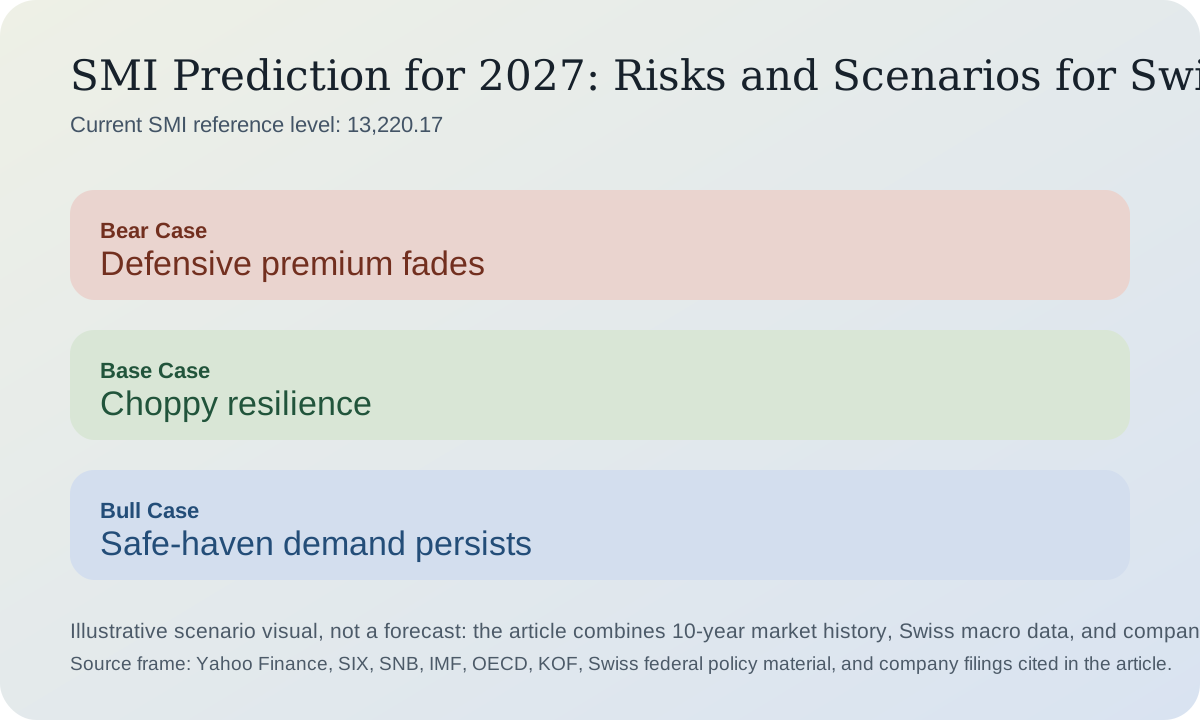
The bull case for 2027 is 14,200 to 14,900. This requires clean healthcare execution, a steadier Nestlé recovery, and continued global appetite for safe-haven quality.
Bearish scenario
The bear case is 11,900 to 12,700. That likely needs defensive de-rating, stronger CHF pressure, and weaker growth from the largest constituents.
Base-case scenario
The base case is 13,300 to 14,100. That implies modest upside from current levels, but with clear valuation discipline and more limited rerating fuel than earlier periods.
Risks to watch
Watch healthcare sales momentum, Nestlé's volume recovery, CHF behavior, insurance pricing, and whether global investors rotate away from defensives.
What could invalidate the forecast
This forecast would be too cautious if investors continue paying a premium for Swiss quality while healthcare and financials both deliver. It would be too optimistic if safe-haven demand fades just as earnings growth slows.
Conclusion
The most reasonable 2027 SMI forecast is constructive but tactical. Swiss quality still matters, yet the market no longer looks cheap enough to assume easy upside.
Disclaimer: This article is for research and informational purposes only. It is not a recommendation to buy, sell, or hedge any specific security or index exposure.
| Scenario | Range | Key conditions | Probability |
|---|---|---|---|
| Bull | 14,200-14,900 | Healthcare and staples hold up while safe-haven demand stays firm | 25% |
| Base | 13,300-14,100 | Modest gains with defensive valuation discipline | 45% |
| Bear | 11,900-12,700 | Defensive de-rating and stronger CHF headwind | 30% |
| Path | Estimated probability | Why |
|---|---|---|
| Higher into 2027 | 45% | The index still has strong quality support and macro stability. |
| Lower into 2027 | 30% | Defensive markets can still correct if valuations and currency work against them. |
| Broadly sideways | 25% | A mature defensive index can digest gains while earnings keep moving slowly. |
06. Investor Positioning
Near-term positioning should stay disciplined
| Investor type | Cautious approach | What to watch |
|---|---|---|
| Investor already in profit | Use trailing stops or light trimming if gains are too concentrated in a few defensives. | How much of the position depends on premium valuation rather than only earnings. |
| Investor currently at a loss | Avoid reflex averaging unless the quality thesis is still intact. | Check whether the issue is timing or weakening business momentum. |
| Investor with no position | Wait for pullbacks or build exposure in layers rather than paying any price for safety. | Valuation and CHF sensitivity. |
| Trader | Trade around earnings, SNB headlines, and CHF moves with defined stops. | The index is slower than growth benchmarks but still reactive at the top weights. |
| Long-term investor | Use short-term weakness as an accumulation window only if concentration remains acceptable. | Dividend durability and defensive earnings quality. |
| Risk-hedging investor | Use explicit hedges rather than assuming Swiss equities solve all risk-management needs. | Currency and sector concentration. |
07. FAQ
Frequently asked questions about the SMI outlook
Why is 2027 mostly a tactical SMI call?
Because one to two years are dominated by valuation, currency, and sector leadership shifts more than by decade-long structural stories.
What is the main 2027 downside risk?
A defensive de-rating combined with stronger franc pressure on multinational earnings.
What could surprise to the upside?
If healthcare and staples remain steadier than feared while investors continue valuing Swiss quality as a safe haven.
References
Sources
- Yahoo Finance chart API for ^SSMI, 10-year monthly history
- Yahoo Finance chart API for ^SSMI, recent daily closes
- SIX SMI overview page
- SIX SMI methodology 2026
- SIX Exchanges Figures February 2026
- Swiss National Bank Quarterly Bulletin 1/2026
- IMF 2025 Article IV consultation for Switzerland
- OECD Switzerland economic snapshot
- KOF Spring 2026 economic forecast
- Federal Council adopts Digital Switzerland Strategy 2026
- Swiss AI regulation overview
- Nestlé three-month sales 2026
- Roche first quarter sales 2026
- Novartis Q1 2026 results
- UBS first-quarter 2026 results
- ABB Q1 2026 results
- Zurich Insurance May 2026 operating update
- Swiss Re Q1 2026 results