01. Quick Answer
For 2027, the SMSN outlook is mostly about catalyst timing: HBM ramps, Galaxy AI monetization, memory pricing, and whether foundry progress becomes visible enough for investors to care
Shorter-term forecasts should be narrower and more catalyst-driven than 2030 or 2035 work. Samsung enters this setup with record Q1 2026 revenue and operating profit, plus explicit management commentary that HBM4 is shipping and HBM sales should more than triple in 2026 from 2025 Q1 2026 results HBM4 shipment announcement.
At the same time, IDC says the global smartphone market fell 2.9% year over year in Q1 2026 and that memory costs are pressuring the broader device ecosystem IDC market data. That tension is the core of the 2027 call: the memory business is helping Samsung, but some of the same supply conditions can hurt its downstream device markets.
Available data suggests 2027 is less about whether Samsung is a winner in the abstract and more about which catalyst dominates first. If HBM and high-end DRAM keep tightening faster than smartphone and foundry headwinds matter, SMSN can still grind higher. If the market starts pricing the post-peak memory cycle early, the stock can stall even with strong trailing earnings.
| Point | Why it matters |
|---|---|
| 2027 is a catalyst year | The time horizon is short enough that product ramps and pricing matter more than distant optionality. |
| HBM matters most | Samsung's own roadmap still places AI memory at the center of the near-term earnings swing. |
| Smartphones are a support leg, not the main engine | Galaxy AI helps brand and mix, but handset demand is not the dominant earnings driver. |
| Watch the market before the financials | Cyclical stocks often peak before reported earnings do. |
02. Historical Context
Samsung's long-term rerating has been real, but the path has never been smooth
Official Samsung investor-relations materials identify SMSN as the London Stock Exchange code for the company's common-share GDR, while the operating business is still reported against the Seoul-listed common stock 005930.KS Samsung listing information. That distinction matters because the GDR price is the right market reference for the title keyword, but the Korean line remains the cleaner anchor for operating history, dividends, and buybacks.
Yahoo Finance shows SMSN.L at 4,534 on 2026-05-15 versus 621 on 2016-05-31, implying a 10-year price CAGR of about 22.11% SMSN 10-year history recent SMSN closes. The underlying common stock closed at KRW 270,500 on the same day, versus KRW 28,500 at the start of the 10-year series, for a price-only CAGR of roughly 25.37% 005930.KS 10-year history recent 005930.KS closes. Available data suggests Samsung has already rerated materially, which means future returns are more likely to depend on margins and mix than on a simple multiple reset.
| Metric | Latest reading | Why it matters |
|---|---|---|
| SMSN.L recent close | 4,534 | The London GDR line is the direct price reference for the topic. |
| SMSN.L 10-year range | 621 to 4,534 | Shows how much cyclicality investors have already absorbed. |
| 005930.KS recent close | KRW 270,500 | Useful cross-check because company disclosures and dividends are reported in KRW. |
| FY 2025 revenue / operating profit | KRW 333.6T / KRW 43.6T | The operating baseline comes from the latest audited full year. |
| Q1 2026 revenue / operating profit | KRW 133.9T / KRW 57.2T | Signals how violently the AI-memory upcycle has changed near-term earnings power. |
| Date | Approximate level | Interpretation |
|---|---|---|
| 2016-05-31 | SMSN 621 | Samsung was still largely valued as a cyclical hardware champion. |
| 2021-05-31 | SMSN 1,783.5 | Semiconductor strength and platform confidence lifted sentiment sharply. |
| 2022-05-31 | SMSN 1,091 | Memory downcycle and macro tightening proved how quickly the stock can derate. |
| 2024-05-31 | SMSN 1,480 | The market started pricing in AI memory optionality, but not the full surge. |
| 2026-05-15 | SMSN 4,534 | Today's price already embeds much stronger HBM and DRAM expectations. |
The historical lesson is straightforward. Samsung is neither a stable consumer staple nor an early-stage software compounder. It is a capital-intensive technology leader whose upside usually arrives when the memory cycle, product mix, and investor confidence all strengthen at the same time. The evidence is mixed rather than one-directional, which is exactly why scenario ranges are more defensible than single-number targets.
03. Main Drivers
The 2027 SMSN prediction depends on five catalysts more than on broad narratives
1. HBM qualification and customer mix. Samsung's HBM4 shipment announcement and AMD collaboration are critical because they convert vague AI enthusiasm into identifiable customer relationships and product ramps HBM4 shipment AMD collaboration.
2. DRAM and NAND pricing discipline. WSTS still sees memory leading semiconductor growth in 2026, but 2027 stock performance will depend on whether customers are still chasing supply or starting to push back on pricing WSTS forecast.
3. Galaxy AI monetization. Samsung's MWC and Galaxy S26 materials show the company leaning hard into agentic and on-device AI. For equity holders, the real question is whether those features defend margins, reduce churn, or justify higher ASPs MWC 2026 Galaxy S26 launch.
4. Foundry credibility. The market does not need Samsung Foundry to become TSMC overnight for SMSN to work in 2027. It does need evidence that advanced-node orders and yield improvement can add confidence rather than consume it 4Q 2025 presentation.
5. Korea macro and trade. The Bank of Korea's 2.0% growth view for 2026 is constructive, but the IMF and OECD both still point to macro uncertainty, especially through trade and external demand channels BOK IMF OECD.
| Catalyst | Bullish read | Bearish read |
|---|---|---|
| HBM ramps | Customer wins convert into durable share and better mix. | Qualification lags or pricing peaks before volumes matter. |
| Memory pricing | Tight supply keeps ASPs strong into 2027. | Customers digest inventory and margins normalize quickly. |
| Galaxy AI | Premium AI features support ASPs and ecosystem stickiness. | AI becomes table stakes with limited pricing power. |
| Foundry progress | Yield and node execution improve credibility. | Losses or delays keep foundry as a valuation drag. |
| Macro and trade | Semiconductor demand stays resilient globally. | Tariffs, energy, or recession fears compress multiples. |
04. Institutional Forecasts and Analyst Views
The public institutional evidence base is constructive, but not clean enough for a single deterministic target
Samsung itself provides the most concrete near-term evidence. The company reported FY 2025 revenue of KRW 333.6 trillion and operating profit of KRW 43.6 trillion, then followed with a record Q1 2026 at KRW 133.9 trillion of revenue and KRW 57.2 trillion of operating profit FY 2025 results Q1 2026 results 1Q 2026 presentation. That scale change is large enough that any forecast ignoring the AI-memory cycle would be obsolete on arrival.
Industry institutions remain supportive but not euphoric. WSTS said the global semiconductor market could approach USD 975 billion in 2026, with memory and logic again leading growth, while IDC said the smartphone market contracted 2.9% year over year in Q1 2026 even as Samsung and Apple held premium share WSTS 2026 forecast IDC smartphone market data. Inference: Samsung's best business is in one of the strongest parts of tech, but one of its largest product categories is still structurally mature.
Visible public institutional commentary points in the same direction. A JPMorgan emerging-markets fund report said it added to Samsung because valuation still looked attractive and earnings outlook was improving, and Morningstar's public analyst note after Q1 2026 said fair value was raised materially after the earnings beat JPMorgan EM fund report Morningstar public note. Those are not blanket buy signals. They do, however, support the view that the company is being rerated for real operating reasons rather than only for narrative heat.
| Source | Main message | What it means for SMSN |
|---|---|---|
| Samsung management | Record profits are now tied to AI memory, HBM, and mix improvement. | Validates a constructive near-term backdrop. |
| WSTS | Memory and logic should lead 2026 semiconductor growth again. | Supports the semiconductor leg of the thesis. |
| IDC | Samsung remains the top smartphone vendor by Q1 2026 shipments, but the market is under memory-cost pressure. | Explains why phones help but do not remove cyclicality. |
| JPMorgan Asset Management | Added to Samsung on attractive valuation and improved earnings outlook. | Public institutional sentiment has turned more constructive. |
| Morningstar | Raised fair value after strong results and tighter memory markets. | Public analyst commentary recognizes better earnings power. |
The scenario ranges in these articles are built from five ingredients rather than one valuation shortcut: today's GDR price, the adjusted 10-year CAGR, the gap between cyclical and structural profits, Samsung's public HBM and AI roadmaps, and Korea's macro backdrop. Probabilities are not statistical certainties. They are decision weights assigned to how likely the business appears to sustain today's earnings power.
05. Scenarios, Risks, and Invalidation
For 2027, scenario analysis should stay tight and catalyst-based
Bullish scenario
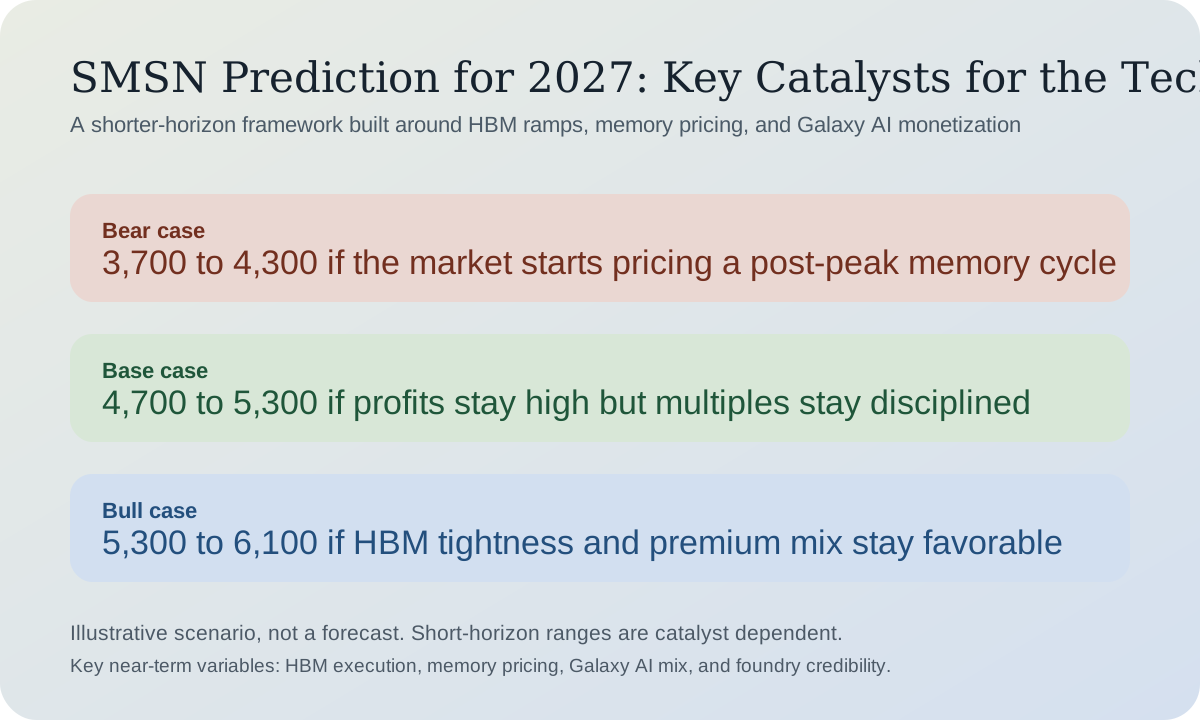
The bullish 2027 case is 5,300 to 6,100 on SMSN.L. That likely requires another year of strong HBM and premium-memory pricing, continued flagship-device resilience, and at least some evidence that investors should stop treating foundry as a perpetual disappointment.
Bearish scenario
The bearish 2027 case is 3,700 to 4,300. That outcome would likely come from the market deciding that the current memory cycle is close to peak, with normalization arriving before Galaxy AI or foundry improvements can offset it.
Base-case scenario
The base case is 4,700 to 5,300. That assumes profits stay healthy, but that the market discounts some margin normalization and remains cautious about how much of current earnings is repeatable into 2027 and beyond.
Risks to watch
The main risks are customer concentration in AI memory, faster supply additions from rivals, muted smartphone replacement demand, unexpected foundry setbacks, and a macro shock that hits Korea-export equities broadly.
What could invalidate the forecast
The range would prove too conservative if Samsung converts the 2026 HBM surge into a visibly broader customer and packaging ecosystem by early 2027. It would prove too aggressive if the memory market rolls over before investors see credible evidence of follow-through.
Conclusion
SMSN can still work in 2027, but the path is much more about execution cadence than storytelling. Investors should treat it like a high-quality cyclical with unusually strong current earnings, not like a straight-line compounder.
Disclaimer: This article is for research and informational purposes only. The scenario ranges and probabilities discussed here are conditional estimates, not personalized investment advice.
| Scenario | Illustrative range | Key conditions | Probability |
|---|---|---|---|
| Bull | 5,300 to 6,100 | HBM tightness persists and mix quality stays high | 30% |
| Base | 4,700 to 5,300 | Strong profits continue, but the market discounts normalization | 45% |
| Bear | 3,700 to 4,300 | The stock begins pricing the post-peak memory cycle | 25% |
| Path | Estimated probability | Why |
|---|---|---|
| Rising from current levels by 2027 | 52% | Near-term earnings momentum is strong enough to keep the bias constructive. |
| Falling below current levels by 2027 | 23% | The most likely reason would be earlier-than-expected memory normalization. |
| Moving broadly sideways | 25% | Plausible if stronger earnings are offset by lower valuation multiples. |
06. Investor Positioning
Near-term positioning in SMSN should be tied to catalysts, not only to long-run admiration
| Investor type | Cautious approach | What to watch |
|---|---|---|
| Investor already in profit | Hold core exposure only if the thesis still depends on multi-year AI memory leadership; trim if portfolio concentration has become excessive. | Watch whether HBM execution remains ahead of the cycle rather than behind it. |
| Investor currently at a loss | Re-underwrite the thesis instead of averaging down automatically. If the original idea was only a quick smartphone rebound, that is too narrow. | Memory pricing, foundry progress, and capital discipline matter more than short-term headlines. |
| Investor with no position | Avoid chasing vertical moves. A staged entry or waiting for pullbacks is usually more prudent in a cyclical mega-cap. | Monitor earnings quality and whether new highs are supported by cash flow, not only price momentum. |
| Trader | Use stop-losses, respect gap risk around earnings, and distinguish a correction from a structural breakdown. | HBM supply news, tariff headlines, and smartphone demand data can move the tape quickly. |
| Long-term investor | Dollar-cost averaging can make sense if conviction rests on Samsung's technology stack and shareholder returns. | Pay attention to whether AI improves normalized returns on capital, not just one year of profits. |
| Risk-hedging investor | Rebalance if the portfolio already has heavy exposure to semiconductors, Korea, or AI capex beneficiaries. | Macro indicators such as energy prices, the won, and global capex intentions remain relevant. |
07. FAQ
Frequently asked questions about SMSN and the 2027 setup
What is the single most important 2027 catalyst for SMSN?
HBM execution is the clearest single catalyst because it directly affects the most profitable part of Samsung's current cycle.
Does Galaxy AI materially change the 2027 stock case?
It can help margins and premium positioning, but by itself it is probably not enough to dominate the stock case unless memory also stays strong.
Why can a stock fall even after record earnings?
Because cyclical technology stocks often peak when investors believe profits are near a high-water mark rather than when reported numbers are weak.
References
Sources
- Yahoo Finance chart API for SMSN.L, 10-year monthly history
- Yahoo Finance chart API for SMSN.L, recent daily closes
- Yahoo Finance chart API for 005930.KS, 10-year monthly history
- Yahoo Finance chart API for 005930.KS, recent daily closes
- Samsung listing information showing SMSN as the London GDR code
- Samsung Electronics announces first quarter 2026 results
- Samsung Electronics 1Q 2026 earnings presentation
- Samsung Electronics announces fourth quarter and FY 2025 results
- Samsung Electronics 4Q 2025 earnings presentation
- Samsung shareholder return policy
- Samsung FY 2025 year-end dividend disclosure
- Samsung ships commercial HBM4 for AI computing
- Samsung unveils HBM4E and AI infrastructure roadmap at NVIDIA GTC 2026
- Samsung and AMD expand AI memory collaboration
- Samsung and NVIDIA AI Megafactory announcement
- Samsung advances Galaxy AI and its connected ecosystem at MWC 2026
- Samsung unveils Galaxy S26 series
- IDC smartphone market insights, Q1 2026
- WSTS autumn 2025 semiconductor forecast for 2026
- Bank of Korea Economic Outlook, February 2026
- IMF 2025 Article IV consultation with the Republic of Korea
- OECD Interim Economic Outlook, March 2026
- Korean MSIT AI computing and AI semiconductor support plan
- JPMorgan Emerging Markets Dividend Income 2026 half-year report
- J.P. Morgan Outlook 2026
- Morningstar note on Samsung Electronics after Q1 2026 results
- Morningstar note on Samsung Electronics after FY 2025 results