01. Quick Answer
A credible 2035 SOL forecast starts with market durability, not fantasy targets
Very few credible institutions publish formal 2035 Solana targets, and that is healthy. It forces analysts to build from scenarios instead of pretending ten years of technology, regulation, and market structure can be compressed into one deterministic number. Available data suggests Solana has far more real-world infrastructure relevance today than it did a few years ago, including regulated wrappers, stablecoin settlement, tokenized funds, and enterprise API tooling (Franklin Templeton) (Visa) (Solana Foundation).
But the evidence is mixed on whether that relevance guarantees a dramatically higher SOL price. VanEck's 2030 work remains instructive because it emphasized how much the answer depends on value capture, not only on user growth (VanEck). The 2035 upside can be substantial. The problem is that more time increases both adoption optionality and uncertainty around monetization, competition, and regulation.
| Dimension | Current reading | Interpretation |
|---|---|---|
| Network durability | Reliability and validator-health evidence improved materially by 2025-2026 | Supports the idea that Solana can still be around as a major rail in 2035 |
| Institutional adoption | CME, Franklin Templeton, Visa, WisdomTree, and Mastercard-linked Solana platform references now exist | The buyer and builder base is broader than in prior cycles |
| Economic uncertainty | Fee capture and trading concentration remain open debates | Why the range has to stay wide |
| Working base case | $180-$400 | Constructive but still far below the most heroic long-tail narratives |
The short answer is that SOL could be far above current levels by 2035, but the stronger case is for a wide band rather than a moonshot slogan. If Solana becomes one of the default public settlement layers for tokenized finance and machine payments, upside can be substantial. If it stays relevant but only partially monetized, returns can still be positive but much less dramatic.
02. Historical Context
Long-duration forecasting works better when it starts from what Solana already proved and what still has to be proved
Solana already proved it can recover from deep skepticism. The available Yahoo series shows a move from well below $1 in 2020 to well above $200 at later peaks, while official Solana reporting and outside research show the ecosystem did not simply vanish during price drawdowns (Yahoo Finance) (Solana Foundation). That matters because long-range upside requires survival first.
What remains unproven is not whether people can build and trade on Solana. That answer is already yes. The unresolved question is whether the chain can keep compounding in ways that support durable token economics across multiple market cycles, including a more institutionalized environment with futures, ETFs, and tokenized funds (CME Group) (Solana Foundation) (Franklin Templeton).
| Theme | Evidence | 2035 implication |
|---|---|---|
| Recovery capacity | SOL recovered from the 2022 collapse into a major 2024 rerating | The asset can survive narrative death spirals |
| Usage resilience | App revenue, stablecoins, and TVL were still improving in Messari's Q3 2025 report | The chain is more than a one-cycle story |
| Institutionalization | CME volume and ETF access were later additions to the story | The next decade may have deeper liquidity but tougher valuation discipline |
| Constraint | Why it matters | Risk if ignored |
|---|---|---|
| Token value capture | Cheap blockspace is good for users but can weaken accrual | High usage may not automatically justify high prices |
| Regulation | 2035 spans multiple policy regimes | Access and institutional demand can widen or narrow sharply |
| Competition | Other chains and hybrid financial rails will keep evolving | Solana may stay relevant without becoming dominant |
For a 2035 investor, the history is useful mainly because it proves both optionality and fragility. That combination is exactly why a disciplined long-range forecast should stay broad.
03. Main Drivers
The real 2035 debate is about whether Solana becomes infrastructure or remains mostly a high-beta narrative asset
The longer the horizon, the more the case shifts away from near-term chart action and toward structural adoption paths.
1. Tokenized finance could become much more important than today's DeFi debate
Solana's platform work with enterprises, WisdomTree's fund minting support, and Franklin Templeton's tokenization research point to a future in which public chains support regulated assets, not just crypto-native trading (Solana Foundation) (Solana Foundation) (Franklin Templeton).
2. Stablecoin settlement can create a more durable volume base
Visa's Solana-linked settlement work and its 2026 stablecoin strategy note suggest institutions increasingly care about programmable treasury operations and 24/7 settlement windows (Visa) (Visa).
3. AI-linked commerce and agent payments could matter more than many current models assume
Solana now explicitly markets itself as a platform for AI agents, and Pay.sh with Google Cloud shows how machine-to-machine payments could become a genuine demand vector (Solana Foundation) (Solana Foundation).
4. Validator and protocol economics must keep maturing
Upcoming items like Alpenglow, rent reduction, and block revenue distribution to delegators aim to improve speed and economic alignment, but they still need successful execution (Solana Foundation).
5. Market access broadens the opportunity and the scrutiny
CME futures and ETF products like SOEZ make it easier for institutions to own or hedge SOL, but they also create a market that can express negative views more efficiently than earlier retail-led cycles (CME Group) (Franklin Templeton).
Those drivers explain why the highest plausible 2035 outcomes are tied to infrastructure leadership, not just to crypto optimism. Solana has to matter in the real financial and commercial stack, not only in token cycles.
04. Institutional Forecasts and Analyst Views
There is no credible 2035 consensus target, so scenario logic matters more than target chasing
The absence of formal 2035 targets from major institutions should not be treated as a weakness. It is a reminder that analysts do not know enough to be precise. What the public record does show is directional: VanEck modeled massive upside optionality by 2030 under very aggressive assumptions, while more recent institutional products from Franklin Templeton and CME show that Solana is already inside regulated product architecture (VanEck) (Franklin Templeton) (CME Group).
A disciplined 2035 range therefore extends those observations without pretending there is a sell-side consensus. Available data suggests Solana's long-duration upside is real if it remains one of the preferred rails for tokenized assets, payments, and AI-linked commerce. Analysts remain divided because the evidence on value capture is still incomplete (Coinbase Institutional) (Solana Foundation).
| Evidence source | Signal | Use in a 2035 framework |
|---|---|---|
| VanEck 2030 model | Huge upside but very assumption-sensitive | Upper-bound optionality, not a base-case shortcut |
| Solana Foundation reports | Reliability, upgrades, developer strength, and payments/tokenization momentum | Supports durability assumptions |
| CME and Franklin Templeton | Regulated access and staking-linked wrappers exist | Supports institutionalization assumptions |
| Visa and enterprise platform work | Settlement and programmable money use cases are no longer theoretical | Supports real-world demand assumptions |
The practical takeaway is that 2035 should be framed as a zone of possibilities. Solana does not need to become the only important chain to justify a higher price. It does need to remain one of the chains that real institutions and applications keep choosing over time.
05. Scenarios, Risks, and Positioning
A 2035 range should stay wide because both extreme success and partial success remain plausible
The following ranges are not mechanical extrapolations from past returns. They reflect what a decade of adoption, competition, and monetization could reasonably produce.
| Scenario | Illustrative range | Conditions | Probability |
|---|---|---|---|
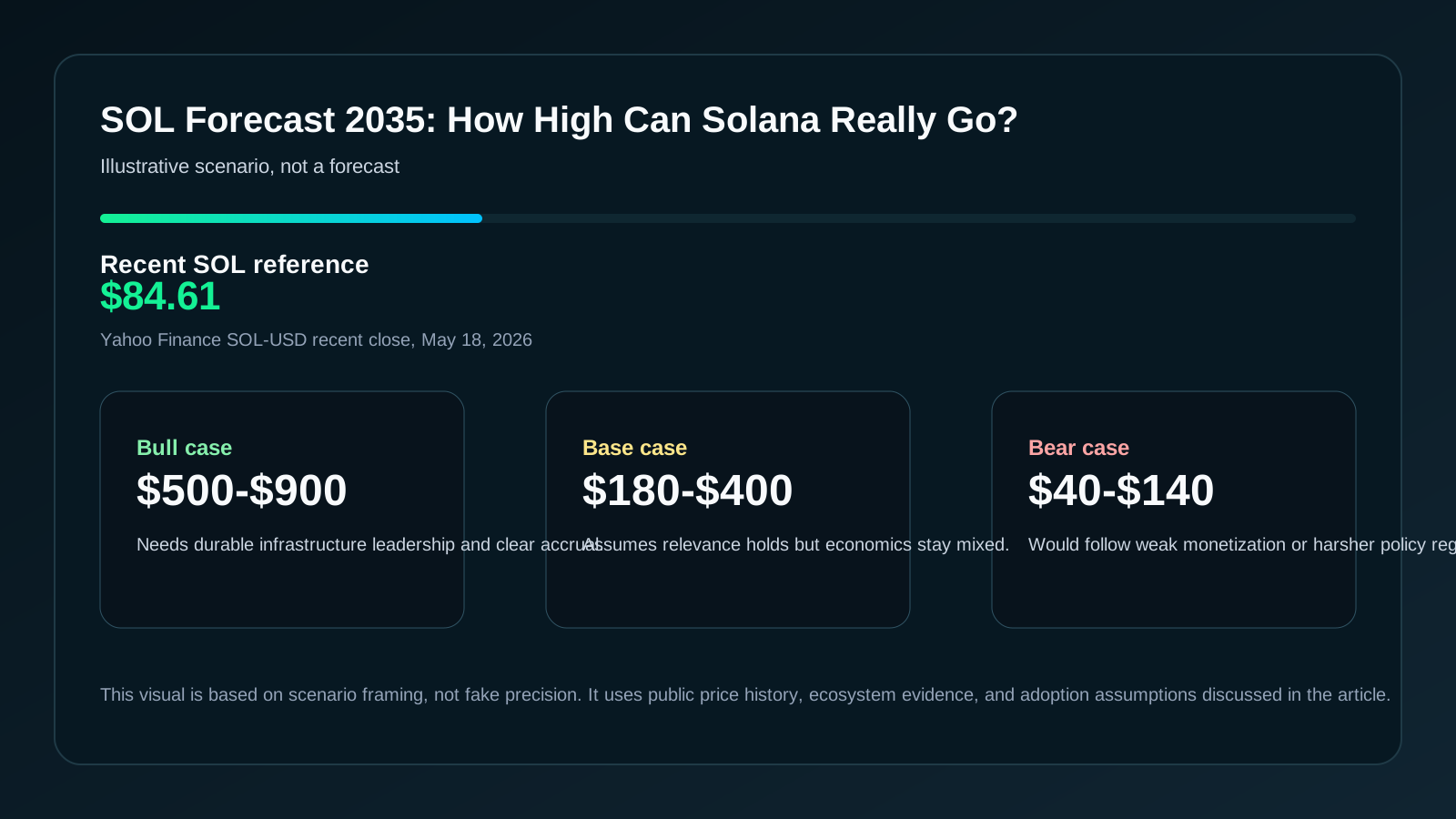
| Bull | $500-$900 | Solana becomes a major public rail for tokenized finance, stablecoin settlement, and agent payments while retaining meaningful accrual to SOL | 20% |
| Base | $180-$400 | Solana remains a leading crypto-finance and developer network, but value capture improves only gradually | 50% |
| Bear | $40-$140 | Competition, regulation, or weak economics cap the rerating despite continued relevance | 30% |
| Path | Probability | Comment |
|---|---|---|
| Higher over the long term | 60% | There is enough infrastructure momentum to support a constructive bias |
| Lower | 15% | Would likely require a serious failure of adoption, regulation, or value capture |
| Sideways with repeated boom-bust cycles | 25% | A realistic middle path if Solana stays important but not sufficiently monetized |
| Investor type | Prudent approach | Main watchpoints |
|---|---|---|
| Investor already in profit | Trim excess concentration and keep only the size you can hold through another deep cycle | Portfolio weight and thesis discipline |
| Investor currently at a loss | Separate long-horizon conviction from the temptation to anchor to old highs | Whether the real adoption story is still improving |
| Investor with no position | Use staged entries rather than one-shot bets; 2035 is a horizon, not a trigger | Valuation resets and macro liquidity |
| Trader | Treat 2035 narratives as background, not timing tools | Trend structure and volatility regime |
| Long-term investor | DCA can be sensible only if you accept that even a good thesis can spend years underwater | Institutional traction and protocol execution |
| Risk-hedging investor | Rebalance and hedge elsewhere; SOL is not a natural hedge asset | Cross-asset correlation and stress behavior |
| Risk | 2035 relevance | Potential offset |
|---|---|---|
| Protocol economics lag usage | Caps valuation multiple even if the chain stays busy | Better fee architecture and enterprise monetization |
| Institutional use cases remain niche | Long-range upside narrows meaningfully | Broader settlement and tokenized-fund adoption |
| AI and payments activity bypass SOL | Adoption helps apps more than token holders | Clearer wallet-linked accrual and settlement demand |
| Policy regimes harden | Reduces global access and product rollout | More jurisdictional diversification and compliant wrappers |
Bullish scenario
The long-run bull case is that Solana becomes one of the core public infrastructures for moving value, issuing tokenized products, and enabling machine payments. In that world, the market starts valuing SOL less like a cyclical altcoin and more like scarce access to an important financial network.
Bearish scenario
The long-run bear case is not zero. It is a slow grind in which Solana remains relevant, perhaps even useful, but never proves that cheap throughput translates into enough tokenholder economics to justify a premium over time.
Base-case scenario
The base case assumes Solana survives, grows, and stays important, but that its token economics improve more slowly than its ecosystem narrative. That still allows meaningful upside from current levels without requiring a fantasy outcome.
What could invalidate this forecast
The constructive 2035 case weakens if public-chain tokenization stays smaller than expected, if stablecoin settlement activity shifts away, or if Solana's value accrual remains structurally thin. The cautious case becomes too pessimistic if enterprise APIs, tokenized funds, and agent payments all deepen while SOL remains economically central.
Conclusion
How high can Solana really go by 2035? Higher than current prices by a wide margin is plausible. But the honest answer is that the upper bound depends less on raw blockchain enthusiasm and more on whether Solana becomes durable financial infrastructure with token economics investors can still defend ten years from now.
06. FAQ
Frequently asked questions about Solana's 2035 outlook
Is a four-figure SOL price impossible by 2035?
No, but it should be treated as a long-tail outcome rather than a central forecast.
Why is the base case below some viral Solana targets?
Because a serious 2035 framework has to discount uncertainty around monetization, regulation, and competition.
Could Solana stay important even if SOL underperforms?
Yes. Network relevance and token performance are related, but they are not the same thing.
What is the most important variable for 2035?
Whether Solana becomes durable infrastructure for tokenized finance and programmable payments, not just a fast trading venue.
07. Methodology and Invalidation
How to read a 2035 SOL forecast without confusing optionality for certainty
The forecast ranges in this article are scenario bands, not promises. They combine live SOL price data from Yahoo Finance, official Solana Foundation disclosures, institutional market commentary, and editorial judgment about how network usage, fee capture, adoption, and regulation interact. Solana is not a traditional equity or commodity, so no single metric can support a defensible long-range target by itself.
The probability tables are editorial estimates rather than statistical certainties. They are built by weighing network resilience, developer momentum, tokenized-asset and stablecoin adoption, derivatives access, and the risk that SOL remains structurally too dependent on trading cycles or speculative bursts. Where the evidence is mixed, the range stays intentionally wide.
The main reason the range stays wide is simple: the further out the horizon, the more the thesis depends on structures that are still forming today. The right use of a 2035 range is to stress-test conviction, not to replace risk management.
Disclaimer: The most important discipline is to state what would invalidate the working view. Investors who are already in profit, investors sitting on losses, traders, hedgers, and long-term allocators do not need the same playbook, so the positioning table separates horizon and risk tolerance instead of pretending one answer fits everyone. Disclaimer: This article is for informational and research purposes only and does not constitute personalized financial advice.
References
Sources
- Yahoo Finance SOL-USD chart API, recent daily closes
- Yahoo Finance SOL-USD chart API, available weekly history
- Yahoo Finance SOL-USD chart API, monthly history
- VanEck, Base, Bear, Bull Case: Solana Valuation by 2030
- Solana Foundation, Network Health Report: June 2025
- Solana Foundation, Solana Network Upgrades
- Solana Foundation, Solana Developer Platform launch
- Solana Foundation and Google Cloud, Pay.sh launch
- Solana Foundation, AI on Solana
- Solana Foundation, WisdomTree expands tokenization ecosystem to Solana
- Messari, State of Solana Q3 2025
- Coinbase Institutional, Analyzing Solana Activity
- CME Group, Q1 2026 cryptocurrency highlights
- Franklin Templeton, launch of Franklin Solana ETF (SOEZ)
- Franklin Templeton, Detangling tokenization of RWAs
- Visa, U.S. stablecoin settlement launch