01. Quick Answer
Solana still has a credible 2030 upside case, but the path depends on whether ecosystem growth becomes economically durable for SOL
Available data suggests Solana remains one of the most operationally ambitious large-cap crypto networks. Official Solana reporting pointed to roughly 16 months of continuous uptime by June 2025, over 7,600 new developers added in 2024, and more than $1 billion in app revenue in each of the two quarters highlighted in that report (Solana Foundation) (Yahoo Finance). That is a materially stronger operating backdrop than the outage-heavy reputation many older Solana critiques still assume.
But the evidence is mixed on how much of that activity reliably accrues to SOL itself. VanEck's 2023 framework modeled a huge 2030 spread from roughly $9.81 in a bear case to more than $3,200 in a bull case, explicitly acknowledging that monetization, market share, and value capture could diverge dramatically (VanEck). That wide dispersion remains the right mindset today. Solana can win share in usage and still disappoint investors if fees stay too cheap, if activity remains too trading-driven, or if regulation slows institutional adoption.
| Dimension | Current reading | Why it matters |
|---|---|---|
| Historical data | SOL's available Yahoo monthly history runs from about $0.57 in May 2020 to around $84.61 in May 2026, with a cycle peak above $237 on the monthly series (Yahoo Finance) | The upside potential has been enormous, but so has volatility |
| Current market conditions | SOL is trading far below its late-2024 peak despite a still-active ecosystem (Yahoo Finance) (Messari) | 2030 models should start from a discounted base, not from euphoric highs |
| Institutional context | CME futures, Franklin Templeton's SOEZ, and Visa settlement pilots show regulated access and real payments relevance now exist (CME Group) (Franklin Templeton) (Visa) | Broader access can deepen demand, but also invites more disciplined price discovery |
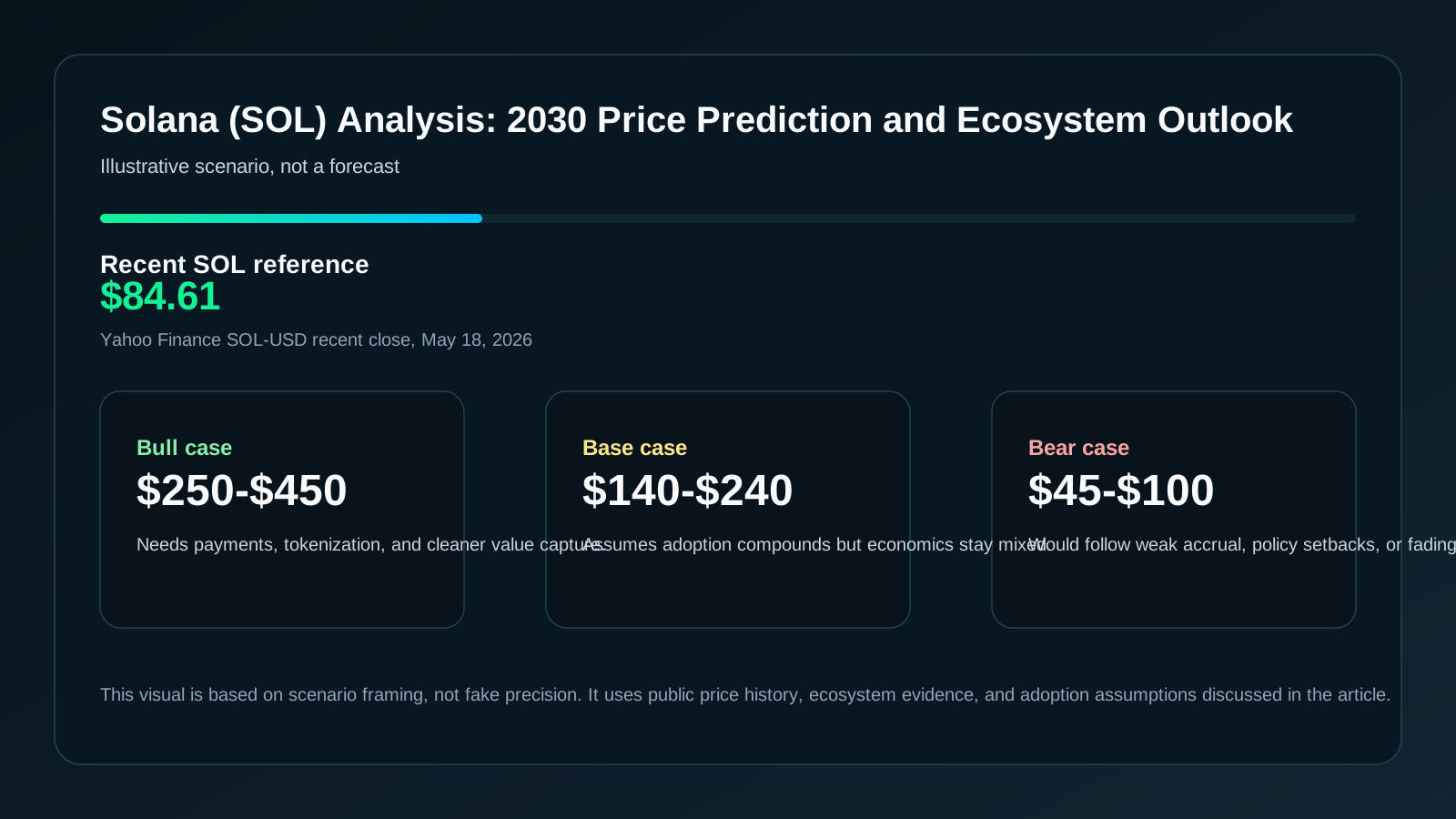
| Working base case | $140-$240 by 2030 | This assumes Solana compounds as a meaningful crypto-finance rail without fully validating the most aggressive 2023-era upside models |
The practical answer is that SOL can still be materially higher by 2030 without needing meme-like assumptions. It does, however, need more than transaction count headlines. It needs evidence that payments, tokenization, and institutional usage keep broadening while validator economics and fee capture improve enough that the token's role remains central rather than ornamental.
02. Historical Context
A 2030 Solana forecast has to start with the cycle record, because SOL has already shown both extreme upside and brutal drawdown risk
Solana's available Yahoo history does not span a full decade, so any '10-year' framing for SOL must be read as available-history analysis rather than mature-cycle analysis. Even so, the pattern is clear enough to matter: SOL rose from sub-$1 pricing in 2020 into triple digits, collapsed in 2022, recovered strongly into 2024, and then corrected again into 2026 (Yahoo Finance). That is the profile of a high-beta network asset whose narrative can re-rate quickly in either direction.
The ecosystem context also changed materially during that journey. Earlier Solana debates centered on outages, memecoin bursts, and whether the chain could survive reputational damage. By June 2025, official Solana reporting emphasized uptime, improving validator health, and stronger developer retention instead (Solana Foundation). That does not erase volatility; it does mean the present network looks structurally different from the one many investors still remember.
| Date or phase | Approximate price | Why it matters |
|---|---|---|
| May 2020 available monthly start | ~$0.57 | Shows how early-stage and reflexive SOL's long-term CAGR still is |
| November 2021 major cycle high | ~$238 | First proof that SOL could become a top-tier speculative and ecosystem asset |
| Late 2022 washout | ~$10 | Demonstrates how quickly confidence can collapse in crypto stress |
| March 2024 recovery | ~$184 | Shows that the chain could regain relevance after the prior crash |
| Late 2024 available weekly peak | ~$253 | Second major peak confirmed renewed appetite but also valuation sensitivity |
| May 18, 2026 | ~$84.61 | Current anchor for 2030 scenario work |
| Observation | Evidence | Implication |
|---|---|---|
| Drawdowns are normal | SOL fell roughly two-thirds from the late-2024 peak to May 2026 on available Yahoo data | A bearish path does not require the network to fail |
| The installed ecosystem survived | Solana kept adding developers, apps, and institutional use cases even after sharp price resets (Solana Foundation) (Solana Foundation) | Price and ecosystem health can diverge for long stretches |
| Institutional wrappers now exist | CME futures and SOEZ did not exist in Solana's earliest cycle years (CME Group) (Franklin Templeton) | The next cycle may be deeper and more disciplined at the same time |
The central historical lesson is not that SOL always comes back. It is that Solana has already survived multiple attempts by the market to relegate it to a temporary trend. That keeps the 2030 upside case alive, but it also means position sizing and scenario discipline matter more here than in less volatile assets.
03. Main Drivers
Five drivers will do most of the analytical heavy lifting between now and 2030
A credible 2030 forecast should be built from the variables that actually move Solana's economics, not from generic crypto optimism.
1. Network performance and reliability have become investable variables again
The June 2025 Solana report highlighted nearly 16 months of continuous uptime, stronger replay performance, and successful handling of very heavy January 2025 activity without downtime (Solana Foundation). The longer that operational record holds, the weaker the old 'Solana is too unstable' discount becomes.
2. Validator economics are improving, but they are not solved
Official Solana reporting pointed to higher block rewards, greater real economic value, and upcoming block-revenue sharing features, while VanEck's older valuation note remains a useful warning that cheap blockspace can be good for adoption but weak for value capture (Solana Foundation) (Solana Foundation) (VanEck).
3. Payments and stablecoins are becoming real commercial use cases
Visa's U.S. USDC settlement launch specifically cited Solana as the blockchain used by initial banking participants, and Visa's 2026 stablecoin strategy note described stablecoin usage as a strategic imperative for financial institutions (Visa) (Visa). That matters because payments demand is usually stickier than speculative demand.
4. Tokenized assets and enterprise APIs broaden the buyer and builder base
Solana Developer Platform, WisdomTree's tokenized funds expansion, and Franklin Templeton's tokenization analysis all point in the same direction: regulated issuers increasingly want public-chain rails that are fast, cheap, and programmable (Solana Foundation) (Solana Foundation) (Franklin Templeton).
5. Trading remains both a strength and a risk
Coinbase Institutional found that trading-linked activity regularly accounted for 75% to 90% of Solana's successful transaction fees, and noted that memecoin launchers out-earned long-standing DeFi apps in parts of 2024 (Coinbase Institutional). That is bullish for engagement but bearish if the market mistakes cyclical trading bursts for permanent fundamental demand.
The balance among those five drivers is why a moderate scenario range is more defensible than one heroic number. Solana already has enough evidence to justify a constructive 2030 outlook. The unresolved question is how much of its usage stack becomes both durable and monetizable.
04. Institutional Forecasts and Analyst Views
Published Solana targets are unusually wide because the unknowns are unusually large
VanEck still offers one of the clearest publicly documented long-range Solana valuation frameworks, with a 2030 bear case near $9.81, base case near $334.70, and bull case above $3,200 (VanEck). Those numbers should not be copied blindly. They were published in October 2023 and explicitly relied on aggressive assumptions about market share, revenue capture, and the emergence of a truly massive application on Solana.
More recent institutional signals are less about point targets and more about market structure. CME's futures launch, Franklin Templeton's staking-enabled ETF structure, and Coinbase's institutional research all indicate that Solana is now monitored and accessed through more traditional finance channels than in earlier cycles (CME Group) (Franklin Templeton) (Coinbase Institutional). That supports a higher-quality debate, even if it does not produce clean sell-side targets.
| Source | Published or implied stance | What it means |
|---|---|---|
| VanEck | 2030 bear ~$9.81, base ~$334.70, bull ~$3,211.28 | Useful for scenario thinking, but too assumption-heavy to use as a simple base case |
| CME Group | Regulated SOL futures and active Q1 2026 suite volume | Institutional hedging and price discovery depth have improved |
| Franklin Templeton | SOEZ holds SOL exposure and may stake up to 100% where practicable | Traditional wrappers can expand the buyer base and normalize staking economics |
| Visa | USDC settlement over Solana for initial U.S. banking participants | Payments relevance strengthens the non-speculative case |
| Messari | Q3 2025 stablecoins, REV, and TVL all rose materially | Onchain financial activity was still broadening before the 2026 price reset |
The best interpretation is that institutions have become more comfortable building around Solana than they were two years ago, but they are still not offering a mature consensus target range. That is why an editorial base case below VanEck's old central figure but above current spot remains the more conservative approach.
05. Scenarios, Risks, and Positioning
A scenario matrix is more honest than a single 2030 target because Solana's future depends on both adoption and economic quality
The following ranges are conditional scenarios rather than predictions of certainty. They start from the current price and then ask what must go right or wrong for SOL to rerate by 2030.
| Scenario | Illustrative range | Conditions | Probability |
|---|---|---|---|
| Bull | $250-$450 | Payments, tokenization, AI-enabled infrastructure, and enterprise APIs scale while validator economics keep improving | 25% |
| Base | $140-$240 | Solana keeps market share in crypto-finance and consumer apps, but fee capture remains mixed and cycles stay volatile | 50% |
| Bear | $45-$100 | Activity remains too trading-led, regulation slows access, or a major competitive shift weakens Solana's premium narrative | 25% |
| Direction | Probability | Why |
|---|---|---|
| Higher by 2030 | 56% | The network has enough real adoption evidence that a higher long-run price is still the default bias |
| Lower than today | 18% | Possible if value capture disappoints badly or crypto regulation turns materially harsher |
| Broadly sideways with high volatility | 26% | Plausible if ecosystem growth continues but the token remains difficult to value cleanly |
| Investor type | Prudent approach | What to watch |
|---|---|---|
| Investor already in profit | Hold a core position only if you still believe Solana can convert usage into durable economics; trim if the position became too large | Concentration, taxable gains, and whether the thesis has become narrative-only |
| Investor currently at a loss | Re-underwrite rather than average down automatically; separate a broken sizing decision from a broken chain thesis | Validator economics, stablecoin growth, and fee quality |
| Investor with no position | Avoid chasing vertical rebounds; staged entries or waiting for cleaner market structure are usually more disciplined | Whether adoption news is being confirmed by revenue quality and liquidity depth |
| Trader | Use stop-losses and respect the difference between a correction, a bear market, and a crash | Funding, open interest, and major unlock or policy headlines |
| Long-term investor | Dollar-cost averaging can make sense only if you accept multi-year volatility and thesis drift risk | Developer retention, enterprise integrations, and tokenized-asset traction |
| Risk-hedging investor | Treat SOL as high-beta growth infrastructure, not as a portfolio hedge | Correlation with broader crypto risk and liquidity conditions |
| Risk factor | Why it matters | What would help |
|---|---|---|
| Fee capture stays too weak | High usage without sufficient accrual can cap valuation quality | More block-revenue sharing and stronger monetized applications |
| Trading concentration remains too high | Speculative bursts can fade quickly | Greater mix from payments, RWAs, and enterprise flows |
| Competitive or regulatory shock | Institutional narratives can reverse if access narrows | Broader wrappers, clearer rules, and cross-border payment traction |
| Execution slippage on upgrades | 2030 upside assumes reliability keeps improving | Clean rollout of Alpenglow, Firedancer, and related changes |
Bullish scenario
The bullish case is that Solana becomes the cleanest liquid expression of high-throughput onchain finance outside Bitcoin's store-of-value role. That requires more Visa-style settlement use, more tokenized-fund issuance, more institutional access through products like SOEZ, and enough upgrade success that old instability objections fade into the background.
Bearish scenario
The bearish case is not that Solana disappears. It is that SOL stays trapped in a pattern where application growth is real but token value capture remains inconsistent, fee demand proves too cyclical, and competition or policy changes prevent the market from assigning a durable premium multiple.
Base-case scenario
The base case is that Solana remains one of the most relevant non-Bitcoin crypto networks through 2030, compounds usage across payments and tokenization, but still experiences major sentiment swings and never fully validates the most aggressive 2023 valuation frameworks.
What could invalidate this forecast
The constructive 2030 view would weaken materially if payments pilots fail to scale, if tokenized-asset activity migrates elsewhere, if validator economics stop improving, or if another period of reliability issues permanently damages trust. The cautious view would be too bearish if stablecoin settlement, enterprise APIs, and tokenized funds all compound faster than expected while SOL retains clear value capture.
Conclusion
Solana has outgrown the lazy version of the debate. It is no longer enough to say the chain is fast or that the token is speculative. The serious 2030 question is whether Solana can keep turning technical scale into commercially valuable activity that still matters for SOL. Available evidence suggests that outcome is plausible, but not automatic.
06. FAQ
Frequently asked questions about Solana's 2030 outlook
Can SOL still make new highs by 2030?
Yes, but the path likely depends on broader adoption in payments, tokenization, and regulated access rather than on speculation alone.
Is VanEck's old 2030 base case of about $335 still realistic?
It is still a useful scenario reference, but it should be treated as an assumption-heavy model rather than as a consensus target.
What matters more for 2030: transaction count or fee quality?
Fee quality matters more. Raw activity helps attention, but token value usually depends on whether the activity is economically durable.
Why mention Visa and Franklin Templeton in a SOL article?
Because those sources show where Solana's non-meme adoption is developing: settlement, tokenization, and regulated wrappers.
07. Methodology and Invalidation
How to interpret this 2030 SOL framework and what would change it
The forecast ranges in this article are scenario bands, not promises. They combine live SOL price data from Yahoo Finance, official Solana Foundation disclosures, institutional market commentary, and editorial judgment about how network usage, fee capture, adoption, and regulation interact. Solana is not a traditional equity or commodity, so no single metric can support a defensible long-range target by itself.
The probability tables are editorial estimates rather than statistical certainties. They are built by weighing network resilience, developer momentum, tokenized-asset and stablecoin adoption, derivatives access, and the risk that SOL remains structurally too dependent on trading cycles or speculative bursts. Where the evidence is mixed, the range stays intentionally wide.
The clearest invalidators would be a collapse in the enterprise and payments narrative, a long period where usage no longer improves validator economics, or evidence that Solana's most visible activity remains too speculative to support durable valuation expansion.
Disclaimer: The most important discipline is to state what would invalidate the working view. Investors who are already in profit, investors sitting on losses, traders, hedgers, and long-term allocators do not need the same playbook, so the positioning table separates horizon and risk tolerance instead of pretending one answer fits everyone. Disclaimer: This article is for informational and research purposes only and does not constitute personalized financial advice.
References
Sources
- Yahoo Finance SOL-USD chart API, recent daily closes
- Yahoo Finance SOL-USD chart API, available weekly history
- Yahoo Finance SOL-USD chart API, monthly history
- VanEck, Base, Bear, Bull Case: Solana Valuation by 2030
- Solana Foundation, Network Health Report: June 2025
- Solana Foundation, Solana Network Upgrades
- Solana Foundation, Solana Ecosystem Roundup: April 2026
- Solana Foundation, Solana Developer Platform launch
- Solana Foundation, WisdomTree expands tokenization ecosystem to Solana
- Messari, State of Solana Q3 2025
- Coinbase Institutional, Analyzing Solana Activity
- CME Group, first trades of Solana futures
- Franklin Templeton, launch of Franklin Solana ETF (SOEZ)
- Franklin Templeton, Detangling tokenization of RWAs
- Visa, U.S. stablecoin settlement launch
- Visa Consulting and Analytics, Stablecoin strategy