01. Quick Answer
The most defensible 2030 SONY forecast is a range, because Sony is both a technology platform and an entertainment compounder
SONY closed at 22.31 on 2026-05-15, versus 5.87 on 2016-06-01 in the 10-year Yahoo Finance series, for a price-only CAGR of about 14.35% (Yahoo Finance 10-year history; recent daily closes). That long run is strong enough to prove that Sony can compound, but not so euphoric that future execution no longer matters.
The current setup is unusually balanced. Sony's FY2025 continuing operations produced sales of JPY 12.48 trillion and operating income of JPY 1.45 trillion, while FY2026 guidance points to sales of JPY 12.3 trillion and operating income of JPY 1.6 trillion Sony FY2025 financial summary Sony FY2025 presentation. Available data suggests the stock still depends on the interaction of PlayStation economics, music and anime monetization, image-sensor leadership, and capital allocation discipline rather than on any single product cycle.
| Point | Why it matters |
|---|---|
| Sony is not a pure consumer-electronics story | Gaming, music, pictures, sensors, and devices all matter to valuation. |
| Continuing-operations data matters more after the financial-services spin-off | Readers should compare the latest numbers on the same basis rather than mixing old and new reporting frames. |
| 2030 upside depends on business quality as much as revenue growth | Margins, recurring platform revenue, and IP monetization matter more than raw top-line expansion. |
| The evidence is mixed, not one-directional | Sony has several premium assets, but also clear cyclicality and execution risk. |
02. Historical Context
Sony's decade-long rerating reflects portfolio quality, not just multiple expansion
Over the past decade, SONY moved from 5.87 to 22.31, within a 10-year range of 5.61 to 29.35. That matters because the stock already reflects a substantial improvement from the older narrative of Sony as a volatile hardware conglomerate. What the market increasingly values now is Sony's mix of platform revenue, content ownership, and selective semiconductor exposure.
FY2025 continuing operations also showed how diversified that model has become. Segment results in the earnings presentation show G&NS sales of JPY 4.69 trillion, Music sales of JPY 2.12 trillion, Pictures sales of JPY 1.50 trillion, ET&S sales of JPY 2.26 trillion, and I&SS sales of JPY 2.15 trillion Sony segment results presentation. That is not the revenue profile of a one-engine business. It is a portfolio whose quality depends on how well Sony allocates capital across businesses with different cycles.
| Metric | Latest reading | Why it matters |
|---|---|---|
| Current ADR price | 22.31 | Starting point for every 2030 scenario. |
| 10-year price CAGR | 14.35% | Shows meaningful long-run compounding without assuming perfection. |
| 1-year range | 19.64 to 30.26 | Reminds investors that sentiment can still swing materially. |
| FY2025 operating margin | 11.6% | Higher-quality earnings are central to the valuation debate. |
| Segment | Sales | Operating income | Interpretation |
|---|---|---|---|
| G&NS | JPY 4.69T | JPY 463.3B | Platform quality remains strong even after the maturing PS5 cycle. |
| Music | JPY 2.12T | JPY 447.0B | Streaming and IP economics remain a major stabilizer. |
| Pictures | JPY 1.50T | JPY 104.9B | Film and anime can add upside, but the margin profile is less consistent. |
| ET&S | JPY 2.26T | JPY 158.6B | Electronics remains relevant, but not the main premium driver. |
| I&SS | JPY 2.15T | JPY 357.3B | Image sensors remain one of Sony's most strategically important assets. |
03. Main Drivers
Six forces are most likely to shape Sony into 2030
1. PlayStation monetization matters more than console-unit headlines. Sony's G&NS segment is still large enough to move group earnings, but investors should pay more attention to network services, software mix, and first-party execution than to hardware units alone Sony business segment materials.
2. Music remains one of Sony's cleanest quality assets. The FY2025 segment presentation said full-year streaming revenue growth on a U.S. dollar basis was 9% for Recorded Music and 14% for Music Publishing, while IFPI said global recorded music revenue rose 6.4% in 2025 Sony Music segment data IFPI Global Music Report 2026.
3. Anime and Pictures can expand Sony's IP flywheel. Sony's Corporate Strategy 2026 release said Crunchyroll surpassed 21 million paid subscribers by the end of March 2026, reinforcing the idea that anime is no longer a niche add-on but a strategic global growth vector Sony Corporate Strategy 2026.
4. Image sensors remain a strategic asset, but also a cyclical one. Sony's I&SS segment produced record operating income in FY2025, yet management's FY2026 outlook still assumes a cautious view of the mobile-sensor market because the trend toward larger sensors may moderate and memory-market uncertainty remains I&SS outlook commentary.
5. Capital allocation can widen or narrow the valuation gap. Sony's IR news archive shows that the company paired FY2025 earnings with a new share-repurchase facility and treasury cancellation, which matters because buybacks and portfolio pruning are part of the equity story, not just a footnote Sony IR news 2026.
6. FX, geopolitics, and Japan macro still shape the range. IMF work on Japan continues to describe downside risks from weaker external demand, tighter financial conditions, and geoeconomic fragmentation. Sony is globally diversified, but that also means it is exposed to many demand and supply channels at once IMF Japan 2026.
04. Institutional Forecasts and Analyst Views
Public institutional evidence supports a constructive but selective 2030 case
The clearest starting point comes from Sony itself. FY2025 continuing-operations sales rose 3.7% to JPY 12.48 trillion and operating income rose 13.4% to JPY 1.45 trillion, while FY2026 guidance points to JPY 1.6 trillion of operating income and JPY 1.16 trillion of net income attributable to stockholders Sony FY2025 financial summary. That is not a no-growth setup. It is a quality-improvement setup.
At the same time, the evidence is mixed. Sony's Corporate Strategy 2026 statement emphasizes entertainment, AI, anime and sensor competitiveness, but management also explicitly flags technological and geopolitical disruption, memory-market tightness, and tariff-related uncertainty Sony strategy release Sony IR news archive. A sober 2030 forecast therefore needs a range, not a single heroic target.
| Source | Main message | Implication for SONY |
|---|---|---|
| Sony FY2025 results | Higher sales and materially higher operating income | Supports a constructive base case. |
| Sony FY2026 guidance | Sales dip modestly, profits rise | Suggests mix and execution matter more than pure revenue growth. |
| IFPI 2026 | Music-industry revenue kept growing in 2025 | Supports durability in Sony's music franchise. |
| IMF Japan 2026 | Macro risks are tilted to the downside | Argues for caution around the global cyclical exposure. |
05. Scenarios, Risks, and Invalidation
A 2030 SONY forecast should distinguish between premium assets and normal cyclicality
Bullish scenario
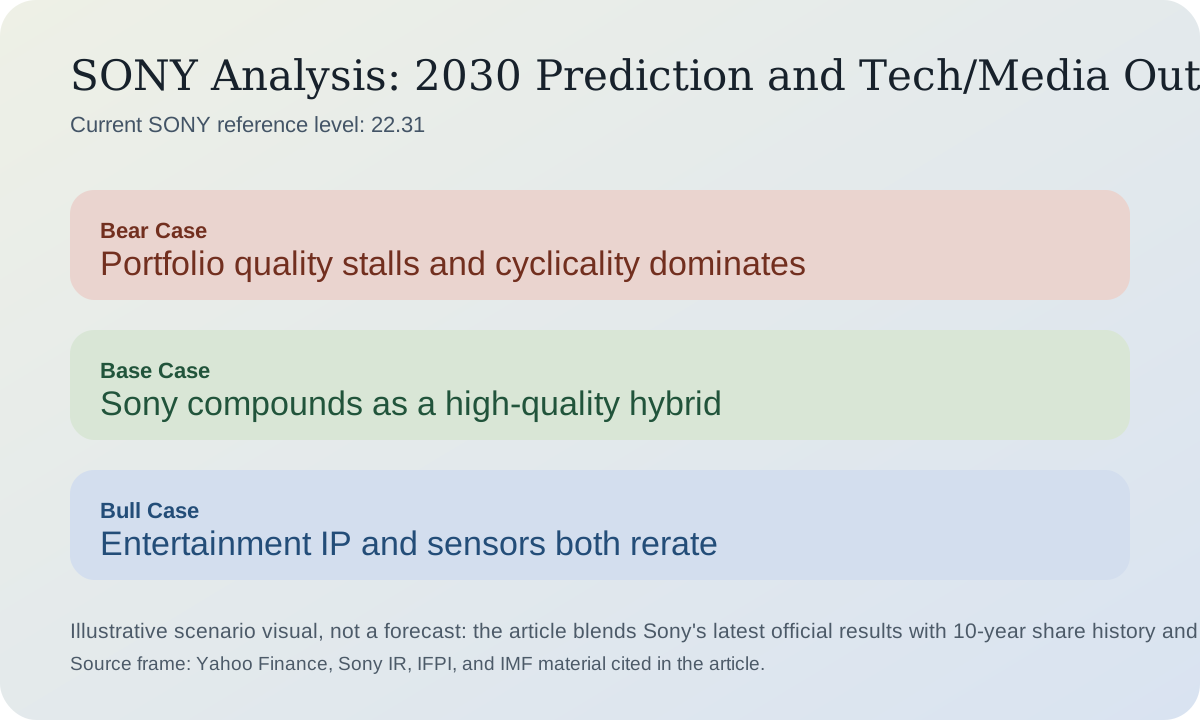
The bull case is $32 to $38 by 2030. This scenario depends heavily on PlayStation monetization staying resilient, Music and anime compounding steadily, and image sensors maintaining technological leadership without margin dilution.
Bearish scenario
The bear case is $18 to $22. That would likely require a weaker console and content cycle, more persistent sensor-market softness, and a market view that Sony's portfolio quality deserves a lower multiple.
Base-case scenario
The base case is $25 to $30. Available data suggests this is the most defensible range if Sony continues to improve business mix and capital discipline, but still trades like a high-quality cyclical rather than a pure software platform.
Risks to watch
Watch network-services momentum, game-release quality, Crunchyroll subscriber trends, image-sensor demand, memory costs, buyback execution, and any deterioration in global consumer demand.
What could invalidate the forecast
This framework would prove too conservative if Sony's entertainment IP flywheel compounds faster than expected and if the sensor business regains a stronger growth trajectory. It would prove too optimistic if the company starts looking like a collection of good assets without enough consolidated earnings momentum.
Conclusion
Sony remains one of the more interesting cross-asset stories in global equities because it blends premium entertainment IP with real industrial technology. That mix is attractive, but it also means the 2030 case works best as a range built on multiple business engines.
Disclaimer: This article is for research and informational purposes only. The scenario ranges and probabilities discussed here are conditional estimates, not personalized investment advice.
| Scenario | Range | Key conditions | Probability |
|---|---|---|---|
| Bull | $32-$38 | IP, platform, and sensor quality all compound well | 25% |
| Base | $25-$30 | Steady execution with normal cyclical noise | 50% |
| Bear | $18-$22 | Cyclical pressure and weaker mix quality | 25% |
| Path | Estimated probability | Why |
|---|---|---|
| Rising from current levels by 2030 | 55% | Sony still has several premium businesses and credible capital discipline. |
| Falling below current levels by 2030 | 15% | A lower level after four years likely needs a broad portfolio disappointment. |
| Moving broadly sideways | 30% | Plausible if quality assets offset cyclical pressure without a higher multiple. |
06. Investor Positioning
Positioning in SONY should reflect both content quality and cyclical discipline
| Investor type | Cautious approach | What to watch |
|---|---|---|
| Investor already in profit | Hold a core position, but trim if the thesis relies too heavily on multiple expansion. | Watch whether earnings quality keeps improving. |
| Investor currently at a loss | Review whether the thesis was based on long-run IP quality or on a short console-cycle rebound. | Segment execution matters more than hope. |
| Investor with no position | Build gradually or wait for pullbacks rather than chasing headlines. | The stock still trades with cyclical drawdowns. |
| Trader | Use stop-losses and respect earnings-day volatility. | FX, guidance changes, and game commentary can move the stock quickly. |
| Long-term investor | Dollar-cost averaging can make sense if conviction rests on Sony's portfolio quality. | Focus on cash generation and segment mix, not only quarter-to-quarter noise. |
| Risk-hedging investor | Rebalance if portfolio exposure to global tech and entertainment is already high. | Macro and yen sensitivity still matter. |
07. FAQ
Frequently asked questions about SONY and the 2030 outlook
Is Sony a tech stock or an entertainment stock?
It is both, which is exactly why range-based forecasting makes more sense than single-metric valuation shortcuts.
What matters most for a 2030 SONY prediction?
The main drivers are PlayStation monetization, Music and anime monetization, sensor competitiveness, and capital allocation quality.
What is the biggest risk to the base case?
The biggest risk is that several good businesses remain healthy individually, but consolidated earnings momentum is not strong enough to sustain a premium valuation.
References
Sources
- Yahoo Finance chart API for SONY, 10-year monthly history
- Yahoo Finance chart API for SONY, recent daily closes
- Sony investor relations homepage
- Sony FY2025 consolidated financial summary
- Sony FY2025 earnings presentation
- Sony Group Corporate Strategy 2026 press release
- Sony Business Segment Presentation and Fireside Chat 2025
- Sony Group Summary
- Sony Corporate Report 2025
- IFPI Global Music Report 2026
- IMF Japan 2026 Article IV mission statement