01. Quick Answer
The most defensible 2030 STOXX50 forecast is a range, not a one-number promise
A serious STOXX50 prediction for 2030 should start with what the market has actually done, not with a slogan about Europe's discount. The EURO STOXX 50 rose from about 2,864.74 ten years ago to 5,827.76 on May 14, 2026, while touching roughly 6,138.41 during the latest upswing, according to the live chart history for ^STOXX50E. That is strong long-run price growth for a benchmark many investors still treat as permanently sluggish.
The macro backdrop is less clean than the long-run chart suggests. Eurostat's flash estimate showed euro area GDP rose only 0.1% quarter over quarter in Q1 2026, while April 2026 inflation accelerated to 3.0% and the ECB's own bulletin described renewed volatility tied to higher energy prices and war-related uncertainty (Eurostat GDP; Eurostat inflation; ECB bulletin).
| Takeaway | Why it matters |
|---|---|
| The index is not a pure GDP trade | The EURO STOXX 50 is dominated by global champions in technology, luxury, industrials, pharma, banks, and energy, so domestic eurozone growth is only one driver. |
| Historical data argues for ranges, not a heroic number | The 10-year path included sharp drawdowns, large rebounds, and a recent move close to record highs. |
| Institutional views are constructive but not euphoric | UBS and J.P. Morgan have become more positive on eurozone equities, while BlackRock remains more selective and valuation-sensitive. |
| 2030 depends on earnings quality more than on headlines | A durable rerating needs better productivity, broader capex, and policy credibility, not just one easing cycle. |
02. Historical Context
The last decade shows why long-run upside is plausible but volatility must stay in the analysis
The STOXX methodology guide defines the EURO STOXX 50 as a free-float market-cap weighted blue-chip index drawn from the broader eurozone universe, using a buffer system rather than a static list (STOXX methodology). That means the benchmark continually refreshes around the region's largest liquid companies, but it still remains concentrated. ETF fact sheets from BlackRock and State Street show how much the benchmark leans on a handful of leaders such as ASML, SAP, Siemens, LVMH, TotalEnergies, Allianz, Schneider Electric, Sanofi, and major banks (BlackRock fact sheet; State Street FEZ page).
That concentration changes how historical context should be read. Over the last decade the benchmark moved from an era dominated by negative rates, low nominal growth, and recurring political stress into a period shaped by inflation, higher defense spending, industrial policy, and an AI-driven semiconductor and infrastructure cycle. Historical returns therefore capture multiple regimes rather than one stable trend.
| Metric | Latest reading | Interpretation |
|---|---|---|
| Recent close | 5,827.76 | A useful anchor for scenario analysis. |
| 52-week high | 6,199.78 | Shows that the index has recently tested a higher valuation zone. |
| 52-week low | 5,154.83 | Reminds investors the market still re-prices sharply when growth or energy worries flare. |
| 10-year price CAGR | 7.36% | Supports a moderate long-run compounding baseline, but not a straight line. |
| Phase | Market character | What it means for 2030 |
|---|---|---|
| 2016-2019 | Recovery with low-rate support | Europe can rally even without strong nominal growth when policy is accommodative. |
| 2020 | Pandemic shock and rapid rebound | Drawdown risk remains material, but liquidity can compress recovery timelines. |
| 2021-2023 | Inflation, rate normalization, and energy shock | Sector mix matters because banks, energy, and defensives can cushion some macro pain. |
| 2024-2026 | Re-rating on easing hopes, fiscal support, and AI-linked winners | The market now needs earnings follow-through to justify a higher long-run range. |
Available data suggests the 2030 debate is really about whether Europe's recent improvement is cyclical, structural, or both. If it is only cyclical, upside could stall once rates settle. If it is partly structural, a higher long-run trading band becomes easier to defend.
03. Main Drivers
Five forces are likely to shape the Euro Stoxx 50 market outlook into 2030
1. Euro area growth and ECB policy still matter
The ECB's March 2026 projections and the OECD's euro area outlook both point to modest, not explosive, growth. That argues against an aggressive earnings boom but supports the idea that recession is not the base case either (ECB projections; OECD outlook).
2. Fiscal expansion, especially in Germany, has become more relevant
UBS and J.P. Morgan both highlight German fiscal support and a brighter capex backdrop as reasons eurozone equities could outperform previous expectations (UBS; J.P. Morgan Europe strategy).
3. Sector leadership is broader than many investors assume
The benchmark has exposure to semiconductors, industrial automation, enterprise software, capital goods, banks, insurers, healthcare, and luxury. That diversification helps explain why the index can rally even if one sector, such as luxury, goes through a soft patch.
4. Energy remains the main macro spoiler
The ECB bulletin and Reuters market coverage both underline how quickly higher energy prices can hurt sentiment, inflation expectations, and risk appetite (ECB bulletin; Reuters coverage).
5. Relative valuation still shapes flows
BlackRock remains more measured than the most bullish houses, preferring selected European financials and industrials rather than a blanket regional call. That is an important signal: valuation can attract capital, but earnings quality must validate it (BlackRock 2026 outlook).
04. Institutional Forecasts and Analyst Views
Public strategist views support a constructive but conditional long-term outlook
Public institutional forecasts for the EURO STOXX 50 rarely come as precise 2030 targets. Instead, they appear as earnings-growth assumptions, valuation preferences, and directional views on eurozone equities. J.P. Morgan says eurozone risk-reward is improving and points to double-digit 2026 earnings growth expectations, while UBS argues Europe's stock markets are supported by stabilization, valuation, and sector breadth (J.P. Morgan European Stocks Outlook; UBS brightening outlook).
BlackRock is more guarded, saying Europe's lagging earnings growth versus the U.S. keeps it neutral overall, even though it favors sectors like financials and industrials (BlackRock investment outlook). State Street's 2026 equity outlook is constructive on global equities but, together with its April 2026 currency note, reminds investors that crisis conditions can quickly support the dollar and pressure European assets (State Street equity outlook; State Street FX commentary).
| Institution | Public stance | Implication for a 2030 range |
|---|---|---|
| J.P. Morgan | Improving eurozone risk-reward and stronger earnings outlook | Supports an upper-middle scenario if profits broaden beyond a few winners. |
| UBS | Constructive on European equities and eurozone cyclicals | Supports a bullish medium-term path if rates and fiscal support cooperate. |
| BlackRock | Neutral Europe overall, but selective in financials and industrials | Argues for a base case rather than an unconditional rerating. |
| State Street | Constructive on equities but sensitive to macro shocks | Keeps the downside case alive if energy and FX conditions worsen. |
For this article, the forecast range is built by combining the live index level, the 10-year price CAGR, the current macro baseline from the ECB and OECD, and the fact that institutional views are constructive but not unanimous. That produces a wider, more honest cone than a single-point estimate would.
05. Bull, Bear, and Base Cases
Scenario analysis is more honest than pretending the path is linear
Bullish scenario
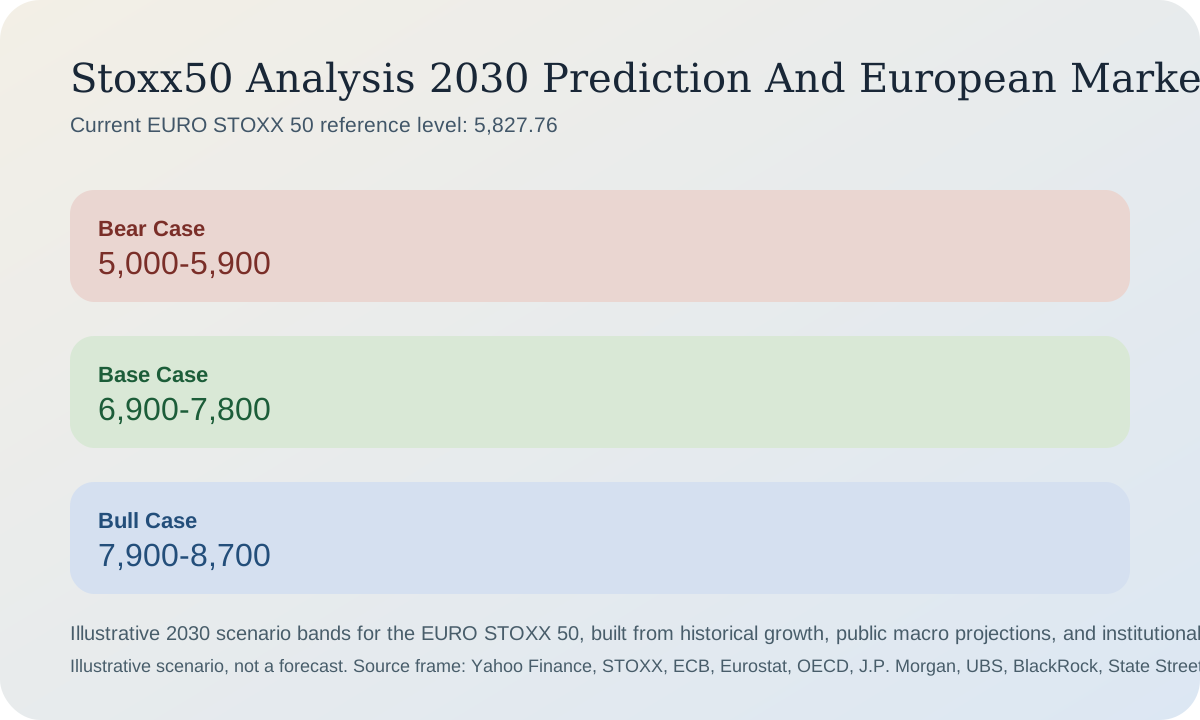
The bull case puts the index in roughly the 7,900 to 8,700 area by 2030. This scenario depends on easier financial conditions, improving eurozone productivity, sustained fiscal support, and earnings delivery from semiconductors, software, industrial electrification, and financials.
Bearish scenario
The bear case sits near 5,000 to 5,900 by 2030. It requires a weaker macro mix: sticky inflation, energy disruptions, a stronger dollar, margin pressure for European exporters, and little valuation catch-up versus the U.S.
Base-case scenario
The base case is 6,900 to 7,800 by 2030. It assumes the current range of institutional evidence is broadly right: growth improves, but only gradually; rates become less restrictive, but not dramatically; and earnings leadership remains selective rather than universal.
| Scenario | 2030 range | Conditions | Read-through |
|---|---|---|---|
| Bull | 7,900-8,700 | Broader earnings growth, lower real rates, calmer energy backdrop, and stronger capital expenditure. | A durable rerating rather than a temporary bounce. |
| Base | 6,900-7,800 | Moderate GDP growth, stable inflation trend, and selective sector leadership. | The index compounds, but not at a speculative pace. |
| Bear | 5,000-5,900 | Energy shock, weak margins, stronger dollar, and slower global demand. | The market holds some gains, but the rerating stalls. |
| Direction | Estimated probability | Why |
|---|---|---|
| Rising by 2030 | 50% | The evidence leans constructive, but not decisively enough for a high-conviction bull call. |
| Falling materially | 20% | A downside outcome needs several negatives to align at the same time. |
| Moving sideways to modestly higher | 30% | This fits a world where Europe improves, but only gradually. |
Those probabilities are not model outputs. They are judgmental weights based on today's valuation backdrop, the 10-year growth record, policy assumptions from the ECB and OECD, and the dispersion across institutional views.
06. Investment Implications
Different investor groups need different levels of caution
| Investor type | Prudent approach | What to monitor |
|---|---|---|
| Investor already in profit | Hold core exposure but trim if the thesis becomes purely multiple expansion. | Earnings revisions and energy prices. |
| Investor currently at a loss | Avoid averaging blindly; reassess whether the original thesis was cyclical or structural. | Sector concentration and policy risk. |
| Investor with no position | Wait for pullbacks or build gradually through dollar-cost averaging. | Entry valuation versus earnings outlook. |
| Trader | Use stop-loss discipline and respect macro event risk. | ECB meetings, inflation prints, and geopolitical headlines. |
| Long-term investor | Rebalance rather than chase highs; focus on total return and diversification. | Dividend resilience and capital expenditure trends. |
| Risk-hedging investor | Use hedges selectively if energy or FX risks rise sharply. | Euro, oil, and volatility regime. |
Risks to watch: energy shocks, a sharper slowdown in China or the U.S., political fragmentation inside Europe, and a return of sustained dollar strength.
What could invalidate this forecast: a much stronger productivity and earnings cycle would make the base case too conservative, while a prolonged stagflation episode would make it too optimistic.
Conclusion: the most credible STOXX50 outlook for 2030 is a range centered on moderate upside, not a straight-line melt-up. The long-run chart is healthier than Europe's reputation, but the macro regime is still too uncertain for certainty language.
Disclaimer: This article is for informational and research purposes only and does not provide personalized investment advice.
07. FAQ
Frequently asked questions about the STOXX50 forecast
Is the EURO STOXX 50 a good proxy for the entire European market?
Not entirely. It is a eurozone blue-chip benchmark, so it excludes the U.K. and is more concentrated than broader European indices.
Why not use a single 2030 target?
Because the evidence is mixed and the distribution of outcomes depends heavily on rates, energy, fiscal policy, and earnings breadth.
What matters most from here?
Watch earnings revisions, ECB policy, energy prices, and whether capital spending linked to automation and AI translates into durable profits.
References
Sources
- Yahoo Finance chart API for ^STOXX50E, 10-year monthly history
- Yahoo Finance chart API for ^STOXX50E, recent daily closes
- STOXX index details page for the EURO STOXX 50
- STOXX Index Guide, April 2026
- iShares Core EURO STOXX 50 UCITS ETF fact sheet, March 2026
- State Street SPDR EURO STOXX 50 ETF benchmark page
- Eurostat flash GDP estimate for Q1 2026
- Eurostat euro area inflation release for April 2026
- ECB staff macroeconomic projections for the euro area, March 2026
- ECB Economic Bulletin Issue 3, 2026
- OECD Economic Outlook, euro area chapter
- Reuters market coverage on European shares and inflation worries, via Investing.com
- J.P. Morgan European Stocks Outlook
- UBS Brightening outlook for Europe's stock markets
- BlackRock 2026 Investment Outlook
- State Street Equity Outlook 2026
- State Street currency commentary, April 2026