01. Quick Answer
A 2027 STOXX50 forecast should be tighter than a 2030 call, but still scenario-based
A 2027 STOXX50 forecast sits in the awkward middle ground between tactical and structural analysis. It is long enough for earnings revisions, fiscal support, and rate expectations to matter, but short enough that energy shocks, geopolitics, and a stronger dollar can still dominate the tape. That is why a 2027 range should be tighter than a 2030 or 2035 range, but still scenario-based.
The current anchor is 5,827.76, with the market having traded between 5,154.83 and 6,199.78 over the last 52 weeks (recent chart). Meanwhile, the euro area economy is still soft rather than booming, with 0.1% Q1 2026 GDP growth and inflation back at 3.0% in April (Eurostat GDP; Eurostat inflation).
| Takeaway | Implication |
|---|---|
| 2027 is a scenario year | Too much can change for a single-point estimate to be credible. |
| Earnings revisions matter more than valuation slogans | If profits broaden, upside can extend; if they narrow, the market can stall quickly. |
| Energy still matters disproportionately in Europe | A spike can hurt both margins and policy flexibility. |
| Institutional views are constructive but conditional | That combination supports a cautious base case, not certainty. |
02. Current Context
The market has already priced in some improvement, which raises the importance of follow-through
Recent performance already shows why 2027 needs balance. The EURO STOXX 50 has re-rated meaningfully from its 2022 energy-crisis lows, yet its most recent monthly high is only slightly below the 10-year peak. In other words, the market has already priced in some good news. That makes the next leg more dependent on actual earnings execution.
This is an important difference from early-cycle rallies, where valuation normalization alone can do much of the work. By 2027, investors are more likely to ask whether profit growth is broad enough to validate the move. If industrials, banks, software, semis, and healthcare all contribute, the market can keep rising. If only a few familiar leaders carry the tape, the index can still drift or correct even without an outright recession.
| Item | Reading | Why it matters |
|---|---|---|
| Recent close | 5,827.76 | The live starting point for the 2027 range. |
| 52-week range | 5,154.83-6,199.78 | Shows that downside and upside are both still active. |
| Euro area Q1 2026 GDP | 0.1% q/q | Growth is positive but weak. |
| Euro area April 2026 inflation | 3.0% y/y | Inflation is not yet fully out of the way for policy. |
| Factor | Bull interpretation | Bear interpretation |
|---|---|---|
| ECB policy | Less restrictive financing supports valuation and capex. | Sticky inflation keeps policy tighter for longer. |
| German and eurozone fiscal support | Helps industrials, banks, and cyclicals. | Can be offset by weaker external demand or politics. |
| AI and industrial investment | Supports leaders like ASML, SAP, Siemens, and Schneider. | If order growth slows, the market can derate quickly. |
| Energy | Calmer prices reduce inflation pressure. | A new shock can reverse sentiment fast. |
03. Main Drivers
Five catalysts and risks will decide whether the index extends or stalls
1. Earnings revisions are the central catalyst
J.P. Morgan's public European strategy notes and UBS's market commentary both rely heavily on improving earnings as a core support for eurozone equities (J.P. Morgan; UBS).
2. The ECB path is still not settled
ECB projections show a moderate base case, but the ECB bulletin makes clear that higher energy prices can complicate the inflation path. That means 2027 valuation support is real, but conditional.
3. Fiscal support can broaden the rally
Strategists highlighting Germany's fiscal shift are effectively arguing that Europe has more domestic demand support than it had in prior cycles.
4. The euro and the dollar can change relative performance
State Street's FX commentary is a useful reminder that crisis conditions can favor the dollar. That matters because a stronger dollar often coincides with tighter global financial conditions for risk assets.
5. Sector breadth will decide whether the market breaks out or churns
If banks, industrials, software, semis, and healthcare participate together, the index can move higher. If leadership narrows back to only a few names, upside becomes more fragile.
04. Institutional Forecasts and Analyst Views
Public strategy notes support a constructive but conditional 2027 outlook
Public strategist material points to a constructive 2026 setup, but not all of that can be imported uncritically into 2027. J.P. Morgan's broad market outlook sees the eurozone benefiting from better credit impulse and fiscal stimulus, while UBS explicitly sees further gains ahead for Europe as part of a broader rally (J.P. Morgan market outlook; UBS secular view).
At the same time, BlackRock's more neutral regional stance and State Street's macro caution argue against assuming a straight path higher. Analysts remain divided mainly on durability, not direction. That is exactly why the evidence supports a base case around 6,000 to 6,500 rather than an aggressive extrapolation toward the high 6,000s or above.
The forecast range itself is built from four ingredients: the current live index level, the recent 52-week trading band, the ECB and Eurostat macro backdrop, and the direction of public strategist commentary. That framework is intentionally simple. It avoids pretending to know the exact multiple investors will pay in 2027, while still forcing the analysis to stay tied to observable inputs.
| Source | What it suggests | How it feeds the 2027 view |
|---|---|---|
| J.P. Morgan | Improving eurozone growth and earnings backdrop | Supports upside if revisions stay positive. |
| UBS | Constructive on Europe and broadening rally | Supports a favorable but not unconditional scenario. |
| BlackRock | Selective on Europe, prefers certain sectors | Keeps the base case disciplined. |
| State Street | Macro shocks can still favor the dollar and hurt Europe | Supports keeping a meaningful downside range. |
05. Bull, Bear, and Base Cases
The 2027 path is best expressed as a probability-weighted range
Bullish scenario
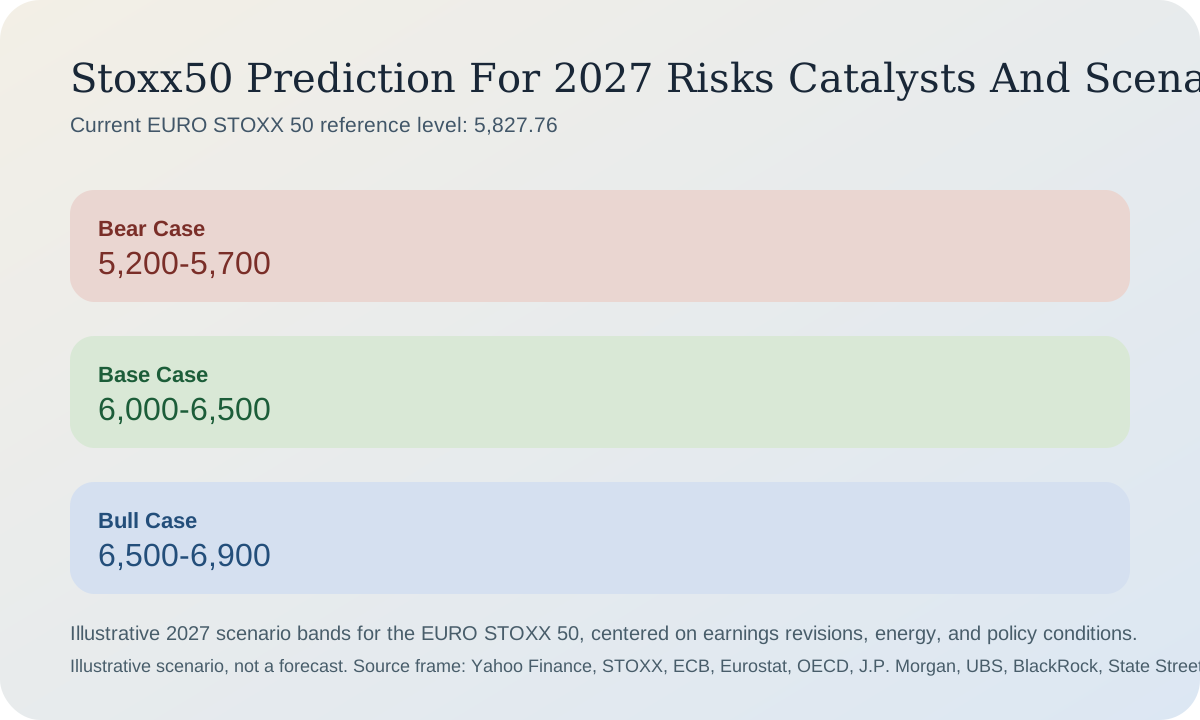
The 2027 bull case is roughly 6,500 to 6,900. It assumes broader earnings delivery, lower financing stress, and no major energy shock.
Bearish scenario
The bearish scenario is about 5,200 to 5,700. It depends on persistent inflation pressure, weaker external demand, and margin stress.
Base-case scenario
The base case is 6,000 to 6,500. This range assumes modest GDP growth, manageable inflation, and selective but real leadership from industrial, financial, and technology-linked names.
| Scenario | 2027 range | Conditions | Probability |
|---|---|---|---|
| Bull | 6,500-6,900 | Broad earnings growth, calmer energy prices, and constructive policy mix. | 30% |
| Base | 6,000-6,500 | Moderate growth and selective earnings resilience. | 45% |
| Bear | 5,200-5,700 | Sticky inflation, weaker demand, and renewed risk aversion. | 25% |
| Path | Probability | Comment |
|---|---|---|
| Rising | 40% | A bit more likely than not, but not overwhelming because some good news is already priced. |
| Falling | 25% | A real risk if energy and inflation re-accelerate together. |
| Sideways | 35% | Quite plausible if the macro mix stays mixed and leadership remains narrow. |
The range and probabilities are built from the live price anchor, the current 52-week band, macro projections, and the split between constructive and selective institutional views.
06. Investment Implications
Positioning should match time horizon and tolerance for macro swings
| Investor type | Prudent approach | Watchpoints |
|---|---|---|
| Investor already in profit | Consider partial trims into strength rather than full exits. | Whether earnings breadth actually improves. |
| Investor currently at a loss | Avoid revenge buying; wait for thesis confirmation. | Inflation trend and sector participation. |
| Investor with no position | Wait for pullbacks or scale in gradually. | ECB path and entry valuation. |
| Trader | Use stop-loss rules and avoid oversized macro bets. | Event risk around inflation and policy. |
| Long-term investor | View 2027 as one checkpoint, not the whole thesis. | Dividend durability and capital allocation. |
| Risk-hedging investor | Consider selective hedges if oil or FX volatility spikes. | Oil, euro, and VSTOXX regime. |
For investors who only want to hedge risk rather than express a directional equity view, the practical lesson is different. A cautious hedge-minded investor may prefer to watch oil, euro-dollar moves, and volatility pricing before acting, because those indicators often shift before the index itself confirms a new trend. That approach is especially useful when the evidence is mixed and the range between bull and bear outcomes remains meaningful.
Risks to watch: higher oil and gas prices, softer China demand, weaker U.S. growth, and disappointment in AI or industrial capex spending.
What could invalidate this forecast: a much stronger recovery would make the base case too cautious, while a full stagflation relapse would make even the bear case too mild.
Conclusion: the most credible 2027 STOXX50 prediction is for a market that can still grind higher, but only if the earnings story broadens. Without that, sideways trading or a policy-sensitive pullback remains plausible.
Disclaimer: This article is for informational purposes only and does not constitute investment advice.
07. FAQ
Frequently asked questions about the STOXX50 prediction for 2027
Is 2027 mainly an ECB story?
No. Policy matters, but the index still needs real earnings support from its largest sectors.
Why is the sideways probability so high?
Because today's macro backdrop is mixed enough that the market could pause even without a major bearish shock.
What would improve the odds of the bull case?
Broader EPS upgrades, calmer energy markets, and confirmation that capex spending remains healthy.
References
Sources
- Yahoo Finance chart API for ^STOXX50E, 10-year monthly history
- Yahoo Finance chart API for ^STOXX50E, recent daily closes
- STOXX index details page for the EURO STOXX 50
- STOXX Index Guide, April 2026
- iShares Core EURO STOXX 50 UCITS ETF fact sheet, March 2026
- State Street SPDR EURO STOXX 50 ETF benchmark page
- Eurostat flash GDP estimate for Q1 2026
- Eurostat euro area inflation release for April 2026
- ECB staff macroeconomic projections for the euro area, March 2026
- ECB Economic Bulletin Issue 3, 2026
- OECD Economic Outlook, euro area chapter
- Reuters market coverage on European shares and inflation worries, via Investing.com
- J.P. Morgan 2026 Market Outlook
- J.P. Morgan European Stocks Outlook
- UBS on Europe's stock markets
- UBS secular growth market note
- BlackRock investment outlook
- State Street FX commentary