01. Intro And Quick Answer
TCHEY's 2030 outlook depends on whether Tencent turns scale into durable AI-era monetization
Tencent enters the second half of the 2020s with a different mix than the one many U.S. investors remember from the 2021 peak. The company is still powered by gaming, but advertising, payments, cloud, mini programs, and AI tooling now matter more to the equity story. On May 15, 2026, the U.S. ADR reference closed at $58.69, while Tencent's Hong Kong line traded around HK$590.5 with a 52-week range of HK$316.8 to HK$614.0. Over a longer window, Tencent's price history has stretched from the mid-teens in 2016 to an all-time high near $89.03 in February 2021, which gives analysts a real historical corridor for thinking about 2030 rather than a blank screen (Stock Analysis TCEHY quote; CompaniesMarketCap Tencent price history; Tencent Investors).
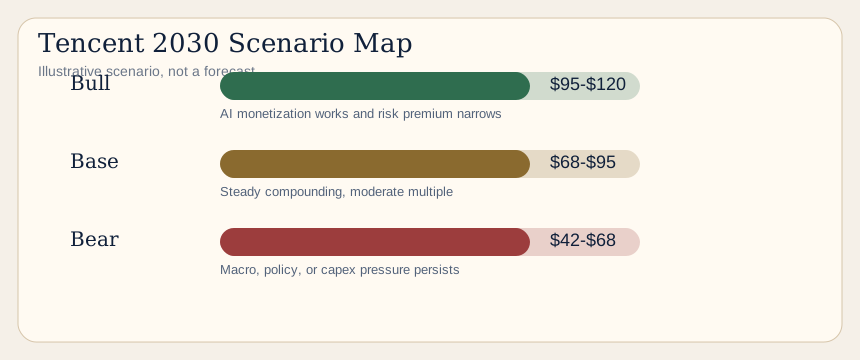
Quick answer: available data suggests Tencent still has a credible path to higher earnings power by 2030, but the upside case depends less on raw user growth and more on whether AI improves monetization in advertising, cloud, payments, and content distribution faster than it lifts costs. A reasonable 2030 base case is $68 to $95 for the ADR reference, with a bull case of $95 to $120 if Tencent keeps compounding games, ads, and AI-linked services, and a bear case of $42 to $68 if regulation, geopolitics, or poor AI returns compress multiples.
A note on ticker accuracy: the user keyword in these titles is TCHEY, but the actively quoted U.S. OTC ADR reference used by major quote services is TCEHY. The price and history discussion therefore use TCEHY market data (Stock Analysis TCEHY quote; CompaniesMarketCap Tencent price history).
02. Current Market Snapshot
The current setup mixes improving operations with unresolved macro and political discounts
Tencent's operating data has clearly improved. FY2025 revenue rose to RMB751.8 billion, up 14% year over year, and non-IFRS operating profit reached RMB280.7 billion, up 18%. In 1Q2026, Weixin and WeChat combined monthly active users reached 1.432 billion, domestic games revenue rose to RMB45.4 billion, international games revenue rose to RMB18.8 billion, and fintech plus business services climbed to RMB59.9 billion (Tencent FY2025 results; Tencent 1Q2026 results).
That looks strong on the surface, but the stock still trades with a persistent China discount. The market is trying to price three different variables at once: the durability of China's consumption and advertising recovery, the returns Tencent can earn from sharply higher AI investment, and the geopolitical overhang surrounding Chinese internet assets, cross-border chips, and the structure of ADR ownership (IMF China 2025 Article IV; World Bank China Economic Update; Reuters on Tencent AI investment plans).
Key takeaways:
- Tencent is no longer only a China gaming story; it is a platform business spanning games, ads, payments, cloud, content, and enterprise services.
- The evidence is mixed on how much AI should expand margins because better monetization and higher capex are arriving together.
- Global games market growth still matters because international games have become a more material earnings buffer than in earlier cycles (Newzoo Global Games Market Report 2025; Tencent FY2025 results).
- Investors should treat 2030 as a range-of-outcomes exercise, not a single-target exercise.
| Metric | Latest reading | Why it matters |
|---|---|---|
| ADR reference price | $58.69 on May 15, 2026 | Sets the base for all 2030 scenario math |
| Weixin/WeChat MAU | 1.432 billion | Shows Tencent still owns one of the world's largest consumer funnels |
| FY2025 revenue | RMB751.8 billion | Confirms Tencent reaccelerated after the post-crackdown slowdown |
| 1Q2026 capex | RMB31.9 billion | Signals AI and infrastructure spending are real, not rhetorical |
| 10-year trading corridor | Roughly mid-teens to $89.03 | Provides a grounded historical valuation range |
03. Historical Context And Drivers
What actually moves Tencent's valuation now
Historical data matters because Tencent's rerating and derating cycles have not been random. The 2016-2021 period rewarded investor belief in China's consumer internet flywheel, payments adoption, and gaming scale. The 2021-2022 derating reflected regulation, macro pressure, and distrust of Chinese platform governance. The 2024-2026 rebound has been powered by better core execution, buybacks, rising game resilience, and a renewed view that Tencent may be one of China's best-positioned incumbents for applied AI (Tencent 2024 Annual Report PDF; Tencent 2025 Annual Report PDF; Tencent FY2025 results).
Four drivers matter most through 2030. First, games remain the earnings anchor. Tencent's domestic titles remain unusually durable, while international revenue now has enough scale to reduce reliance on any single local policy cycle. Second, advertising can still grow because WeChat's search, video accounts, mini programs, and merchant ecosystem create monetizable inventory. Third, fintech and business services give Tencent exposure to digitization and payments volume even if pure social-media engagement matures. Fourth, AI may deepen moats by improving ad targeting, recommendation quality, customer service, cloud productivity tools, and game operations (Tencent 1Q2026 results; Tencent FY2025 results; Reuters on WeChat AI agent integration).
The pushback is obvious. More AI spending raises near-term capital intensity. Export controls still shape chip availability. Chinese growth is slowing structurally, with the IMF projecting 2026 GDP growth around 4.5% and the World Bank projecting around 4.4%. A slower macro backdrop means Tencent's multiple cannot detach completely from broader China risk (IMF China 2025 Article IV; World Bank China Economic Update).
| Driver | Bullish interpretation | Bearish interpretation |
|---|---|---|
| Gaming | Evergreen franchises plus global exposure support durable cash flow | Hit-driven business can disappoint if pipeline weakens |
| Advertising | AI can lift yield per impression across WeChat surfaces | Ads remain cyclical if consumption weakens |
| Fintech / business services | Payments and cloud give Tencent broader monetization legs | Regulation and lower enterprise spending can cap growth |
| AI | Improves relevance, retention, and cloud attach rates | Higher capex may outrun revenue for several years |
04. Institutional Views
Institutions are constructive on Tencent's operations, but few offer genuine 2030 precision
One of the most important research facts is that major institutions generally publish near-term or medium-term targets, not true 2030 price forecasts. That means investors need to distinguish between institutional signals and long-range scenario building. Recent coverage has leaned constructive because 1Q2026 operating trends held up, AI products are broadening, and capex is being funded by a highly cash-generative core business (CNBC Tencent Q1 2026 earnings; Reuters on Tencent AI investment plans; Tencent FY2025 results).
Still, analyst optimism is not uniform. Some sell-side commentary highlighted stronger AI positioning and raised targets, while other firms remained more neutral because AI spending can create a profitability air pocket before monetization becomes visible. Analysts also remain divided on how much of Tencent's discount is macro versus political versus structural. That distinction matters because a macro discount can narrow, while a legal or geopolitical discount may persist far longer.
| Source | What it adds | Limit for investors |
|---|---|---|
| Tencent FY2025 and 1Q2026 releases | Hard operating data on revenue, users, capex, and segment mix | Management tone is naturally optimistic |
| CNBC and Reuters market coverage | Shows how public markets interpreted the latest quarter | Mostly short-horizon and event-driven |
| IMF and World Bank China work | Frames macro growth, tariff, and consumption backdrop | Does not speak directly to Tencent valuation |
| Newzoo games data | Helps judge whether Tencent is outgrowing the underlying market | Industry data still requires company-level interpretation |
The scenario ranges below are author-built ranges rather than broker price targets. They are anchored to Tencent's current ADR reference price of $58.69 on May 15, 2026, the Hong Kong line's 52-week range of HK$316.8 to HK$614.0, Tencent's past-decade trading history from roughly the mid-teens to a peak near $89.03, reported revenue and profit growth, and a qualitative assessment of regulation, macro conditions, AI monetization, and capital intensity (Stock Analysis TCEHY quote; CompaniesMarketCap Tencent price history; Tencent Investors). The probability table separates three paths: rising, falling, and sideways. 'Sideways' means a result that does not decisively confirm either a major rerating or a major derating.
05. Scenarios And Positioning
Bull, bear, and base case ranges for 2030
| Scenario | 2030 ADR range | Conditions | Interpretation |
|---|---|---|---|
| Bull | $95 to $120 | AI lifts advertising yield, cloud monetization improves, gaming stays resilient, and the China discount narrows | This would require both earnings growth and a higher multiple |
| Base | $68 to $95 | Tencent compounds earnings steadily, but valuation remains below U.S. megacap peers | The most balanced range if execution stays solid but politics remain noisy |
| Bear | $42 to $68 | AI spending disappoints, macro stays weak, or regulation/geopolitics revive the risk discount | This is a derating scenario, not a collapse scenario |
| Path | Probability | Why |
|---|---|---|
| Probability of rising | 45% | Tencent has better operating momentum than it did in 2022-2023 |
| Probability of falling | 25% | China policy and capital-allocation risks are still material |
| Probability of moving sideways | 30% | A solid business can still deliver a flat stock if the discount rate stays high |
| Investor type | Prudent stance | What to watch next |
|---|---|---|
| Investor already in profit | Hold core, trim into sharp reratings, rebalance position size | AI capex discipline and ad monetization |
| Investor currently at a loss | Avoid panic selling into weakness; reassess thesis against 2030 range | Whether earnings growth is offsetting valuation discount |
| Investor with no position | Wait for pullbacks or build slowly with dollar-cost averaging | Entry price versus policy risk |
| Trader | Use stop-loss levels and avoid chasing headline spikes | Quarterly revenue mix and sentiment swings |
| Long-term investor | Accumulate only if comfortable with China and ADR structure risks | Sustained free cash flow and buybacks |
| Risk-hedging reader | Pair with broader global tech or defensive exposure | Macro and geopolitics rather than company-only factors |
06. Risks, Invalidation, And Conclusion
What could break the forecast
The main risks are not abstract. China could tighten platform or gaming oversight again. U.S.-China tensions could worsen around chips, cloud, or data, which could prolong Tencent's valuation discount. AI spending could remain elevated without producing visible margin leverage. And Tencent's ecosystem, while deep, is mature enough that execution missteps matter more now than they did in the hyper-growth era (CNBC on China draft gaming rules; Reuters on Tencent AI investment plans; US security review risk coverage).
What would invalidate the 2030 base case? A clear deterioration in domestic games, a sustained failure to monetize AI-linked surfaces, or a return to a 2021-style regulatory shock would all weaken it. On the other hand, the bear case would be invalidated if Tencent keeps posting double-digit profit growth while AI improves ad and cloud productivity at scale. The evidence is mixed today, but not random: Tencent's current operating trend is better than its headline political risk premium suggests.
On balance, Tencent looks more like a long-duration compounding platform than a broken China proxy. That does not make it low-risk. It simply means the 2030 debate should be framed around scenario quality, not sensational one-number predictions.
Disclaimer: This article is for research and educational purposes only. It is not individualized investment advice, and all scenario ranges are conditional estimates rather than promises of future performance.
07. FAQ
Frequently asked questions
Is TCHEY the correct ticker for Tencent?
The commonly quoted U.S. OTC ADR ticker is TCEHY. This article keeps TCHEY in the title for search intent, but the pricing discussion references the actively quoted ADR data (Stock Analysis TCEHY quote).
What is the biggest reason Tencent could beat 2030 expectations?
The cleanest upside driver would be a combination of steady game cash flow and AI-driven monetization across ads, cloud, and merchant tools, which would lift both earnings and confidence in the quality of those earnings.
What is the biggest downside risk?
Policy and geopolitical risk remain the hardest variables to model. Even strong financial execution may not fully offset a renewed external discount.
Does the past decade support a higher long-term price?
Historical data supports the case for large swings in both directions. Tencent has already shown it can compound into the $80-plus range, but it has also shown that macro and regulation can cut multiples sharply.
References
Sources
- Tencent Investors
- Tencent 1Q2026 results
- Tencent FY2025 results
- Tencent 1Q2025 results
- Tencent 2025 Annual Report PDF
- Tencent 2024 Annual Report PDF
- Stock Analysis TCEHY quote
- CompaniesMarketCap Tencent price history
- IMF China 2025 Article IV
- World Bank China Economic Update
- Newzoo Global Games Market Report 2025
- CNBC Tencent Q1 2026 earnings
- CNBC on China draft gaming rules
- Reuters on Tencent AI investment plans
- US security review risk coverage