01. Shorter-Term Thesis
The 2027 setup is about catalysts, not a decade-long narrative
A 2027 Tencent forecast should focus on what can change over the next six to eighteen months. The market already knows Tencent owns a giant ecosystem. What it is still trying to price is whether the company's current momentum in games, ads, and AI can push earnings revisions higher fast enough to rerate the stock from today's $58.69 ADR reference (Stock Analysis TCEHY quote).
The best way to think about 2027 is through catalysts. Tencent does not need every business line to accelerate at once. It needs enough visible wins to convince investors that FY2025 was not a one-off and that 1Q2026 was not simply an easy comparison quarter.
02. Current Snapshot
Tencent's starting point into 2027 is stronger than in the last two reporting cycles
In FY2025, total revenue reached RMB751.8 billion and non-IFRS operating profit reached RMB280.7 billion. In 1Q2026, domestic games grew 6% year over year, international games grew 13%, and fintech plus business services rose 9%. That is a healthier setup than investors saw during the post-crackdown reset period (Tencent FY2025 results; Tencent 1Q2026 results).
The near-term market debate is whether these improvements can continue while Tencent ramps AI spending. CNBC's coverage of the latest quarter underscored that Tencent still benefits from robust demand for games and advertising while also committing more resources to new AI initiatives. That combination can be bullish, but only if the market believes the spending is generating future monetization rather than just chasing peers (CNBC Tencent Q1 2026 earnings; Reuters on Tencent AI investment plans).
The historical context also supports a catalyst framework. Tencent's decade-long trading history shows that the stock can reprice quickly when investors believe operating momentum is broadening, and it can derate just as quickly when the market sees policy or execution risk. A 2027 call therefore has to respect both the upside optionality and the speed with which sentiment can change (CompaniesMarketCap Tencent price history; Stock Analysis TCEHY history).
| Latest signal | 2027 relevance | Read-through |
|---|---|---|
| WeChat MAU at 1.432B | Distribution advantage | Huge surface for search, ads, mini programs, and agents |
| Domestic games +6% in 1Q2026 | Core cash flow resilience | Keeps funding buybacks and AI investment |
| International games +13% in 1Q2026 | Diversification | Reduces dependence on one regulatory market |
| Capex at RMB31.9B in 1Q2026 | Execution test | Management is accelerating infrastructure spend |
03. Key Catalysts
Five catalysts could drive the 2027 move
1. A stronger evergreen game slate. Tencent's 2025 results showed recent titles such as Delta Force contributing alongside long-lived franchises. If that mix continues, the market can get more comfortable that gaming is not over-earned (Tencent FY2025 results).
2. Better monetization of WeChat surfaces. Video Accounts, search, and mini program commerce all raise advertising inventory quality. AI-enhanced ad matching is a direct earnings catalyst if it keeps increasing yield (Tencent 1Q2026 results).
3. Visible returns from AI spending. The market will likely reward evidence of productivity and monetization more than model benchmarks. Investors should watch whether business services growth stays strong enough to absorb higher infrastructure spending (Reuters on Tencent AI investment plans; Reuters on WeChat AI agent integration).
4. A steadier China policy backdrop. Tencent does not need perfect regulation. It just needs fewer surprises than in 2021-2023. The memory of the 2023 draft gaming rules shock still matters for sentiment (CNBC on China draft gaming rules).
5. Ongoing capital return. Buybacks and a calmer multiple framework can turn even moderate earnings growth into good per-share performance.
There is also a sequencing issue. For 2027, the market probably wants to see proof in the order of games first, ad monetization second, and AI payoff third. That order matters because Tencent's games and advertising businesses can finance the AI buildout. If AI is asked to justify itself before those core businesses keep performing, the stock may struggle even if management is executing reasonably well.
| Catalyst | Bullish effect | Constraint |
|---|---|---|
| Game pipeline | Raises confidence in durable VAS growth | Title timing can move revenue recognition |
| Ad yield | Expands margins without massive new user growth | Consumption softness can slow budgets |
| AI commercialization | Supports rerating into 2027 | Payback period may be longer than bulls expect |
| Policy stability | Reduces valuation discount | Unexpected drafts or enforcement actions can shock sentiment |
| Buybacks | Helps per-share compounding | Cannot fully offset a macro derating |
04. Analyst Context
Near-term institutional commentary is more useful here than in a 2035 article
Unlike a 2035 forecast, a 2027 article can use near-term institutional commentary more directly. Recent coverage emphasized that Tencent's quarter was solid, that AI is becoming a larger line item, and that games and advertising continue to do most of the near-term heavy lifting (CNBC Tencent Q1 2026 earnings; Reuters on Tencent AI investment plans).
That does not remove uncertainty. Analysts remain divided on how much of Tencent's upside should come from earnings growth versus multiple expansion. The evidence is mixed because 2027 is close enough for execution to matter a lot, but still far enough out that policy surprises can materially change the path.
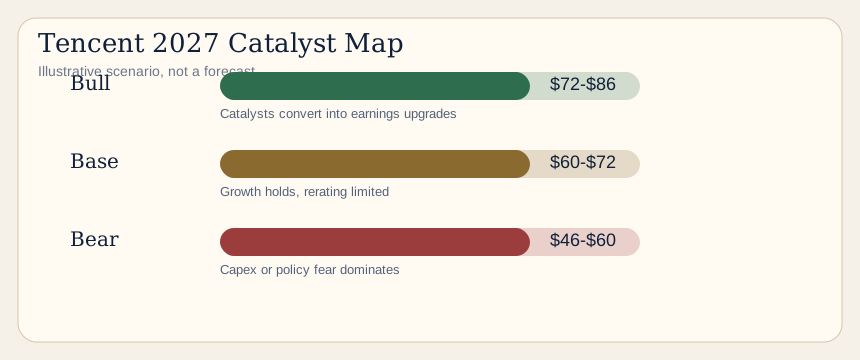
The scenario ranges below are author-built ranges rather than broker price targets. They are anchored to Tencent's current ADR reference price of $58.69 on May 15, 2026, the Hong Kong line's 52-week range of HK$316.8 to HK$614.0, Tencent's past-decade trading history from roughly the mid-teens to a peak near $89.03, reported revenue and profit growth, and a qualitative assessment of regulation, macro conditions, AI monetization, and capital intensity (Stock Analysis TCEHY quote; CompaniesMarketCap Tencent price history; Tencent Investors). The probability table separates three paths: rising, falling, and sideways. 'Sideways' means a result that does not decisively confirm either a major rerating or a major derating.
05. 2027 Scenarios
Scenario ranges for the next major waypoint
| Scenario | 2027 ADR range | What gets Tencent there |
|---|---|---|
| Bull | $72 to $86 | Earnings upgrades from games, ad yield, and early AI monetization |
| Base | $60 to $72 | Steady growth but no major valuation rerating |
| Bear | $46 to $60 | Capex pressure, slower ads, or a renewed policy discount |
| Path | Probability | Interpretation |
|---|---|---|
| Probability of rising | 50% | There are more identifiable upside catalysts than in 2023-2024 |
| Probability of falling | 20% | Downside still exists, but the business has better momentum |
| Probability of moving sideways | 30% | The market may wait for more proof on AI returns |
| Investor type | Prudent 2027 stance | Tactical note |
|---|---|---|
| Investor already in profit | Hold with partial trims into sharp rallies | 2027 upside is real but headline-sensitive |
| Investor currently at a loss | Reassess thesis against segment data, not past peak nostalgia | Do not average down blindly |
| Investor with no position | Wait for pullbacks or build gradually | The 2027 setup is catalyst-rich but not risk-free |
| Trader | Trade around earnings and policy headlines | Use stop-losses because sentiment can flip quickly |
| Long-term investor | Use 2027 as a checkpoint, not the end of the thesis | Focus on per-share value creation |
| Risk-hedging reader | Avoid chasing, keep exposure sized modestly | Near-term volatility is likely to stay elevated |
06. Risks And Invalidation
What could invalidate the 2027 catalyst story
The forecast weakens if Tencent cannot show visible returns from higher AI capex by the time investors begin modeling 2027 earnings in earnest. It also weakens if domestic ad demand disappoints or if new gaming policy headlines trigger another rerating lower. Investors should distinguish a normal correction from a true bear market in the name. A correction could happen even in a valid thesis; a bear market would require evidence that profits or monetization quality are deteriorating.
The upside case is invalidated if catalysts stay hypothetical. The downside case is invalidated if Tencent keeps compounding revenue and profit while the market gains confidence that AI is strengthening, not weakening, returns on capital.
Practically, that means investors should watch three data points each quarter: whether domestic games stay resilient after major title launches normalize, whether marketing services keep showing AI-assisted pricing strength, and whether business-services growth remains good enough to justify heavier infrastructure spending. If those three readings stay constructive, the 2027 base case likely shifts upward. If two out of three wobble at once, the market may treat Tencent as a value trap rather than a catalyst story.
That is also why 2027 should be treated as a checkpoint rather than a final verdict. If Tencent reaches 2027 with stronger per-share earnings, improving monetization on WeChat surfaces, and a calmer policy backdrop, investors can justify a higher long-term range from there. If it reaches 2027 with only headline AI enthusiasm and no stronger business quality, the prudent stance becomes much more defensive.
For that reason, a cautious investor does not need to predict every catalyst perfectly. It is enough to monitor whether the catalyst stack is getting better or worse. Direction of evidence often matters more than precision of target price in a stock as headline-sensitive as Tencent.
Disclaimer: This article is for research and educational purposes only. It is not individualized investment advice, and all scenario ranges are conditional estimates rather than promises of future performance.
07. FAQ
Frequently asked questions
Why focus so much on catalysts for 2027?
Because the 2027 horizon is short enough that identifiable operating events matter more than distant structural narratives.
Is Tencent still the gaming king?
It remains one of the most powerful gaming operators globally, but the bigger investment question is how gaming cash flow supports the rest of the ecosystem.
What catalyst matters most?
A combination of durable game performance and stronger ad monetization on WeChat surfaces likely matters most for the next rerating.
What would make the stock lag even if earnings grow?
A persistent China discount, geopolitical noise, or investor skepticism toward AI payback could keep the multiple from expanding.
References
Sources
- Tencent Investors
- Tencent 1Q2026 results
- Tencent FY2025 results
- Tencent 1Q2025 results
- Tencent 2025 Annual Report PDF
- Stock Analysis TCEHY quote
- CompaniesMarketCap Tencent price history
- Newzoo Global Games Market Report 2025
- CNBC Tencent Q1 2026 earnings
- CNBC on China draft gaming rules
- Reuters on Tencent AI investment plans
- Reuters on WeChat AI agent integration
- IMF China 2025 Article IV
- World Bank China Economic Update