01. Long-Range Setup
A 2035 Tencent forecast has to separate company quality from China's policy and macro cycle
Forecasting Tencent to 2035 is not about predicting a single earnings print ten years out. It is about asking whether Tencent's ecosystem can remain economically central enough that earnings compound despite slower user growth, higher AI capex, and a structurally lower China multiple than U.S. peers. Tencent's core platforms still reach more than 1.4 billion monthly users, FY2025 revenue reached RMB751.8 billion, and 1Q2026 showed the company still growing games, ads, and business services at the same time (Tencent 1Q2026 results; Tencent FY2025 results).
The critical 2035 question is whether this is merely a cyclical rebound or the early shape of a new capital cycle. If Tencent proves that AI raises monetization quality across WeChat, search, mini programs, advertising, cloud, and content operations, the 2035 bull case becomes plausible. If AI mostly raises cost while geopolitics keep the valuation ceiling low, the long-range case weakens quickly.
02. Historical Data And Current Conditions
The base from which 2035 begins is far stronger than headline sentiment implies
Historical data shows Tencent has already survived multiple regime changes: smartphone adoption, mobile payments, short-video competition, Beijing's platform crackdown, the gaming freeze, and the first wave of generative AI competition. The stock's path from the mid-teens to nearly $89 and then back toward the high $50s makes one lesson obvious: Tencent is volatile, but volatility and structural impairment are not the same thing (CompaniesMarketCap Tencent price history; Stock Analysis TCEHY quote).
Current market conditions are neither euphoric nor distressed. Tencent's ADR reference price of $58.69 is well below the 2021 peak but far above the 2022 trough. FY2025 revenue growth of 14%, non-IFRS operating profit growth of 18%, and 1Q2026 capex of nearly RMB31.9 billion suggest management is funding a major infrastructure pivot from a position of strength rather than defensiveness (Tencent FY2025 results; Tencent 1Q2026 results).
At the same time, China's macro base rate is slower than in Tencent's hyper-growth years. The IMF's 2026 projection of roughly 4.5% growth and the World Bank's 4.4% estimate imply a less forgiving domestic backdrop. Tencent can still grow faster than the economy, but the margin for error is lower than it was in the 2010s (IMF China 2025 Article IV; World Bank China Economic Update).
| Time frame | What history suggests | 2035 implication |
|---|---|---|
| 2016-2020 | Tencent could scale rapidly when platform monetization deepened | The ecosystem can support long compounding arcs |
| 2021-2022 | Policy shocks can erase premium multiples fast | Long-range upside always needs a discount-rate caveat |
| 2024-2026 | Operations reaccelerated across games, ads, and services | The company still has strategic flexibility entering the AI era |
03. Key Drivers
The 2035 case is built on five long-duration drivers
1. WeChat as infrastructure, not just social media. The more Tencent turns WeChat into a transaction, search, merchant, and agent layer, the harder it becomes to substitute. That matters for long-term advertising yield and merchant monetization (Tencent 1Q2026 results; Reuters on WeChat AI agent integration).
2. Games as capital engine. Tencent's global games business gives it a rare ability to self-fund new bets. Newzoo's market work implies the broader market is still expanding, and Tencent's own 2025 results showed games revenue outgrowing the global industry pace (Newzoo Global Games Market Report 2025; Tencent FY2025 results).
3. Fintech and enterprise adjacency. Commercial payments, wealth management, and business services can keep Tencent attached to China's formal digitization trend even if pure entertainment growth cools (Tencent 1Q2026 results; Tencent FY2025 results).
4. AI as a productivity layer. The strongest long-term Tencent AI thesis is not that it wins a foundation-model beauty contest. It is that Tencent inserts AI into places where it already controls traffic and workflow.
5. Capital return. Buybacks and disciplined capital allocation matter more in a mature phase. They can cushion long-range returns if top-line growth normalizes.
| Driver | Bull-case effect by 2035 | Bear-case risk by 2035 |
|---|---|---|
| WeChat ecosystem | Higher monetization without needing huge user growth | Engagement matures faster than commerce tools scale |
| Global games | Cross-border diversification reduces single-market risk | Content pipeline weakens or regulation bites again |
| Fintech and cloud | Adds recurring service-like earnings | Lower margins or more oversight cap the upside |
| AI | Raises relevance and lowers friction across products | Capex-heavy with delayed monetization |
| Capital allocation | Supports per-share compounding | Large spending cycles dilute near-term returns |
04. Analyst And Institutional Context
There is no clean institutional 2035 consensus, so scenario logic matters more than point targets
Institutional research around Tencent is much better at describing the next one to eight quarters than the next ten years. Recent commentary highlighted resilient quarterly growth, stronger AI positioning, and a willingness to invest even under chip constraints. That is helpful, but it is not the same as a defensible 2035 target (CNBC Tencent Q1 2026 earnings; Reuters on Tencent AI investment plans).
For a 2035 forecast, the most useful institutional inputs are the official company disclosures, macro assumptions from the IMF and World Bank, and industry evidence from Newzoo. That is enough to frame three coherent scenarios. It is not enough to justify false precision.
The scenario ranges below are author-built ranges rather than broker price targets. They are anchored to Tencent's current ADR reference price of $58.69 on May 15, 2026, the Hong Kong line's 52-week range of HK$316.8 to HK$614.0, Tencent's past-decade trading history from roughly the mid-teens to a peak near $89.03, reported revenue and profit growth, and a qualitative assessment of regulation, macro conditions, AI monetization, and capital intensity (Stock Analysis TCEHY quote; CompaniesMarketCap Tencent price history; Tencent Investors). The probability table separates three paths: rising, falling, and sideways. 'Sideways' means a result that does not decisively confirm either a major rerating or a major derating.
05. Bull, Base, And Bear Case
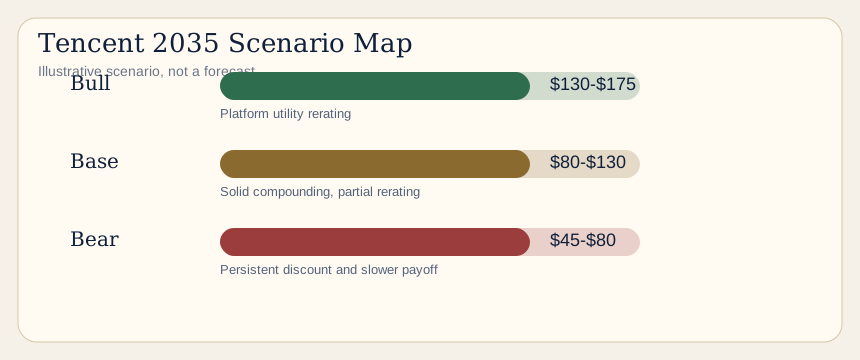
2035 scenario ranges
| Scenario | 2035 ADR range | Conditions required | Narrative |
|---|---|---|---|
| Bull | $130 to $175 | Tencent monetizes AI across ads, cloud, search, and merchant tooling; games remain globally strong; the China discount narrows | Tencent becomes viewed as a durable platform utility rather than a cyclical China internet stock |
| Base | $80 to $130 | Earnings compound but the discount rate stays elevated; AI helps but does not transform the model overnight | Steady value creation, moderate multiple expansion |
| Bear | $45 to $80 | Weak AI payoff, regulatory setbacks, or prolonged geopolitical friction | Tencent remains profitable but cannot command a richer long-term multiple |
| Path | Probability | Rationale |
|---|---|---|
| Probability of rising | 50% | Tencent still has multiple engines and unusually strong distribution assets |
| Probability of falling | 20% | A structurally lower valuation is possible, but total business erosion looks less likely |
| Probability of moving sideways | 30% | Long periods of earnings growth can still be offset by valuation drag |
| Reader profile | Prudent 2035 approach | Why |
|---|---|---|
| Investor already in profit | Hold a core position, trim excess concentration on euphoric rallies | Long-range upside exists, but decade forecasts always carry regime risk |
| Investor currently at a loss | Re-underwrite the thesis against business quality, not just the old peak price | Anchoring to 2021 alone is not analysis |
| Investor with no position | Scale in gradually and avoid all-at-once entries | China sentiment can change faster than fundamentals |
| Trader | Treat 2035 ranges as background only; trade around quarterly catalysts | Long-range scenarios do not define near-term risk |
| Long-term investor | Prefer disciplined accumulation and periodic rebalancing | Tencent can compound, but not in a straight line |
| Risk-hedging reader | Use position sizing and diversification rather than hero calls | The biggest risks are external and difficult to forecast |
06. Risks And Invalidation
What could make the 2035 forecast wrong
The bull case fails if Tencent cannot turn scale into higher quality monetization. It also fails if geopolitical restrictions make advanced AI infrastructure materially harder to source or deploy over several cycles. The bear case fails if Tencent proves that AI spending is economically rational and keeps translating into stronger ad pricing, better content distribution, and higher enterprise attachment (Reuters on Tencent AI investment plans; Reuters on WeChat AI agent integration).
The most important discipline for 2035 is to separate correction from structural break. A 20% drawdown would not by itself invalidate Tencent's long-term case. A prolonged loss of regulatory room, game leadership, or WeChat monetization depth would.
My conclusion is that Tencent remains one of the few Chinese internet names with a credible 2035 compounding case, but the evidence is mixed on whether the market will reward that quality with a peer-like multiple. That tension is exactly why the base case sits between optimism and caution.
Disclaimer: This article is for research and educational purposes only. It is not individualized investment advice, and all scenario ranges are conditional estimates rather than promises of future performance.
07. FAQ
Frequently asked questions
Why does a 2035 forecast need such a wide range?
Because the range has to absorb regulation, geopolitics, AI economics, and macro growth. A narrow range would look confident but be less honest.
Is Tencent still primarily a gaming stock?
No. Gaming is still central, but WeChat commerce, marketing services, fintech, cloud, and AI integration now matter almost as much for valuation quality.
Could Tencent reach its old peak again before 2035?
Yes, but recapturing an old price is not the same thing as sustaining a long-term rerating. The market would want both earnings growth and lower perceived policy risk.
What should investors monitor first?
Quarterly segment mix, capex efficiency, and any evidence that AI is improving monetization rather than simply raising costs.
References
Sources
- Tencent Investors
- Tencent 1Q2026 results
- Tencent FY2025 results
- Tencent 2025 Annual Report PDF
- Tencent 2024 Annual Report PDF
- Stock Analysis TCEHY quote
- CompaniesMarketCap Tencent price history
- IMF China 2025 Article IV
- World Bank China Economic Update
- Newzoo Global Games Market Report 2025
- CNBC Tencent Q1 2026 earnings
- Reuters on Tencent AI investment plans
- Reuters on WeChat AI agent integration
- US security review risk coverage