01. Quick Answer
The AEX bull case rests on a rare European mix of structural growth and defensive quality
The AEX closed at 1,010.44 on 2026-05-15, up from 435.88 at the start of its 10-year Yahoo Finance monthly series on 2016-06-01, for a price-only CAGR of about 8.77% (Yahoo Finance 10-year history; recent daily closes). The core bullish argument is that Amsterdam still offers one of Europe’s most attractive combinations of structural technology leadership and non-cyclical quality.
Available data suggests a credible upside thesis can be built from ASML, RELX, Wolters Kluwer, Adyen, and the Dutch Semiconductor Vision 2035. That does not make the bull case certain, but it makes it much more than a quality-at-any-price slogan.
| Point | Why it matters |
|---|---|
| The bull case is now an earnings-mix story | The AEX has already rerated enough that future upside needs more than simple multiple expansion. |
| ASML remains the clearest structural asset | Europe has very few listed technology franchises of this strategic quality. |
| Defensive compounders matter almost as much | RELX and Wolters Kluwer make the bull case more resilient than a pure chip-cycle thesis. |
| Policy support is a real tailwind | The Dutch semiconductor strategy strengthens the ecosystem argument around the index. |
02. Historical Context
A bull case is more credible when it starts from what already worked and what can still broaden
The AEX closed at 1,010.44 on 2026-05-15, up from 435.88 at the start of its 10-year Yahoo Finance monthly series on 2016-06-01, for a price-only CAGR of about 8.77% (Yahoo Finance 10-year history; recent daily closes). The strongest part of the bullish argument is not the backward-looking price chart alone. It is the mix of businesses that produced it.
Recent years were dominated by technology and digitalization. But Amsterdam’s support base is broader than many bulls acknowledge. RELX and Wolters Kluwer provide recurring-revenue quality. Adyen offers scalable payments exposure. Prosus adds platform optionality. That breadth matters because it allows the index to keep moving higher even if no single story is perfectly linear.
The bullish case therefore depends on breadth and execution. If several sectors work together, the market can absorb some normalization in any one leadership group.
| Driver | Evidence | Bullish implication |
|---|---|---|
| Semiconductor leadership | ASML remains central to EUV and AI-infrastructure capex | Supports a durable growth premium. |
| Recurring-revenue quality | RELX and Wolters continue to show resilience | Stabilizes the market through slowdowns. |
| Digital commerce and payments | Adyen and Prosus still provide upside optionality | Broadens the growth stack beyond one name. |
| Policy support | Dutch Semiconductor Vision 2035 confirms strategic national importance | Improves long-run ecosystem confidence. |
| Area | Why it helps | Main caveat |
|---|---|---|
| Semiconductors | Rare global technology leadership | Concentration and geopolitical sensitivity remain high. |
| Information services | High margins and recurring revenue | Premium valuations can still compress. |
| Payments and internet | Long runway if execution stays strong | Higher volatility and sentiment risk. |
| Energy and staples | Adds ballast and cash flow | Usually does not drive explosive upside on its own. |
03. Main Drivers
Six forces explain why the AEX could still surge higher from here
1. AI and chip-capex remain powerful secular supports. ASML is the obvious driver, but suppliers, sentiment, and European capital allocation all benefit when the chip cycle remains healthy.
2. Dutch policy is aligned with semiconductor relevance. The Semiconductor Vision 2035 matters because it reinforces long-run industrial support.
3. Information businesses can keep compounding. RELX and Wolters Kluwer are valuable precisely because they can grow even when the broader economy is only modestly expanding.
4. Fintech still offers optional upside. Adyen can still surprise if global digital commerce remains healthy and margins improve.
5. Prosus adds a second digital optionality layer. Its large platform exposure can help if global internet valuations improve.
6. The Dutch macro base is stable enough. DNB still points to resilience, which helps prevent the bull case from relying on fragile domestic conditions.
04. Institutional Forecasts and Analyst Views
The institutional macro backdrop is moderate, which means the bull case must come from execution and structural leadership
The OECD, IMF, and DNB do not project a boom. That is actually useful for the bull case because it forces discipline. If the AEX still outperforms in that environment, listed-company quality is doing the heavy lifting.
Analysts remain divided because the evidence is mixed. The bulls are right that the Netherlands has more publicly listed structural winners than many European peers. The skeptics are right that concentration and valuation remain real constraints. A serious bullish framework has to acknowledge both.
The practical implication is that the AEX does not need explosive macro growth to outperform. It needs enough earnings breadth that investors keep treating Amsterdam as a premium-quality market rather than as a narrow and over-owned semiconductor expression. If that perception holds, upside can remain surprisingly durable. If it does not, the bull case quickly starts looking like an expensive concentration trade instead for many investors over time in practice. That distinction matters greatly today.
| Source | Positive signal | Why it matters |
|---|---|---|
| ASML | AI-infrastructure and lithography demand remain central | Supports the unique technology premium in the index. |
| Semiconductor Vision 2035 | National strategy aligns with ecosystem importance | Adds policy reinforcement to the long-run bull case. |
| RELX and Wolters Kluwer | Recurring quality remains intact | Helps the market compound beyond a pure chip narrative. |
| Adyen and Prosus | Digital optionality remains alive | Creates upside surprise potential if global sentiment improves. |
05. Scenarios, Risks, and Invalidation
The bull case is credible, but it still needs a clear answer to the main bearish objections
Bullish scenario
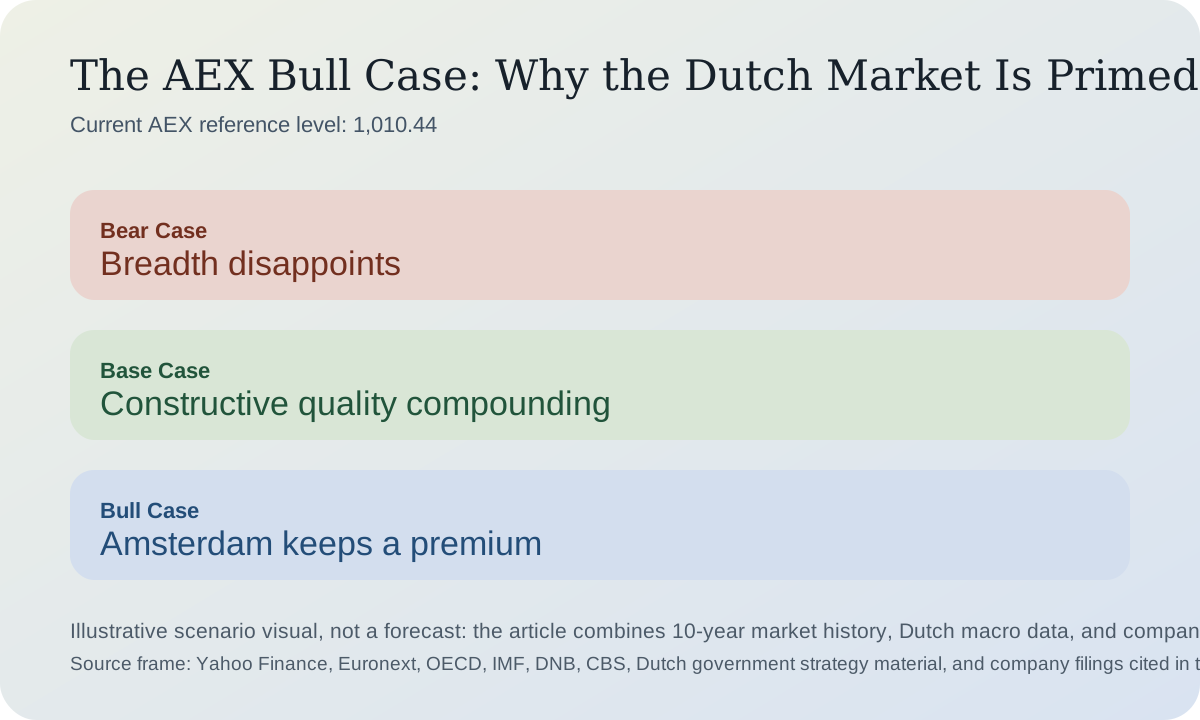
The core bull case is 1,350 to 1,500 by 2030. That path requires durable semiconductor demand, premium but justified valuations for quality businesses, and enough breadth that the market does not rely on one name alone.
Base-case scenario
The base case is 1,180 to 1,320. This remains constructive, but it assumes the upside arrives more slowly and with more valuation pauses.
Bearish counter-scenario
The bull thesis weakens materially if lower growth, export friction, or quality de-rating hit several of the largest constituents at once.
Risks to watch
Watch chip-capex guidance, digital-payments growth, European rate expectations, internet valuations, and whether defensive compounders keep earning their premium.
What could invalidate the bull case
The bullish view would be wrong if the AEX remains far more dependent on a narrow semiconductor story than it appears today. It would also fail if premium quality names stop justifying their valuations at the same time growth moderates.
Conclusion
The AEX bull case is not about blind faith in expensive Dutch equities. It is about a market that still owns some of Europe’s strongest structural assets and can compound further if breadth and execution remain healthy.
Disclaimer: This article is for research and informational purposes only. Bull cases are conditional scenarios, not promises of future returns.
| Scenario | Range | Conditions | Probability |
|---|---|---|---|
| Bull | 1,350-1,500 | Broad quality leadership and sustained semiconductor demand | 30% |
| Base | 1,180-1,320 | Constructive compounding with valuation discipline | 45% |
| Bear | 950-1,050 | Concentration and multiple pressure overpower the quality case | 25% |
| Path | Estimated probability | Comment |
|---|---|---|
| Rising | 55% | The index still has multiple credible long-duration earnings engines. |
| Falling | 20% | Downside remains real, but not dominant if semiconductor and defensive quality both hold. |
| Sideways | 25% | Possible if strong earnings are offset by a valuation plateau. |
06. Investor Positioning
Even a bull case requires prudent positioning
| Investor type | Cautious approach | What to watch |
|---|---|---|
| Investor already in profit | Let quality winners run selectively, but trim if the position has become too concentrated. | The best bull case still fails if sizing discipline disappears. |
| Investor currently at a loss | Reassess whether the loss comes from timing or from a broken thesis about Dutch quality. | Use the bull case only if the core drivers remain intact. |
| Investor with no position | Stage entries and avoid chasing breakouts after strong runs. | The bull case is better pursued through patience than fear of missing out. |
| Trader | Trade momentum, but respect that the AEX is still headline-sensitive. | Export controls and ASML news can reverse short-term setups quickly. |
| Long-term investor | Favor diversified exposure and reinvestment over all-in directional calls. | The bull case works best over time, not in a single quarter. |
| Risk-hedging investor | Pair upside exposure with hedges if technology concentration is unacceptable. | This is still a concentrated index, not a low-volatility utility portfolio. |
07. FAQ
Frequently asked questions about the AEX outlook
What makes the AEX bull case stronger than many European peers?
It combines a genuine semiconductor leader with recurring-revenue information businesses and global consumer franchises.
Does the bull case require fast Dutch GDP growth?
No. It mainly requires stable macro conditions and strong execution by the largest listed companies.
What is the main risk to the bullish thesis?
That the market is still too dependent on a narrow group of expensive winners and that breadth does not improve enough.
References
Sources
- Yahoo Finance chart API for ^AEX, 10-year monthly history
- Yahoo Finance chart API for ^AEX, recent daily closes
- Euronext AEX index factsheet
- Euronext Amsterdam market page
- OECD economic snapshot for the Netherlands
- OECD Economic Survey of the Netherlands 2025
- IMF 2025 Article IV consultation for the Netherlands
- De Nederlandsche Bank economic outlook, March 2026
- Statistics Netherlands consumer prices archive
- Dutch government Semiconductor Vision 2035
- Dutch government Generative AI vision
- Dutch Authority for the Digital Infrastructure AI supervision update
- ASML Q1 2026 results
- Adyen Q1 2026 business update
- ING Q1 2026 results
- ABN AMRO Q1 2026 results
- RELX trading update 2026
- Wolters Kluwer 2026 trading update
- Shell first quarter 2026 results
- Philips Q1 2026 results
- Prosus annual results 2026