01. Quick Answer
The strongest ALV bull case is that Allianz keeps turning fortress economics into per-share compounding
The cleanest Allianz bull case is not flashy. It is the argument that the company remains a financial fortress at a time when many investors still underestimate how powerful that can be. A strong Solvency II ratio, major ratings support, diversified earnings, and an active buyback program give Allianz a combination of resilience and per-share compounding that many financials cannot match (Allianz 1Q 2026; ratings profile).
| Bullish point | Why bulls care |
|---|---|
| Balance-sheet strength is real | A fortress capital position reduces the chance that a normal industry setback becomes a permanent impairment. |
| Capital return is a feature, not a marketing line | Buybacks and dividends materially raise the per-share compounding case. |
| Diversification matters | Insurance, life and health, and asset management together create multiple engines of value. |
| The bull case still needs discipline | Even strong insurers can be overpaid for if investors ignore valuation and cyclical risk. |
02. Historical Context
The last decade supports the argument that quality and capital discipline can compound in Allianz
The last decade supports the fortress argument. ALV.DE rose from about €127.80 in May 2016 to roughly €374.50 in May 2026, a price-only CAGR of around 11.4% (Yahoo Finance history). That did not happen because Allianz became a speculative growth story. It happened because the market increasingly trusted the group's underwriting quality, capital strength, and payout discipline across very different macro environments.
| Metric | Latest reading | Bull-case implication |
|---|---|---|
| 1Q 2026 operating profit | €4.5 billion | Shows the earnings engine remains healthy. |
| 2025 operating profit | €17.4 billion | Record profitability gives the bull case hard evidence, not just a narrative. |
| Solvency II ratio | 221% | A central reason Allianz can look like a fortress rather than a fragile cyclical financial. |
| Capital return policy | Buybacks plus dividends with a 75% payout target | Per-share compounding remains a major pillar of the upside case. |
Historical context also shows why bulls should stay specific. Allianz is stronger because it combines an insurer's float-like economics with fee-based asset-management earnings and a conservative capital culture. The bullish case is not that every quarter will be clean. It is that the group's structure absorbs shocks better than many peers can.
That distinction is crucial. A genuine fortress stock is not one that never reports a difficult quarter. It is one that can absorb difficult quarters without losing strategic flexibility. Allianz's current capital position, dividend culture, and diversified earnings mix are what keep that description credible.
03. Main Drivers
Five factors explain why Allianz still has a credible bull case
1. Capital strength remains the first reason bulls stay involved
A 221% Solvency II ratio gives management strategic freedom. It lets Allianz think about growth, dividends, and buybacks from a position of choice rather than necessity.
2. The payout framework turns decent earnings growth into better per-share growth
At CMD 2024, Allianz reaffirmed a 75% payout target and an explicit commitment to capital efficiency (CMD 2024). That matters because buybacks can keep lifting per-share outcomes even if top-line growth stays moderate.
3. Higher reinvestment yields still support the model
Insurers have spent years waiting for a more normal investment environment. Higher bond yields are not a guarantee of upside, but they do support the long-run earnings base more than the negative-rate era did.
4. Asset-management exposure can upgrade the quality profile
When Pimco and AllianzGI execute well, the market sees a stronger and more diversified cash-generation machine than a pure insurer could offer on its own.
5. AI could gradually widen operating leverage
From AllianzGPT to underwriting copilots and enterprise AI governance, the group is building the kind of internal productivity stack that can matter meaningfully over several years (AllianzGPT; Insurance Copilot; Responsible AI).
04. Institutional Forecasts and Analyst Views
The bullish evidence is strongest where public operating and capital data are strongest
The best evidence for a bullish Allianz thesis is not a sensational target price. It is the combination of current profitability, balance-sheet quality, and public medium-term compounding targets. Institutional materials support that framing: management guides to continued EPS growth, rating agencies keep Allianz in the top tier, and sector research suggests insurers still benefit from a more normal rate environment and disciplined pricing (Allianz targets; Swiss Re; Deloitte).
| Evidence | What it shows | Bullish implication |
|---|---|---|
| Record 2025 operating profit | The earnings base is already strong | Bulls do not need a turnaround, only continuity. |
| 221% solvency ratio | Capital remains abundant | Supports resilience and buybacks. |
| 75% payout target | Management wants excess capital to reach shareholders | Per-share growth can outpace operating growth. |
| AI deployment initiatives | Productivity work is becoming operational, not theoretical | Creates optional upside to margins by the end of the decade. |
Analysts remain divided mainly on magnitude, not on direction. The debate is whether Allianz should be treated as a steadily compounding quality financial or as a mature insurer that deserves only limited upside from current levels. The bull case says the former view wins more often than the market expects.
Put differently, the bullish argument is less about multiple expansion from here and more about the market underestimating the persistence of Allianz's per-share compounding. If earnings, dividends, and buybacks all remain durable, a stock can continue working even without dramatic headlines.
05. Bull, Base, and Counter-Bear Cases
A serious bull case still needs a downside framework
Bullish scenario
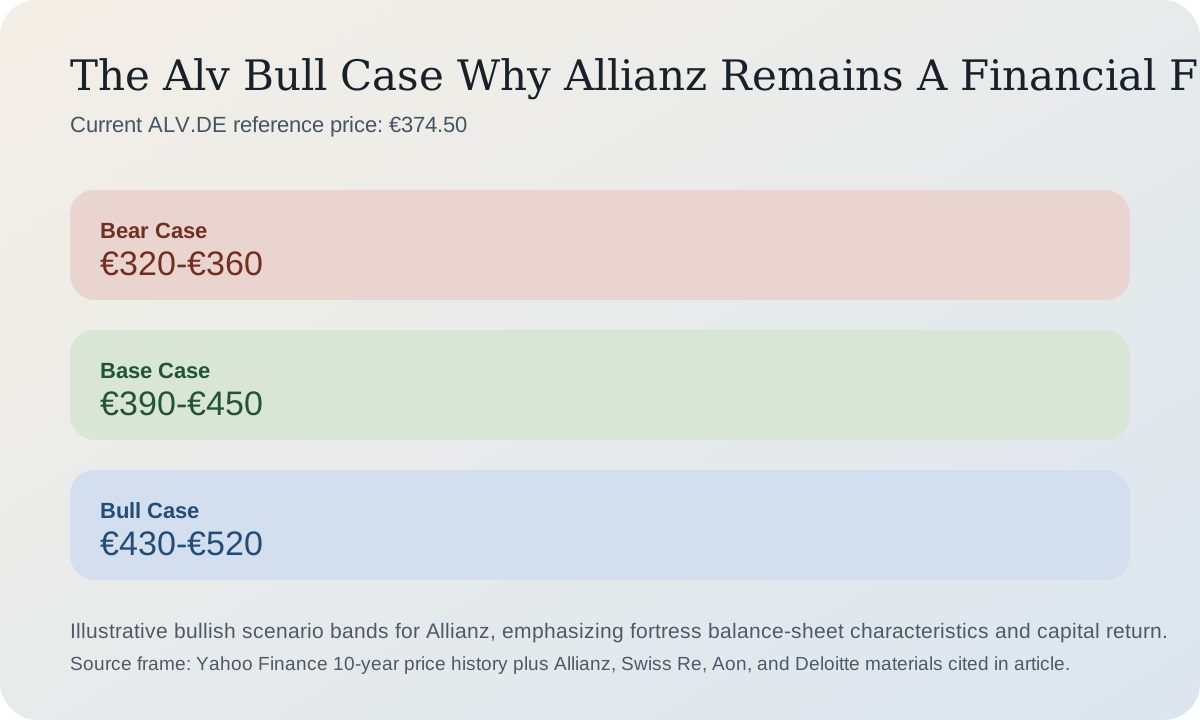
The primary bull range is €430 to €520 over a medium-term multi-year view. That scenario assumes continued execution on earnings, capital return, and productivity, plus no material erosion in pricing discipline.
Base-case scenario
The base case is €390 to €450. Even in a bullish article, the base case should reflect that Allianz is a mature large-cap with limits to how quickly it can rerate after a strong decade.
Bearish counter-scenario
The counter-bear case is €320 to €360 if cat losses rise, pricing weakens, or capital return loses momentum. Including that downside range is important because a fortress is still not invulnerable.
The most persuasive part of the bull case is that it does not need extraordinary assumptions. It mainly needs Allianz to keep doing what it has already shown it can do: preserve capital strength, allocate excess cash sensibly, and translate diversified earnings into steady per-share progress.
| Scenario | Range | What drives it | Probability |
|---|---|---|---|
| Bull | €430-€520 | Payout discipline, strong solvency, resilient pricing, and better productivity. | 45% |
| Base | €390-€450 | Steady but unspectacular compounding from a mature starting point. | 35% |
| Bear | €320-€360 | A reminder that even strong financials can derate when cycles turn. | 20% |
| Path | Estimated probability | Interpretation |
|---|---|---|
| Rising | 55% | The evidence still favors durable compounding over deterioration. |
| Falling | 20% | Downside is credible, but current capital strength limits extreme scenarios. |
| Sideways | 25% | A high-quality insurer can consolidate after a strong rerating. |
Risks to watch
Bulls should still track catastrophe severity, pricing adequacy, asset-management flows, and capital discipline. The biggest risk to the bull thesis is complacency about how cyclical insurance can still be.
Another subtle risk is timing. Even a correct bull thesis can feel wrong for long stretches if the stock consolidates while investors wait for new evidence. That is why valuation discipline and staged entries still matter.
What could invalidate the bull case
The bullish view would weaken if Allianz failed to convert its capital strength into durable per-share growth, or if repeated loss-heavy years made the franchise look less stable than its ratings imply.
Conclusion
The Allianz bull case is strongest when it stays grounded. This is not a story stock. It is a financially sturdy business with multiple cash-generation engines, credible capital return, and growing AI optionality. That can be enough.
For disciplined investors, that is the point. A fortress does not need to be exciting every quarter. It only needs to keep allocating capital well while preserving downside resilience better than the market fully credits.
Disclaimer: This article is for informational research only and is not a solicitation to buy or hold Allianz shares.
06. Investor Positioning
A bullish thesis should still translate into cautious position management
| Investor type | Prudent stance | What to monitor |
|---|---|---|
| Investor already in profit | Let the core position work, but rebalance if the weight is too large. | Whether capital return remains at fortress-like levels. |
| Investor currently at a loss | Reassess on fundamentals, not emotion. | If the balance-sheet thesis is intact, averaging should still be gradual. |
| Investor with no position | Accumulate over time rather than chase strength. | Entry price discipline still matters in quality names. |
| Trader | Trade the quality narrative around events, not as a permanent truth. | Results, cat seasons, and bond-yield moves. |
| Long-term investor | Dollar-cost averaging fits the compounding thesis best. | Dividend growth, buybacks, and management delivery. |
| Risk-hedging investor | Treat Allianz as a defensive financial, not a pure hedge. | Pair with broader diversification if portfolio protection is the goal. |
07. FAQ
Frequently asked questions about the Allianz bull case
Why call Allianz a financial fortress?
Because the company combines strong solvency, top-tier ratings, diversified earnings, and active capital return in a way that materially lowers balance-sheet fragility.
Does the bull case depend on explosive growth?
No. It depends more on disciplined compounding and per-share value creation than on unusually fast revenue growth.
What is the biggest risk to the bull case?
The biggest risk is not one event but a combination of pricing pressure, heavier catastrophe losses, and weaker-than-expected capital return.
References
Sources
- Yahoo Finance chart API for ALV.DE, 10-year monthly history and recent daily closes
- Allianz 1Q 2026 earnings release
- Allianz full-year 2025 earnings release
- Allianz Group Annual Report 2025
- Allianz Capital Markets Day 2024: 2027 targets and capital framework
- Allianz ratings page
- Swiss Re Institute insurance industry outlook and sigma research
- Aon Global Insurance Market Insights, Q1 2026 overview
- Deloitte insurance industry outlook
- Allianz Risk Barometer
- Allianz natural catastrophe resilience research
- Allianz Responsible AI principles