01. Quick Answer
A credible ASX rally can happen without a speculative mania
The strongest bullish case for Australia is not a story about explosive software multiples. It is a case for a dividend-rich, bank-and-resource-heavy market regaining favor in a world where investors want cash flow, inflation hedges, and valuations that still look more grounded than many global growth benchmarks. The ASX 200 has already shown that it can trade to records in this environment, touching around 9,202.90 before easing back (Yahoo Finance chart API for ^AXJO, one-year daily history).
The question now is whether the ingredients for another leg higher can reassemble. AMP thinks Australian shares still have more upside as profit growth returns. Fidelity Australia sees opportunities in resources, practical AI adoption, and stock-specific alpha. Government policy is also leaning more visibly toward investment, resilience, and strategic supply chains (Australian Government Budget 2026-27 overview; Australian Treasury, Future Made in Australia).
| Support pillar | Why it could drive a rally |
|---|---|
| Dividends | Income matters more when global equity leadership broadens beyond pure growth. |
| Resources | Strategic commodities can support earnings and capital returns. |
| Banks | Stable profitability can anchor the index during macro noise. |
| Policy support | Industrial and investment measures can improve confidence at the margin. |
02. Historical Context
The ASX does not need glamour to rally; it needs enough macro stability for cash flow to matter
Over the last 10 years the benchmark compounded at roughly 5.15% on price alone (Yahoo Finance chart API for ^AXJO, 10-year monthly history). That is not the profile of a market that depends on constant narrative excitement. It is the profile of a market that can do very well when earnings, dividends, and valuations line up, especially after periods of underperformance versus more fashionable global peers.
The official factsheet reinforces that framing. The benchmark's projected P/E of 15.33 and indicated dividend yield of 3.43% give the market a valuation and income profile that can look appealing when investors get tired of crowded growth trades (S&P Dow Jones Indices, S&P/ASX 200 Index (AUD) Factsheet, as of April 30, 2026). The market still needs help from earnings and macro stability, but it does not need perfection.
| Metric | Reading | Bull-case relevance |
|---|---|---|
| Current index level | 8,630.80 | Leaves room to retest and exceed the February 2026 record. |
| 52-week high | 9,198.60 | Shows what the market can do when miners and banks both work. |
| Financials + materials | 59.5% | If those sectors cooperate, the index can rally even without tech leadership. |
| Top 10 weight | 48.6% | Leadership concentration can accelerate upside as well as downside. |
| Rally ingredient | Mechanism | Likely beneficiaries |
|---|---|---|
| Rate relief or at least rate stability | Improves valuation confidence and household sentiment | Banks, REITs, and domestic cyclicals. |
| Commodity resilience | Supports earnings revisions and capital returns | BHP, Rio, Woodside, and broader materials. |
| Profit growth recovery | Lets the market rise without heroic multiple expansion | Broad index leadership, not only one sector. |
| Global rotation into value and income | Attracts fresh foreign capital | Australia's dividend-rich large caps. |
03. Main Drivers
Five reasons the bull case is still credible
1. Profit growth can return. AMP has argued that Australian shares have more upside because profit growth is returning (AMP, The outlook for Australian shares – is the long underperformance over?). That matters more than slogans because earnings are what ultimately finance sustainable rallies.
2. The index still pays investors to wait. A 3.43% indicated dividend yield is not trivial in a benchmark this large (S&P Dow Jones Indices, S&P/ASX 200 Index (AUD) Factsheet, as of April 30, 2026). That income support can matter when volatility spikes.
3. Commodity exposure can be an asset, not only a risk. Westpac's commodities work and ANZ's China decarbonisation analysis both suggest that several strategic materials remain well supported even as the composition of demand evolves (Westpac IQ, Commodities Update February 2026; ANZ, How China’s decarbonisation is reshaping Australia’s trade outlook).
4. Policy is turning more industrial. Future Made in Australia, the critical minerals agenda, and the 2026-27 Budget all point toward a more interventionist support framework for investment and resilience (Australian Treasury, Future Made in Australia; Australian Government Budget 2026-27 overview).
5. Relative valuation still matters globally. If global investors seek diversification away from concentrated U.S. growth, a large income-rich market with hard-asset leverage can attract flows even without becoming a pure tech story (Fidelity 2026 outlook; AMP 2026 outlook).
04. Institutional Forecasts and Analyst Views
The bullish evidence is real, but it is conditional rather than euphoric
AMP explicitly says it sees more upside in Australian shares, while also acknowledging that the path should stay bumpy. Fidelity Australia argues that resources are better positioned, practical AI adoption is improving, and stock-specific fundamentals are regaining importance. ANZ remains constructive on Australia's broader fundamentals. These are meaningful positive signals because they come from institutions that are not pretending the macro environment is easy.
That is also the limit of the bull case. RBA policy and ABS inflation data still warn that rates and prices remain active constraints. So the stronger interpretation is not that a rally is guaranteed, but that enough supports exist for a new advance if inflation stops getting worse.
| Source | Bullish element | Constraint |
|---|---|---|
| AMP | More upside from returning profit growth | Valuations and macro risks still matter. |
| Fidelity Australia | Resources and practical AI can broaden leadership | Volatility remains high. |
| ANZ / Westpac | Commodity and macro fundamentals remain supportive in parts | External demand is not risk-free. |
| Treasury / Budget | Industrial support is becoming clearer | Execution risk remains substantial. |
05. Scenarios, Risks, and Invalidation
The rally case improves if inflation stops crowding out the earnings story
Bullish scenario
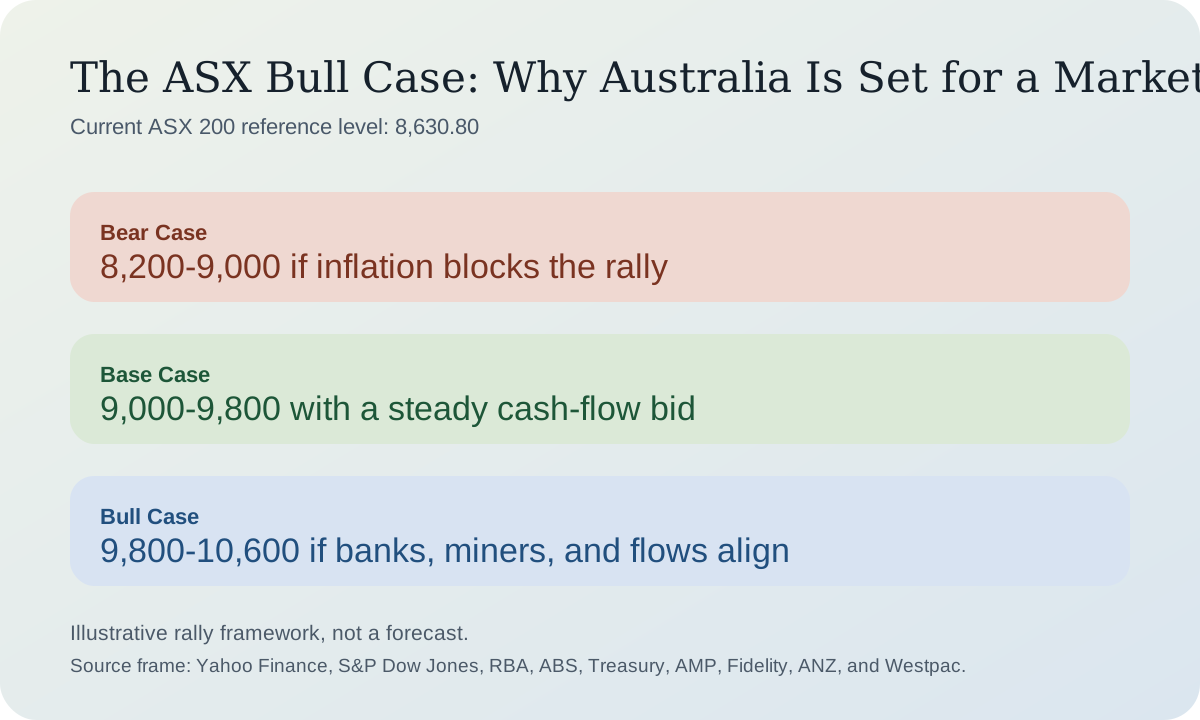
The strongest rally case is 9,800 to 10,600. That likely requires steadier policy expectations, continued bank resilience, firm resources, and renewed foreign appetite for income-rich markets.
Bearish rebuttal
The main rebuttal is simple: if inflation stays elevated and rates remain restrictive, even good cash-flow businesses can struggle to rerate meaningfully.
Base-case scenario
The base case is 9,000 to 9,800. This assumes a positive but not explosive move, with dividends and earnings doing more of the work than multiple expansion.
| Scenario | Range | Conditions | Probability |
|---|---|---|---|
| Bull | 9,800-10,600 | Rates stabilize, commodities stay constructive, and banks keep delivering | 35% |
| Base | 9,000-9,800 | Steady but unspectacular rally supported by cash flow and dividends | 40% |
| Bear rebuttal | 8,200-9,000 | Inflation and rates continue to cap valuation upside | 25% |
| Direction | Probability | Comment |
|---|---|---|
| Higher | 45% | The bull case is credible because earnings and income do not need perfection to matter. |
| Lower | 20% | The rally fails if inflation or external demand deteriorates meaningfully. |
| Sideways | 35% | Still plausible if the market stays supported but cannot rerate. |
Risks to watch
Watch CPI, wage growth, the RBA, iron ore and copper, and whether global allocators continue broadening beyond the most crowded U.S. growth names.
What could invalidate the bull case
The upside thesis weakens if inflation stays sticky, the RBA stays restrictive, and resource earnings fade before investors are willing to pay up again for income and value.
Conclusion
The ASX bull case is credible because Australia does not need a tech bubble to rally. It mainly needs enough macro stability for earnings, dividends, and strategic resources to matter again.
Disclaimer: This article is for informational purposes only. Any scenario range in this piece is an editorial estimate based on public data, not a guaranteed outcome or personal recommendation.
06. Investor Positioning
Different investor profiles need different levels of patience and risk control
| Investor type | Cautious approach | Why it fits the setup |
|---|---|---|
| Investor already in profit | Hold core winners, but trim if one sector has become the whole portfolio. | A rally can continue while still requiring risk control. |
| Investor currently at a loss | Only average if the original thesis still fits improving macro conditions. | A bull case is strongest when the reason for owning the market is becoming clearer, not weaker. |
| Investor with no position | Build exposure in stages and avoid chasing post-data spikes. | The next rally may still be uneven and macro-sensitive. |
| Trader | Trade around CPI, RBA, and major earnings updates with defined stops. | Bullish setups can fail quickly when inflation surprises. |
| Long-term investor | Use dividends and periodic buying to build exposure over time. | The ASX often rewards patience more than urgency. |
| Risk-hedging investor | Use the ASX as a value and income complement to growth-heavy exposures. | The bull case is strongest as part of a balanced portfolio, not as a single all-in bet. |
07. FAQ
Frequently asked questions about the ASX bull case
Does the ASX need rate cuts to rally?
Not necessarily. It may only need confidence that rates will stop becoming more restrictive and that inflation will not worsen.
Why are dividends so important in the bull case?
Because Australia's market structure means total return often relies meaningfully on income, not just price appreciation.
What would be the clearest sign the rally is broadening?
Better participation beyond a few banks and miners, especially if domestic cyclicals and selective growth names start confirming the move.
References
Sources
- Yahoo Finance chart API for ^AXJO, one-year daily history
- Yahoo Finance chart API for ^AXJO, 10-year monthly history
- S&P Dow Jones Indices, S&P/ASX 200 Index (AUD) Factsheet, as of April 30, 2026
- AMP, The outlook for Australian shares – is the long underperformance over?
- AMP, The investment outlook for 2026
- Fidelity Australia, A word on: Australian equities
- Fidelity Australia, 2026 outlook: rotations, resources and re-ratings
- ANZ, The big themes of 2026
- ANZ, How China’s decarbonisation is reshaping Australia’s trade outlook
- Westpac IQ, Commodities Update February 2026
- Australian Government Budget 2026-27 overview
- Australian Treasury, Future Made in Australia
- Reserve Bank of Australia, Statement on Monetary Policy, May 2026
- Australian Bureau of Statistics, Consumer Price Index, Australia, March 2026