01. Quick Answer
The cleanest BP bull case is that modestly better execution can matter more than many investors assume
BP does not need a euphoric oil market to move higher. It needs enough evidence that debt is coming down, buybacks can return, the project slate is improving, and the reset is producing better returns than the market is pricing in. Available data suggests the upside case is credible, though still highly conditional.
| Point | Why it matters |
|---|---|
| The bull case starts with skepticism already embedded in the stock | BP's long-run case is still mainly about capital discipline and cash flow, not about premium secular growth. |
| Capital-return recovery can change sentiment faster than many expect | Debt, buybacks, and strategic credibility remain central to valuation. |
| Asset quality and discoveries can support a better long-run profile | Oil, refining, and trading can create sharp upside or downside even when the long-run thesis is unchanged. |
| The bullish thesis still needs rebuttals built in | Forecasts work better as scenarios than as one-number promises for an energy major. |
02. Historical Context
BP remains an integrated energy major, but the modern thesis is about capital discipline, upstream quality, and whether the reset can rebuild credibility
BP moved from roughly $35.51 to about $44.12 over the last 10 years based on Yahoo Finance monthly data, implying a 10-year CAGR of about 2.19%. That is not the profile of a secular compounder. It is the profile of a cyclical integrated energy stock whose total-return case depends on payout discipline, cash-flow resilience, portfolio quality, and management credibility rather than on relentless revenue growth. Available data suggests BP is trying to re-rate itself through a more hydrocarbon-heavy reset, tighter capital allocation, and a sharper focus on debt, but investors remain divided on whether that is enough.
| Metric | Latest reading | Why it matters |
|---|---|---|
| 1Q25 underlying RC profit | $1.4 billion | Shows how exposed BP still is to weak refining and trading conditions when the macro mix turns less favorable |
| 1Q25 operating cash flow | $2.8 billion | Cash generation is the core issue because dividends, debt reduction, and buybacks all depend on it |
| 1Q25 net debt | $27.0 billion | Debt remains one of the market's main constraints on how generous BP can be with repurchases |
| Quarterly dividend | 8.32 cents per share | The dividend is one of the few parts of the BP story investors still treat as relatively durable |
| Feature | BP implication | Forecast effect |
|---|---|---|
| Balance-sheet sensitivity | Buybacks and valuation support are more tightly linked to net debt than they are at some peers | Base and bull cases need to assume cleaner debt progress, not just stronger oil prices |
| Strategy credibility gap | The market is still testing whether BP's strategic reset can deliver higher returns without looking reactive | Multiple expansion is possible, but it is not automatic |
| Integrated model with weaker perceived quality | BP has upstream, trading, refining, and transition optionality, but investors often discount execution more heavily | Forecast ranges should stay wider than for a cleaner premium story |
| Energy-transition tension | BP still has to balance hydrocarbon returns with low-carbon ambitions and divestment choices | That can create upside if discipline improves, or downside if the mix looks confused again |
03. Main Drivers
Five forces are most likely to shape BP stock over the next several years
1. Oil and gas prices still set the broad earnings envelope
The IEA's April 2026 oil-market work and broader 2026 energy review both point to a less obviously tight backdrop than the market priced during earlier shocks. That matters because BP still needs commodity support to keep cash generation strong enough for debt reduction and capital returns.
2. Debt reduction remains central to valuation repair
Reuters reported in February 2026 that BP suspended its buyback program to prioritize debt reduction after profit met expectations rather than exceeded them. That single decision says a lot about the stock: management still has to earn the right to be more generous on capital returns.
3. The hydrocarbon-heavy strategy reset can help if returns actually improve
BP's reset toward oil and gas, lower-end capex, and planned divestments may appeal to investors who want sharper cash-flow discipline. But the evidence is mixed because a strategic reset only helps valuation if the operating result is visibly better and durable.
4. Portfolio quality can still surprise to the upside
Reuters highlighted BP's deepwater discovery in the Gulf of America in 2025 as a potentially material long-run resource addition. Discoveries, project execution, and divestments are important because BP needs more than a cyclical rebound. It needs confidence that asset quality is improving.
5. AI and operating technology are likely to matter through efficiency, not hype
BP's own technology and digital materials frame AI as an operational tool for maintenance, subsurface work, trading support, and process optimization. For investors, that matters less as a headline story than as a possible driver of lower costs, better uptime, and better capital productivity.
04. Institutional Forecasts and Analyst Views
The strongest evidence base comes from BP's capital frame, debt path, and Reuters coverage rather than from any heroic point target
There are not many credible institutional 2030 or 2035 point targets for BP that deserve to be repeated as fact. The more defensible approach is to combine the current stock price, the weak 10-year CAGR, BP's own capital and strategy materials, Reuters coverage of the 2026 reset, and IEA supply-demand evidence. That naturally leads to range-based scenarios rather than to a single-number claim.
| Source | What it says | Implication for BP |
|---|---|---|
| BP results and annual-report materials | Capital discipline, selective growth, and debt management remain the core of the equity story | Supports a valuation framework built around cash flow, not hype |
| Reuters, February 2026 | BP suspended buybacks, kept the dividend unchanged, and guided 2026 capex toward the lower end | Confirms that the balance sheet still shapes market sentiment |
| Reuters, April 2026 | BP flagged exceptional first-quarter trading but expected net debt to rise | Shows how volatile the near-term signal can be even when operations improve |
| IEA 2026 oil work | Oil demand and supply assumptions remain constructive but not one-directional | Supports wide scenario ranges rather than certainty |
| BP digital and AI materials | AI is being applied as an industrial productivity layer rather than a marketing theme | Long-run upside is more likely to come through operating leverage than through multiple hype |
05. Scenarios
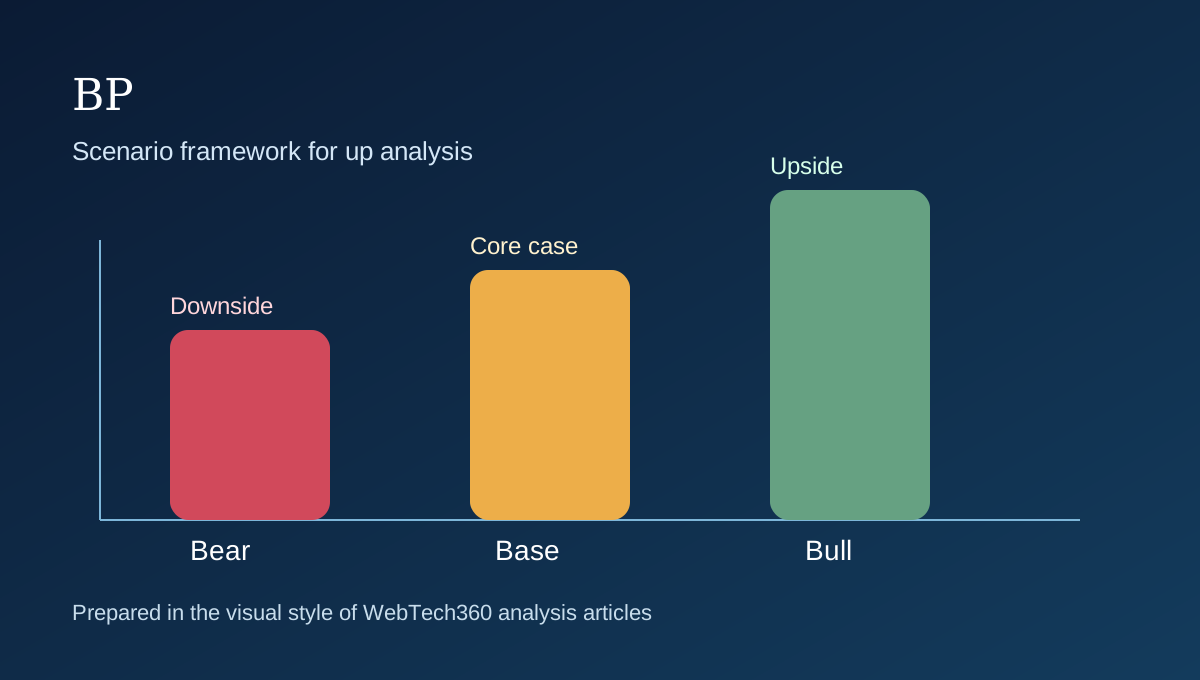
Bull, bear, and base-case scenarios for BP
| Scenario | Range | What would likely drive it | Editorial probability |
|---|---|---|---|
| Bull | $48-$58 | Debt trends lower, buybacks restart, and investors give BP more credit for execution and project quality | 35% |
| Base | $40-$48 | Operations improve, but valuation expansion remains limited because investors still demand proof | 40% |
| Bear rebuttal | $32-$40 | Oil, refining, or strategy headlines keep the stock trapped despite some internal progress | 25% |
| Outcome | Probability | Interpretation |
|---|---|---|
| Higher | 45% | A decent upside move is plausible because the starting valuation already reflects a lot of caution |
| Flat to mildly higher | 35% | Still plausible if improvement is visible, but not strong enough to drive a larger rerating |
| Lower | 20% | The bull case breaks down if macro and company-specific pressures arrive together |
06. Investor Positioning
How different investors might respond
| Investor type | Prudent stance | Why |
|---|---|---|
| Investor already in profit | Hold core, but trim if BP has become an outsized oil-price bet inside the portfolio | BP can re-rate higher, but it is still more cyclical and debt-sensitive than a premium compounder |
| Investor currently at a loss | Reassess the debt, buyback, and capital-discipline thesis before averaging down | The path higher depends on balance-sheet repair as much as on commodity strength |
| Investor with no position | Wait for pullbacks or build slowly through staged entries | Range-bound energy majors can offer opportunity, but chasing one good quarter is rarely optimal |
| Trader | Use stop-losses and watch crude, refining margins, debt updates, and buyback policy | Near-term moves can turn on macro headlines faster than on long-run thesis quality |
| Long-term investor | Focus on debt, project quality, dividend durability, and execution on divestments; consider dollar-cost averaging | BP can work as a patient value and income idea, but only if the strategy stays disciplined |
| Hedging-focused investor | Use BP as one sleeve in a broader energy or inflation-sensitive basket, not as a one-stock hedge | It offers oil and macro sensitivity, but its company-specific execution risk is real |
07. Risks to Watch
What could change the outlook quickly
The best bull arguments are capital discipline, asset quality, and low expectations. But they only matter if BP proves the reset is durable and balance-sheet progress is visible. Investors should watch debt, buyback language, and project execution more than narrative slogans.
| Potential invalidation | Why it matters |
|---|---|
| Debt falls faster than expected and buybacks resume more confidently | Would strengthen the bull and base cases by restoring part of the capital-return narrative |
| Oil, refining, and trading stay supportive together | Would create a stronger cash-flow bridge than a market skeptical of BP may currently expect |
| Execution on divestments and portfolio simplification goes well | Would support the claim that the reset is becoming more coherent and investable |
| AI and digital tools visibly improve reliability or cost efficiency | Would support a better through-cycle operating profile even without a dramatic commodity rally |
08. Conclusion
Bottom line
BP could surprise to the upside if even a moderate improvement in balance-sheet quality and execution forces the market to price the stock less harshly. The bull case is real, but it is earned through discipline, not through hype.
FAQ
Frequently asked questions
Why is BP harder to forecast than some other oil majors?
Because the outcome depends not only on oil and gas prices, but also on debt, buybacks, strategy credibility, divestments, and whether the market believes the reset is durable.
Why do debt and buybacks matter so much for BP?
They are central to how investors judge capital discipline. If debt stays too high or buybacks remain constrained, BP usually struggles to earn a premium valuation.
How were the forecast ranges built?
The ranges combine the current BP price, the 10-year CAGR, BP's reported operating and balance-sheet context, Reuters coverage of the 2026 strategy reset, IEA demand assumptions, and scenario analysis around oil, refining, debt, and execution risk.
Can AI really change BP financially?
Yes, but mostly through process improvement, maintenance, analytics, and operating efficiency rather than through a flashy direct revenue story.
Methodology and Invalidation
How these BP ranges were built and what would change them
These scenario ranges are editorial frameworks, not guarantees or institutional targets. They start with the live BP price near $44.12` in mid-May 2026, then layer on the stock's 10-year CAGR of roughly 2.19%, BP's reported debt and cash-flow profile, Reuters coverage of the 2026 reset, and the larger commodity backdrop implied by the IEA. A purely mechanical extrapolation of the last decade would miss the role of balance-sheet repair, buyback policy, divestments, and portfolio quality.
For downside language, a correction usually means around 10% down from a recent high, a bear market closer to 20%, and a crash something sharper tied to oil-price shock, recession, or balance-sheet stress. BP is especially sensitive to that distinction because a softer commodity tape can hurt both earnings and the market's willingness to trust the capital-return story.
The evidence base here is intentionally current. Yahoo Finance shows BP near $44.12`, versus roughly $35.51` 10 years ago. Reuters reported in February 2026 that BP suspended buybacks to trim debt, while keeping the dividend unchanged and guiding 2026 capital spending toward the lower end of its range. Reuters also reported in April 2026 that BP expected exceptional first-quarter trading but a rise in net debt. Those signals together justify a cautious but not uniformly bearish stance.
What would invalidate the constructive case? A deeper oil downturn, weaker refining, debt reduction that stalls, or another strategic reset that looks inconsistent would all matter. What would invalidate the bearish case? Better trading results, cleaner debt progress, successful divestments, stronger project execution, and more visible efficiency gains from AI and technology would weaken it. Investors should treat these articles as conditional research tools that need updating as oil, debt, and strategy evolve.
Disclaimer: This material is for research and editorial purposes only, does not constitute investment advice, and should not be treated as a recommendation to buy, sell, or hold BP p.l.c. or any related security.
References
Sources
- Yahoo Finance chart API, BP 10-year monthly history and current price
- BP investors results and reporting hub
- BP annual report hub
- BP Annual Report and Form 20-F 2024 PDF
- BP strategy at work
- BP technology at bp
- Digital at bp
- How AI is shaping BP operations
- Reuters, BP suspends buybacks to trim debt after quarterly profit meets expectations, February 10, 2026
- Reuters, BP forecasts exceptional first quarter and expects net debt jump, April 15, 2026
- Reuters, BP shares rise after quarterly profit beats estimates, July 29, 2025
- Reuters, BP says Gulf of America discovery could hold up to 8 billion barrels in place, August 11, 2025
- IEA Oil Market Report, April 2026
- IEA Global Energy Review 2026, oil section