01. Quick Answer
The Brent bull case is not fantasy if today's disruptions expose a system with too little comfortable spare capacity
Brent near $110.99/bbl is already telling investors that oil is still a strategic commodity, not a solved transition afterthought. The bull case says the market is not merely pricing a temporary conflict premium. It is starting to reprice years of underinvestment, logistics vulnerability, and producer discipline. The World Bank Commodity Markets Outlook, Reuters on Barclays, and the supply-security language in the OPEC World Oil Outlook all give that argument more substance than a momentum headline.
| Category | Evidence-based read | Implication |
|---|---|---|
| Historical data | Brent already proved it can jump from $16/bbl to $137/bbl within one cycle Yahoo Finance | Oil spikes happen when spare capacity and security assumptions break. |
| Current market conditions | Spot Brent near $110.99/bbl still reflects active disruption and shipping risk Reuters market report | The market is already validating scarcity fear. |
| Institutional signals | The World Bank Commodity Markets Outlook explicitly allows a high-price stress range and Barclays raised its 2026 view in coverage by Reuters on Barclays | The upside case has real external support, not just retail enthusiasm. |
| Most important watchpoints | Spare capacity, inventory draws, sanctions, and investment discipline | These are the variables that can turn a rally into a squeeze. |
02. Historical Context
Oil rallies become explosive when the system loses confidence in available supply
The best evidence for a Brent bull case is history. Oil does not need perfect demand to skyrocket. It only needs a market that stops trusting its own safety cushion. The Yahoo Finance ten-year series and the physical-market commentary in the IEA Oil Market Report show that once inventories are thin and shipping risk rises, prices can overshoot far beyond neat spreadsheet expectations.
| Metric | Latest read | Why it matters |
|---|---|---|
| Current Brent reference | $110.99/bbl | Already elevated enough to confirm that the market is pricing strategic risk. |
| Ten-year high | $137/bbl | Proof that Brent can move far above base-case analyst comfort zones. |
| World Bank stress lens | $95-$115 in a stress case | Even the World Bank frames a much tighter upside band than baseline. |
| OPEC investment warning | Large cumulative investment still needed | Underinvestment is the classic setup for future scarcity. |
| Marker | Level | Interpretation |
|---|---|---|
| 2020 trough | $16/bbl | The low matters because it shows how deeply capex and sentiment can reset before a later shortage. |
| 2022 spike | $137/bbl | This is the cleanest recent example of how fast Brent can reprice when physical security is questioned. |
| 2024 balance period | $70s | Balanced markets can still coexist with later spikes if spare capacity shrinks again. |
| Late-2025 softness | $60.85/b | The market was complacent enough to underprice risk before 2026. |
| 2026 shock repricing | $110.99/bbl | The latest move is the bull thesis in real time: security risk still commands a premium. |
03. Main Drivers
Five drivers could push Brent much higher
1. Persistent geopolitical fragmentation
The most obvious upside driver is that conflict, sanctions, and shipping insecurity persist. The World Bank release makes clear that escalation can keep oil materially above baseline.
2. Chronic underinvestment
If long-cycle capital stays cautious while decline rates continue, the market can discover that adequate supply at moderate prices was an illusion. OPEC keeps stressing this point in the OPEC WOO release.
3. Thin inventories and fragile logistics
Oil prices can skyrocket even without booming demand if inventories are too lean to absorb a shock. The IEA Oil Market Report repeatedly shows why physical buffers matter.
4. OPEC discipline and strategic spare capacity
If producers use spare capacity as a strategic tool rather than an immediate stabilizer, price spikes can persist longer than buyers expect.
5. Demand resilience
The bull case also needs demand to hold up better than expected. Available data suggests that even with slower global growth, aviation, petrochemicals, and emerging-market mobility still offer support to oil demand OPEC World Oil Outlook.
04. Institutional Forecasts and Analyst Views
The market's most bullish public signposts come from stress scenarios, not from consensus baselines
No major public institution is publishing a clean call for permanently sky-high Brent as a baseline. But the bull case does not need that. It needs evidence that high-price stress is plausible and persistent enough to matter. The World Bank Commodity Markets Outlook provides that via its escalation ranges, while Reuters-covered analyst revisions such as Reuters on Barclays show how quickly private forecasts move higher when disruptions deepen.
| Source | Message | Interpretation |
|---|---|---|
| World Bank | Escalation can keep Brent around $95-$115 in 2026 | Confirms that triple-digit oil can remain part of the realistic distribution. |
| Barclays via Reuters | Raised 2026 Brent forecast to $100/b | Private-sector expectations can climb quickly when supply risk hardens. |
| IEA | Physical market remains highly sensitive to disruptions and inventory strain | Supports the mechanism for upside spikes. |
| OPEC | Demand stays resilient and investment needs remain large | Provides the structural rationale for a higher floor. |
| Reuters market reports | Prompt market responds sharply to conflict headlines | Evidence that the premium remains active, not theoretical. |
05. Bull, Bear, and Base Case
A disciplined bull case still needs a bear case and a base case
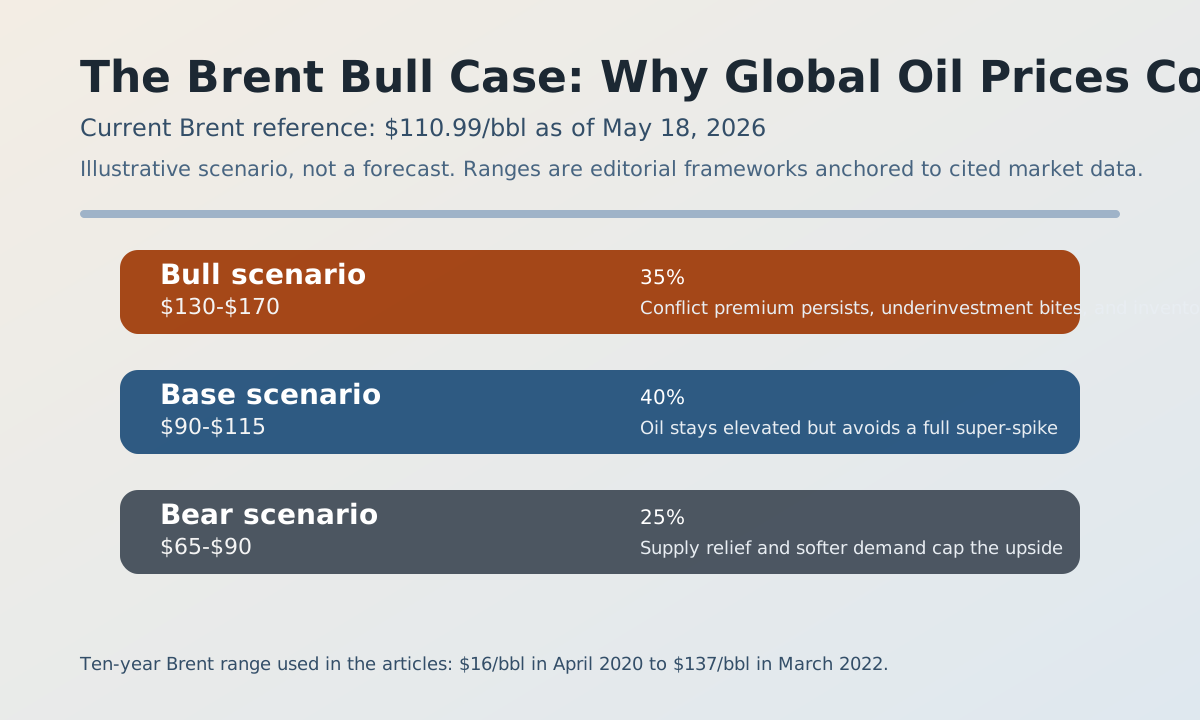
The point of a bullish Brent article is not to declare that oil must explode. It is to lay out what conditions would make a major upside move rational. The scenario matrix below therefore keeps both a base case and a bearish counter-case. That is the only credible way to discuss a commodity as volatile as Brent.
| Scenario | Price range | Conditions | Probability |
|---|---|---|---|
| Bull | $130-$170 | Conflict premium persists, underinvestment bites, and inventories stay thin | 35% |
| Base | $90-$115 | Oil stays elevated but avoids a full super-spike | 40% |
| Bear | $65-$90 | Supply relief and softer demand cap the upside | 25% |
| Direction | Probability | Comment |
|---|---|---|
| Higher | 40% | A higher path is credible if supply insecurity and underinvestment reinforce each other. |
| Lower | 20% | A lower path still exists if the current premium fades and supply responds cleanly. |
| Elevated but mixed | 40% | The middle path is an elevated market with periodic spikes and retreats. |
Bullish scenario. Brent can move into the $130-$170 zone if conflict risk remains active, spare capacity is not deployed fast enough, and buyers conclude that long-cycle underinvestment has left the system too brittle. This is the classic squeeze setup.
Bearish rebuttal. The bull case fails if current disruptions prove temporary and if the official normalization logic in the EIA global oil page and IMF WEO database reasserts itself. That is why chasing a vertical move without risk controls is still a bad idea.
Base case. The $90-$115 range assumes oil stays strategically expensive more often than it did before 2022, but does not require a nonstop emergency. It is the most practical midpoint between current spot and official medium-term normalization.
06. Positioning, Risks, and Conclusion
How to participate in a bull case without losing risk discipline
| Investor type | Prudent approach | Main watchpoints |
|---|---|---|
| Investor already in profit | Hold a core position, but trim into extreme spikes and hedge if the position has become too reliant on one geopolitical path. | Prompt spreads, OPEC language, and freight disruption. |
| Investor currently at a loss | Do not average aggressively just because the narrative sounds exciting. Rebuild only if the structural tightness thesis has actually strengthened. | Inventory trends and supply outages. |
| Investor with no position | Avoid chasing after a one-day or one-week spike. Wait for pullbacks or use staged entries. | Volatility and event calendars. |
| Trader | Trade the catalyst, not the slogan. Use stop-losses because oil squeezes can reverse violently. | Headline velocity and curve shape. |
| Long-term investor | Express the view through diversified energy exposure, capital-discipline screens, and risk limits rather than one oversized crude bet. | Balance-sheet quality and capex posture. |
| Risk-hedging investor | Use Brent selectively as inflation and geopolitical insurance, then rebalance if the hedge becomes a speculative position. | Inflation beta and portfolio concentration. |
Risks to watch
Risks to watch include ceasefire progress, emergency supply releases, surprise OPEC output additions, and demand destruction if prices stay high long enough. The strongest bull case is a squeeze caused by brittle supply, not a fantasy of infinite demand.
Conclusion
The Brent bull case is real because oil still trades inside a security framework as much as a macro one. Prices can skyrocket when the system no longer trusts spare capacity, inventories, or logistics. But a disciplined investor still has to admit that the same market can normalize quickly if those fears fade. The right bull stance is conditional and risk-managed, not absolute. Disclaimer: This article is for informational and research purposes only and does not constitute personalized financial advice.
07. FAQ
Frequently asked questions
Could Brent really skyrocket again?
Yes. Oil has repeatedly shown that when supply security is questioned, upside moves can be much larger than baseline models expect.
What is the best evidence for the bull case?
The strongest public evidence is the combination of World Bank Commodity Markets Outlook stress scenarios, OPEC's investment warnings, and current live disruption pricing in the spot market.
What is the biggest risk to the bull case?
A fast fade in the geopolitical premium or a stronger-than-expected supply response would weaken it.
What would invalidate the bull case?
Improving logistics, calmer geopolitics, faster non-OPEC supply growth, and evidence that demand weakens materially at high prices would all invalidate it.
Methodology and Invalidation
How to interpret this framework and what would invalidate it
This article builds its upside case from a small set of observable mechanisms: today's elevated Brent quote from Yahoo Finance, escalation framing from the World Bank Commodity Markets Outlook, physical-market tightness from the IEA Oil Market Report, OPEC's long-run investment argument in the OPEC World Oil Outlook, and live market revisions such as Reuters on Barclays.
The scenario ranges are editorial rather than institutional targets. They reflect what oil prices can do when spare capacity, inventories, and logistics all become less reliable at the same time.
What would invalidate the framework? A return of comfortable spare capacity, fading conflict risk, faster supply growth, or clearer demand destruction would all pull the distribution lower and make the highest ranges far less plausible.
References
Sources
- Yahoo Finance, Brent Crude Oil Futures quote page and historical chart
- World Bank, Commodity Markets Outlook, April 2026
- World Bank, Commodity Markets Outlook release, April 28, 2026
- U.S. EIA, Short-Term Energy Outlook global oil section
- IMF, World Economic Outlook database, April 2026
- IEA, Oil Market Report, May 2026
- OPEC, World Oil Outlook 2025
- OPEC, World Oil Outlook release note
- Reuters via TradingView, Barclays raises 2026 Brent forecast
- Reuters via Investing.com, oil rises on Middle East supply fears
- Reuters via Investing.com, oil prices jump after ceasefire concerns