01. Quick Answer
The Copper Bull Case: Why HG Is the Future of Green Energy
The short answer is that copper has one of the strongest structural bull cases in industrial commodities because there are few realistic substitutes that match its conductivity, manufacturability, and installed-base economics across electrification.
That does not mean every bullish target is reasonable. It means the base case itself is higher than in previous decades, while the bull case becomes credible if supply bottlenecks keep colliding with energy-transition capex.
The present starting point also matters. With HG already near $6.247/lb, the bull case is less about discovering copper and more about asking whether the market still underestimates the duration of constrained supply in a power-hungry world (Yahoo Finance chart API, HG=F recent daily data; IEA chart, mined supply and demand outlook for copper, 2026-2035; BHP, Copper Growth).
| Category | Evidence-based read | Implication |
|---|---|---|
| Energy transition demand | Copper demand is broadening across EVs, charging, renewables, and transmission. | The demand floor is more diversified than in old cycles. |
| Supply challenge | IEA, S&P Global, and BHP all see meaningful gaps in future supply. | Higher prices may be needed to ration or finance supply. |
| Not one-way | Even strong structural bulls should expect corrections, substitution efforts, and policy noise. | Discipline matters even in a secular bull. |
| Best framing | The copper bull case is strongest over years, not weeks. | The thesis is strategic, not just tactical. |
02. Historical Context
Current market snapshot and historical context
The bull case becomes stronger when you zoom out from one quarter of Chinese imports and focus on where electricity systems are heading. In that view, copper is less a cyclical metal and more a scarce enabler of infrastructure replacement.
| Metric | Latest read | Why it matters |
|---|---|---|
| EV demand signal | Copper use rises sharply with electrified transport | More wiring, motors, charging, and grid reinforcement |
| Grid signal | Transmission and distribution need more copper under electrification | Copper is embedded in the capex, not just in the vehicles |
| Renewables signal | Wind and solar are copper-intensive versus fossil alternatives | Energy-transition spending directly supports copper demand |
| Supply signal | Project pipeline still lags expected needs | Bull case depends on constrained elasticity, not demand alone |
| Period marker | Approximate price | Interpretation |
|---|---|---|
| 10-year low | $2.02/lb | The monthly series bottomed near this level during the 2016 industrial slowdown. |
| 2020 shock reset | around $2.10/lb | Copper sold off during the pandemic shock before reopening demand changed the trend. |
| 2021 reopening high | near $4.89/lb | Electrification optimism and supply friction started to re-rate the metal. |
| 2024–2026 re-rating | $5.20 to $6.64/lb | Tighter supply, tariffs, AI-related power demand, and mine disruptions pushed HG into a higher regime. |
| Latest close | $6.247/lb | Yahoo daily data puts HG near cycle highs on May 18, 2026. |
03. Main Drivers
Main drivers of price movement
1. Clean-energy demand is now measurable, not hypothetical
IEA's copper report shows clean-energy applications and other uses converging into a much larger total-demand base by 2030 and 2040. That matters because the demand base is broad and policy-supported.
2. EV copper intensity is still meaningful
S&P Global estimates EV-based copper demand rising from 2.6 million tons in 2025 to 6.3 million tons by 2040, while all-vehicle copper demand rises from 4.0 to 6.9 million tons. The evidence suggests transport electrification remains a durable demand pillar.
3. Power grids may matter even more than EV headlines
A lot of copper demand comes from the less glamorous part of the transition: transmission, substations, transformers, interconnection, and distribution upgrades. Those are slow to build and hard to substitute away from.
4. Supply has not kept pace with the thesis
IEA, S&P Global, and BHP all point to project-pipeline gaps. That is why the copper bull case is not just about rising demand; it is about weak supply elasticity.
5. Green-energy policy can survive even with cyclical slowdowns
Policy support can wobble, but the installed-base need for electrification does not disappear. That is one reason the long-run bull case can survive periods of weaker GDP growth.
04. Institutional Forecasts and Analyst Views
Institutional forecasts and analyst views
The strongest evidence for the bull case comes less from one price target and more from the alignment of industrial, policy, and producer-side sources that all describe a structurally tight future market.
| Source | Forecast / signal | Interpretation |
|---|---|---|
| IEA | 31.1 Mt demand in 2030 APS, 36.4 Mt by 2040 | Official energy-transition framework keeps copper in structural demand growth |
| S&P Global | Energy-transition demand from 8.5 Mt in 2025 to 15.6 Mt by 2040 | Strong acceleration across EVs, grids, and renewables |
| BHP | Global copper demand from around 34 Mt today to more than 50 Mt by 2050 | Producer-side demand confidence remains high |
| Goldman Sachs | $15,000/t by 2035 | Market-based expression of scarcity pricing |
| UBS | $15,000/t by March 2027 | Shows how quickly the market can start discounting structural tightness |
05. Bull, Bear, and Base Case
How the forecast range and probability table are built
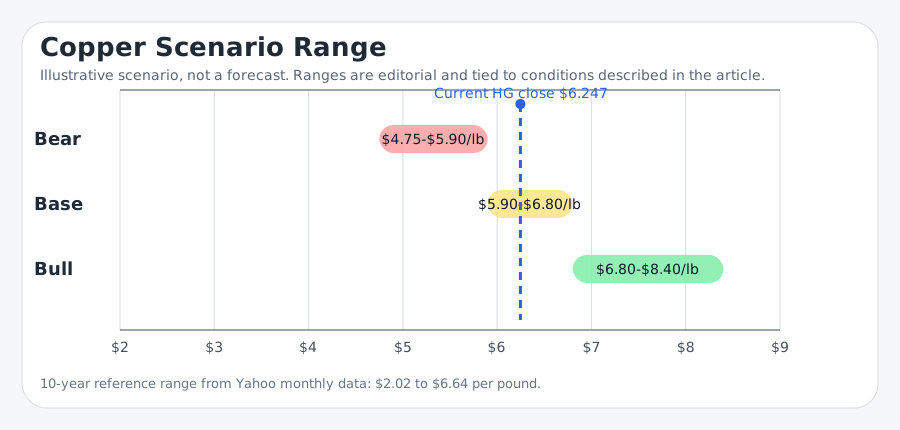
The range in this article is editorial and scenario-based rather than a deterministic forecast. It starts with current HG pricing, the 10-year trading band, the World Bank near-term baseline, ICSG balance data, and structural demand evidence from IEA, S&P Global, and BHP.
| Scenario | Price range | Conditions | Probability |
|---|---|---|---|
| Bull | $6.80-$8.40/lb | Grid capex, EV adoption, and renewable build-outs keep rising while supply disappoints | 40% |
| Base | $5.90-$6.80/lb | Copper stays structurally expensive, with corrections but no return to the old range | 40% |
| Bear | $4.75-$5.90/lb | Transition demand grows more slowly and enough supply or substitution eases the pressure | 20% |
| Direction | Probability | Comment |
|---|---|---|
| Higher | 50% | The structural bull case is one of the strongest in large-cap commodities |
| Lower | 20% | Downside exists, but it likely requires both slower demand and better supply execution |
| Sideways at high levels | 30% | A plausible outcome if copper stays scarce but not panic-scarce |
| Investor type | Prudent approach | Main watchpoints |
|---|---|---|
| Investor already in profit | Hold a core position if the thesis is multi-year, but trim if positioning becomes euphoric. | Strong stories can still get overcrowded. |
| Investor currently at a loss | Revisit the thesis through demand and supply evidence, not through narrative loyalty. | Bull cases need ongoing confirmation. |
| Investor with no position | Favor staged entries over chasing breakouts, especially when spot is already elevated. | Secular bulls still get better entry windows. |
| Trader | Trade around infrastructure and energy-transition catalysts, but keep risk tight because sentiment can outrun fundamentals. | HG is not a one-way line. |
| Long-term investor | Dollar-cost averaging can fit the green-energy thesis if volatility tolerance is real. | Copper's strategic role is clearer over years than months. |
| Risk-hedging investor | Copper can hedge green-infrastructure cost inflation, but pair it with diversified metals or utilities exposure. | Avoid single-thesis concentration. |
The copper bull case is compelling because the metal sits inside nearly every serious electrification pathway and because supply still looks slower, costlier, and more political than demand. The case becomes weaker only if the world under-builds the energy transition or if higher prices successfully trigger far more supply and substitution than current evidence implies. Disclaimer: This article is for informational and research purposes only and does not constitute personalized financial advice.
06. FAQ
Frequently asked questions
Why is copper called the metal of electrification?
Because it remains central to wiring, motors, transformers, charging, transmission, and renewable-energy systems.
Could aluminum replace copper in green energy?
In some applications yes, but the evidence suggests substitution is partial and often slow, not a full replacement.
Does the green-energy thesis guarantee higher prices?
No. Prices still depend on timing, policy, growth, and supply response.
What would invalidate the bull case?
A much weaker energy-transition build-out or a surprisingly strong supply response would weaken it.
Methodology and Invalidation
How to interpret this framework and what would change it
This article leans more heavily on structural demand sources than on near-term balance data because its main question is thematic: why copper sits at the center of green-energy capex (IEA, Copper report within Global Critical Minerals Outlook 2024; S&P Global, Copper in the Age of AI: Challenges of Electrification, January 2026; S&P Global, Plugged in and politicized: Copper in a fractured world; BHP, Copper Growth).
Even so, the framework does not ignore valuation and cycle risk. Current spot levels are already high, which is why the base case is constructive without assuming the strongest bull targets arrive quickly.
Invalidation would come from demand disappointment or substitution that proves faster than expected. Investors should watch grid-spending realization, EV adoption quality, treatment charges, and greenfield project approvals rather than rely on slogans about electrification.
That caution matters because green-energy demand is not perfectly synchronized. EVs, grids, renewables, and storage all move on different policy and financing timelines. A delayed rollout in one channel does not automatically negate the full bull case, but it can change the pace at which copper needs to clear the market at higher prices.
References
Sources
- Yahoo Finance chart API, HG=F 10-year monthly data
- Yahoo Finance chart API, HG=F recent daily data
- World Bank, Commodity Markets Outlook, April 2026
- ICSG, Table 1: World refined copper production and usage trends, April 2026
- Reuters on ICSG April 2026 forecast update
- IEA, Copper report within Global Critical Minerals Outlook 2024
- IEA, Global Critical Minerals Outlook 2025 overview
- IEA chart, mined supply and demand outlook for copper, 2026-2035
- S&P Global, Copper in the Age of AI: Challenges of Electrification, January 2026
- S&P Global, Plugged in and politicized: Copper in a fractured world
- BHP, Copper Growth
- BHP Insights, How copper will shape our future
- IMF, World Economic Outlook, April 2026
- USGS, Mineral Commodity Summaries 2026
- Reuters on Goldman Sachs reiterating a $15,000/t copper view for 2035
- UBS CIO, commodities note, February 27, 2026