01. Bull Setup
Why AXA's dividend-led equity story deserves respect
The bull case for AXA is not built on reinvention. It is built on financial architecture. High solvency, resilient underwriting, broad business mix, and a very explicit capital-return culture give AXA a profile that many income-oriented investors actively seek. If those features stay intact, CS can still make new highs even without becoming a glamorous market story.
| Bullish pillar | Why it matters |
|---|---|
| Dividend power | Cash income remains a major reason investors stay patient with AXA. |
| Buyback support | Repurchases can enhance total return and tighten the share count over time. |
| Balance-sheet strength | High solvency lets AXA keep rewarding shareholders without looking reckless. |
| Operating breadth | P&C, commercial lines, life, and health reduce dependence on any one engine. |
The long record matters here. AXA has already demonstrated that it can navigate very different regimes: low rates, pandemic stress, inflation, and a tougher catastrophe environment. Even after those shocks, the stock compounded from EUR 17.81 to EUR 39.18 over the last decade and paid meaningful cash distributions along the way (10-year share history).
| Evidence | Current reading | Bullish interpretation |
|---|---|---|
| Underlying earnings | EUR 8.4 billion in FY 2025 | The business is not only solvent; it is producing large recurring earnings. |
| Underlying EPS growth | Upper end of 6-8% plan range for 2026 | Momentum into the end of the plan still looks constructive. |
| Capital-return policy | 75% total payout target framework | AXA actively converts profitability into shareholder value. |
| Solvency | 211%-224% recent range | Provides confidence that payouts are not being forced from weakness. |
That does not guarantee upside, but it explains why the bull case deserves to be taken seriously. Some dividend stories are traps built on stagnation. AXA's current evidence suggests a more attractive version: a mature financial that still combines capital return with respectable growth.
The distinction is important because dividend investors often conflate yield with quality. AXA's bullish case works only because the income stream sits on top of a still-expanding earnings base and a robust solvency profile. Without those supports, the dividend would be much less impressive.
02. Bullish Drivers
What could push AXA to new highs
1. Dividend power can attract patient capital
AXA's 2026 dividend of EUR 2.32 per share, up 8% year over year, is not just a headline number. It signals management confidence in capital generation and balance-sheet resilience (FY 2025 earnings; AGM approval).
2. Buybacks reinforce the equity story
An annual buyback framework of up to EUR 1.25 billion keeps AXA relevant to shareholders who want more than income. The combination of cash yield and repurchases can support total returns even when the valuation multiple does not race higher.
3. Execution quality is visible in both P&C and Life & Health
Q1 2026 showed growth in both P&C and Life & Health. That balanced momentum matters because it reduces dependence on a single business line and supports a more durable earnings profile (Q1 2026 indicators).
4. Strong solvency creates optionality
High solvency does more than protect the downside. It gives management room to keep distributing capital, absorb volatility, and stay patient when opportunities arise.
5. AXA can benefit from being boring at the right time
In uncertain markets, many investors re-learn the value of predictable cash generation. AXA can benefit from that rotation, particularly if the next strategic plan stays clear and disciplined instead of stretching for novelty.
03. Institutional Reading
How current disclosures support a constructive AXA thesis
A constructive institutional view on AXA does not require blue-sky assumptions. It only requires accepting the public evidence that the current plan has delivered, that capital returns remain central, and that industry conditions still reward well-capitalized insurers more than poorly disciplined ones (strategic plan; Swiss Re insurance outlook).
| Item | Current status | Bullish implication |
|---|---|---|
| Record FY 2025 performance | Achieved | Confirms that AXA's earnings model is currently operating from strength. |
| Q1 2026 momentum | Still solid | Suggests no obvious break in the thesis yet. |
| Capital return framework | Explicit and visible | Supports a premium versus weaker or less generous peers. |
| Broad analyst coverage | Yes | Good execution can be recognized quickly by the market. |
The evidence is mixed only on how far the market is willing to re-rate a large insurer. It is not mixed on whether AXA has a coherent shareholder case. That distinction is the heart of the bull thesis.
If the market continues rewarding predictability, solvency, and disciplined distributions, AXA does not need heroic earnings acceleration to grind higher. It only needs to avoid breaking trust.
That makes AXA's upside unusually practical. A new all-time high would not require the market to discover a hidden story. It would require investors to conclude that the current mix of underwriting quality, payout discipline, and line-of-business balance deserves slightly better treatment than it receives today.
04. Scenarios
Bull case, rebuttal, and investor positioning
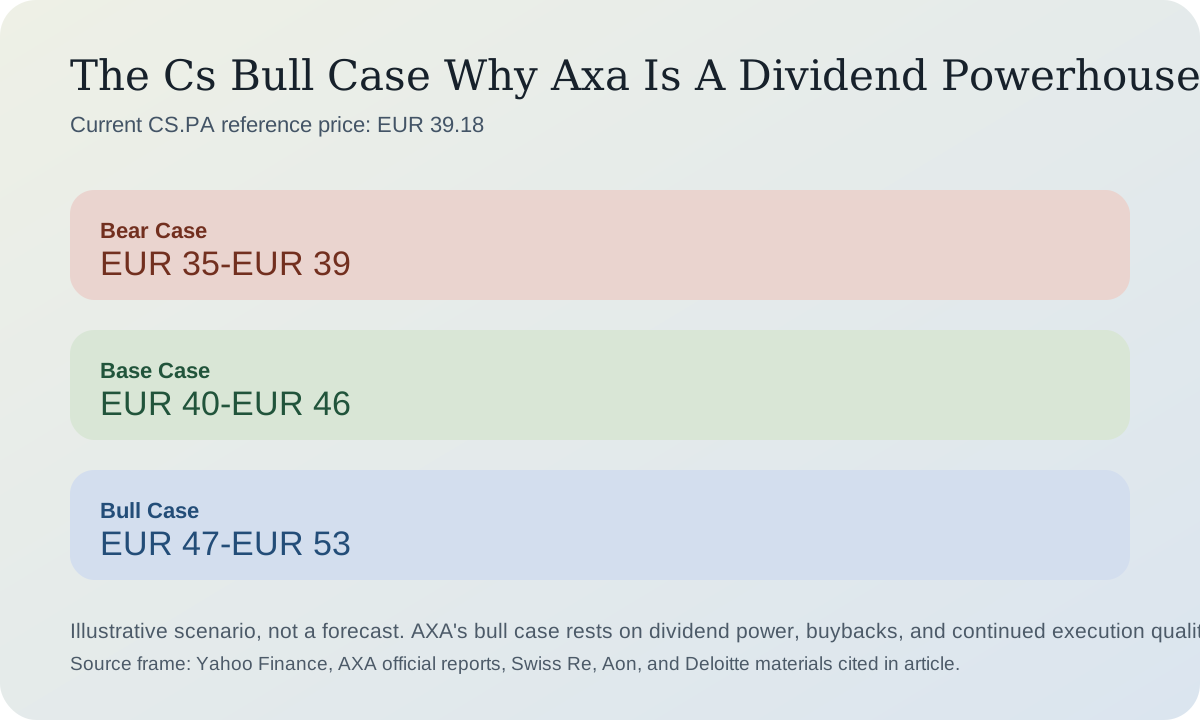
Primary bull scenario
The main bullish range is EUR 47 to EUR 53. That would likely require another phase of steady execution, a well-received strategic update, and sustained confidence that AXA deserves to be owned as a dividend-rich quality financial.
Base scenario
The base scenario remains constructive but less dramatic: moderate upside plus ongoing distributions. That is still a respectable outcome for the type of business AXA is.
Bearish rebuttal to the bull case
The obvious rebuttal is that income investors may already appreciate these strengths and that AXA can remain cheap if insurance-cycle conditions normalize lower. That criticism is fair. The bull case works best when underwriting quality and capital return keep improving together.
It also works best when management resists the temptation to overcomplicate the story. AXA does not need a dramatic reinvention to rally. It needs several more reporting periods in which the market sees strong solvency, clean reserve language, and repeated evidence that shareholder returns are not crowding out future growth.
| Path | Probability | Why |
|---|---|---|
| Renewed rally and new highs | 44% | Possible if the next plan extends the current formula and the market stays quality-focused. |
| Sideways with income doing most of the work | 33% | A realistic outcome for mature insurers. |
| Meaningful pullback | 23% | Still possible if the market loses confidence in durability. |
| Investor type | Prudent bullish stance | Discipline |
|---|---|---|
| Investor already in profit | Let winners run but rebalance if the AXA weight is too large. | Do not turn a dividend stock into a concentration risk. |
| Investor currently at a loss | Average only if the business thesis still looks intact. | Separate frustration from analysis. |
| Investor with no position | Prefer staged buying or waiting for a pullback rather than chasing a breakout. | Yield alone is not a timing tool. |
| Trader | Trade the setup around earnings and plan updates, not around dividend mythology. | Use stop-loss rules. |
| Long-term investor | AXA fits a patient total-return mindset if diversification is maintained. | Reinvest only if solvency and underwriting remain strong. |
| Risk-hedging investor | Own AXA for quality income exposure, not for crash protection. | Keep true hedges elsewhere. |
How the bull range was built: the range assumes only moderate multiple expansion from current levels, plus continued confidence in AXA's dividend and buyback profile. It does not assume a radical change in how the market values insurers.
Risks to watch: reserve slippage, catastrophe volatility, strategy disappointment, or any sign that shareholder returns are becoming less dependable.
What would invalidate the bull case: weak reserve commentary, a defensive next strategic plan, or deterioration in solvency that forces investors to rethink AXA as a payout-driven compounder.
Disclaimer: This article is for informational and research purposes only. The bullish case for AXA is a scenario analysis, not a guarantee or a recommendation to buy shares immediately.
AXA's appeal is that it can be financially powerful without being theatrical. That is exactly why the stock can still work in a disciplined portfolio even if it never becomes a fashionable momentum name.
For bullish investors, that means the real edge is patience. A dividend powerhouse rarely looks exciting every week. It becomes attractive when compounding, capital return, and balance-sheet quality reinforce each other for long enough that the market has to notice.
That patience is especially relevant for European financials, where reratings often arrive slowly and only after repeated operational confirmation. AXA's bull case is therefore strongest for investors who can let a solid capital-return machine do its work over time instead of demanding immediate excitement.
Viewed that way, AXA's upside case is less about chasing momentum and more about owning a franchise that can keep compounding shareholder value through a mix of cash distribution, disciplined underwriting, and resilient capital generation over long periods for patient investors globally.
05. FAQ
Frequently asked questions about AXA's bull case
Why call AXA a dividend powerhouse?
Because the shareholder case explicitly includes a high dividend payout ratio and annual buybacks supported by strong capital generation.
Can AXA make new all-time highs without a big valuation rerating?
Yes. Moderate rerating plus earnings growth and strong distributions can be enough.
What is the biggest risk to the bull case?
A loss of confidence in underwriting quality or payout durability would be the clearest threat.
Does the dividend make AXA automatically defensive?
No. It can make the stock more patient-owner friendly, but it does not eliminate market and insurance-cycle risk.
06. Sources
Reference list
- Yahoo Finance chart API for CS.PA, 10-year monthly history
- Yahoo Finance chart API for CS.PA, recent daily closes
- AXA Full Year 2025 earnings release
- AXA 1Q26 activity indicators
- AXA 2025 Annual Report
- AXA 2024-2026 strategic plan and financial targets
- AXA strategic plan page
- AXA 2026 share buyback execution release
- AXA 2026 shareholders meeting and dividend approval
- AXA analysts coverage page
- AXA ratings page
- Swiss Re sigma 2/2025 on world insurance conditions
- Swiss Re sigma 5/2025 on insurance market outlook
- Aon Q1 2026 global insurance market overview
- Deloitte 2026 global insurance outlook