01. Quick Answer
Ethereum could lead the next altseason if leadership rotates from pure scarcity stories toward utility, tokenization, and liquid institutional access
The strongest bullish case for ETH is not that every altcoin season has to start with Ethereum. It is that ETH remains the most institutionally legible large-cap smart-contract asset. SEC-approved spot products, BlackRock's ETF wrapper, normalized staking, and growing tokenization use cases give ETH a bridge between crypto-native upside and traditional-finance experimentation (SEC) (BlackRock) (Franklin Templeton). If capital rotates from Bitcoin dominance toward broader crypto beta, Ethereum is still one of the first logical destinations.
| Category | Evidence-based read | Implication |
|---|---|---|
| Historical data | ETH has often acted as the bridge between Bitcoin leadership and broader altcoin risk appetite | If altseason returns, ETH is structurally positioned to participate |
| Current market conditions | ETH still trades far below the 2025 peak despite network relevance (Yahoo Finance) (Grayscale) | That leaves room for catch-up if sentiment improves |
| Institutional setup | Spot ETFs, deep derivatives, and active ETP flow data give ETH a mainstream access channel (BlackRock) (CME Group) (CoinShares) | Leadership can be expressed by much larger pools of capital than in earlier cycles |
| Practical read | The bull case is real, but it still needs confirmation from relative strength and demand quality | Do not confuse possibility with inevitability |
02. Historical Context
ETH does not need to beat every rival chain to lead the next altseason; it needs to regain the market's confidence first
Grayscale's 2025 Ethereum report is a useful starting point because it acknowledges both the promise and the frustration of the asset (Grayscale). Ethereum remains the foundational smart-contract ecosystem by many measures, yet ETH's market performance has lagged. That underperformance can actually help the next bull case if it reflects pessimism that later unwinds rather than permanent impairment.
| Metric | Latest reading | Why it matters |
|---|---|---|
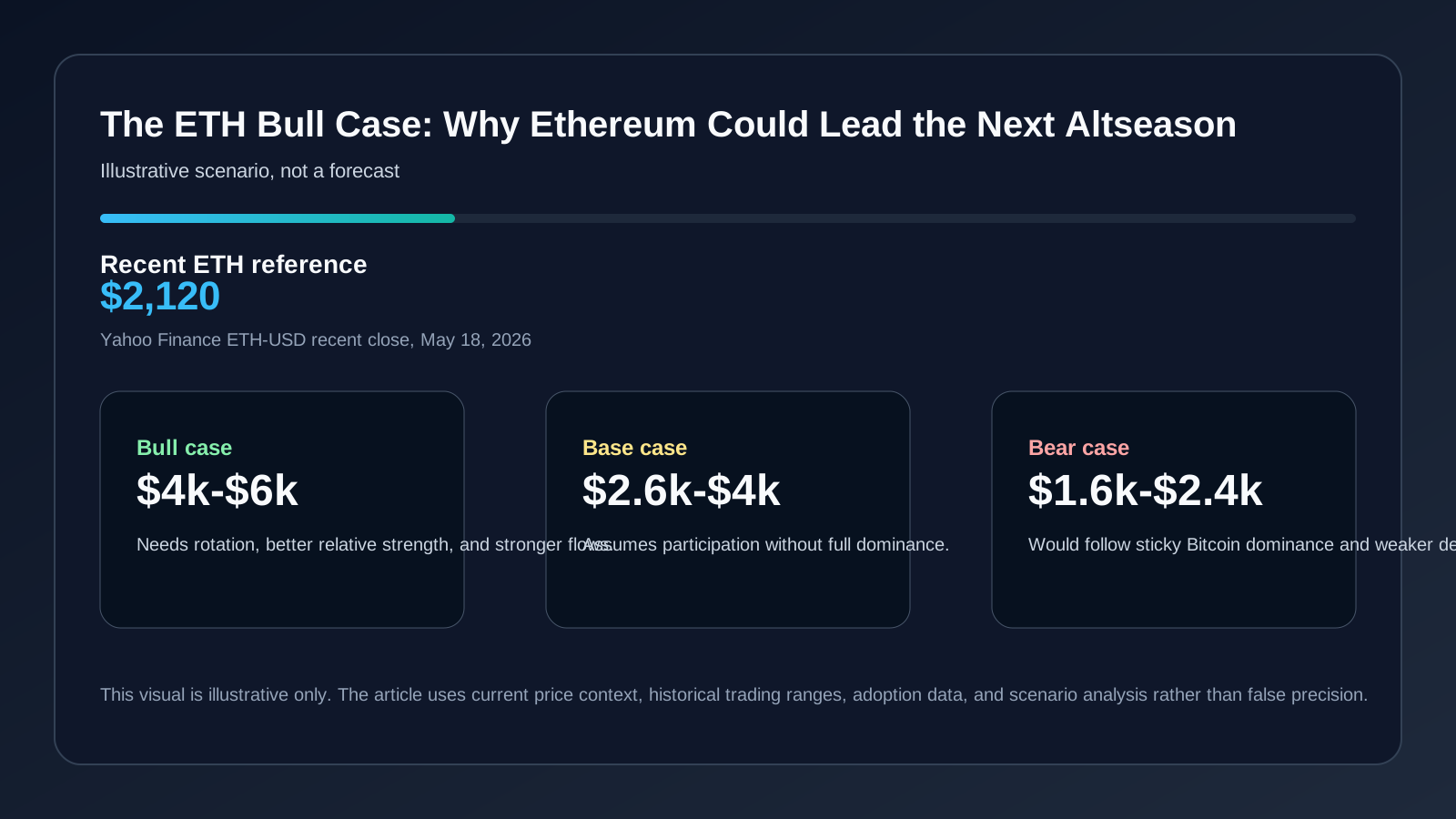
| Recent ETH close | ~$2,120.16 | Anchor for any upside framework |
| Institutional wrapper | Spot Ether ETFs and regulated exposure are available | Makes ETH easier to own than most altcoins |
| Network role | Ethereum remains central to rollups, stablecoins, DeFi, and tokenization narratives | Supports the leadership case if risk appetite broadens |
| Recent flow clue | $315M of weekly Ethereum inflows in March 2026 | Shows capital can rotate back when conditions improve |
| Condition | Current read | Why it matters for altseason leadership |
|---|---|---|
| ETH/BTC stabilization | Still a work in progress | Leadership usually needs relative-strength repair |
| Cleaner ETF and ETP demand | Supportive at times, not yet dominant | Supports a sustained rerating |
| Constructive tokenization narrative | Real and growing | Gives ETH a differentiated macro story |
| Macro risk appetite | Unsettled | Altseason rarely flourishes in a persistent risk-off regime |
03. Main Drivers
Five drivers could make ETH the first major beneficiary of a broader altcoin rotation
1. Ethereum still has the cleanest institutional wrapper among smart-contract assets
BlackRock's ETHA and SEC-approved spot products matter because they let allocators express a smart-contract view without using offshore venues or operationally messy structures (BlackRock) (SEC). In a rotation trade, ease of access matters.
2. Tokenization gives ETH a narrative that goes beyond crypto-native speculation
Franklin Templeton's tokenization work shows why this matters (Franklin Templeton). If markets start rewarding assets linked to the future of digital market infrastructure, ETH has a more concrete story than many alternative chains.
3. Staking makes ETH look more like a productive asset
Fidelity's investment thesis and the Ethereum Foundation's own staking actions both reinforce the idea that ETH can be framed as a yield-linked network asset rather than just a speculative token (Fidelity) (Ethereum Foundation).
4. Rollups can be bullish if the market focuses on network dominance instead of fee leakage
Ethereum.org's roadmap argues that scaling comes from layer 2s (Ethereum.org). Bulls will argue this means Ethereum becomes the settlement backbone for more applications, even if direct fees per user fall.
5. Altseason leadership usually favors assets with both liquidity and narrative depth
Coinbase's institutional survey and CME's derivatives growth suggest Ethereum still sits at the center of liquid risk transfer and institutional attention (Coinbase and EY-Parthenon) (CME Group). That combination can matter more than being the most exciting chain on social media.
04. Institutional Forecasts and Analyst Views
The bullish setup looks credible, but even the best published frameworks still imply a wide range of outcomes
VanEck's public valuation work is the clearest example of how bullish the long-run ETH case can become under strong market-share assumptions (VanEck). Fidelity and Coinbase help from another angle by showing why institutions keep engaging with the asset class and why Ethereum remains one of the most investable expressions of utility-driven crypto exposure (Fidelity) (Coinbase and EY-Parthenon).
The counterargument is just as important. Grayscale's report is a warning that Ethereum can lead on usage and still disappoint on price if too much economic value migrates away from ETH itself (Grayscale). That is why the bull case needs confirmation from price action and flows, not just from protocol significance.
| Catalyst | Current read | Why bulls care |
|---|---|---|
| ETF and ETP access | Already in place | Lowers friction for large allocators |
| Staking narrative | Stronger than pre-Merge | Supports productive-asset framing |
| Tokenization growth | Credible and visible | Expands the addressable macro story |
| Relative-strength repair | Not complete | Needed for ETH to lead rather than just participate |
The strongest ETH bull case is therefore conditional, not blind. It assumes the market starts rewarding liquid utility and programmable-finance exposure more than it fears fee leakage.
05. Bull, Bear, and Base Case
A bullish thesis still needs a disciplined scenario matrix
| Scenario | Price zone | Conditions | Probability |
|---|---|---|---|
| Bull | $4k-$6k | ETH/BTC improves, ETF demand broadens, tokenization and staking narratives strengthen, and altcoin risk appetite returns | 28% |
| Base | $2.6k-$4k | ETH participates in a rotation but leadership is only partial and valuation debate persists | 44% |
| Bear | $1.6k-$2.4k | Bitcoin dominance stays high, flows disappoint, or macro pressure suppresses altcoin beta | 28% |
| Direction | Probability | Comment |
|---|---|---|
| Higher | 46% | The bull case is credible if rotation broadens beyond Bitcoin |
| Lower | 21% | A weaker path would likely follow persistent dominance and macro caution |
| Sideways | 33% | Plausible if ETH remains relevant but never fully regains leadership |
| Investor type | Prudent approach | Main watchpoints |
|---|---|---|
| Investor already in profit | Hold a core position but trim into vertical rallies instead of assuming altseason lasts forever | ETH/BTC and ETF flows |
| Investor currently at a loss | Use rebounds to reassess position size rather than forcing a maximal conviction trade | Cost basis and time horizon |
| Investor with no position | Wait for confirmation or scale in on pullbacks instead of chasing initial breakout candles | Relative-strength trend and volume |
| Trader | Use stop-losses and avoid turning a rotation trade into a long-term bag-holding exercise | Momentum, funding, and market breadth |
| Long-term investor | Accumulate gradually if you believe Ethereum remains the best large-cap programmable-asset platform | Tokenization, staking, and developer activity |
| Risk-hedging investor | Avoid assuming altseason strength makes ETH defensive; it usually stays cyclical | Cross-asset correlations |
What could invalidate the bull case? If ETH fails to outperform even when crypto breadth improves, or if tokenization growth benefits the ecosystem without lifting ETH demand, then the leadership argument weakens materially. Conversely, stronger relative strength and sustained regulated inflows would reinforce it.
06. FAQ
Frequently asked questions
Why would ETH lead altseason instead of another chain?
Because ETH still combines liquidity, institutional access, staking, and a credible tokenization story in a way few rivals can match.
Does rollup growth hurt the bull case?
It can, if investors focus on fee leakage. It can also help, if investors decide Ethereum is becoming the dominant settlement backbone.
What is the biggest confirmation signal?
ETH/BTC relative-strength improvement alongside better ETF and ETP demand.
Can ETH rally without a full altseason?
Yes. Ethereum can rerate on its own if tokenization and institutional narratives improve even before smaller-cap alts participate.
Methodology and Invalidation
How to interpret this ETH bull-case framework and what would change it
The forecast ranges in this article are scenario bands, not promises. They combine live ETH price data, official Ethereum documentation, and institutional or market-structure research from major asset managers, exchanges, research desks, and financial firms, plus editorial judgment about market structure. That mix matters because ether is not driven by one variable. It reacts to fee generation, staking, tokenization demand, rollup economics, derivatives positioning, regulation, and macro risk at the same time.
Probability tables in this article are editorial estimates rather than mathematical certainties. They are derived by weighing whether the evidence currently favors stronger usage and institutionalization, a mixed middle path with slower monetization, or a weaker path marked by fee compression, risk-off conditions, or renewed competition. Where the evidence is mixed, the range stays intentionally wide. False precision is usually a sign that the analyst is hiding uncertainty rather than measuring it honestly.
The most important invalidators would be persistent relative underperformance, weak regulated inflows, or mounting evidence that Ethereum's ecosystem success is not translating into ETH demand. The most important discipline is to state what would invalidate the working view. Investors who are already in profit, investors sitting on losses, traders, hedgers, and long-term allocators do not need the same playbook, so the positioning table separates horizon and risk tolerance instead of pretending one answer fits everyone. Disclaimer: This article is for informational and research purposes only and does not constitute personalized financial advice.
References
Sources
- Yahoo Finance ETH-USD chart API, recent daily closes
- U.S. SEC, references to the Spot Ether ETP Approval Order and related approvals
- BlackRock, iShares Ethereum Trust ETF overview
- CoinShares, Digital asset fund flows, March 16, 2026
- Fidelity Digital Assets, Ethereum Investment Thesis
- Coinbase and EY-Parthenon, 2025 Institutional Investor Digital Assets Survey
- CME Group, record 2025 derivatives activity including ether futures growth
- Ethereum.org, Scaling Ethereum
- Ethereum Foundation, Treasury Staking Initiative, February 24, 2026
- Grayscale Research, Ethereum: The OG Smart Contract Blockchain
- Franklin Templeton, Revolution-Not Evolution: Detangling tokenization of RWAs
- Franklin Templeton, Benji platform overview