01. Quick Answer
The bear case is not that gold is worthless. It is that the market may have priced too much structural optimism too quickly
Bulls are right about several things. Central banks have been consistent buyers. Reserve diversification is real. Fiscal pressure is not going away. But none of that guarantees short- or medium-term price appreciation after a giant rally. The strongest bear case is that the market has already capitalized much of the good structural news, leaving XAU increasingly dependent on additional investor flows, lower real yields, and persistent macro stress to justify still-higher levels.
When a market re-rates, the first stage is often fundamental. The second stage often becomes positioning-dependent. Gold increasingly looks like it has entered that second stage.
The practical implication is that bears do not need to win the long-term argument to be right over the next several quarters. They only need enough bullish assumptions to prove too optimistic at once.
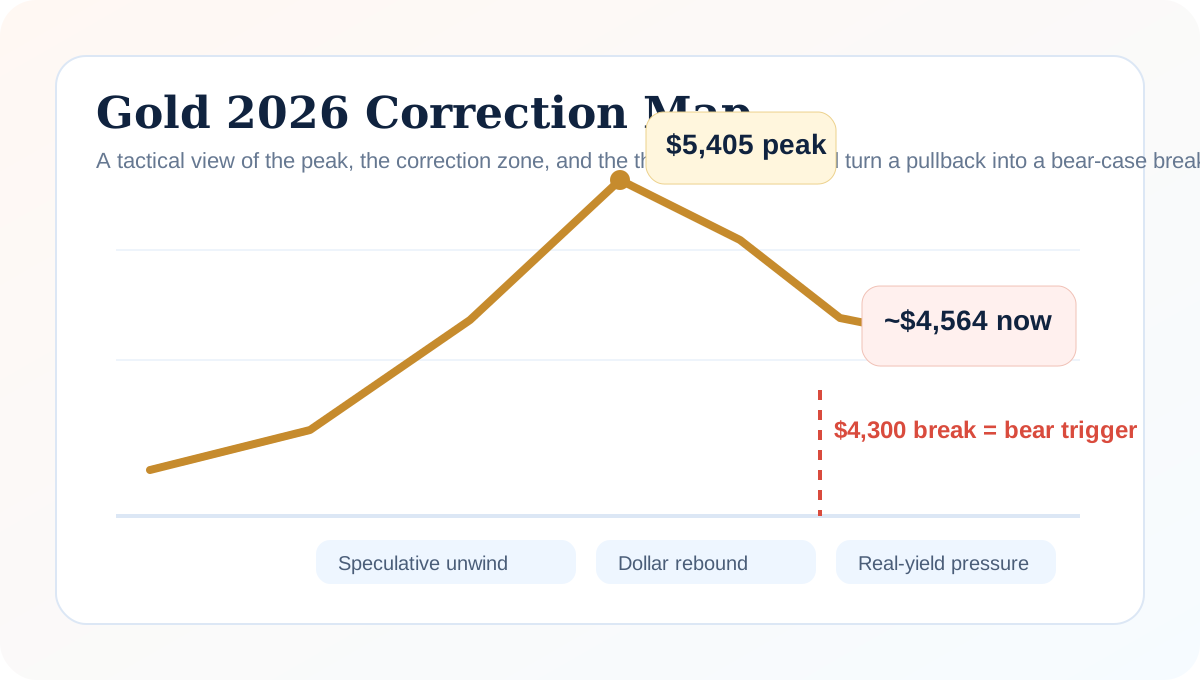
02. Historical Context
Every major gold bull market eventually runs into valuation, positioning, or policy resistance
Gold's 2025 record demand and early-2026 price behavior explain why the bull thesis feels compelling. But history is still instructive. Gold often overshoots during periods when macro fear, monetary concerns, and investor inflows align. It also tends to correct abruptly when one of those legs weakens. WGC's own research on March and April 2026 price action shows exactly that kind of sensitivity. Markets moved from a narrative of endless upside to one where technical support, CTA flows, ETF liquidation, and higher real yields suddenly mattered again.
A good bear case therefore starts with humility. Gold can remain structurally strong and still disappoint buyers at current levels.
That is especially true after the market has already rewarded the thesis. Many weak bear arguments simply deny the structural changes that took place after 2022. A stronger bear case accepts those changes, but argues they may have been over-discounted in price.
| Observation | Bear interpretation | Bull response |
|---|---|---|
| Record demand in 2025 | Peak enthusiasm may already be priced | Broad participation proves the move is durable |
| Q1 2026 ETF inflows slowed sharply | Momentum is decelerating | Flows were still net positive |
| Real yields remain positive | Opportunity cost can still bite | Gold can outperform despite positive real yields in stress periods |
| Central banks remain active | But price sensitivity is increasing | Official demand is still far above old norms |
The valuation debate is admittedly imprecise because gold does not have earnings or cash flows like an equity. But that does not mean valuation is irrelevant. In practice, gold's "valuation" is expressed through how much macro fear, reserve diversification, and portfolio-insurance demand the market is willing to capitalize at once. Bears argue that willingness may already be stretched.
03. The Bear Drivers
Four reasons the bulls could be wrong
1. Real yields can stay restrictive longer than the market wants
Gold works best when investors believe cash and bonds are becoming less attractive in real terms. But early-May 2026 FRED data still showed 10-year real yields near 1.94%. If inflation stabilizes without a deep growth scare, rates could remain an uncomfortable headwind for gold much longer than the bulls expect.
2. ETF ownership may be less sticky than official-sector buying
Central banks provide the floor; ETFs often determine the slope. WGC's Q1 2026 investment data showed just how fast Western flows can reverse when the price breaks momentum and rates move against the metal. If the investor base that joined late in the rally proves tactical rather than strategic, downside can accelerate.
3. Geopolitical premium can shrink faster than fiscal stress can reprice
Some of gold's current valuation reflects ongoing geopolitical fragmentation. If the market decides those risks are stabilizing, safe-haven urgency can fade quickly. Fiscal problems, by contrast, usually reprice slowly. That timing mismatch is a bearish problem because near-term flows often care more about immediate headlines than long-term debt arithmetic.
4. Central-bank demand may remain strong, but not infinitely price-insensitive
WGC's 2025 data still show historically strong official-sector buying, yet 2025 buying fell from the previous three years. That by itself is not bearish. But it does show that even strategic buyers react to valuation, reserve needs, and market conditions. If investors are assuming official demand will absorb every correction, that assumption may be too aggressive.
There is also an asymmetry here. Central-bank buying can be slow, strategic, and hard to observe in real time. ETF selling is visible, immediate, and emotionally contagious. That means a market that is structurally sound can still trade much worse than the fundamentalists expect before the slower support shows up.
| Bear trigger | What would happen | Severity |
|---|---|---|
| Real yields remain high | Gold loses part of its macro appeal | High |
| ETF flows flip persistently negative | Momentum and sentiment weaken together | High |
| Geopolitical stress fades | Safe-haven premium compresses | Medium |
| Official-sector buying slows materially | Structural floor weakens | Very high |
Another underappreciated bearish factor is narrative exhaustion. Once a market becomes the consensus hedge for debt, de-dollarization, and geopolitics all at once, it becomes vulnerable to disappointment on any single front. Gold does not need all those themes to disappear. It only needs fewer buyers to feel urgency about them.
04. Bull, Bear, and Base Case
A serious bear case still needs to coexist with a serious invalidation case
| Scenario | Illustrative price path | Conditions | Probability |
|---|---|---|---|
| Bear | $3,500-$4,200 | Sticky real yields, softer ETFs, stronger dollar, fading geopolitical premium | 30% |
| Base | $4,200-$5,100 | Official demand stays firm, but investor demand oscillates | 45% |
| Bull invalidation of bear case | Renewed breakout above recent highs | ETF inflows re-accelerate, rates roll over, and stress assets wobble again | 25% |
| Direction | Probability | Comment |
|---|---|---|
| Higher | 30% | The bear case fails if investor demand rebuilds faster than macro drag |
| Lower | 30% | Meaningful downside remains plausible after such a sharp repricing |
| Sideways | 40% | Most likely if structural support offsets cyclical headwinds |
That probability split also explains why the bear case is not the same as a crash call. A bearish investor can reasonably think the upside is capped, the market is over-owned, and better entry levels will emerge later, without expecting gold to revisit pre-rerating norms.
What could invalidate the bear case most decisively? Three things: a clear downturn in real yields, a return of strong ETF buying, and continuing evidence that central banks still want more gold even at higher prices. If those conditions appear together, the bear case weakens quickly.
That is why a disciplined bear case should never become dogmatic. If gold begins attracting fresh investment demand despite positive real yields, or if reserve diversification clearly speeds up rather than plateaus, then valuation arguments alone will not be enough.
05. Investor Implications
How to think prudently if you respect the bear case but do not want to overstate it
| Investor type | Prudent stance | Main focus |
|---|---|---|
| Investor already in profit | Trim, rebalance, or hedge if gold has become oversized in the portfolio | Risk management, not heroics |
| Investor currently at a loss | Separate tactical pain from long-term thesis before adding | Do not average blindly into macro headwinds |
| Investor with no position | Wait for confirmation or build slowly on weakness | Avoid chasing either fear or hype |
| Trader | Favor discipline and stop-losses over conviction narratives | Rates, dollar, options, and ETFs |
| Long-term investor | Maintain diversification logic, but accept that entry valuation matters | Structural support versus tactical overextension |
| Hedge-focused investor | Use gold as one hedge, not the only hedge | Correlation behavior in inflationary shocks |
For readers who mainly want risk control, the useful question is not "Am I bullish or bearish?" but "How much disappointment is already embedded in my portfolio if gold stops behaving like the perfect hedge?" That framing usually leads to better decisions than ideological commitment to either side.
Conclusion: the bulls could be wrong not because gold has no macro role, but because markets can overprice real truths. A disciplined investor should be able to hold both ideas at once: gold may remain strategically useful, and XAU may still be vulnerable to a meaningful tactical disappointment. That tension is the entire bear case.
For portfolio construction, this usually translates into caution rather than hostility. Respecting the bear case can mean smaller position sizes, more patient entries, or active rebalancing. It does not require declaring that gold's structural story has ended.
That is also why the best bear cases tend to age better than the loudest ones. They focus on conditions, not slogans. If those conditions improve, the bear case should fade. If they worsen, the market can reprice lower without any dramatic ideological shift.
Disclaimer: This article is for research and education only and should not be treated as a personalized investment recommendation.
06. FAQ
Frequently asked questions
Is being bearish on gold the same as being anti-gold?
No. A bear case can simply mean the market has moved too far, too fast relative to near-term conditions.
What is the strongest bearish argument?
Persistent positive real yields combined with fading ETF demand and a calmer geopolitical backdrop.
What would make the bear case wrong?
Lower real yields, renewed ETF inflows, and continued strong official-sector accumulation at high prices.
Can gold stay expensive without making new highs?
Yes. Sideways consolidation at higher levels is a realistic outcome if structural support remains but momentum cools.
References
Sources
- World Gold Council, Gold Market Commentary April 2026
- World Gold Council, Gold Market Commentary March 2026
- World Gold Council, Gold Outlook 2026
- World Gold Council, Full-Year 2025 central banks
- World Gold Council, Q1 2026 investment demand
- World Gold Council, Q1 2026 outlook
- J.P. Morgan Global Research, gold outlook
- LBMA, 2026 analyst forecasts
- LBMA, 2026 survey at a glance
- FRED, 10-year TIPS real yield
- IMF COFER Q4 2025 data brief
- Congressional Budget Office, long-term budget outlook