01. Quick Answer
The cleanest Alphabet bull case is that AI strengthens rather than weakens the company’s most valuable commercial loop
Alphabet could lead the AI rally if investors increasingly conclude that AI is expanding Google’s surface area instead of cannibalizing it. The strongest version of that case combines several elements: Search monetization remains resilient, Gemini improves user and enterprise behavior, Cloud keeps scaling profitably, YouTube and subscriptions deepen engagement, and optional assets like Waymo or Wiz begin to matter more to how the market values the company. In that framework, Alphabet is not merely defending the past. It is funding and shaping the next interface.
| Category | Evidence-based read | Implication |
|---|---|---|
| Historical data | Alphabet has repeatedly monetized user attention at enormous scale, but its moat is being tested in a new interface era | Search durability remains the decisive variable |
| Current market conditions | Search and Cloud remain strong, while AI disruption and antitrust remain active risks | Forecasts should stay scenario-based rather than binary |
| Institutional signals | Reuters and S&P both show resilient monetization with persistent legal and competitive debate | Analysts remain constructive, but not complacent |
| Most important watchpoints | AI Overviews monetization, AI Mode usage, Cloud margins, remedies, and Wiz integration | These variables will likely shape the stock range more than broad AI slogans |
02. Historical Context
Alphabet’s long-run story still begins with Search, but it no longer ends there
Alphabet remains one of the few mega-cap companies where a mature core franchise still funds several large option values at once. The business is still anchored by Search and advertising economics, but cloud, YouTube, subscriptions, AI products, Waymo, and infrastructure software increasingly matter to the equity thesis. That combination is why Alphabet can look simultaneously like a high-quality compounder and a company facing unusual disruption risk. If AI changes how users search, the core cash engine could be challenged. If AI strengthens monetization, cloud usage, and enterprise tools at the same time, the company could emerge even more powerful than before.
| Metric | Latest official reading | Why it matters |
|---|---|---|
| Quarterly revenue | $90.2 billion in Q1 2026 | Shows the core business is still growing at very large scale |
| Search and other revenue | $50.7 billion in Q1 2026 | Search remains the cash engine that funds everything else |
| Google Cloud | $12.3 billion, up 28% | Cloud is now too large to treat as a side story |
| Capital return | 5% dividend hike and $70 billion repurchase authorization in Q1 2026 | Supports per-share compounding even if growth moderates |
03. Main Drivers
Five forces are most likely to shape Alphabet’s stock over the next several years
1. Search monetization quality remains the central variable
Reuters reported in April 2026 that AI Overviews are monetizing at about the same rate as traditional Search. If that remains true as AI features expand, Alphabet’s biggest fear could become one of its biggest advantages. If not, the entire multiple discussion changes.
2. Google Cloud now matters as a growth and valuation anchor
Cloud is large enough and profitable enough to influence how the market values Alphabet beyond advertising. Continued 20%-plus growth helps diversify the story away from pure search sensitivity.
3. Gemini and AI Mode need to strengthen usage, not just headlines
Official Google releases around Gemini 2.5 and AI Mode show aggressive product deployment. The key issue is whether those tools improve retention, monetization, and enterprise adoption faster than they increase cost and cannibalization risk.
4. Regulation remains a live swing factor
DOJ remedies around Search and wider antitrust scrutiny matter because Alphabet’s moat is partly behavioral, partly distribution-based, and partly contractual. A remedies regime that changes default-search economics could alter the long-run cash profile more than one weak quarter would.
5. Capital allocation and optionality still matter
Waymo, YouTube subscriptions, and the planned Wiz acquisition all show that Alphabet still has several high-potential levers beyond the core ad franchise. Investors should not ignore them, but they should also avoid pretending those options already deserve full credit.
04. Institutional Forecasts and Analyst Views
The market still believes in Alphabet’s earnings power, but it is actively repricing the shape of the moat
Official releases and market reporting support the quality of that bullish story. Search and Cloud remain strong, AI Overviews monetization appears encouraging, and Cloud Next 2026 reinforced Google’s enterprise AI push. The bull case still needs continued proof, but it no longer depends on abstract promise alone.
| Source | Message | Interpretation |
|---|---|---|
| Alphabet official reporting | Search and Cloud remained healthy, while shareholder returns increased | Operational execution remains strong |
| S&P Global | Cloud and Search resilience support earnings, but AI search transition remains central to valuation | Supports a balanced base-to-bull case |
| Reuters | AI Overviews monetization is encouraging, but remedies and AI competition remain material risks | Keeps optimism from becoming certainty |
| Strategic optionality | Waymo, YouTube subscriptions, and Wiz provide upside beyond Search | Supports the long-run quality of the story |
05. Bull, Bear, and Base Case
How the forecast range and probability table are built
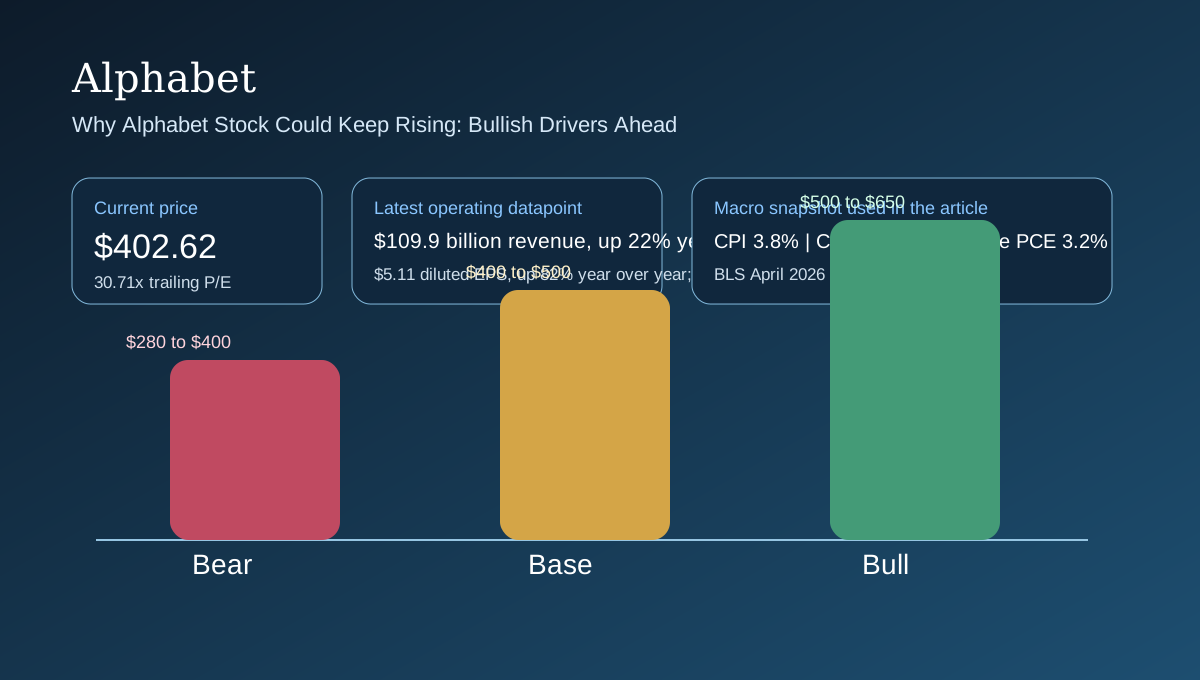
The ranges in this article are not point targets. They are editorial scenario matrices built from Search durability, Cloud growth quality, AI monetization, legal outcomes, and valuation sensitivity. In practical terms, the probability weights ask whether Alphabet can defend the cash engine of Search while adding enough AI- and Cloud-driven upside to broaden the equity story.
| Scenario | Likely outcome | Conditions | Probability |
|---|---|---|---|
| Bull | Alphabet leads the AI rally | Search stays highly monetizable, Cloud expands, and AI products deepen usage rather than dilute it | 35% |
| Base | Measured advance | Operational quality remains strong, though the market keeps some discount for transition risk | 40% |
| Bear rebuttal | Rally fades | Remedies, monetization concerns, or stronger AI competition reassert themselves | 25% |
| Direction | Probability | Comment |
|---|---|---|
| Higher | 50% | Most credible if Alphabet continues proving that AI can be monetized inside Search and Cloud at scale |
| Lower | 15% | Would likely require a more serious deterioration in Search confidence |
| Sideways | 35% | Plausible if strong fundamentals coexist with ongoing valuation skepticism |
| Investor type | Prudent approach | Main watchpoints |
|---|---|---|
| Investor already in profit | Hold a core stake, but trim if valuation starts assuming AI transition risk has fully disappeared | Search monetization and legal remedies |
| Investor currently at a loss | Reassess whether the thesis is Search durability, Cloud growth, or AI optionality and avoid averaging blindly | Cloud margins, Gemini adoption, and sentiment resets |
| Investor with no position | Stage entries or wait for pullbacks rather than chase relief rallies tied to one strong quarter | AI Mode usage and antitrust milestones |
| Trader | Use stop-loss discipline and trade around earnings, remedies headlines, product launches, and Cloud read-throughs | Volatility, ad checks, and court updates |
| Long-term investor | Dollar-cost average only if convinced Alphabet can protect Search economics while broadening Cloud and AI value | Search share, monetization, and Cloud scale |
| Risk-hedging investor | Rebalance if Alphabet has become a concentrated bet on one AI-search transition outcome | Portfolio concentration and mega-cap tech risk |
Conclusion: Alphabet could lead the AI rally if the market decides the company is not merely surviving the search transition but actively turning it into a broader monetization and platform opportunity. Disclaimer: This article is for informational and research purposes only and does not constitute personalized financial advice.
06. FAQ
Frequently asked questions
Is Alphabet still primarily a Search stock?
Yes, Search still drives much of the earnings power, but Cloud, YouTube, subscriptions, and AI products increasingly matter to the valuation story.
What matters most for the next forecast revision?
AI Overviews monetization, AI Mode usage, Google Cloud growth and margins, and DOJ remedies are the most important inputs.
Is the biggest risk AI competition or antitrust?
They are connected. AI competition shapes demand and behavior, while antitrust can affect distribution and monetization economics at the same time.
What would invalidate the optimistic case?
Evidence that AI reduces Search economics materially, weaker Cloud momentum, or more severe remedies than the market expects would all weaken the optimistic case.
Methodology and Invalidation
How to interpret this Alphabet framework and what would change it
Alphabet should not be analyzed like a standard ad-tech stock or like a pure AI platform. The company sits at the intersection of Search, digital advertising, cloud, video, subscriptions, developer infrastructure, and frontier AI products. That makes its valuation unusually sensitive to a few central questions. Can Search remain commercially powerful as interfaces become more conversational? Can Google Cloud become large enough and profitable enough to change how the market values the company? Can Gemini and AI Mode improve user and enterprise behavior without materially weakening ad economics? These are the kinds of questions that make scenario analysis more useful than simplistic point targets.
The factual baseline in these articles comes first from Alphabet’s own reporting. The Q1 2026 release showed revenue of $90.2 billion, Search and other revenue of $50.7 billion, YouTube ads of $8.9 billion, Google Cloud revenue of $12.3 billion, and operating income for Cloud of $2.2 billion. The 2025 Form 10-K then adds important context around legal reserves, capex, contractual commitments, and the company’s risk-factor discussion on antitrust, AI competition, and advertising concentration. Those primary documents are the foundation because they show both the scale of the current business and the legal and strategic pressure points that could change its earnings quality over time.
External sources then help explain what the market is debating now. Reuters’ April 2026 reporting pointed to resilient Search and Cloud, while also highlighting that AI Overviews were monetizing around the same rate as traditional Search. That is a very important sign, but not a final answer. S&P Global’s preview and review work also emphasized that investors are trying to decide whether Alphabet deserves a higher AI multiple or a discount for search disruption risk. Available data suggests the company currently benefits from both resilience and skepticism. That combination is exactly why the forecast ranges here are intentionally scenario-based rather than dependent on a single narrative.
Investor positioning should also reflect horizon. A trader may care most about Search ad checks, Gemini product launches, AI Mode rollout, DOJ remedies headlines, and quarterly Cloud growth. A long-term allocator should care more about whether Search remains monetizable at scale in an AI environment, whether Cloud becomes a larger share of operating value, and whether Alphabet’s optional assets like Waymo and cybersecurity deepen strategic optionality. Someone already in profit may trim if the position has grown too large relative to portfolio risk. Someone with no position may prefer staged entries while the market is still repricing Search’s long-term moat. Different prudent actions can be rational under the same forecast range because time horizon and risk tolerance differ.
What would invalidate a constructive Alphabet outlook? Clear evidence that AI interfaces are damaging Search monetization, that remedies materially weaken default-distribution economics, that Cloud growth slows materially, or that AI spending expands without comparable revenue quality would all weaken the bull case. What would invalidate a more bearish Alphabet view? Continued resilient Search monetization, strong Gemini adoption, sustained Cloud profitability, and evidence that AI Mode improves rather than undermines the user-commercial loop would weaken the downside thesis. The discipline investors should want is simple: each forecast should explain what evidence would make the range move up or down rather than treating Alphabet as permanently safe or permanently threatened.
Inline evidence anchors that discipline. Alphabet’s own earnings and 10-K establish the baseline (Alphabet Q1 2026 earnings release; Alphabet 2025 Form 10-K). Google’s product releases then show how aggressively the company is rolling out Gemini, AI Mode, and Cloud AI tooling (Gemini 2.5; AI Mode update; Cloud Next 2026 wrap-up). External reporting and research frame the active market debate around monetization, regulation, and strategic optionality (Reuters on AI Overviews monetization; Reuters on DOJ remedies; S&P Global post-earnings review). That combined evidence base is why the probabilities in these articles are ranges rather than certainty theater.
References
Sources
- Alphabet, Q1 2026 earnings release
- Alphabet, Form 10-K for fiscal year ended December 31, 2025
- Alphabet investor relations
- Google, Gemini 2.5 model family expands, April 29, 2026
- Google, AI Mode update for Search, May 20, 2026
- Google Cloud Next 2026 wrap-up
- S&P Global, Alphabet post-earnings review Q1 2026
- S&P Global, Alphabet earnings preview Q1 2026
- Reuters, Google results beat as Search ads and Cloud stay resilient, April 24, 2026
- Reuters, AI Overviews monetizing about the same rate as traditional Search, April 29, 2026
- Reuters, Google faces DOJ remedies trial over search monopoly, April 22, 2026
- Reuters, Alphabet to buy Wiz for $32 billion, March 18, 2026