01. Quick Answer
The cleanest Eli Lilly bull case is that few healthcare companies can match its combination of metabolic leadership, manufacturing expansion, and pipeline breadth
Eli Lilly is a healthcare powerhouse if investors increasingly conclude that this is not just a one-cycle obesity winner, but a broader therapeutic and commercial platform where obesity, diabetes, oral formulations, and next-generation indications all reinforce one another. The strongest version of that bull case does not require fantasy assumptions. It requires current demand to remain strong, manufacturing to scale, access to broaden, and follow-on products to expand the franchise rather than merely sustain it.
| Category | Evidence-based read | Implication |
|---|---|---|
| Historical data | LLY moved from about $78.75 to about $1006.70 over 10 years | Long-run upside is credible, but future ranges should reflect both leadership and valuation risk |
| Current market conditions | GLP-1 demand, guidance, and new-product momentum remain very strong | Forecasts should stay scenario-based, not simply extrapolative |
| Institutional signals | Official reporting, Reuters, and S&P all point to powerful execution with a rising burden of proof | Analysts remain constructive, though not blind to concentration and policy risk |
| Most important watchpoints | GLP-1 supply, payer access, oral pipeline, competitor data, and manufacturing scale | These variables will likely shape the stock range more than generic pharma sentiment |
02. Historical Context
Eli Lilly is still a pharma company first, but the modern thesis is increasingly shaped by the GLP-1 platform and manufacturing scale
LLY moved from roughly $78.75 to about $1006.70 over the last 10 years based on Yahoo Finance monthly data, implying a 10-year CAGR of about 29.02%. That is extraordinary for a large-cap pharmaceutical company and reflects more than a good drug cycle. Eli Lilly's modern investment case is driven by obesity and diabetes therapies, manufacturing expansion, pipeline depth, and the company's ability to keep widening a category lead without stumbling on supply, pricing, or policy. The central forecasting challenge is no longer whether Lilly has blockbuster products. It is whether the company can sustain a premium valuation while scaling the GLP-1 platform, defending share, and developing the next wave of therapies.
| Metric | Latest official reading | Why it matters |
|---|---|---|
| Q1 2026 revenue | `$19.8 billion, up 56% | Shows Lilly is still expanding at an unusual pace for a pharma company this large |
| 2026 guidance | `$82-85 billion revenue | Raised full-year guidance confirms continued confidence in demand and execution |
| Mounjaro and Zepbound momentum | Still the central growth engine | The obesity and diabetes franchise remains the most important earnings driver |
| Oral GLP-1 pipeline | Potentially category-expanding | Next-generation formulation success could broaden the addressable market materially |
03. Main Drivers
Five forces are most likely to shape Eli Lilly stock over the next several years
1. GLP-1 demand is still the core economic engine
Lilly's Q1 2026 results and Reuters coverage both make clear that Mounjaro and Zepbound remain the center of gravity. As long as supply, access, and pricing hold up, Lilly has a very powerful demand engine.
2. Manufacturing capacity is now as important as clinical promise
With demand already very strong, the next debate is often less about efficacy and more about how quickly Lilly can expand manufacturing, device formats, and geographic availability without introducing execution bottlenecks.
3. Oral GLP-1 and next-generation obesity products matter to the long-run multiple
Axios and Reuters both highlight that Lilly sees the oral GLP-1 opportunity as additive rather than cannibalistic. If that proves true, Lilly's obesity platform could widen meaningfully.
4. Competitive pressure from Novo and others remains real even if Lilly is leading now
LLY bulls cannot assume a permanently one-sided market. Pipeline data, pricing behavior, payer access, and next-generation efficacy comparisons still matter.
5. Policy, reimbursement, and valuation remain structural risks
When a pharmaceutical company becomes this central to a major therapeutic category, scrutiny increases. Payer behavior, political focus on drug pricing, and the market's willingness to keep supporting a premium multiple all matter alongside product demand.
04. Institutional Forecasts and Analyst Views
The market rewards Lilly's category leadership, but it is asking harder questions about how long exceptional growth can remain exceptional
Official reporting and market commentary support the quality of that bullish story. Lilly keeps raising guidance, demand remains strong, and next-generation product discussions increasingly suggest a broader market rather than a simple replacement cycle. The bull case still needs continued proof, but it no longer depends on one narrow launch story.
| Source | Message | Interpretation |
|---|---|---|
| Lilly official reporting | Revenue and guidance both moved sharply higher in Q1 2026 | Operational quality remains strong |
| Reuters | Weight-loss and diabetes demand remain the central growth driver | Supports a constructive but concentration-aware base case |
| S&P Global | GLP-1 momentum is strong, but execution expectations are now very high | Keeps both upside and disappointment risk visible |
| Axios | Oral GLP-1 could expand the market rather than cannibalize injectables | Strengthens the case for a broader long-run platform story |
05. Bull, Bear, and Base Case
How the forecast range and probability table are built
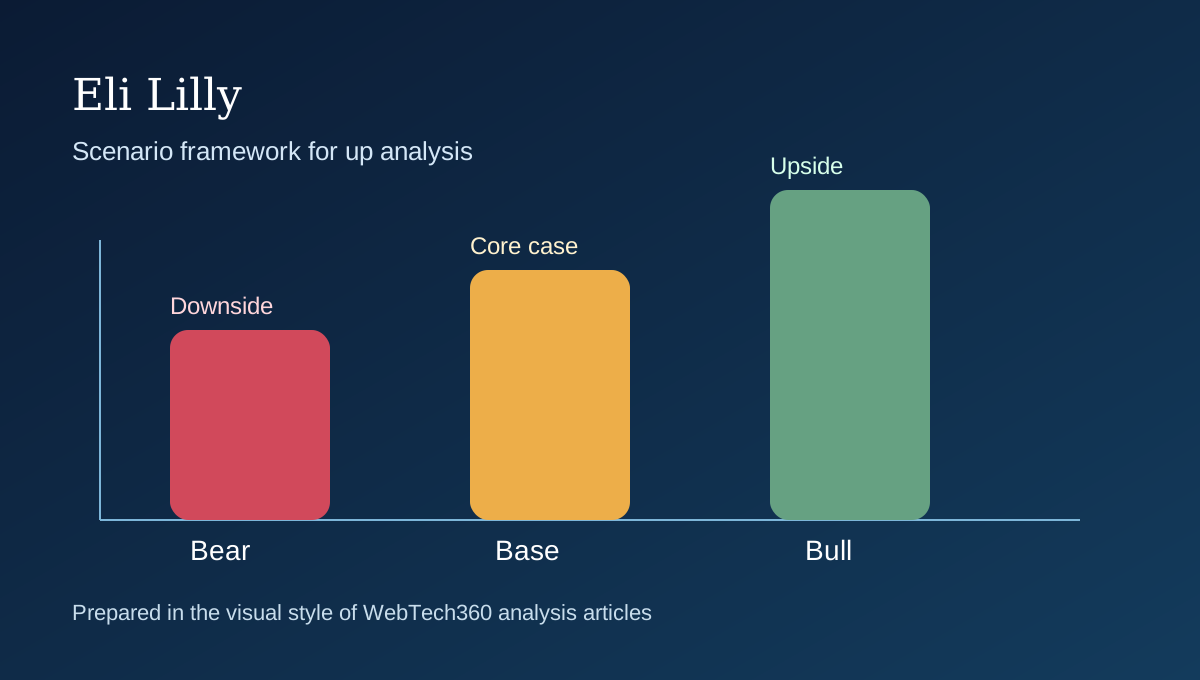
The ranges in this article are not institutional point targets. They are editorial scenario matrices built from current price, 10-year compounding history, GLP-1 franchise durability, manufacturing expansion, payer access, pipeline breadth, competitive dynamics, and the pace at which Lilly can convert scientific leadership into durable earnings quality.
| Scenario | Likely outcome | Conditions | Probability |
|---|---|---|---|
| Bull | Lilly keeps advancing | GLP-1 leadership, oral expansion, and manufacturing scale all improve enough to justify a richer premium | 35% |
| Base | Measured advance | Business quality remains strong, though valuation expansion stays controlled | 40% |
| Bear rebuttal | Rally stalls | Competition, access, or supply concerns reassert themselves | 25% |
| Direction | Probability | Comment |
|---|---|---|
| Higher | 50% | Most credible if Lilly keeps proving it deserves a premium because the platform is broadening, not narrowing |
| Lower | 15% | Would likely require a more serious break in supply, access, or category-leadership confidence |
| Sideways | 35% | Plausible if fundamentals stay strong but the stock needs time to digest extraordinary prior gains |
| Investor type | Prudent approach | Main watchpoints |
|---|---|---|
| Investor already in profit | Hold a core stake, but trim if the position now assumes flawless execution across GLP-1, manufacturing, and pipeline expansion | Position size, valuation premium, and category concentration |
| Investor currently at a loss | Reassess whether the thesis is obesity leadership, pipeline depth, or long-run pharma compounding before averaging down | Supply updates, reimbursement, and competitor data |
| Investor with no position | Stage entries or wait for biotech or pharma pullbacks instead of chasing peak enthusiasm around GLP-1 leadership | Valuation, supply commentary, and pipeline events |
| Trader | Use stop-loss discipline and trade around earnings, FDA events, competitor readouts, and payer headlines | Volatility, options pricing, and event risk |
| Long-term investor | Dollar-cost average only if convinced Lilly can remain a platform company rather than just a one-franchise winner | Pipeline breadth, manufacturing execution, and long-run pricing power |
| Risk-hedging investor | Rebalance if Lilly has become an oversized healthcare growth exposure tied too heavily to one therapeutic category | Portfolio concentration and competitive-reversal risk |
Conclusion: Eli Lilly could keep advancing if the market keeps concluding that obesity leadership, platform breadth, and manufacturing scale are improving the quality and durability of the business faster than critics assume. Disclaimer: This article is for informational and research purposes only and does not constitute personalized financial advice.
06. FAQ
Frequently asked questions
Is Eli Lilly still mainly a GLP-1 story?
GLP-1 remains the central growth engine, but the more important long-run question is whether Lilly can turn that leadership into a broader platform with durable follow-on products and indications.
What matters most for the next forecast revision?
Supply, payer access, oral GLP-1 progress, new indication wins, competitor data, and guidance revisions are the key inputs.
Is the biggest risk competition or reimbursement?
Both matter. Competition affects long-run share and pricing, while reimbursement and policy affect how much of the category can be monetized cleanly.
What would invalidate the bullish case?
Supply problems, weaker payer access, slower next-generation uptake, stronger competition, or sharper policy pressure would all weaken the bullish case.
Methodology and Invalidation
How to interpret this Eli Lilly framework and what would change it
Eli Lilly should not be analyzed like a normal mature pharmaceutical stock, but it also should not be treated as if blockbuster demand automatically removes execution risk. The company sits at the intersection of obesity therapeutics, diabetes care, manufacturing expansion, pricing power, reimbursement dynamics, and next-generation pipeline development. That mix is why point targets without context are often misleading. Lilly can look expensive on conventional pharma multiples and still look justified if the GLP-1 platform keeps widening. It can also look unstoppable right before supply, access, or policy constraints begin to matter more.
These articles therefore anchor their ranges to three things: current price, 10-year growth history, and present operating evidence. Yahoo Finance chart data place LLY around `$1006.70` in mid-May 2026, versus roughly `$78.75` at the start of the 10-year comparison window. That implies a 10-year CAGR of about 29.02%. For a large-cap pharmaceutical business, that is exceptional. But it is not a forecast by itself. Lilly's next decade will depend on whether it can keep translating scientific leadership into manufacturing scale, payer access, and new high-value indications while defending against competition and policy friction.
Primary documents matter most. Lilly's Q1 2026 results showed revenue of `$19.8 billion`, up 56%, and management raised 2026 revenue guidance to `$82-85 billion`. The 2025 Form 10-K adds context around manufacturing commitments, product concentration, litigation, reimbursement, and the importance of pipeline execution. Those materials are important because they show both the magnitude of Lilly's current momentum and the concentration risk that comes with such a dominant franchise in obesity and diabetes.
External reporting helps explain what the market is debating now. Reuters emphasized that Lilly raised annual forecasts because of sustained weight-loss and diabetes demand. Axios highlighted management's view that oral GLP-1 products could expand rather than cannibalize the injectable market. S&P Global framed the quarter around GLP-1 momentum, supply, and the need to keep meeting a very high bar for execution. Available data suggests Lilly benefits from both category leadership and rapidly rising expectations. That combination is exactly why scenario analysis is more useful than a single point estimate.
Investor positioning should therefore reflect horizon. A trader may care most about supply updates, guidance revisions, competitor data, and payer access changes. A long-term allocator should care more about whether Lilly can remain a platform company rather than a one-franchise story. Someone already in profit may trim if the position size now assumes flawless obesity-market dominance. Someone with no position may prefer staged entries after biotech or pharma pullbacks rather than chasing strong prints. What would invalidate a constructive Lilly view? Slower GLP-1 demand growth, reimbursement pressure, supply problems, weaker oral-GLP-1 economics, or tougher competition from Novo and others would all matter. What would invalidate a bearish Lilly view? Continued strong volume, smoother capacity expansion, new indications, and evidence that oral GLP-1 broadens the market would weaken it.
Inline evidence anchors the framework (Yahoo LLY chart API; Lilly Q1 2026 results; Lilly 2025 Form 10-K; Reuters on raised guidance; Axios on oral GLP-1 dynamics; S&P Global post-quarter snapshot). That combined evidence base is why the forecast ranges here are scenario tools rather than certainty theater.
References
Sources
- Yahoo Finance chart API, LLY 10-year monthly history and current price
- Eli Lilly quarterly results hub
- Lilly reports first-quarter 2026 financial results and raises full-year guidance
- Eli Lilly Q1 2026 earnings release PDF
- Eli Lilly annual reports
- Eli Lilly, Form 10-K for fiscal year ended December 31, 2025
- Axios, Lilly does not expect oral GLP-1 pill to hurt injectable sales, February 4, 2026
- Axios, Novo slumps further in fight with Eli Lilly on weight-loss drugs, February 23, 2026
- Reuters, Eli Lilly raises annual forecasts as GLP-1 drugs fuel growth, April 30, 2026
- Reuters, Lilly to launch multi-dose weight-loss drug device in the U.S., February 23, 2026
- Reuters, Lilly launches Mounjaro in India after approval, March 20, 2025
- S&P Global, Eli Lilly post-quarter snapshot, April 2026
- S&P Global, Eli Lilly preview on GLP-1 volume and guidance, April 2026
- Yahoo Finance, Lilly Q1 2026 earnings summary