01. Quick Answer
The MIB bull case rests on broader leadership, not just on Italy trading at a discount
The FTSE MIB closed at 49,116.47 on 2026-05-15, up from 16,198 at the start of its 10-year Yahoo Finance monthly series on 2016-06-01, for a price-only CAGR of about 11.73% (Yahoo Finance 10-year history; recent daily closes). The bull argument is that the market can still move materially higher because its leadership set is broader than many allocators assume. Italy is not only a bank trade anymore.
Available data suggests a credible upside thesis can be built from cash-return financials, defense spending, grid and power investment, and selected AI-related industrial infrastructure. The UniCredit, Leonardo, Enel, and Prysmian disclosures all point to identifiable multi-year drivers. That does not make the bull case certain, but it does make it more than a slogan.
| Point | Why it matters |
|---|---|
| The bull case is now an earnings-mix story | Italy has already rerated enough that future upside needs more than simply looking cheap. |
| Banks still matter, but they are not alone | Defense, utilities, power infrastructure, and premium industrials can all contribute. |
| AI matters indirectly | Data-center power, cabling, and electronics can benefit MIB names even without a large software sector. |
| The best bull case still needs policy discipline | Italy's debt load means macro credibility remains part of the upside story. |
02. Historical Context
A bull case is more credible when it starts from what has already worked and what may now broaden
The last decade proves Milan can surprise on the upside. The FTSE MIB closed at 49,116.47 on 2026-05-15, up from 16,198 at the start of its 10-year Yahoo Finance monthly series on 2016-06-01, for a price-only CAGR of about 11.73% (Yahoo Finance 10-year history; recent daily closes). But the strongest part of the bullish argument is not the backward-looking performance itself. It is the way leadership may be broadening.
Recent years were dominated by the banking rerating. That story can still contribute through capital return, but the market now has additional channels. Leonardo is tied to Europe's defense spending cycle. Enel and Prysmian are tied to grid renewal and electricity demand. STMicroelectronics gives the index limited but real exposure to the electronics side of AI and industrial digitalization. That mix can allow the MIB to keep rising even if banks move from explosive improvement to steadier support.
The bullish case therefore depends on breadth. If several sectors work at once, the market can absorb some normalization in any single leadership group.
| Driver | Evidence | Bullish implication |
|---|---|---|
| Bank capital return | UniCredit and Intesa continue to emphasize shareholder distribution | Supports floor and total-return appeal. |
| Defense spending | Leonardo's industrial plan still points to robust strategic demand | Adds growth that is less tied to Italian GDP. |
| Grid and power capex | Enel and Prysmian remain exposed to long-cycle electricity investment | Creates durable infrastructure-led earnings support. |
| AI-adjacent industrial demand | STMicro and Prysmian show indirect AI exposure | Broadens the story beyond classic value sectors. |
| Area | Why it helps | Main caveat |
|---|---|---|
| Banks | Cash returns and still-healthy profitability | Normalization risk if rates fall faster. |
| Utilities | Visible capex and regulated cash flow | Rate-sensitive and capital-intensive. |
| Defense | Structural European spending support | Execution and procurement timing still matter. |
| Premium industrials | Pricing power and global demand | Global slowdown can still hurt volumes. |
03. Main Drivers
Six forces explain why the MIB could still surge higher from here
1. Italian banks remain unusually important cash-return vehicles. Even if peak net interest income is behind them, they may still produce enough dividends and buybacks to keep supporting the whole benchmark.
2. Defense is turning into a structural European theme. Leonardo gives Italy a blue-chip defense platform that many national indices do not have at comparable scale.
3. Electricity demand is a genuine long-cycle theme. Enel and Prysmian are positioned for networks, grid resilience, and data-center-related power needs.
4. AI can help without turning Milan into a tech index. The benefit is indirect but real through power, connectivity, industrial automation, and electronics, including STMicroelectronics.
5. Italy's market can still rerate if policy credibility holds. The bull case is stronger when investors stop seeing Italy as a temporary trade and start treating parts of the market as strategic holdings.
6. The market does not need heroic GDP growth. A combination of modest growth, contained spreads, and strong company execution may be enough.
04. Institutional Forecasts and Analyst Views
The institutional macro backdrop is modest, which means the bull case must come from sector execution and sustained confidence
The OECD, European Commission, and Banca d'Italia do not project a boom. That is actually useful for the bull case because it prevents lazy optimism. If the MIB still outperforms in that environment, it means listed-company strategy is doing the heavy lifting.
Analysts remain divided because the evidence is mixed. The bulls are right that Italy has more sector-quality than its stereotype implies. The skeptics are right that debt, spreads, and bank normalization remain real constraints. A serious bullish framework has to acknowledge both.
| Source | Positive signal | Why it matters |
|---|---|---|
| Bank results | Large capital return programs remain in place | Support total return and sentiment. |
| Leonardo plan | Order and cash-flow visibility improved | Creates structural defense upside. |
| Enel and Prysmian materials | Grid and electricity capex remains durable | Supports a longer-lived infrastructure theme. |
| STMicro results | AI and data-center electronics demand can add optionality | Broadens sector leadership beyond traditional value. |
05. Scenarios, Risks, and Invalidation
The bull case is credible, but it still needs a clear answer to the main bearish objections
Bullish scenario
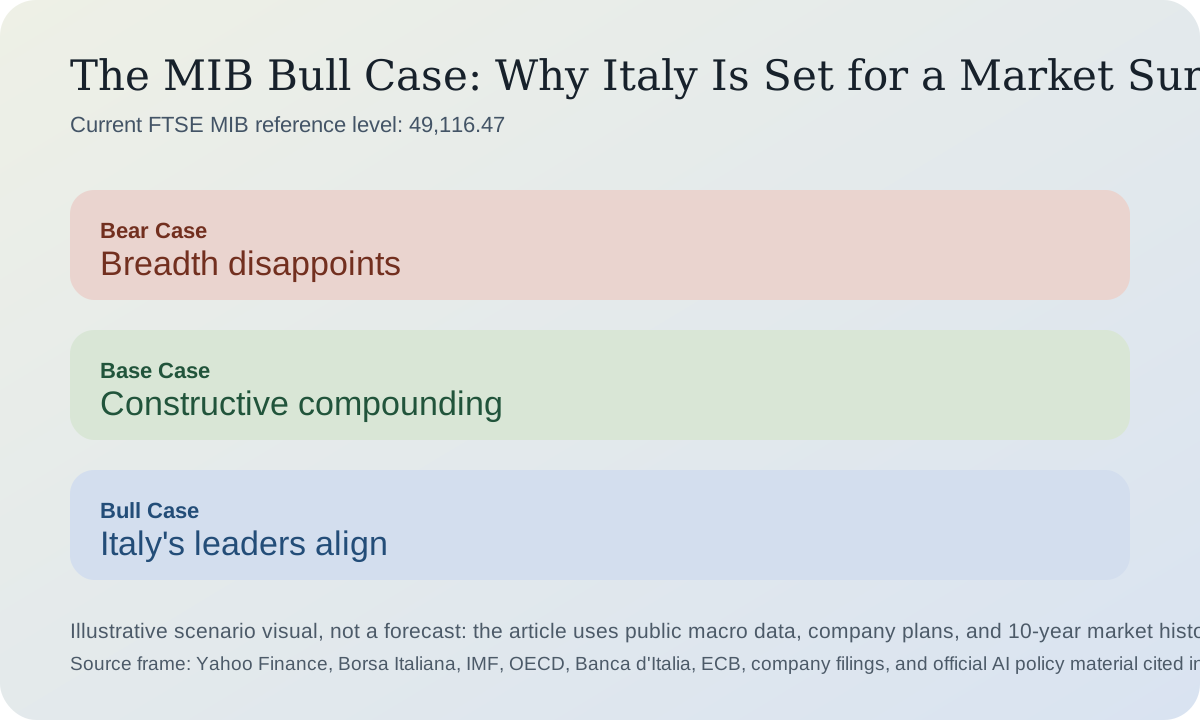
The core bull case is 70,000 to 80,000 by 2030. That path requires resilient bank capital return, contained spreads, durable defense spending, and a continued capex cycle in power and grid infrastructure.
Base-case scenario
The base case is 58,000 to 66,000. This remains constructive, but it assumes the upside arrives more slowly and with more drawdowns.
Bearish counter-scenario
The bull thesis weakens materially if lower rates cut bank earnings more than expected, if Italy's fiscal credibility slips, or if industrial demand slows enough to offset utilities and defense support.
Risks to watch
Watch spreads, the pace of ECB easing, credit quality at banks, energy costs, and whether long-cycle capex programs keep translating into listed-company results.
What could invalidate the bull case
The bullish view would be wrong if the market remains far more dependent on banks than current narratives suggest. It would also fail if the infrastructure and defense themes do not convert into enough earnings breadth to offset weaker financials.
Conclusion
The MIB bull case is no longer about blind faith in cheap Italian equities. It is about a market whose best companies may now have several overlapping structural tailwinds at once. That is a real reason for optimism, provided investors remain disciplined about the risks.
Disclaimer: This article is for research and informational purposes only. Bull cases are conditional scenarios, not promises of future returns.
| Scenario | Range | Conditions | Probability |
|---|---|---|---|
| Bull | 70,000-80,000 | Broader leadership, contained spreads, and sustained capital return | 30% |
| Base | 58,000-66,000 | Constructive compounding with volatility | 45% |
| Bear | 44,000-50,000 | Banks normalize harder and breadth disappoints | 25% |
| Path | Estimated probability | Comment |
|---|---|---|
| Rising | 55% | The market still has multiple credible earnings engines. |
| Falling | 20% | Downside remains real, but not dominant if macro conditions stay orderly. |
| Sideways | 25% | Possible if good company execution is offset by slower macro or spread pressure. |
06. Investor Positioning
Even a bull case requires prudent positioning
| Investor type | Cautious approach | What to watch |
|---|---|---|
| Investor already in profit | Let winners run selectively, but trim if the position is too concentrated. | The best bull case still fails if you ignore position sizing. |
| Investor currently at a loss | Reassess whether your loss comes from entry timing or a broken thesis. | Use the bull case only if the underlying drivers are still intact. |
| Investor with no position | Stage entries and avoid chasing breakouts after strong runs. | The bull case is better pursued through patience than FOMO. |
| Trader | Trade momentum, but respect that the index is still headline-sensitive. | ECB, spreads, and bank earnings can reverse short-term setups fast. |
| Long-term investor | Favor diversified exposure and reinvestment over all-in directional calls. | The bull case works best over time, not in one month. |
| Risk-hedging investor | Pair upside exposure with hedges if sovereign-risk sensitivity is unacceptable. | This is still Italy, not a risk-free compounder. |
07. FAQ
Frequently asked questions about the FTSE MIB outlook
What makes the MIB bull case more credible than in the past?
It is broader. Banks still matter, but defense, grids, electrification, and AI-adjacent infrastructure now add other channels.
Does the bull case require Italy to grow quickly?
No. It mainly requires moderate macro stability plus strong execution from the index's biggest companies.
What is the main risk to the bullish thesis?
That the market is still too dependent on financials and that other sectors do not broaden leadership enough.
References
Sources
- Yahoo Finance chart API for FTSEMIB.MI, 10-year monthly history
- Yahoo Finance chart API for FTSEMIB.MI, recent daily closes
- Borsa Italiana FTSE MIB performance page
- Borsa Italiana monthly market report, March 2026
- IMF 2025 Article IV consultation for Italy
- OECD Economic Surveys: Italy 2026
- European Commission Spring 2026 forecast for Italy
- Banca d'Italia Economic Bulletin 2/2026
- ECB monetary policy decisions, April 2026
- ISTAT consumer prices, April 2026
- UniCredit first quarter 2026 results
- Intesa Sanpaolo first quarter 2026 results
- Leonardo industrial plan update, March 12 2026
- Enel 2026-2028 strategic plan
- Prysmian first quarter 2026 results
- STMicroelectronics first quarter 2026 results
- Stellantis 2025 second-half preliminary results
- AgID Italian artificial intelligence strategy 2024-2026
- IT4LIA AI Factory official page