01. Quick Answer
The cleanest Microsoft bull case is that few companies can match its combination of cloud scale, enterprise trust, product breadth, and AI monetization momentum
Microsoft can remain a top growth pick without requiring investors to believe in fantasy economics. The stronger bull case is straightforward: Azure keeps compounding, Copilot and agents deepen enterprise attachment, AI ARR continues scaling, and the company uses its software, security, and data footprint to monetize AI more efficiently than rivals can. In that framework, heavy spending is not a flaw. It is the cost of reinforcing an already powerful moat.
| Category | Evidence-based read | Implication |
|---|---|---|
| Historical data | Microsoft has repeatedly compounded through enterprise platform depth | Supports a durable long-term growth case |
| Current market conditions | Azure, cloud, and AI demand are strong, but capex is unusually large | The stock needs both growth and proof of return on investment |
| Institutional signals | Reuters and S&P both highlight strong demand alongside spending scrutiny | Analysts remain broadly constructive, but not complacent |
| Most important watchpoints | Azure growth, AI ARR, Copilot seats, capex discipline, OpenAI relationship | These variables will likely shape multiple durability |
02. Historical Context
Microsoft’s long-run equity story is built on enterprise compounding, not on one product cycle
Microsoft has spent years turning itself into a cloud- and subscription-first platform company, and that history matters because it shapes how investors should judge the current AI wave. The company’s annual report and Q3 2026 materials show a business with multiple reinforcing engines: Azure, Microsoft 365, security, LinkedIn, and developer tooling. AI is now accelerating several of those engines, but it is also pushing capital intensity sharply higher. That is why Microsoft’s outlook is not just about whether Copilot sounds impressive. It is about whether the company can translate demand into durable high-return growth without letting capex and competition outrun monetization.
| Metric | Latest read | Why it matters |
|---|---|---|
| Revenue trend | FY26 Q3 revenue of $82.9 billion | Shows Microsoft is still growing quickly at enormous scale |
| Cloud momentum | Microsoft Cloud revenue of $54.5 billion, up 29% | Confirms cloud remains the core of the thesis |
| AI monetization | AI annual revenue run rate above $37 billion | Suggests AI revenue is real, not hypothetical |
| Cost pressure | 2026 capex plan of $190 billion per Reuters | Creates the central debate about returns and margin durability |
03. Main Drivers
Five drivers matter most for Microsoft’s medium- and long-run stock outlook
1. Azure growth remains the core scorecard
Microsoft can launch new AI products, but Azure still does much of the heavy lifting in investor confidence. A 40% growth rate is powerful. If that rate holds better than expected, the bull case gains credibility. If it fades while capex stays high, the debate becomes tougher.
2. Copilot adoption must move from promise to durable monetization
More than 20 million paid seats is meaningful. The question is how much incremental revenue, retention, and workflow lock-in that translates into over several years. Seat growth without pricing durability or usage depth would be less valuable than the market hopes.
3. AI infrastructure spending is both moat building and risk creation
Large capital outlays can widen Microsoft’s advantage if they secure scarce capacity and deepen enterprise lock-in. They can also pressure returns if model economics become more open or if customers slow adoption relative to spending.
4. OpenAI ties still matter, even after exclusivity loosens
Reuters’ reporting on the revised OpenAI deal underscores a subtle shift. Microsoft remains deeply connected to OpenAI, but investors can no longer treat that relationship as an unquestioned exclusivity moat. That places more weight on Microsoft’s own platform, distribution, and model-agnostic strategy.
5. Enterprise breadth is a real strategic advantage
Microsoft’s ability to cross-sell across productivity, security, cloud, data, and developer tools remains one of the strongest reasons the company can monetize AI more effectively than many competitors. That breadth is why even bearish Microsoft arguments need to stay measured.
04. Institutional Forecasts and Analyst Views
The market likes Microsoft’s execution, but it is still interrogating the price of leadership
Official results and product announcements support that optimism. More than 20 million paid Copilot seats, strong Azure growth, and the push into Frontier Suite and enterprise agents all strengthen the argument that Microsoft is building not just features but an operating layer for work. The bull case still requires proof of returns, but it no longer depends on hypothetical demand alone.
| Source | Message | Interpretation |
|---|---|---|
| Microsoft official reporting | Revenue, Azure, and AI ARR remained strong in fiscal Q3 2026 | The operating trend is still favorable |
| Reuters | Investors welcomed stronger cloud guidance but focused on the huge 2026 capex plan | Keeps the debate centered on ROI |
| S&P Global | Preview commentary emphasized Azure, OpenAI, and valuation expectations into 2027 | Supports a balanced range rather than a blind bull case |
| Microsoft AI product disclosures | Frontier Suite, Copilot growth, and agent tooling show product depth | Strengthens the quality of the long-run AI thesis |
05. Bull, Bear, and Base Case
How the forecast range and probability table are built
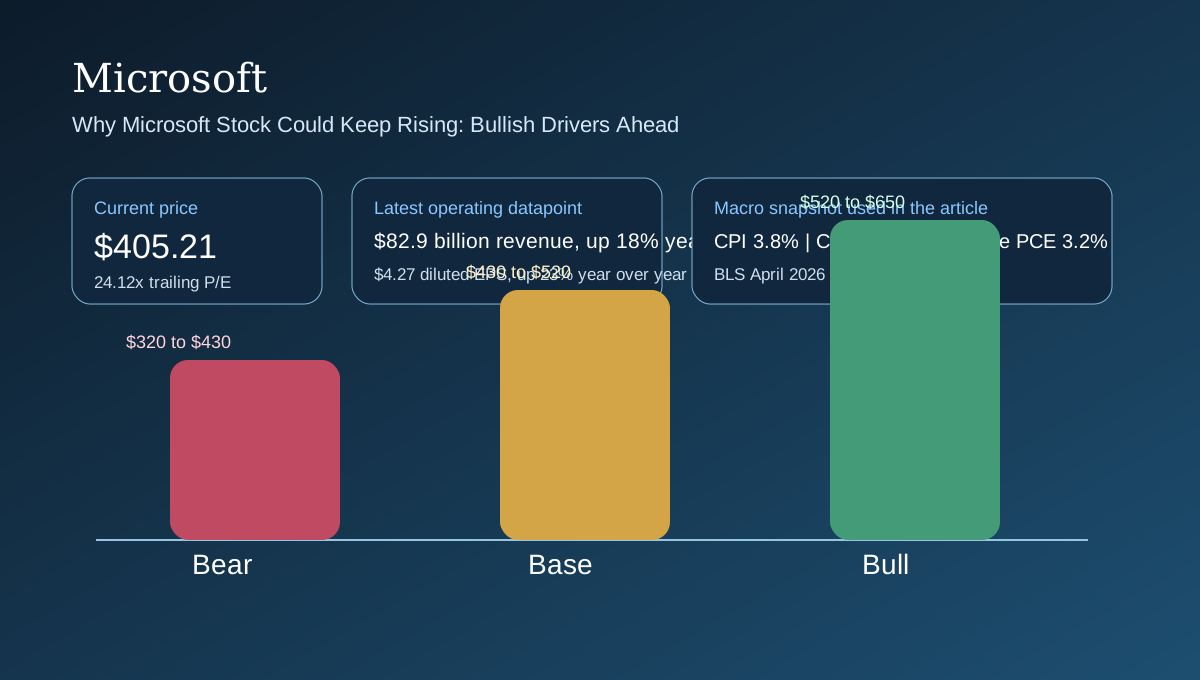
The range in this article is not a promise. It is an editorial scenario matrix built from Azure growth durability, AI monetization, capex intensity, enterprise attachment, and valuation sensitivity. In practice, the probability table below asks how much of today’s spending turns into lasting revenue and how much of Microsoft’s platform advantage remains defensible as models and clouds become more contested.
| Scenario | Likely outcome | Conditions | Probability |
|---|---|---|---|
| Bull | Microsoft keeps outperforming | Azure and AI growth remain strong enough to validate capex and sustain premium valuation | 35% |
| Base | Measured advance | Business quality remains excellent even if valuation expansion is limited | 40% |
| Bear rebuttal | Rally stalls | Spending concerns, weaker AI payback, or broader tech rerating cap the stock | 25% |
| Direction | Probability | Comment |
|---|---|---|
| Higher | 50% | Most credible if Microsoft keeps demonstrating that enterprise AI demand is both large and monetizable |
| Lower | 15% | Would likely require a more serious shift in growth or margin confidence |
| Sideways | 35% | Plausible if quality remains strong but the multiple stops expanding |
| Investor type | Prudent approach | Main watchpoints |
|---|---|---|
| Investor already in profit | Hold a core position, but trim if the stock starts pricing flawless AI ROI despite record capex | Azure growth and capex efficiency |
| Investor currently at a loss | Reassess whether the thesis is enterprise durability or near-term AI momentum and avoid averaging blindly | Copilot monetization and margins |
| Investor with no position | Stage entries or wait for pullbacks instead of chasing euphoric AI narratives | OpenAI developments and earnings revisions |
| Trader | Use stop-loss rules and focus on Azure, capex, and guidance catalysts | Post-earnings volatility and sector rotation |
| Long-term investor | Dollar-cost average only if convinced Microsoft can turn heavy AI spending into durable free-cash-flow compounding | AI ARR, capex intensity, and enterprise wallet share |
| Risk-hedging investor | Rebalance if Microsoft has become an outsized portfolio weight through momentum alone | Concentration risk and broad tech drawdowns |
Conclusion: Microsoft is still a top growth pick if investors believe Azure, Copilot, and its enterprise stack can continue compounding faster than capex, competition, and skepticism can erode that advantage. Disclaimer: This article is for informational and research purposes only and does not constitute individualized financial advice.
06. FAQ
Frequently asked questions
Is Microsoft still a top growth stock?
Available data suggests Microsoft still has strong growth characteristics, but the market increasingly wants proof that AI-related spending can sustain returns rather than just headlines.
What matters most for the next forecast revision?
Azure growth, AI annual revenue run rate, Copilot seat expansion, capex discipline, and the strategic impact of the revised OpenAI relationship matter most.
Is the biggest risk competition or capex?
They are connected. Competition matters more when the capex commitment is unusually large, because weaker differentiation would make that spending harder to justify.
What would invalidate the optimistic case?
Meaningful Azure deceleration, weaker AI adoption, or evidence that capex is outrunning monetization would all weaken the optimistic case materially.
Methodology and Invalidation
How to interpret this Microsoft framework and what would change it
Microsoft stock should not be reduced to a single AI narrative, even though AI is now central to the equity story. The company remains a multi-engine platform business spanning Azure, Microsoft 365, Dynamics, LinkedIn, security, GitHub, Windows, and gaming, with cloud and enterprise software economics still doing most of the heavy lifting. That matters because investors can misread the stock in two opposite ways. One mistake is to assume Microsoft is merely an AI proxy and ignore the durability of its legacy and cloud franchises. The other is to assume those franchises make the AI spending cycle automatically low risk. Neither view is precise enough for a serious long-term forecast.
The articles in this batch therefore build scenario ranges from a mix of official reporting and market interpretation. Microsoft’s fiscal Q3 2026 release and conference call showed revenue of $82.9 billion, Microsoft Cloud revenue of $54.5 billion, AI annual revenue run rate above $37 billion, Azure growth of 40%, and paid Microsoft 365 Copilot seats above 20 million. Those figures establish real momentum. But Reuters reporting also highlighted the other side of the ledger: planned 2026 capital spending of $190 billion, chip-cost pressure, investor concern about returns on AI infrastructure, and a revised OpenAI relationship that remains strategically meaningful while no longer fully exclusive. Available data suggests Microsoft’s outlook is therefore best framed as a balance between exceptional demand and exceptional spending intensity.
Microsoft’s AI case also differs from Apple’s because monetization is already happening inside enterprise workflows and cloud consumption. Official materials around the Frontier Suite, Copilot Wave 3, and the Q3 conference call suggest Microsoft is trying to turn copilots and agents from a feature set into an enterprise operating layer. That is strategically powerful if adoption scales. It also introduces questions around pricing, usage-based economics, product quality, margin mix, and whether customers convert pilots into durable seat growth. Investors should therefore treat AI not as a slogan but as a margin and demand equation: how much new revenue, how much infrastructure cost, and how defensible the platform position remains if model access becomes more open across the industry.
Positioning depends on horizon. A trader may care most about Azure deceleration or acceleration, capex guidance, OpenAI developments, and post-earnings revisions. A long-term allocator should care more about Azure share, enterprise distribution, security attachment, data advantages, AI product stickiness, and whether high capex translates into long-run durable cash flow rather than a shorter-lived boom. Someone already in profit may trim if expectations become too dependent on uninterrupted Azure and Copilot acceleration. Someone with no position may prefer to wait for evidence that AI revenue growth is converting into sustained margin resilience. Again, different prudent actions can be rational under the same forecast range.
What would invalidate a constructive Microsoft outlook? Clear evidence of persistent Azure supply constraints without monetization upside, a more serious loss of AI differentiation as OpenAI and model access become less exclusive, weaker enterprise AI seat expansion, or lasting margin pressure from capex would all matter. What would invalidate a more bearish Microsoft view? Continued 40%-type Azure growth, expanding AI ARR, strong seat additions, durable enterprise wallet share, and evidence that spending is earning attractive returns would all weaken it. Investors should want that falsifiability. The point of a forecast is not to sound confident. It is to explain what would change the range.
Inline evidence anchors the framework. Microsoft’s own quarter, transcript, annual report, and product announcements establish the operational baseline (Microsoft FY26 Q3 release; Q3 call transcript; Microsoft 2025 annual report). External sources then frame the market debate around capex, cloud competition, and OpenAI dependence (Reuters on results and capex; Reuters on the OpenAI deal; S&P Global preview). That combined evidence base is the reason the ranges here are scenario-based rather than certainty theater.
References
Sources
- Microsoft, FY26 Q3 earnings release
- Microsoft, FY26 Q3 earnings conference call transcript
- Microsoft, Form 10-Q for quarter ended March 31, 2026
- Microsoft, 2025 annual report
- Microsoft, FY26 Q3 performance summary
- Microsoft, Introducing the First Frontier Suite, March 9, 2026
- Reuters, Microsoft expects strong cloud growth and plans record capital spending, April 29, 2026
- Reuters, Microsoft and OpenAI change terms of deal, April 27, 2026
- S&P Global, Microsoft earnings preview, April 24, 2026
- Microsoft, FY26 Q3 segment revenue details