01. Quick Answer
The strongest MUFG bull case is that few major banks offer this combination of rate leverage, payout support, and Asia optionality
MUFG is a rare bank where the macro, company, and shareholder-return stories all currently point in the same direction. The ADR closed at 18.84 on 2026-05-15 after a 10-year price CAGR of 15.65% (Yahoo Finance chart API for MUFG, 10-year monthly history; Yahoo Finance chart API for MUFG, recent daily closes). Yet the official earnings bridge still points higher, not lower.
MUFG reported record FY2025 net income of ¥2.427 trillion and is targeting ¥2.7 trillion for FY2026, with an ROE goal of roughly 12%, a dividend forecast of ¥96, and another buyback already approved for the first half (MUFG Financial Highlights under Japanese GAAP for the fiscal year ended March 31, 2026; MUFG Consolidated Summary Report under Japanese GAAP for the fiscal year ended March 31, 2026). For a bank this large, that is serious evidence of a still-improving earnings regime rather than empty bull-market rhetoric.
| Point | Why it matters |
|---|---|
| Higher rates still help | MUFG remains one of the clearest listed beneficiaries of a normalized Japanese rate environment. |
| Payouts are rising | Dividend growth and buybacks make the bull case more tangible. |
| The bank is not only domestic | Asia, integrated capital markets, and Morgan Stanley broaden the upside case. |
| The thesis is still conditional | A disciplined bull case still respects credit and market risk. |
02. Historical Context
The bull case starts with evidence that the old Japanese bank constraints have loosened
For years, the problem with many Japanese banks was not scale, franchise, or safety. It was return on equity. Low rates, modest loan demand, and conservative valuation norms made it hard for investors to imagine a sustained rerating. MUFG's latest results suggest that constraint has loosened meaningfully (MUFG Financial Highlights under Japanese GAAP for the fiscal year ended March 31, 2026; MUFG Report 2025 integrated report).
The bull case becomes credible because current profitability is not being driven by one speculative theme. It reflects higher domestic spreads, stronger customer-segment NOP, improved portfolio outcomes relative to last year's bond rebalancing drag, and a framework that keeps linking better profits to shareholder returns (MUFG Consolidated Summary Report under Japanese GAAP for the fiscal year ended March 31, 2026).
| Metric | Current reading | Bull-case relevance |
|---|---|---|
| FY2025 net income | ¥2.427 trillion | Shows the earnings base is already high enough to matter. |
| ROE | 11.3% | Moves MUFG into a more investable quality band. |
| FY2026 dividend forecast | ¥96 | Strengthens total-return appeal. |
| FY2026 target ROE | Approx. 12% | Suggests management believes the improvement is not done. |
| Advantage | Why it matters | Bull-case effect |
|---|---|---|
| Japan rate leverage | Few global banks have this specific tailwind now | Supports margin and valuation expansion. |
| Morgan Stanley alliance | Adds differentiated capital-markets reach | Improves earnings quality beyond plain domestic banking. |
| Asia growth options | Partner-bank and digital strategy extend the runway | Broadens long-run upside. |
| Capital-return culture | Rising dividends and buybacks make upside tangible | Supports per-share compounding. |
03. Main Drivers
Five reasons the bull thesis remains credible
1. Positive-rate Japan is still a major tailwind. The BOJ's current 0.75% setting is already a regime shift from where Japan spent much of the last decade. MUFG's own assumptions lean toward about 1% for FY2026 (MUFG Financial Highlights under Japanese GAAP for the fiscal year ended March 31, 2026).
2. The profit target is large enough to matter. A ¥2.7 trillion FY2026 target would represent another step up from an already record FY2025 base. That is real operating momentum, not just multiple expansion.
3. Consensus still expects further earnings growth. S&P Global's Visible Alpha-based article supports the idea that the earnings path remains upward over the next two fiscal years.
4. Capital returns are no longer an afterthought. FY2025's dividend was raised to ¥86, FY2026 is forecast at ¥96, and buybacks remain active (MUFG Consolidated Summary Report under Japanese GAAP for the fiscal year ended March 31, 2026). That helps explain why MUFG appeals to both value and income investors.
5. The strategy is broader than domestic loans. MUFG Report 2025 highlights Asia x Digital, customer growth in retail, and integrated-firm collaboration. The bull case is stronger because it has multiple earnings channels.
04. Institutional Forecasts and Analyst Views
The institutional backdrop is one of cautious optimism, which is exactly what a durable bull case needs
Truly credible bull cases usually do not begin with universally euphoric forecasts. They begin with positive but still conditional evidence. That is exactly where MUFG sits today. S&P Global's January 2026 work argued Japanese lenders were unusually well placed to expand margins relative to peers. The May 2026 follow-up extended that story into record-profit expectations for the megabanks.
Meanwhile, the IMF and BOJ are not dismissive; they are balanced. They say the system is resilient, but they also point to specific vulnerabilities. That actually strengthens the bull case's credibility because it means the upside is not being built on denial of risk.
| Source | Bullish takeaway | Limits |
|---|---|---|
| MUFG FY2026 guidance | Earnings and dividends still rising | Management targets still require delivery. |
| S&P Global consensus work | Street still expects profit and NIM improvement | Consensus can reverse if BOJ or credit conditions change. |
| BOJ policy regime | Higher-rate Japan supports bank economics | That support is macro-dependent. |
| Ratings and official stability assessments | No sign of a stressed franchise | Does not remove cyclical or valuation risk. |
05. Scenarios, Risks, and Invalidation
A disciplined bull case still needs explicit guardrails
Bullish scenario
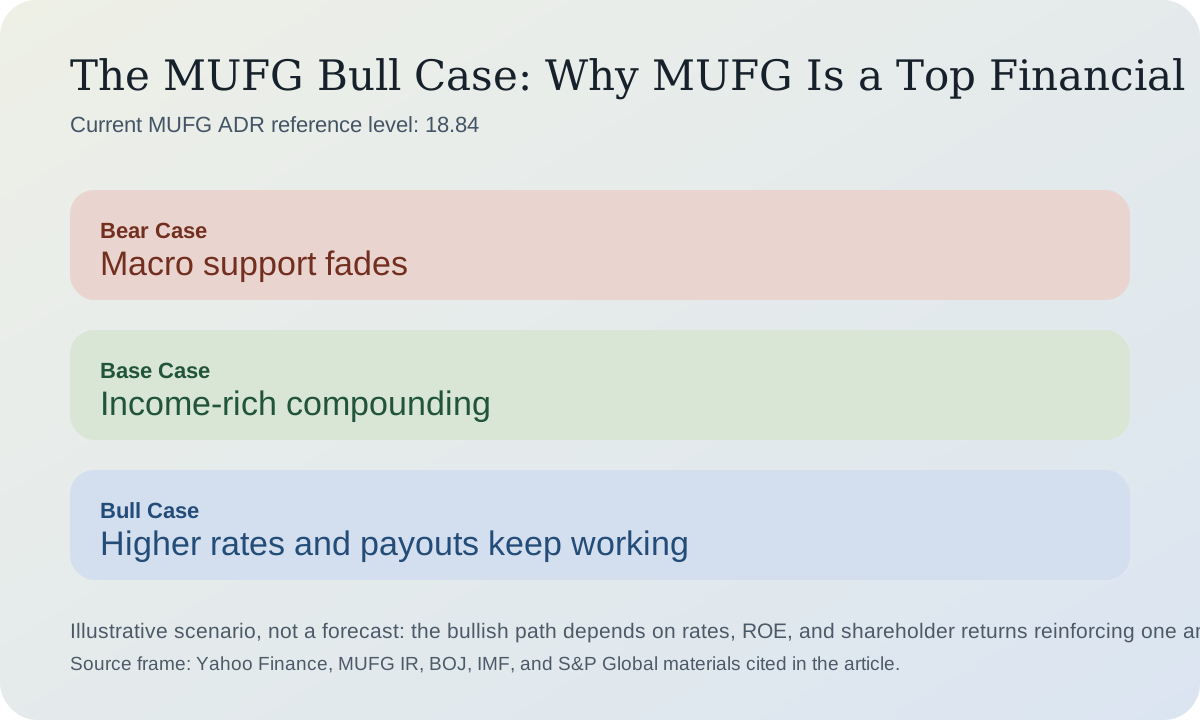
The bull case is $22 to $26 over the medium term and potentially higher if the higher-rate regime proves durable into 2030. This requires sustained earnings delivery, continued buybacks, and no major credit or market shock.
Bearish rebuttal
The bull case weakens if rates stop helping, provisions rise faster than expected, or investors decide that MUFG still deserves an old-style bank multiple despite improved returns.
Base-case scenario
The base case is $19 to $22.50. It assumes the thesis remains positive, but the stock advances in a more income-like and measured way.
Risks to watch
Watch domestic rate expectations, dividend follow-through, securities volatility, and whether ROE remains near the new target zone.
What could invalidate the bullish forecast
This framework is too bullish if higher margins attract offsetting competitive or funding pressure, or if market-value losses begin to dominate the income story. It is too cautious if MUFG earns a more durable premium as investors fully accept the new profitability regime.
Conclusion
MUFG still qualifies as one of the more interesting global financial plays because the macro setup, company execution, and capital-return story currently reinforce one another. The bull case is real, but it remains strongest when expressed with conditions rather than certainty.
Disclaimer: This article is for research and informational purposes only. Bullish scenarios are conditional estimates based on public information and cited sources, not a recommendation to buy any security.
| Scenario | Range | Conditions | Probability |
|---|---|---|---|
| Bull | $22-$26 | Profit delivery, rates, and payouts all stay favorable | 35% |
| Base | $19-$22.5 | The bank compounds steadily without a major rerating | 40% |
| Bear rebuttal | $15-$19 | Macro or market conditions interrupt the better-regime narrative | 25% |
| Direction | Probability | Comment |
|---|---|---|
| Higher | 50% | MUFG has more visible support than many large-bank peers right now. |
| Lower | 15% | The bull thesis weakens only if several supports fade together. |
| Sideways | 35% | Plausible because some of the positive change is already reflected in the stock. |
06. Investor Positioning
Position sizing should reflect starting point, time horizon, and macro tolerance
Bullish investors still need portfolio discipline because even good bank stories can deliver their returns through income and measured compounding rather than uninterrupted price momentum.
| Investor type | Prudent approach | Why |
|---|---|---|
| Investor already in profit | Hold the core, but trim if Japanese bank exposure has become oversized after MUFG's long rerating. | That preserves gains while leaving room for BOJ upside if margins keep widening. |
| Investor currently at a loss | Re-check whether the original thesis was about dividends, rates, or broad value re-rating before averaging down. | Losses in bank stocks often come from wrong catalysts rather than wrong franchises. |
| Investor with no position | Build exposure in stages or wait for pullbacks instead of chasing strong sentiment. | Japanese bank stocks can reprice sharply around BOJ meetings, FX moves, and credit headlines. |
| Trader | Use stop-losses, focus on BOJ dates, JGB volatility, and earnings guidance, and avoid treating dividends as a short-term shield. | Near-term price action is still macro-driven. |
| Long-term investor | Favor dollar-cost averaging, periodic rebalancing, and disciplined review of ROE, CET1, and payout quality. | The long case depends on multi-year profitability, not one quarter of excitement. |
| Risk-hedging investor | Consider hedging market beta or rebalancing against cyclical financial exposure. | MUFG can be a hedge against rising Japanese rates, but not against every global risk shock. |
07. FAQ
Frequently asked questions about the MUFG bull case
Why call MUFG a top financial play?
Because few large banks currently combine positive-rate leverage, rising payouts, Asia growth optionality, and improving ROE in the way MUFG does.
What is the main risk to the bull case?
The main risk is that the macro rate tailwind fades before the market fully trusts the new earnings level.
Is MUFG's upside mainly about dividends?
No. Dividends matter, but the stronger part of the thesis is better earnings quality plus shareholder returns.
References
Sources
- Yahoo Finance chart API for MUFG, 10-year monthly history
- Yahoo Finance chart API for MUFG, recent daily closes
- MUFG Financial Highlights under Japanese GAAP for the fiscal year ended March 31, 2026
- MUFG Consolidated Summary Report under Japanese GAAP for the fiscal year ended March 31, 2026
- MUFG Report 2025 integrated report
- MUFG strategy page and medium-term business plan
- Bank of Japan Statement on Monetary Policy, April 28, 2026
- IMF staff concluding statement for the 2026 Article IV mission to Japan
- Bank of Japan Financial System Report, April 2026
- S&P Global Market Intelligence on Japan megabank earnings expectations, May 2026
- S&P Global Market Intelligence on Japanese lender margin outlook, January 2026