01. Quick Answer
The nat gas bull case is credible because the market can tighten fast when LNG, weather, and firm-power demand arrive before supply does
NYMEX natural gas futures settled at about $3.04/MMBtu on May 18, 2026 on the Yahoo Finance chart API, NG=F 1-month daily data, while EIA's official monthly Henry Hub benchmark averaged $2.77/MMBtu in April 2026 according to the EIA, Short-Term Energy Outlook: Natural gas, May 12, 2026. That split matters. Futures reflect the market's latest expectations and risk premium, while the Henry Hub cash benchmark is the cleaner official anchor for medium-term scenario work.
The bullish argument is not that natural gas is scarce today. It is that the current price still underestimates how quickly balances can tighten when several known forces line up: export growth, colder weather, lower storage, AI-era power demand, and delays to the global LNG easing wave.
| Category | Evidence-based read | Implication |
|---|---|---|
| Historical proof | Gas reached more than $10/MMBtu in 2022 and nearly $7.8 intramonth in January 2026. | The market has already shown it can overshoot to the upside. |
| Structural support | LNG exports and power demand are both rising. | The demand floor is stronger than it was in earlier shale-only cycles. |
| Near-term friction | Global LNG easing has been delayed, not canceled. | Shortages and risk premium can persist longer than expected. |
| Important discipline | Bullish outcomes still need supply underperformance or demand surprise. | A bull thesis without conditions is weak analysis. |
02. Historical Context
The best bull-case evidence is the market's own history
Over the last decade, the same benchmark has traded from a 10-year low near $1.43/MMBtu in June 2020 to a 10-year high near $10.03/MMBtu in August 2022 based on the Yahoo Finance chart API, NG=F 10-year monthly data. That range is why any serious natural gas forecast needs regimes and probabilities, not a single heroic target. The 2022 crisis showed that domestic shale abundance does not fully protect the U.S. benchmark once LNG exports link the market to global scarcity. The January 2026 move toward the upper 7s showed that the market can still reprice sharply even without returning to 2022's extreme geopolitics.
Those episodes do not prove that a new supercycle is guaranteed. They do prove that upside scenarios deserve serious probability weight. A commodity with this kind of convexity should not be analyzed as if a 3-dollar handle is automatically stable.
| Marker | Approximate level | Interpretation |
|---|---|---|
| June 2020 low | $1.43/MMBtu | Pandemic-era demand destruction and oversupply showed how quickly gas can break when storage and weather turn against bulls. |
| August 2022 high | $10.03/MMBtu | The European energy crisis and LNG-linked scarcity proved that U.S. gas is no longer insulated from global stress. |
| March 2024 low close | $1.76/MMBtu | Warm weather, strong output, and ample inventories can still push the market back toward sub-$2 conditions. |
| January 2026 spike | $7.83 intramonth high | Short-term squeezes remain possible when winter weather, storage withdrawals, and export utilization line up. |
| May 18, 2026 close | $3.04/MMBtu | The latest tape sits near the middle of the long-run range, which is why scenarios matter more than momentum extrapolation. |
03. Bullish Drivers
Five reasons natural gas prices could soar higher
1. LNG export growth keeps tightening domestic balances
EIA, U.S. natural gas exports to grow nearly 30% by 2027 as LNG facilities ramp up, April 17, 2026 projects U.S. LNG exports rising to 18.2 Bcf/d in 2027, and the Shell LNG Outlook 2025 press release remains constructive on global LNG demand into 2040. If U.S. terminals keep running near capacity, Henry Hub becomes more exposed to global scarcity than many domestic-only models assume.
2. The LNG easing wave has already been delayed
The IEA, Gas Market Report Q2 2026 executive summary says Middle East disruption has delayed the easing effect of new LNG capacity by at least two years. That means the market may stay tighter for longer even if the long-run supply story remains constructive.
3. Data-center growth can support gas-fired generation
The EIA press release, strongest four-year growth in U.S. electricity demand since 2000, fueled by data centers, January 13, 2026 and IEA, Energy and AI: Energy supply for AI both point to stronger electricity demand, and IEA explicitly says natural gas and coal together may meet more than 40% of incremental data-center electricity demand through 2030. Gas is not the only answer, but it is one of the fastest scalable ones.
4. Storage and weather can still squeeze a balanced market
Even a market that looks comfortable on annual averages can spike if storage runs below average into winter or if cold weather arrives when export utilization is already high. This is one reason a medium-term bull case can coexist with a fairly modest annual-average baseline.
5. Long-term official models still sit above current futures
The EIA, Annual Energy Outlook 2026 year-by-year data workbook places the early 2030s above the current strip, with Henry Hub around $4.48 in 2030 and $5.05 in 2035 in real terms. That is not a bull-market forecast by itself, but it supports the argument that today's market may still be underpricing longer-run tightening.
| Driver | What the latest evidence suggests | Why it matters for price |
|---|---|---|
| LNG exports | EIA expects U.S. LNG exports to rise from 15.1 Bcf/d in 2025 to 17.0 in 2026 and 18.2 in 2027. | Higher export capacity links Henry Hub more tightly to global gas balances. |
| Associated gas | May 2026 STEO assumes more oil-linked gas output from the Permian than earlier forecasts did. | If oil stays firm, gas supply can grow even without a gas-drilling boom. |
| Storage | EIA estimated March-end inventories at 1,908 Bcf, around 4% above the five-year average. | Storage direction affects whether winter risk premium can stick. |
| Global LNG security | IEA says Middle East disruption has delayed the LNG easing wave by at least two years. | International tightness can still pull U.S. gas prices higher through arbitrage and export utilization. |
| Power demand and AI | EIA and IEA both point to data centers as a meaningful electricity-demand driver through 2027 and beyond. | Natural gas remains one of the fastest scalable firm-power options in many U.S. regions. |
04. Institutional Forecasts and Analyst Views
The bull case draws strength from demand persistence and delayed supply relief
The EIA, We expect Henry Hub natural gas spot prices to fall slightly in 2026 before rising in 2027, January 14, 2026 is still useful for the bullish argument because it shows how quickly official models can move toward tighter balances when LNG feedgas demand outruns supply growth. The IEA, Gas Market Report Q2 2026 executive summary adds a global support layer by arguing that LNG easing has been delayed. Meanwhile, the EIA press release, strongest four-year growth in U.S. electricity demand since 2000, fueled by data centers, January 13, 2026 and IEA, Energy and AI: Energy supply for AI show that power demand is becoming a more structural support variable.
The weakness in the bull case is that not all of these supports arrive at once in the base case. To argue for materially higher prices, you need export strength, a less elastic supply response, and at least periodic weather or storage pressure. That is why the bull case is plausible, but conditional.
| Source | Bullish signal | Why it matters |
|---|---|---|
| EIA January 2026 commentary | 2027 could approach the mid-$4s. | Shows how quickly balances can tighten in official models. |
| EIA LNG export outlook | Exports continue climbing through 2027. | Domestic gas remains tied to international demand. |
| IEA Gas Market Report Q2 2026 | LNG easing delayed by at least two years. | Global tightness can persist longer. |
| IEA Energy and AI | Gas remains a major provider of incremental data-center power. | Supports structural power demand. |
| EIA AEO 2026 | Early-2030s baseline sits above current futures. | Long-run official modeling is not cheap-gas forever. |
05. Bull, Base, and Bear Case
How high could nat gas go under a credible bullish setup?
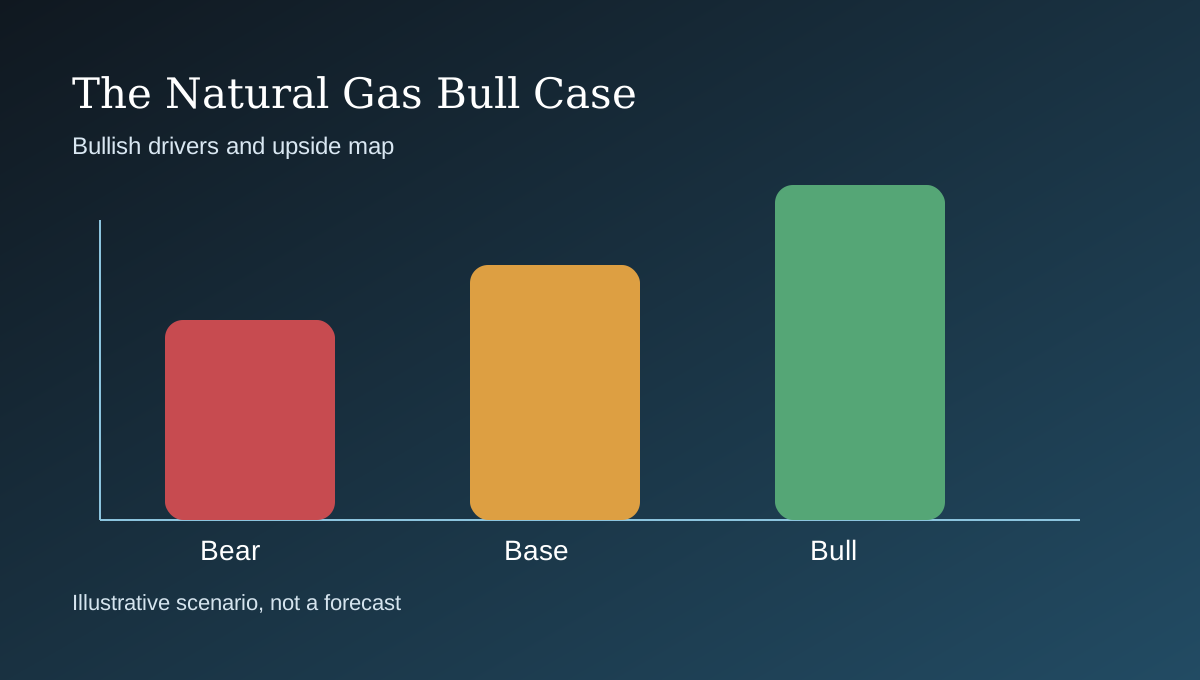
The bull case below is not a claim that prices must soar. It is a map of what would need to happen for a higher regime to become the market's center rather than its tail.
| Scenario | Price range | Conditions | Probability |
|---|---|---|---|
| Bear | $2.50-$3.50/MMBtu | Supply remains comfortable and export demand is absorbed without tightness. | 20% |
| Base | $3.75-$5.00/MMBtu | Export and power demand improve enough to lift the floor, but supply still responds. | 45% |
| Bull | $5.25-$7.50/MMBtu | LNG stays tight, storage runs lean, weather turns supportive, and supply response disappoints. | 35% |
| Direction | Probability | Comment |
|---|---|---|
| Probability of rising | 50% | Long-run and structural evidence gives the upside a meaningful chance. |
| Probability of falling | 20% | Downside remains possible, but it needs comfort on both storage and supply. |
| Probability of moving sideways | 30% | Often the default when one bullish force is offset by one bearish force. |
| Investor type | Prudent approach | Main watchpoints |
|---|---|---|
| Investor already in profit | Hold a core position if the thesis still depends on LNG growth or higher structural demand, but trim into sharp weather-driven spikes. | Watch whether rallies are backed by storage draws and export strength or only by short-covering. |
| Investor currently at a loss | Re-underwrite the thesis before averaging. A commodity can be right long term and still punish poor entries. | Separate structural LNG demand from short-term weather trades. |
| Investor with no position | Avoid chasing vertical moves. Wait for pullbacks, scale in gradually, or stay out when risk-reward is asymmetric. | Natural gas often offers better entries after volatility rather than during it. |
| Trader | Use stop-losses, respect seasonality, and follow storage, weather, production, and LNG feedgas daily. | Fast price moves can reverse before a macro thesis has time to play out. |
| Long-term investor | Dollar-cost averaging can work only with small sizing and a clear tolerance for drawdowns. | A cyclical energy asset should not be sized like a stable compounder. |
| Risk-hedging investor | Use natural gas as part of a broader inflation or energy-security hedge basket, then rebalance when the hedge becomes a crowded directional bet. | Gas can diversify some macro risks while creating weather and policy risk of its own. |
| Invalidation trigger | Why it matters | Effect on thesis |
|---|---|---|
| Associated gas growth overwhelms export growth | Would keep balances loose despite demand gains. | Bull probabilities fall. |
| Global LNG repairs and capacity come back faster than expected | Would reduce international support. | Upper-end price targets lose credibility. |
| AI-related power demand is served mostly by non-gas resources | Would reduce structural gas burn. | The bull case would look too aggressive. |
The nat gas bull case is strongest when viewed as a scenario framework rather than a promise. Disclaimer: This article is for research and informational purposes only and is not personalized financial advice.
06. FAQ
Frequently asked questions
Can natural gas really revisit 5 to 7 dollars?
Yes. History shows that higher prices are possible, but they usually require multiple bullish inputs at the same time.
What is the single strongest bullish driver?
LNG export demand is the strongest structural bullish driver because it ties the U.S. market more closely to global scarcity.
Does AI automatically make gas bullish?
No. AI supports electricity demand, but the price impact depends on how much of that load is actually met by gas-fired power.
Why should investors avoid chasing nat gas rallies?
Because gas often overshoots on weather and positioning, then reverses quickly even when the broader bull thesis remains intact.
References
Sources
- Yahoo Finance chart API, NG=F 10-year monthly data
- Yahoo Finance chart API, NG=F 1-month daily data
- EIA, We expect Henry Hub natural gas spot prices to fall slightly in 2026 before rising in 2027, January 14, 2026
- EIA, U.S. natural gas exports to grow nearly 30% by 2027 as LNG facilities ramp up, April 17, 2026
- EIA press release, strongest four-year growth in U.S. electricity demand since 2000, fueled by data centers, January 13, 2026
- EIA, Annual Energy Outlook 2026 year-by-year data workbook
- IEA, Gas Market Report Q2 2026 executive summary
- IEA, Energy and AI: Energy supply for AI
- Shell LNG Outlook 2025 press release
- World Bank, Commodity Markets Outlook, April 2026
- IMF, World Economic Outlook, April 2026
- TD Economics, Commodities Quick Take, May 2026