01. Quick Answer
The best Nestle bull case is that the company can become a better quality compounder than its flat stock chart suggests
The market already knows Nestle is large, global, and cash generative. What it has not fully trusted in recent years is that the company can turn those strengths into better growth quality and a more attractive earnings mix.
That is why the bull case starts with recent evidence, not nostalgia. Q1 2026 organic growth of 3.5%, strong coffee momentum, a maintained 2026 outlook, and management's ongoing focus on growth platforms and savings all support a more constructive long-term view (Q1 2026 press release; strategy overview).
| Point | Why it matters |
|---|---|
| The bull case is rooted in better growth quality | Nestle does not need dramatic sales growth if volumes, margins, and category mix all improve. |
| Coffee and petcare are central upside drivers | Those categories offer the clearest route to a stronger earnings profile. |
| Cash flow and dividends make patience easier | Long-term winners in staples often compound through consistency rather than excitement. |
| The bull case still needs a rebuttal to bearish risks | Nutrition and water issues, plus sector fragmentation, are the main reasons the upside case is not automatic. |
02. Historical Context
Nestle's operating durability has held up much better than the market's enthusiasm, which is exactly why the bull case still matters
The stock's roughly flat 10-year price CAGR obscures a business that never stopped producing scale, cash flow, and category depth. That mismatch can create opportunity if management restores enough confidence for the market to pay more for those qualities.
Nestle's 2025 Annual Review still shows a group with CHF 89.5 billion in sales, CHF 14.4 billion in UTOP, and a dividend record that management has maintained or increased in Swiss francs for 66 years. Those are not traits of a broken enterprise. They are traits of a quality franchise that needs a stronger next chapter.
| Metric | Latest sourced reading | Why it matters |
|---|---|---|
| Dividend proposal for FY 2025 | CHF 3.10 per share | Supports the long-term hold case and reduces the pressure for explosive capital gains. |
| Q1 2026 coffee signal | Broad-based acceleration and double-digit OG | Strengthens the idea that Nestle's best categories can carry the portfolio. |
| 2026 free cash flow guide | Above CHF 9 billion | A major support for dividends, patience, and strategic flexibility. |
| Nutrition and health ambition | Target to grow more nutritious product sales by CHF 20-25 billion by 2030 | Shows the company still has a credible long-run growth agenda beyond defensive staples status. |
| Data point | Reading | Interpretation |
|---|---|---|
| 10-year price stagnation | About 0.38% CAGR | Creates upside room if the market stops treating Nestle as a tired bond proxy. |
| 2021 high | CHF 127.44 | Shows the market can assign a much richer quality premium when sentiment is supportive. |
| Category breadth | Coffee, petcare, nutrition, food & snacks, and water | Multiple engines lower the chance that a single weak category breaks the whole thesis. |
| Global scale | 185 countries | Supports diversification, pricing, sourcing, and resilience over long cycles. |
03. Main Drivers
Five arguments make the bull case credible despite the stock's frustrating history
1. Coffee is a better business than many slower packaged-food lines
Nestle's current disclosures keep pointing back to coffee as the strongest category. Strong brands, innovation, and global relevance make it a logical driver of a better long-term mix.
2. Petcare and nutrition extend the franchise beyond traditional pantry staples
These businesses give Nestle exposure to attractive, habit-driven categories that can grow even when legacy processed-food markets are mature or more promotional.
3. Cost savings can fund growth instead of replacing it
The strategy target of CHF 3.0 billion savings by end-2027 matters because management explicitly links efficiency to bolder investment in successful brands and platforms. If that linkage holds, Nestle can grow while getting leaner.
4. Nutrition and wellness positioning can improve over time
Nestle's target to add CHF 20-25 billion of sales from more nutritious products by 2030 is not a short-term valuation trigger, but it supports the long-run idea that the portfolio can evolve toward better demand pockets (Nestle nutrition target).
5. The market does not need to become euphoric for bulls to win
Because the starting valuation has already compressed over the last decade, the bull case can work with only moderate multiple expansion if earnings quality improves consistently.
| Lever | Latest evidence | Forecast impact |
|---|---|---|
| Coffee | Best recent category momentum | Supports both earnings quality and the equity narrative. |
| Petcare | Defensive category with room for premiumization | Strengthens the long-term growth mix. |
| Nutrition-health agenda | CHF 20-25 billion target by 2030 for more nutritious product sales | Adds strategic optionality beyond classic staples demand. |
| Savings plus reinvestment | CHF 3.0 billion target by end-2027 | Can improve margins without starving the brand portfolio. |
04. Institutional Forecasts and Analyst Views
The most convincing bullish evidence is not hype, but a set of operating signals that could gradually restore Nestle's premium
Nestle's public materials do not support a fantasy narrative. What they do support is a credible case for gradual improvement: better Q1 2026 momentum, a maintained 3% to 4% growth guide, explicit medium-term margin ambitions, and a clear focus on the categories that matter most.
That combination is enough to support a constructive long-term view if investors stay patient. The market does not need Nestle to become fast growing. It needs the company to become reliably better than the muted expectations already embedded in the stock.
| Source | What it says | Implication for NESN |
|---|---|---|
| Q1 2026 press release | Growth momentum was strong across most zones and categories, especially coffee and food & snacks | Shows the bull case is grounded in current operating data rather than distant hope. |
| Strategy overview | Focus on global platforms, successful brands, and cost savings to fund growth | Provides a coherent management blueprint for long-term upside. |
| Capital Markets Day 2024 | About 4% organic growth in normal conditions and above-17% UTOP margin | Represents the operational benchmark bulls want Nestle to approach. |
| Nutrition target and Nescafe Plan 2030 | Evidence of long-horizon portfolio investment | Supports the idea that Nestle is still shaping future demand rather than merely defending the past. |
05. Scenarios
Bull, base, and bear views through a bullish lens
This article is bullish, but not blindly so. The upside case is strongest when it is confronted directly with the reasons it might fail.
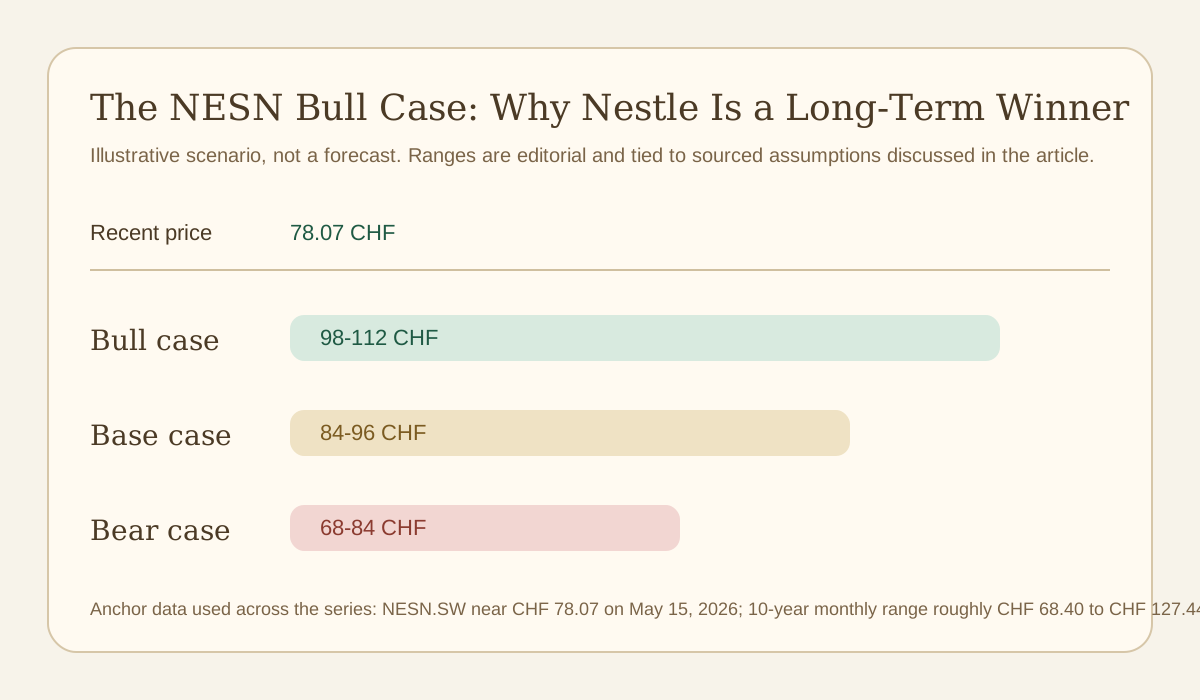
The ranges below therefore include a bear rebuttal and a realistic base case, rather than pretending the only outcome is a straight climb.
| Scenario | Range | What would likely drive it | Editorial probability |
|---|---|---|---|
| Bull | CHF 98-112 | Coffee, petcare, and nutrition quality improve enough for earnings and valuation to rise together. | 34% |
| Base | CHF 84-96 | Nestle compounds steadily, but valuation expansion remains modest and periodic setbacks continue. | 43% |
| Bear rebuttal | CHF 68-84 | Operational issues or soft food demand limit how far the market is willing to rerate the stock. | 23% |
| Outcome | Probability | Interpretation |
|---|---|---|
| Rising | 48% | The upside odds are better here because the current starting point already reflects years of caution. |
| Falling | 21% | Bearish risks remain, but they are balanced by cash flow and category strength. |
| Moving sideways | 31% | Still plausible if operations improve but not enough to transform sentiment. |
| Risk | Why it matters | What to monitor |
|---|---|---|
| Nutrition recovery stays messy | Could weaken the quality-improvement story. | Consumer offtake and management confidence in normalization. |
| Water overhang persists | Could keep governance and portfolio simplification questions alive. | Partnering progress and regulatory developments. |
| Cost savings harm brand investment | A false efficiency program would eventually hurt growth. | Advertising, innovation cadence, and market-share trends. |
| Food-sector fragmentation deepens | Could make incumbent scale less valuable than bulls assume. | Private-label share and channel shifts across major markets. |
| Condition | Why it would change the view |
|---|---|
| Weak coffee momentum after 2026 | That would remove the clearest operational pillar of the bull case. |
| Little progress toward margin goals | That would undermine the idea that Nestle can become a better-quality compounder. |
| Structural erosion in key categories | That would challenge the thesis that Nestle's scale still creates a durable moat. |
06. Investor Positioning
What a prudent investor might do if they lean bullish on Nestle
Even a bullish Nestle view should stay disciplined. The stock is better suited to gradual accumulation and portfolio construction than to aggressive all-in behavior.
| Investor type | Prudent stance | Why |
|---|---|---|
| Investor already in profit | Hold and let the dividend work, trimming only for portfolio-balance reasons | The bull case depends on continued compounding rather than one explosive move. |
| Investor currently at a loss | Assess whether the business thesis is improving before averaging down | The bull case is stronger when based on current data, not just attachment to an old entry point. |
| Investor with no position | Build through dollar-cost averaging or buy on pullbacks | This matches the slow-but-credible nature of the upside thesis. |
| Trader | Avoid chasing defensive spikes and focus on earnings-quality signals | Nestle usually rewards patience more than speed. |
| Long-term investor | Emphasize free cash flow, dividends, and quality-of-growth markers | Those are the real drivers of long-term winners in staples. |
| Risk hedger | Let Nestle be part of a defensive sleeve, but keep separate hedges for market risk | A bull case does not eliminate portfolio downside elsewhere. |
07. Conclusion
Nestle can still be a long-term winner if investors judge it as a compounding franchise rather than a momentum stock
The strongest bullish argument is that Nestle's operating franchise remains better than its recent stock performance suggests. Better coffee trends, disciplined cost savings, nutrition-health optionality, and stable cash generation all support that case.
The counterargument is also real: a fragmented food sector, nutrition setbacks, and water overhangs mean the company has to earn back trust. That is why the best bull case is balanced. It does not promise certainty. It argues that the odds of moderate long-term success may now be better than the market is pricing.
Disclaimer: This article is an editorial scenario analysis based on public information available as of May 16, 2026. It is not personalized investment advice, and the ranges above should be read as conditional outcomes rather than promises.
08. FAQ
Frequently asked questions
Why would Nestle be a long-term winner if the stock has been flat for years?
Because a flat stock can still become attractive if the underlying business quality improves and the valuation starts from a more disciplined base.
What makes coffee so important to the bull case?
Coffee currently looks like Nestle's clearest growth and quality engine, with brand power, innovation, and better economics than many slower food categories.
Does the bull case depend on a major acquisition?
No. The cleaner version of the thesis depends more on internal execution, mix improvement, and margin repair than on deal-making.
What is the main bull-case risk?
The main risk is that Nestle remains a decent business but never convincing enough to deserve a richer multiple.
References
Sources
- Yahoo Finance chart API for NESN.SW 10-year monthly price history and recent price data
- Nestle annual report hub
- Nestle Annual Review 2025 PDF
- Nestle full-year results 2025 press release
- Nestle full-year results 2025 prepared remarks PDF
- Nestle full-year results 2025 transcript PDF
- Nestle three-month sales 2026 press release
- Nestle Q1 2026 investor call transcript PDF
- Company-compiled analyst consensus before Nestle Q1 2026 sales
- Nestle Capital Markets Day 2024
- Nestle investor strategy overview
- Nestle 2025 operating segment and product restatements PDF
- Nestle nutrition-sales target for 2030
- Nescafe Plan 2030
- McKinsey State of Food and Beverage, 2026