01. Quick Answer
The next Nifty rally, if it comes, will likely be earnings-led rather than purely valuation-led
The strongest bullish case for the Nifty 50 is that India combines above-peer economic growth, resilient domestic flows, lower inflation pressure, and a renewed private investment cycle. If those pieces line up, the index could move materially higher from current levels without needing an unsustainably rich multiple. But the evidence is mixed on a pure momentum melt-up because current valuation already assumes a lot of macro resilience.
- The best bull case is rooted in profits, not slogans.
- Domestic SIP flows are one of the clearest structural supports for the index.
- A mega-rally likely needs broader leadership beyond banks and a few mega caps.
- The bullish case fails if oil, valuations, or earnings breadth turn against it.
02. Current Market Snapshot
A bull case starts with recognizing both strength and limits
As of May 15, 2026, the Nifty 50 closed near 23,643.50, according to Yahoo Finance chart data[1]. That puts the benchmark well above its 10-year monthly low of 8,185.80 but still below the 1-year high of 26,328.55 reached on January 02, 2026[1]. In other words, this is not a washed-out index, but it is no longer trading at the peak optimism seen in early 2026.
The official April 30, 2026 Nifty factsheet adds useful context: the index still showed a negative 1-year price return of 1.38%, a 5-year price CAGR of 10.40%, a P/E of 20.94, a P/B of 3.29, and a dividend yield of 1.3%[2]. Those figures matter because most long-range Nifty forecasts ultimately come down to three variables: earnings growth, starting valuation, and how much domestic liquidity continues to cushion external shocks.
| Metric | Value | Why it matters |
|---|---|---|
| Recent close | 23,643.50 on May 15, 2026 | Starting point for all scenario work |
| 10-year range | 8,185.80 to 26,202.95 | Shows how much repricing India large caps have already delivered |
| 10-year CAGR | 11.11% | Useful reality check against aggressive long-term projections |
| 1-year high / low | 26,328.55 / 22,331.40 | Captures the early-2026 correction and rebound window |
| Deepest 10-year drawdown | -38.44% | Distinguishes normal volatility from a true crisis phase |
| Official valuation snapshot | P/E 20.94, P/B 3.29, yield 1.3% | Valuation discipline is central to any Nifty forecast |
The current setup is constructive enough to support a bull article but not clean enough to support complacency. That matters because the quality of the next rally will depend on whether it is fueled by better fundamentals or by another valuation stretch.
03. Historical Context And Main Drivers
Five forces could power the next major Nifty advance
Over the past decade, the Nifty 50 compounded at roughly 11.11% annually from 8,287.75 to 23,643.50[1]. That record supports a constructive long-run view on Indian large caps, but it also reminds investors that heroic forecasts should be tested against what the index has historically delivered. Even strong structural stories rarely move in straight lines.
The most severe drawdown in the 10-year daily series was about -38.44%, from 26,328.55 on January 02, 2026 to 7,610.25 on March 23, 2020[1]. That distinction matters. A correction can be uncomfortable; a bear market involves deeper multiple compression and earnings stress; a crash usually requires forced liquidation or a macro shock. Readers searching for a Nifty forecast should be explicit about which regime they are actually discussing.
| Driver | Current evidence | Bullish implication | Bearish implication |
|---|---|---|---|
| Domestic SIP flows | AMFI still reports over Rs 31,000 crore monthly | Provides a recurring local bid under drawdowns | If flows weaken, momentum can fail |
| Benign inflation | RBI cut CPI outlook to 3.1% | Could support lower real rates and stronger consumption | A rebound in inflation would hurt the setup |
| Credit and financials | Financials are the biggest sector in the index | Healthy banks can pull the whole benchmark higher | If banks stall, the rally loses its engine |
| Capex cycle | World Bank and IMF remain constructive on growth resilience | Private investment could widen earnings leadership | If capex stays narrow, upside remains concentrated |
| Reform and productivity | IMF sees room for stronger productivity through innovation | Can raise long-run earnings power | Slow reform would cap the rally's durability |
The first pillar of the bull case is domestic liquidity. India's mutual fund system continues to collect very large recurring SIP inflows, and that matters because it lowers the market's dependence on foreign timing. When a market has a steady domestic bid, pullbacks can become opportunities rather than trend-ending events.
The second pillar is macro quality. RBI's lower inflation projection and the World Bank's still-constructive medium-term growth view mean India has a plausible path to better earnings without requiring a global boom. That is the kind of backdrop in which a durable rally can form: not perfect, but supportive enough for profits to rise faster than fears.
04. Institutional Forecasts And Analyst Views
Institutional views show that a bullish case still exists despite recent caution
There is a practical limit to what institutional forecasts can tell investors beyond one or two years. Banks publish abundant 12-month targets, but very few publish formal 2030 or 2035 Nifty targets. That means any long-range projection should be treated as a scenario framework built on current earnings expectations, macro assumptions, and plausible valuation bands, not as a precise institutional consensus number[7] [8].
| Source | Target / stance | Core thesis | What it signals |
|---|---|---|---|
| BofA | 29,000 for 2026 | Earnings, not multiple expansion, should drive returns | Healthy bull case with discipline |
| Morgan Stanley | Bull market call on Indian equities | Macro stability and investment can restart leadership | Supports the higher-end upside narrative |
| J.P.Morgan | 30,000 bull case for 2026 | Even a cautious house still outlines an upside path | Bull case survives if risks fade |
| IMF / World Bank | Constructive macro baseline | India remains one of the strongest major growth stories | Macro floor for a rally remains present |
The key point is that institutional optimism has not disappeared; it has become more conditional. That is actually healthy. Bull markets tend to be more durable when they are rooted in earnings and macro improvement rather than in unquestioned consensus euphoria.
In practical terms, the next major rally probably needs the market to see evidence that large-cap earnings can accelerate again while inflation and oil do not sabotage the story. If that happens, current institutional targets could start to look conservative rather than ambitious.
05. Bullish Scenario
What the next Indian mega-rally would probably look like
A genuine Nifty mega-rally would likely be broad-based. Banks would still matter because of their weight, but the rally would probably also include industrials, telecom, capital goods, consumer-facing cyclicals, and a steadier IT complex. That breadth would reduce the market's dependence on a handful of heavyweights and make the advance more durable.
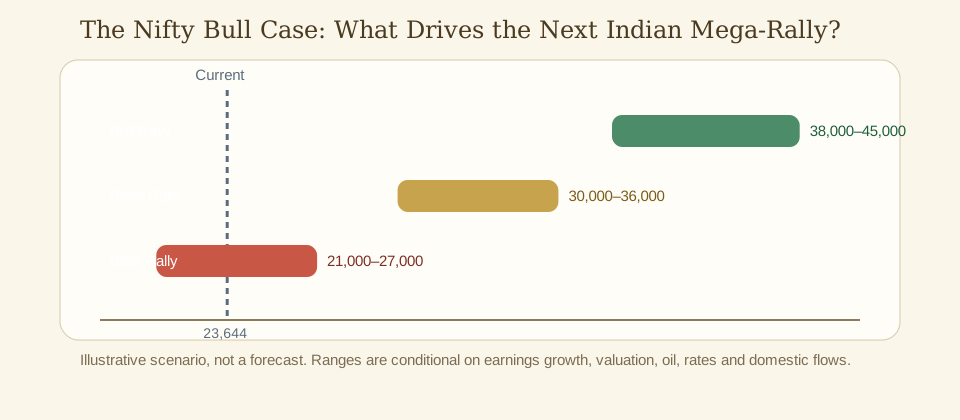
It would also likely be accompanied by a narrative shift from 'India is expensive but resilient' to 'India is expensive because profit pools are widening.' That is a very different kind of market. In that scenario, a move toward 38,000 to 45,000 over the medium term becomes realistic rather than promotional.
06. Bearish Scenario
What could stop the rally before it becomes a mega-rally
The cleanest rally-killer is still oil. A high-energy-cost environment can damage consumption, margins, inflation, rates, and the current account all at once. The second risk is that earnings remain concentrated in too few sectors, which would leave the market looking expensive again before the rally has broadened.
A third problem would be crowding. If investors chase the bull case before the data improve, the market can reprice upward faster than earnings justify, setting up another fragile peak. That is why a bullish article still needs valuation discipline.
07. Base Case
Why a constructive but non-euphoric upside path fits best
The most defensible bullish conclusion is that the Nifty can rally meaningfully from here if the macro backdrop stays supportive and earnings broaden. That is not the same as predicting a melt-up. It is a statement that the structural ingredients for another advance are real and measurable.
A 30,000 to 36,000 base rally path therefore makes sense. It recognizes macro resilience, domestic flows, and potential earnings expansion, while still leaving room for periodic valuation resets and oil shocks that can interrupt even a strong trend.
08. Probability Framework And Investor Positioning
Bull-case probabilities and how to participate prudently
Even bullish investors need a distribution of outcomes. The probabilities below reflect a favorable macro baseline but still respect valuation and external-risk constraints.
| Path | Probability | Conditions |
|---|---|---|
| Rising toward 30k-45k | 60% | Needs earnings breadth, supportive inflation, and strong domestic flows |
| Falling toward 21k-27k | 15% | Could follow oil stress or renewed earnings cuts |
| Moving sideways | 25% | Possible if profits improve only enough to offset valuation drag |
| Investor profile | Prudent approach | Why that stance fits |
|---|---|---|
| Investor already in profit | Hold core winners, trim overcrowded positions, rebalance | A bull market still punishes excess concentration |
| Investor currently at a loss | Add selectively where earnings visibility is improving | A rally helps quality first, not every laggard |
| Investor with no position | Build gradually and avoid chasing breakout days | A good bull case is not the same as a good entry price |
| Trader | Ride trends but use stop-loss rules | Bull narratives can reverse fast around macro shocks |
| Long-term investor | Dollar-cost average into leaders and cyclical beneficiaries | This is where the bull case is most actionable |
| Hedger / risk-only investor | Keep partial hedges rather than full protection | The macro base is supportive enough to avoid over-hedging |
The strongest bullish positioning is selective, not indiscriminate. If a mega-rally comes, quality and breadth should matter more than narrative chasing.
09. Risks To Watch And What Could Invalidate The Forecast
A real bull case still needs an explicit invalidation test
A bullish article becomes unhelpful when it stops admitting what could go wrong. Oil, valuation overextension, weak breadth, and fading domestic flows are the clearest invalidators. None of them are theoretical; all of them can be monitored in real time.
The upside case would strengthen if earnings breadth expands and inflation remains subdued. It would weaken if the market rerates faster than profits or if energy costs shock the macro outlook again. In other words, the next mega-rally needs fuel, not just hope.
| Signal | Why it matters | Implication for the thesis |
|---|---|---|
| Oil shock returns | Would pressure macro and margins simultaneously | Bull case weakens sharply |
| Breadth fails to improve | Would leave the market too dependent on a few sectors | Rally becomes fragile |
| SIP and equity inflows slow materially | Would remove a critical market support | Upside ranges should be reduced |
Disclaimer: This article is an editorial scenario analysis, not personalized investment advice. Forecast ranges are conditional and can fail if earnings, policy, energy prices, or global liquidity move materially away from current assumptions.
10. Conclusion
The Nifty bull case is real, but it has to be earned
The Nifty 50 does have a credible bull case from current levels. India's growth resilience, domestic household participation, softer inflation outlook, and potential capex cycle all support another meaningful advance. But the next mega-rally is more likely to be profit-led than valuation-led. Investors who want to participate should focus on breadth, earnings quality, and position discipline rather than on excitement alone.
FAQ
Frequently asked questions
What would drive the next Nifty bull run?
The strongest drivers would be broader earnings growth, steady domestic inflows, supportive inflation, and a better private investment cycle.
Can the Nifty rally even if foreign investors stay cautious?
Yes, to a degree. Domestic SIP and mutual fund inflows have become a meaningful stabilizer.
What is the biggest threat to the bullish case?
A sustained oil shock is the clearest threat because it can undermine both macro and earnings conditions.
Should investors chase a breakout in a bullish market?
Usually not. A staged approach is more prudent when valuation is not obviously cheap.
References
Sources
- Yahoo Finance chart data for ^NSEI - 10-year monthly and 1-year daily history
- NSE Indices, Nifty 50 Factsheet, April 30, 2026
- Reserve Bank of India monetary policy press release - GDP growth 6.5% and CPI 3.1% outlook
- IMF Executive Board Concludes 2025 Article IV Consultation with India
- World Bank India Development Update, April 2026
- AMFI Monthly Note, April 2026 - SIP contributions and equity flows
- Reuters via MarketScreener - J.P.Morgan downgrades India to neutral and cuts Nifty target to 27,000
- Business Standard - BofA sees Nifty at 29,000 in 2026 as earnings drive returns
- Moneycontrol - Morgan Stanley sees a bull market ahead for Indian equities with Sensex at 95,000
- IMF article - Business Growth and Innovation Can Boost India's Productivity