01. Quick Answer
The bull case for the Nikkei is that Japan now has more than one reason to work
The Nikkei reached 61,409.29 on 2026-05-15, after a decade of extraordinary compounding from 15,575.92 (Yahoo Finance chart API for ^N225, 10-year monthly history; Yahoo Finance chart API for ^N225, recent daily closes). The strongest bull argument is not momentum alone. It is that Japan can now offer governance reform, better nominal growth, stronger bank profitability, and AI-linked industrial leadership at the same time.
Available data suggests that combination is real. TSE pressure on cost of capital, English-disclosure progress, rising megabank profitability, and AI-driven demand at Advantest all point in the same direction: the earnings base may be broadening beyond the old weak-yen exporter story.
| Point | Why it matters |
|---|---|
| The bull case is about breadth | A stronger rally is more durable if banks, domestic cyclicals, and tech all contribute. |
| Reform still matters | Capital-discipline improvements remain one of Japan's clearest structural equity catalysts. |
| AI gives Japan a strategic angle | Semiconductor equipment and testing keep Tokyo relevant to global capex. |
| The bullish case still needs rebuttal | Energy, yen, and valuation risks can still break the rally if conditions deteriorate. |
02. Historical Context
The rally already happened, but that does not mean the bull case is exhausted
The Nikkei has already proven that Japan can rerate. The index compounded at roughly 14.78% over the last 10 years (Yahoo Finance chart API for ^N225, 10-year monthly history). That makes the current bull case harder, but also more credible: future upside would now need to be earned by broader earnings power and better capital allocation, not by simple relief that Japan is no longer stuck in the old deflation regime. In other words, the next rally would be healthier if it looks more like a quality-of-earnings story than a pure multiple-expansion story.
The benchmark's construction helps explain why the bull case can persist. Because the Nikkei is price weighted (Nikkei Stock Average guidebook, July 2025 edition; Nikkei Stock Average factsheet), strong execution at a handful of premium franchises can still have outsize impact. Yet this time the bullish argument is stronger when it includes banks, software-like information businesses, industrial automation, and consumer leaders, not only semiconductors.
| Driver | Evidence | Bullish implication |
|---|---|---|
| Governance reform | TSE continues pushing cost-of-capital discipline and better disclosure | Supports valuation resilience and shareholder returns. |
| Financial-sector normalization | Megabanks are expected to post record profits as rates normalize | Broadens the earnings base beyond tech. |
| AI capex | Advantest and Tokyo Electron remain key beneficiaries | Provides a structural growth engine. |
| Domestic normalization | Wages and inflation are closer to a healthier equilibrium | Supports a better nominal backdrop for earnings. |
| Area | Why it helps | Main caveat |
|---|---|---|
| Banks | Higher rates can finally improve margins | Credit costs still matter in a slowdown. |
| Semiconductors | Japan has real leverage to AI infrastructure | Cyclical demand swings remain sharp. |
| Retail and consumer | Wage growth can support demand and premium brands | Imported inflation could still squeeze households. |
| Governance | Capital efficiency is now a standing market theme | Some of the rerating is already reflected in prices. |
03. Main Drivers
Six forces explain why the Nikkei could still extend higher
1. TSE reform pressure is still changing behavior. Cost-of-capital discipline and disclosure reform are not abstract themes anymore (TSE action to implement management conscious of cost of capital and stock price; TSE English disclosure implementation survey, January 26 2026). They influence buybacks, investor communication, and management targets.
2. Bank profitability is improving. S&P Global expects megabanks to keep benefiting from policy normalization. That matters because a rally supported by financials is broader and sturdier.
3. AI-capex exposure remains real. Advantest explicitly pointed to AI-related investment, and Tokyo Electron continues to sit at the center of semiconductor equipment demand.
4. Domestic champions are still executing. Fast Retailing reported record first-half revenue and profit, showing that the Japan story is not only a capital-goods or exporter story.
5. Policy normalization can help more than it hurts. In a country emerging from decades of ultra-low inflation, modestly positive rates can improve financial intermediation and market confidence rather than automatically kill equity valuations.
6. Foreign-investor relevance has improved. Better English disclosure, clearer governance expectations, and more visible strategic sectors make Japan easier to own for global capital than it was in earlier cycles.
04. Institutional Forecasts and Analyst Views
The institutional bull case is real, but it is built on conditions, not certainty
Invesco emphasizes wage growth, governance reform, and domestic demand. Goldman calls Japanese fundamentals steady, though not risk free. UBS keeps Japan attractive. These are not fringe opinions; they are mainstream reasons why global allocators still pay attention to Tokyo. The common thread is that Japan looks most compelling when investors can point to several reinforcing drivers rather than a single macro trade.
Still, analysts remain divided because the evidence is mixed. The market already had a huge move, and the highest-quality names are no longer obviously cheap. The practical bull case therefore rests on breadth: banks, domestic consumer names, industrials, and tech all need to contribute.
| Source | Positive signal | Why it matters |
|---|---|---|
| JPX / TSE | Governance and disclosure reform continue to deepen | Supports better valuation support and foreign participation. |
| S&P Global | Megabanks are expected to post record profits | Broadens the market beyond a narrow tech rally. |
| Advantest / Tokyo Electron | AI and semiconductor demand remain central | Gives Tokyo a structural growth angle. |
| Fast Retailing | Consumer-facing execution remains strong | Shows domestic and global brand strength still matter. |
05. Scenarios, Risks, and Invalidation
The bull case is credible, but it still needs a sober risk framework
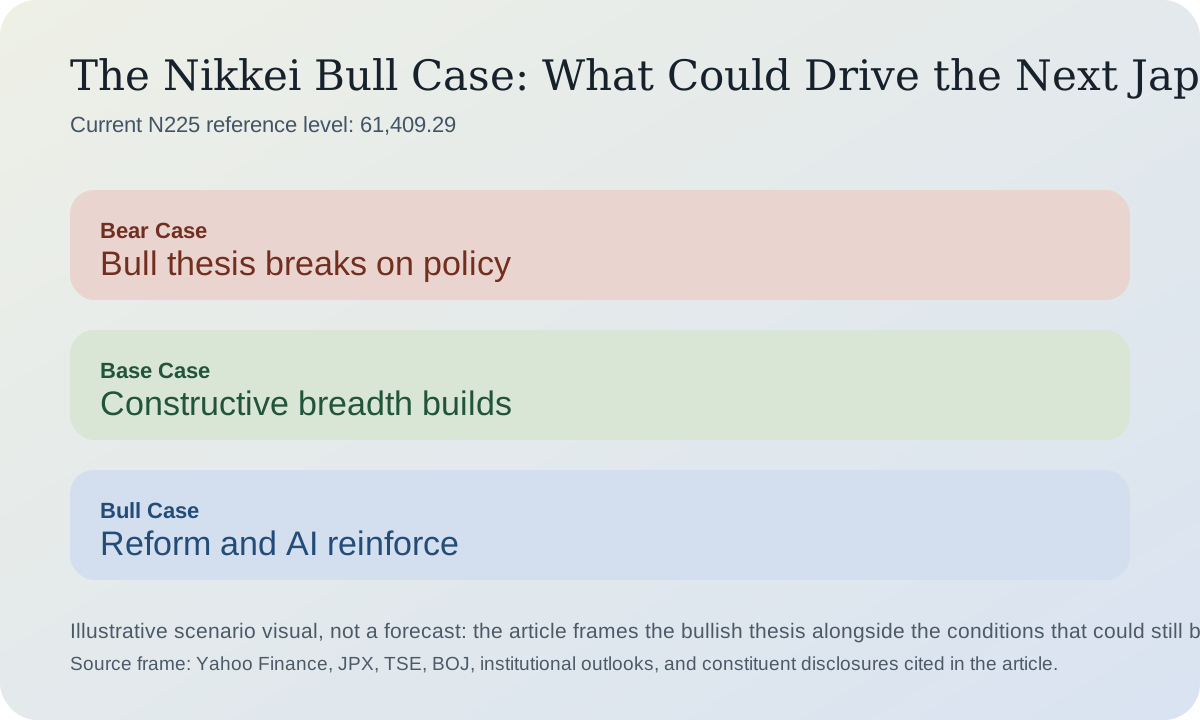
Bullish scenario
The core bull range is 75,000 to 85,000. This path requires governance breadth, bank margin support, and continued AI-related earnings strength.
Base-case scenario
The base case is 62,000 to 72,000. It assumes a constructive but bumpier path, with valuation pauses and periodic yen or energy scares.
Bearish counter-scenario
The bull thesis weakens if imported inflation rises, BOJ communication disrupts valuations, or a narrow group of expensive leaders stops carrying the market.
Risks to watch
Watch oil prices, wage trends, BOJ signaling, semiconductor capex, and whether governance reform still translates into visible shareholder-return actions.
What could invalidate the bull case
The bullish view would be wrong if the rally turns out to be mostly a valuation story on a few names rather than a broadening earnings story. It would also fail if policy normalization tightens financial conditions faster than the market expects.
Conclusion
The Nikkei bull case is stronger than a simple weak-yen trade. It is a case for a market where reform, nominal growth, and strategic technology exposure may still reinforce one another.
Disclaimer: This article is for research and informational purposes only. Bull-case scenarios are conditional paths, not guarantees of future returns.
| Scenario | Range | Conditions | Probability |
|---|---|---|---|
| Bull | 75,000-85,000 | Broad earnings support and continued reform momentum | 30% |
| Base | 62,000-72,000 | Constructive compounding with valuation pauses | 45% |
| Bear | 50,000-58,000 | Imported inflation and narrower leadership | 25% |
| Path | Estimated probability | Comment |
|---|---|---|
| Rising | 60% | The bull case assumes more than one earnings engine is now working for Japan. |
| Falling | 15% | Downside remains real, but it is not the dominant path if reform and AI both hold. |
| Sideways | 25% | A valuation plateau is still possible after a huge decade-long move. |
06. Investor Positioning
Even a bullish article requires prudent sizing and discipline
| Investor type | Cautious approach | What to watch |
|---|---|---|
| Investor already in profit | Hold core winners but trim if the position has become too concentrated in a few tech-linked names. | The best bull case still fails if sizing discipline disappears. |
| Investor currently at a loss | Reassess whether the thesis is intact before adding. | Use the bull case only if the same fundamental catalysts still apply. |
| Investor with no position | Stage entries and avoid chasing breakouts after large runs. | The bull case is stronger when pursued patiently. |
| Trader | Trade momentum but respect headline and policy risk. | BOJ, oil, and semiconductor news can reverse setups quickly. |
| Long-term investor | Favor diversified Japan exposure and periodic rebalancing. | The bull case works best as a compounding thesis, not a quarter-by-quarter bet. |
| Risk-hedging investor | Pair upside exposure with hedges if currency and external shocks would be problematic. | The Nikkei is still globally exposed despite its domestic reform narrative. |
07. FAQ
Frequently asked questions about the Nikkei bull case
What makes the Nikkei bull case more credible now than in older cycles?
It is supported by governance reform, healthier nominal growth, improving bank margins, and real AI-linked industrial exposure.
Does the bull case depend only on semiconductors?
No. It is stronger if banks, retailers, and domestic cyclicals also contribute.
What is the main risk to the bullish thesis?
The biggest risk is that leadership remains too narrow and policy or energy shocks cause the market to reassess valuations quickly.
References
Sources
- Yahoo Finance chart API for ^N225, 10-year monthly history
- Yahoo Finance chart API for ^N225, recent daily closes
- Nikkei Stock Average guidebook, July 2025 edition
- TSE action to implement management conscious of cost of capital and stock price
- TSE English disclosure implementation survey, January 26 2026
- TSE draft revisions to the Corporate Governance Code, April 10 2026
- S&P Global on Japanese megabanks and policy normalization
- Advantest financial review for fiscal year ended March 2026
- Tokyo Electron investor relations and FY2026 earnings release
- Fast Retailing FY2026 first-half results summary
- Invesco 2026 investment outlook for Japan equities
- Goldman Sachs Japan Economic Outlook 2026
- UBS House View with Japan rated Attractive
- Bank of Japan Outlook for Economic Activity and Prices, April 2026