01. Quick Answer
The next Sensex rally, if it comes, will likely be earnings-led rather than purely valuation-led
The strongest bullish case for the Sensex is that India combines above-peer economic growth, resilient domestic flows, lower inflation than in past stress episodes, and a renewed private investment cycle. If those pieces line up, the benchmark can move materially higher from current levels without needing an unsustainably rich multiple.
But the evidence is mixed on a pure momentum melt-up because current valuation already assumes a lot of macro resilience. That is why the best bull case is rooted in profits, breadth, and policy continuity rather than in slogans about inevitable growth.
- Historical data supports a constructive long-run view, but not a straight-line rally.
- Current market conditions show resilience, yet Sensex concentration makes breadth important.
- Institutional forecasts are strongest over 12 to 24 months, so longer targets should stay scenario-based.
- Bull, bear, and base cases depend on earnings growth, domestic flows, oil, and valuation discipline.
02. Current Market Snapshot
A Sensex outlook needs a current anchor before it can become a forecast
As of May 15, 2026, the Sensex closed near 75,237.99, according to Yahoo Finance chart data[1]. That leaves the benchmark below its 52-week high of 86,159.02 but above the 52-week low of 71,545.81[2]. The market is therefore not washed out, but neither is it trading at the euphoric high reached in late 2025.
History also matters here. Over the past decade, monthly closes moved from about 26,999.72 in late May 2016 to 75,237.99 in mid-May 2026, a roughly 10.79% annualized gain[1]. The BSE's 40-year paper adds a longer lens: it notes about 13.4% annualized Sensex growth over 39 years, in line with nominal GDP growth, while also emphasizing that sector leadership has changed materially over time[5].
| Metric | Value | Why it matters |
|---|---|---|
| Recent close | 75,237.99 on May 15, 2026 | Starting point for all scenario work |
| 10-year range | 26,626.46 to 85,706.67 | Shows how much India's large-cap benchmark has already repriced |
| 10-year CAGR | 10.79% | Useful reality check against aggressive long-run projections |
| 1-year high / low | 86,159.02 / 71,545.81 | Captures the 2025 peak and the 2026 stress window |
| Deepest 10-year drawdown | -38.07% | Helps separate a correction from a true bear market |
| Structural concentration | Top 10 names about 65% of index weight | Leadership breadth matters more than headline GDP alone |
The other reason current structure matters is concentration. According to the BSE Sensex at 40 paper, financial-services weight nearly doubled from about 22% in 2005 to roughly 39.5% in 2025, and the top 10 names represent about 65% of the benchmark's weight[5]. That means the headline market story can look healthy even when leadership is narrower than many investors assume.
03. Historical Context And Main Drivers
Five forces could power the next major Sensex advance
Sensex behavior over the last decade already shows why forecast language has to stay disciplined. The daily series implies a maximum drawdown of roughly -38.07%, from 41,952.63 on January 14, 2020 to 25,981.24 on March 23, 2020[2]. That was a genuine crisis drawdown, not a routine correction. Distinguishing correction, bear market, and crash is not semantics; it changes how investors should interpret risk.
| Driver | Current evidence | Bullish implication | Bearish implication |
|---|---|---|---|
| Domestic SIP flows | AMFI still reports more than Rs 31,000 crore monthly | Provides a recurring local bid under drawdowns | If flows weaken, momentum can fail |
| Benign inflation versus past stress | March CPI was 3.40% even before oil fully normalized | Can support lower real rates and stronger demand | A rebound in inflation would weaken the setup |
| Credit and financials | Financials remain the largest sector in the benchmark | Healthy banks can pull the whole index higher | If banks stall, the rally loses its main engine |
| Capex cycle | World Bank, IMF, and brokers still see room for investment recovery | Private investment can widen earnings leadership | If capex stays narrow, upside remains concentrated |
| Reform and productivity | IMF sees room for stronger productivity through innovation | Can raise long-run earnings power | Slow reform would cap the rally's durability |
The first pillar of the bull case is domestic liquidity. India's mutual-fund system continues to collect very large recurring SIP inflows, which lowers the market's dependence on foreign timing[9]. When a market has a steady local bid, drawdowns can become opportunities rather than trend-ending events.
The second pillar is macro quality. The World Bank remains constructive on India's growth resilience, and Invesco's 2026 India outlook highlighted supportive macro fundamentals, valuation improvement after correction, and a favorable setup for banking, telecoms, and data-center-linked themes[8][14]. That is exactly the sort of backdrop in which a durable rally can form: not perfect, but supportive enough for profits to rise faster than fear.
04. Institutional Forecasts And Analyst Views
Institutional views show that a bullish case still exists despite tactical caution
There is a practical limit to what institutional forecasts can tell investors beyond one or two years. Most sell-side houses publish 12-month targets, not clean 2030 or 2035 endpoints. That means any longer-horizon Sensex estimate should be treated as a scenario framework built from current valuation, earnings assumptions, macro conditions, and credible institutional anchors rather than as a precise consensus number[10][11][12][13].
| Source | Target / stance | Core thesis | What it signals |
|---|---|---|---|
| HSBC | 94,000 by end-2026 | Improved valuations, supportive policy, and resilient domestic flows | The bull case is still institutional, not just retail enthusiasm |
| Morgan Stanley | 95,000 base case and 107,000 bull case | Valuations, positioning, and growth-cycle inflection all improved | A structured upside path already exists in broker work |
| Invesco | Constructive 2026 India equities outlook | Banking, telecoms, and data centers favored as earnings improve | Upside could broaden beyond a few legacy leaders |
| IMF / World Bank | No price target, but supportive macro framing | India remains one of the more compelling major-economy growth stories | Macro support helps the bullish earnings thesis |
The interesting feature of current institutional coverage is not that everyone agrees. It is that even after bouts of caution, several respected houses still see meaningful upside if macro conditions cooperate. HSBC and Morgan Stanley have both published constructive pathways, while Invesco's outlook remains supportive on earnings and sector opportunities.
That does not make the bull case automatic. It does show that upside is defensible when built on earnings, liquidity, and improving breadth instead of on valuation alone. For a bullish article, that is the argument worth focusing on.
05. Bullish Scenario
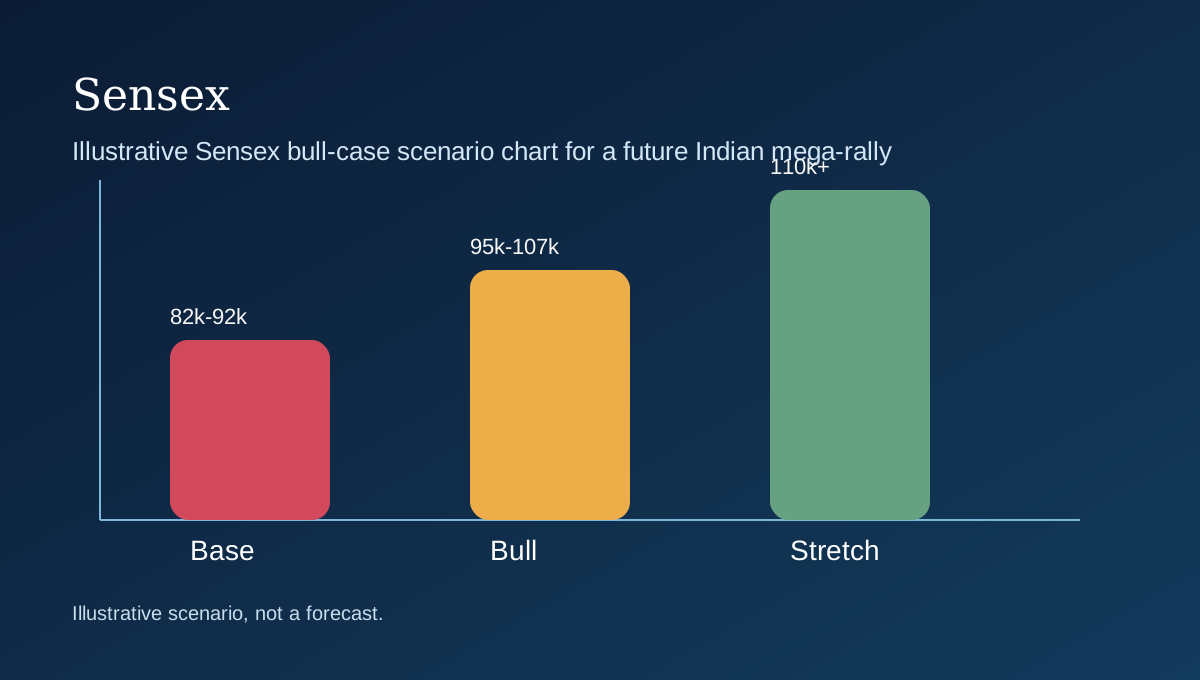
What could power a move toward 95,000 to 107,000 and beyond
A credible bull case begins with cleaner profits. If banks continue to deliver, if private capex broadens, and if telecom, consumer, and industrial leaders add more to index earnings, the Sensex can climb without requiring fragile valuation excess.
The next layer of upside is sentiment repair. If foreign investors return to India not just as a macro allocation but as an earnings and productivity story, the benchmark can plausibly challenge the upper end of the current broker range and possibly exceed it in a stronger cycle.
06. Bearish Scenario
What still threatens the bullish setup
The bullish case fails if oil, valuations, or earnings breadth turn against it. A premium market with narrow leadership is still vulnerable if imported inflation returns or if the largest weights stop carrying profits.
That is why a real bull case has to include its own rebuttal. India's macro story can stay structurally attractive while the Sensex still corrects if execution disappoints or the market gets ahead of itself.
07. Base Case
Why a measured rally path remains more credible than a melt-up story
The more defensible bullish base path is 82,000 to 92,000 rather than an immediate euphoric breakout. That range requires strong but plausible execution: earnings improvement, continuing household flows, and no major oil shock.
A mega-rally above that zone is possible, but it should be reserved for a scenario where leadership broadens and profit growth becomes obviously better than current skepticism assumes.
08. Probability Framework And Investor Positioning
Probability table and positioning by investor type
The probabilities below are judgment calls, not objective odds. They combine the starting valuation, the Sensex's concentration, official macro material, domestic flow data, and current institutional notes. The point is to show how a forecast range is built rather than to pretend precision where none exists.
| Path | Probability | Conditions |
|---|---|---|
| Rising toward 82k-107k | 60% | Requires earnings-led upside, strong domestic flows, and no major oil shock |
| Falling materially from current levels | 15% | Would likely need renewed macro stress and earnings disappointment |
| Mostly sideways / volatile consolidation | 25% | Possible if earnings improve but valuation support stays capped |
| Investor profile | Prudent approach | Why that stance fits |
|---|---|---|
| Investor already in profit | Hold core, trim weak positions, rebalance on strength | Protect gains without treating every rally as permanent |
| Investor currently at a loss | Avoid panic selling; review thesis, stagger exits or adds | Entry price risk is different from broken market structure |
| Investor with no position | Wait for pullbacks or use staged dollar-cost averaging | A full-size entry into a premium market raises regret risk |
| Trader | Use stop-loss rules and respect oil, rupee, and earnings catalysts | Short-term price action can diverge sharply from the macro story |
| Long-term investor | Accumulate selectively and rebalance sector concentration | Time horizon helps only if sizing stays disciplined |
| Hedger / risk-only investor | Use partial hedges, avoid overpaying for tail risk | India has macro risk, but not every risk deserves an extreme hedge |
For most readers, the practical implication is the same across themes: avoid treating a structural India story as a license to chase price. The benchmark can remain attractive over the long run while still being vulnerable to valuation resets, oil shocks, and leadership rotations.
09. Risks To Watch And What Could Invalidate The Forecast
The strongest bull case is the one that survives contact with risk
The main risks to the upside are straightforward: energy stress, a stall in financial earnings, fading household inflows, and a benchmark that never really broadens beyond a few giant names. A strong bull thesis should not ignore those issues; it should explain why they are manageable rather than nonexistent.
What would invalidate this article? A weaker-than-expected profit cycle or a renewed inflation shock would make the upside case too optimistic. On the other hand, cleaner breadth and stronger capex would make it too conservative. That is the point of a scenario framework: it gives investors ways to update rather than reasons to pretend certainty.
| Signal | Why it matters | Implication for the thesis |
|---|---|---|
| Oil rises and inflation pressure returns | Would weaken margins and policy flexibility | The bullish base path would likely be too high |
| Broad earnings acceleration emerges outside top financials | Would improve breadth and durability of the rally | The upside case would likely be too conservative |
| Domestic inflows slow sharply | A weaker local bid reduces support under corrections | The probability of a choppier path rises |
Disclaimer: This article is editorial scenario analysis, not personalized financial advice. Forecast ranges are conditional and can fail if earnings, policy, liquidity, inflation, or geopolitics move materially away from current assumptions.
10. Conclusion
The Sensex bull case works best when it stays grounded in earnings
The strongest bullish case for the Sensex is not that India is exciting. It is that India's growth, domestic savings, and investment cycle can translate into durable listed-company earnings. If that happens, upside remains credible. If it does not, the benchmark can still disappoint even while the macro narrative stays broadly attractive.
FAQ
Frequently asked questions
Why is the Sensex bull case more about earnings than valuation?
Because a premium market usually needs profit growth to justify sustained upside. Pure multiple expansion tends to be less durable.
What is the single biggest support for the Sensex right now?
Recurring domestic SIP flows are one of the clearest structural supports because they provide a local bid during volatility.
Could the Sensex rally even if foreign investors stay cautious?
Yes, to a degree. Strong domestic participation can cushion foreign outflows, though it does not make the market invulnerable.
What would make the bull case materially stronger?
Broader leadership beyond financials and clearer evidence of a deeper private capex and productivity cycle.
References
Sources
- Yahoo Finance chart data for ^BSESN - 10-year monthly history
- Yahoo Finance chart data for ^BSESN - daily history for drawdowns and 52-week range
- BSE Sensex at 40 research paper, January 2026
- World Bank India Development Update, April 2026
- AMFI Monthly Note, April 2026
- Reuters via TradingView - HSBC upgrades Indian equities to overweight, sees Sensex at 94,000 by 2026-end
- Business Standard - Morgan Stanley sees Sensex at 95,000 base case and 107,000 bull case
- Invesco 2026 Outlook - India Equities
- IMF note: Business Growth and Innovation Can Boost India's Productivity
- MoSPI CPI release for March 2026, published April 13, 2026