01. Quick Answer
Silver's strongest bullish argument is that multiple demand engines can overlap while supply stays only slowly responsive
COMEX silver futures (SI=F on Yahoo Finance) were trading around $75.7/oz on 2026-05-18. The same 10-year monthly series started near $18.6/oz on 2016-06-01 and most recently showed $75.7/oz, with a 10-year range of roughly $14.1 to $78.3 and a price-only CAGR near 17.78% (10-year monthly data).
The bullish case for XAG starts with the physical market. The Silver Institute still expects a sixth consecutive annual deficit in 2026, even with total supply rising to a decade high. That is unusual because it means the market can stay tight without requiring perfect conditions (Silver Institute 2026 outlook).
The second part of the bull case is breadth. Silver demand is no longer only a solar story. The Silver Institute's technology work highlights AI infrastructure, data centers, EVs, charging systems, and grid investment as additional growth channels through 2030. If those channels expand while investors keep treating silver as a high-beta precious metal, the market can reprice very aggressively (technology demand release; IEA electricity outlook).
| Point | Why it matters |
|---|---|
| Physical market | Persistent deficits keep silver unusually sensitive to incremental demand shocks. |
| Industrial breadth | AI, power infrastructure, EVs, and electronics reduce the market's dependence on one single end use. |
| Macro sponsorship | Silver can rally faster when gold is strong and investors want a higher-beta precious metal exposure. |
| Risk awareness | A strong bull case still needs to account for demand destruction and substitution. |
02. Historical Context
The bullish case became more credible when deficits persisted even after major price gains
A weak bull case says silver should rally because it is historically cheap versus gold. A stronger bull case starts with actual market structure. The 2025 survey release shows five straight deficit years, elevated lease-rate stress during the prior squeeze, and enough investment demand to keep the market under pressure despite higher prices (Silver Institute April 2026 release).
The 2026 outlook reinforces that point. Total supply is set to rise, yet the market is still forecast to remain in deficit by 67 million ounces. That means the bull case does not depend on zero supply response. It only depends on supply responding more slowly than broad demand.
The biggest structural improvement in the bull story is diversification. Silver Institute materials on industry, solar, and technology suggest the demand base is spreading across more sectors, which can make the market more resilient even if any one end use slows down.
| Metric | Latest reading | Why it matters |
|---|---|---|
| Current silver price | $75.7/oz | Every forward-looking range should be anchored to the current futures market, not to an outdated low. |
| 52-week range | $32.1 to $121.3 | Silver has already shown how wide its volatility band can be in a single year. |
| 10-year monthly range | $14.1 to $78.3 | Helps distinguish a normal correction from a structural break in the thesis. |
| 10-year price CAGR | 17.78% | A very high recent CAGR is a warning against straight-line extrapolation. |
| 2026 J.P. Morgan anchor | $81 average | A major-bank reference point for whether today's level already discounts a lot of the bullish story. |
| Editorial base range | $85-$110 | Scenario ranges are more defensible than pretending silver has one inevitable destination. |
| Line item | Latest official reading | Interpretation |
|---|---|---|
| 2025 total demand | 1.13 billion oz | Demand eased 2% year over year, but stayed historically high even after a huge price move. |
| 2025 mine production | 846.6 Moz | Mine output rose 3%, yet still did not erase the structural tightness narrative. |
| 2025 industrial demand | 657.4 Moz | Industrial offtake slipped 3%, largely because photovoltaic demand cooled from a very high base. |
| 2025 coin and bar demand | +14% y/y | Retail investment partially offset weakness in jewelry, silverware, and industrial uses. |
| 2026 total supply forecast | 1.05 billion oz | Metals Focus still expects a decade-high supply year, which matters for the bear case. |
| 2026 mine supply forecast | 820 Moz | Mine growth is positive but still only around 1%, which limits how fast supply can relieve tightness. |
| 2026 industrial demand forecast | Around 640-650 Moz | AI, autos, and grid demand help, but PV thrifting remains a real headwind. |
| 2026 market deficit forecast | 67 Moz | A sixth consecutive deficit would keep pressure on above-ground inventories. |
03. Main Drivers
Five forces could keep silver's upside open for longer than many skeptics expect
1. Deficits keep silver vulnerable to renewed squeeze dynamics
A market that remains in deficit year after year can become extremely sensitive to incremental buying. That does not guarantee a squeeze, but it keeps the option alive.
2. AI and data-centre investment widen the industrial demand base
The Silver Institute's technology release explicitly identifies data centers and AI as long-run drivers of silver demand. The IEA's electricity work adds macro context by showing that data centres are becoming a significant share of demand growth in major power markets.
3. Power grids, EVs, and electrification support use beyond solar
Electrification matters because silver's conductivity and reliability keep it embedded in multiple hardware layers, from connections and switches to advanced electrical systems.
4. Investor demand can amplify fundamentals
The Silver Institute's 2025 investment update showed how quickly ETP holdings can rise. In a tight market, financial flows do not just reflect fundamentals; they can intensify them.
5. Gold can act as a leadership asset for silver
Silver often outperforms when precious-metals sentiment broadens beyond gold. If macro investors look for a higher-beta expression of the same reserve, inflation, or geopolitical concerns, silver can attract a disproportionate share of incremental flows.
04. Institutional Forecasts and Analyst Views
Institutional forecasts do not prove the bull case, but they do show that a high-price regime is no longer fringe
J.P. Morgan expects silver to average $81 in 2026 and $85.5 in 2027. That is not a moonshot forecast, but it is powerful evidence that one of the world's largest banks sees the metal holding a historically elevated range.
The official LBMA survey strengthens the upside argument in a different way. Its 2026 average forecast is $79.57, but the upper end of the official analyst range runs to $165. That does not make $165 likely. It does show that serious analysts still see a path to explosive upside if tightness intensifies.
The Silver Institute bridges the institutional and physical sides of the story. It argues that deficits, broad technology demand, and a supportive macro backdrop can limit downside while keeping the market sensitive to renewed buying.
| Source | Published view | Why it matters |
|---|---|---|
| J.P. Morgan Global Research | $81 average in 2026 and $85.5 in 2027 | One of the clearest big-bank silver forecast paths currently available. |
| LBMA 2026 Forecast Survey | $79.57 average for 2026 | Official industry survey average from a broad analyst panel. |
| LBMA analyst range | $42 to $165 for 2026 | The range itself shows how unstable silver becomes when industrial and precious-metal narratives collide. |
| Silver Institute / Metals Focus 2026 outlook | Sixth straight deficit with downside limited by supportive macro and gold strength | Useful because it links price behavior to actual physical-balance expectations. |
| World Bank October 2025 outlook | Silver annual average expected up 34% in 2025 and another 8% in 2026 | Adds a macro-commodity forecasting frame rather than a pure precious-metals one. |
| LBMA-hosted individual analysts | Published averages span roughly mid-$40s to above $100 | Official analyst submissions show just how wide the plausible distribution still is. |
05. Bull, Bear, and Base Case
The silver bull case is strongest when it is framed as a conditional upside path rather than as a promise
Bullish scenario
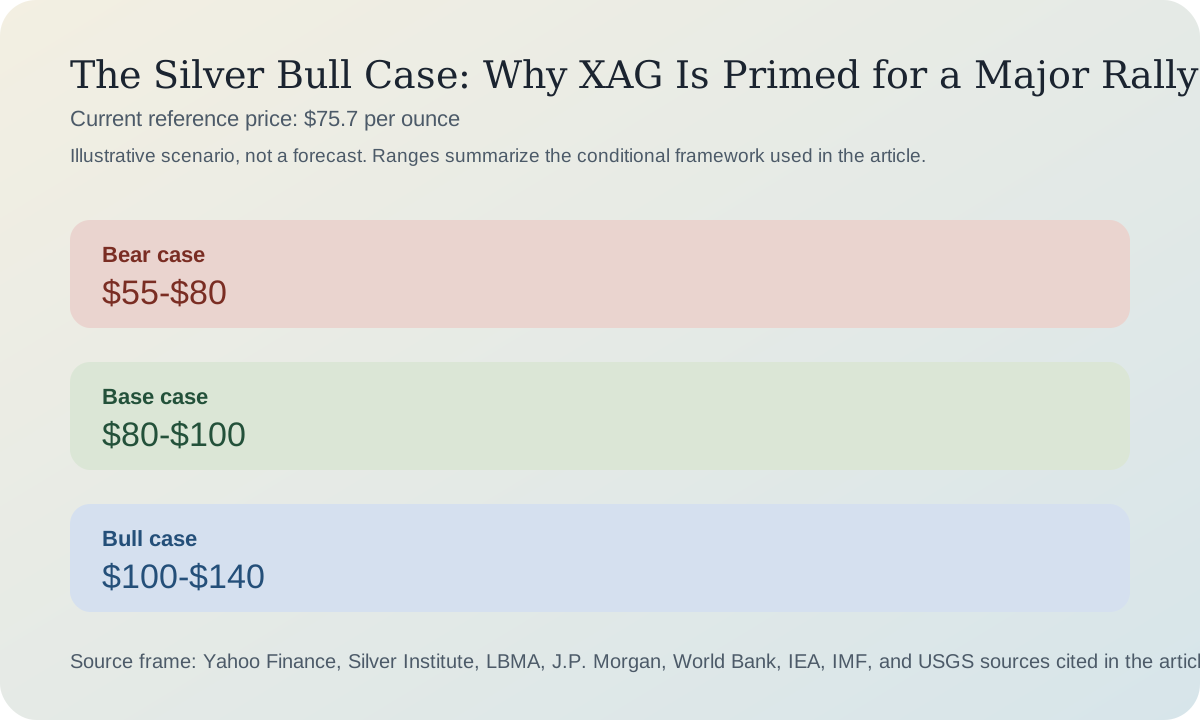
The main bull case is $100 to $140. It assumes continued deficits, broad technology demand, and enough investor participation that silver remains a preferred high-beta precious metal.
Base-case scenario
A balanced base case is $80 to $100. That still implies a firm market, but one where periodic corrections prevent a one-way melt-up.
Bearish rebuttal
Any serious bull case has to admit the bearish rebuttal: PV thrifting, demand destruction at high prices, and better supply response can all cap the rally. If those pressures intensify together, silver may stay firm without delivering a major breakout.
Risks to watch
The key risks are substitution, softer industrial activity, weaker ETF flows, and signs that inventories are normalizing more quickly than expected.
What could invalidate the forecast
The bull thesis would be too aggressive if deficits disappear, industrial intensity keeps falling, and silver loses its macro sponsorship. It becomes more credible if pullbacks repeatedly attract physical and financial buying.
Conclusion
Silver is primed for a major rally only conditionally, not automatically. But the conditions are real: persistent deficits, diversified industrial uses, and recurring macro demand together create a more credible bull case than the market had for most of the previous decade.
| Scenario | Illustrative range | Conditions | Probability |
|---|---|---|---|
| Bull | $100-$140 | Deficits persist, industrial breadth widens, and investors keep adding exposure. | 35% |
| Base | $80-$100 | The market stays firm but avoids another extreme squeeze. | 45% |
| Bear rebuttal | $55-$80 | Demand destruction, thrift, and supply response limit the rally. | 20% |
| Path | Estimated probability | Comment |
|---|---|---|
| Probability of rising | 55% | The physical and industrial setup still leans constructive if deficits continue. |
| Probability of falling | 20% | Downside remains possible because silver punishes crowded positioning fast. |
| Probability of moving sideways | 25% | A choppy high-range market is plausible if bulls are directionally right but timing is messy. |
06. Investor Implications
A silver bull case is only useful if readers still manage the metal as a volatile asset
Bullish readers often make the same mistake bearish readers do: they assume being directionally right removes the need for discipline. Silver does not reward that kind of thinking for long.
| Investor type | Cautious approach | What to watch |
|---|---|---|
| Investor already in profit | Hold a core allocation if the thesis still fits, but trim or rebalance if silver has become an outsized risk position. | The gold-silver ratio, ETF flows, and whether price spikes are being confirmed by physical demand. |
| Investor currently at a loss | Separate a broken thesis from a bad entry. Average in only if the horizon is long and the supply-demand case still holds. | Evidence that deficits persist and that corrections are orderly rather than panic-driven. |
| Investor with no position | Avoid chasing vertical rallies. Prefer staged entries, pullback plans, or dollar-cost averaging. | Macro risk sentiment, rate expectations, and whether physical-market tightness is easing. |
| Trader | Use stop-losses, respect gap risk, and trade silver as a volatility asset rather than as a tidy trend story. | Dollar moves, gold leadership, inventory headlines, and tariff or policy shocks. |
| Long-term investor | Think in terms of portfolio role, scenario ranges, and rebalancing bands instead of one target. | Whether silver keeps its dual industrial and monetary appeal through the cycle. |
| Reader seeking a hedge | Use silver as a partial hedge, not as a perfect crisis instrument. Combine it with cash, gold, or other defenses if needed. | Whether silver is behaving more like an industrial metal or a safe-haven asset in the current regime. |
Disclaimer: This bullish scenario is a research framework, not a guaranteed rally call and not personalized financial advice. Silver's upside case remains highly path-dependent.
07. FAQ
Frequently asked questions about the silver bull case
Why is silver considered a higher-beta precious metal?
Because it can benefit from the same macro drivers as gold while also reacting to industrial demand and tighter physical balances, which makes its swings larger.
What is the strongest long-run bullish argument for silver?
Persistent deficits combined with broadening industrial uses and recurring investment demand form the strongest structural case.
What is the biggest risk to the bull case?
The biggest risk is that higher prices accelerate thrift, substitution, and demand destruction before investors can push the market into a durable new range.
References
Sources
- Yahoo Finance SI=F recent daily chart
- Yahoo Finance SI=F 10-year monthly chart
- Silver Institute 2026 market outlook
- Silver Institute World Silver Survey 2026 release
- Silver Institute 2025 deficit outlook
- Silver Institute supply and demand overview
- Silver Institute technology demand release
- Silver Institute silver and solar page
- Silver Institute silver in industry page
- Silver Institute 2025 investment update
- Silver Institute physical silver investment overview
- LBMA 2026 forecast survey
- LBMA 2026 analysts forecasts
- LBMA Alchemist survey summary
- J.P. Morgan Global Research silver outlook
- World Bank commodity outlook October 2025
- World Bank commodity outlook April 2026
- World Bank commodity markets portal
- IEA Electricity 2026 demand analysis
- IEA data-centre electricity news
- IMF AI preparedness speech
- IMF AI Can Lift Global Growth
- IMF AI and Productivity in Europe
- USGS Mineral Commodity Summaries 2026