01. Quick Answer
The SMI bull case rests on a rare mix of defensive earnings quality and persistent trust in Swiss institutions
The SMI closed at 13,220.17 on 2026-05-15, up from 8,020.15 at the start of its 10-year Yahoo Finance monthly series on 2016-06-01, for a price-only CAGR of about 5.12% (Yahoo Finance 10-year history; recent daily closes). The core bullish argument is that Switzerland still offers a public-market blend of resilience and credibility that few European markets can match.
Available data suggests a credible upside thesis can be built from Roche, Novartis, Nestlé, UBS, and the broader Swiss macro credibility described by the SNB and IMF. That does not make the bull case certain, but it makes it more than a lazy safe-haven cliche.
| Point | Why it matters |
|---|---|
| The bull case is a quality and trust story | Investors still value Swiss balance sheets, healthcare pipelines, and institutional stability. |
| Healthcare remains the cleanest upside channel | Roche and Novartis can keep anchoring the market if execution stays strong. |
| Financials can broaden the story | UBS, Zurich, and Swiss Re help prevent the SMI from being only a pharma-and-food benchmark. |
| The best bull case still needs valuation discipline | Safe havens can be overowned and overpriced too. |
02. Historical Context
A bull case is more credible when it starts from what already worked and what can still broaden
The SMI closed at 13,220.17 on 2026-05-15, up from 8,020.15 at the start of its 10-year Yahoo Finance monthly series on 2016-06-01, for a price-only CAGR of about 5.12% (Yahoo Finance 10-year history; recent daily closes). The strongest part of the bullish argument is not explosive past return. It is the fact that the index kept compounding through shocks that hurt more cyclical markets.
Swiss defensives are not merely boring. They have often been reliable cash generators with pricing power and global reach. That matters because the SMI can still rise even if Switzerland never becomes a high-growth economy. The benchmark only needs its leading franchises to keep delivering steady earnings and capital return while the market continues rewarding resilience.
The bullish case therefore depends on breadth inside defensiveness. If healthcare, staples, insurance, and selective industrial leaders all keep doing their jobs, the SMI can still compound meaningfully from here.
That breadth matters because it is the difference between a genuinely resilient market and a narrow concentration trade hiding behind a safe-haven label.
| Driver | Evidence | Bullish implication |
|---|---|---|
| Healthcare leadership | Roche and Novartis continue to deliver meaningful operational updates | Supports a durable quality premium. |
| Staples resilience | Nestlé is still central to whether the defensive thesis feels credible | Helps stabilize the benchmark if growth markets wobble. |
| Financial strength | UBS, Zurich, and Swiss Re continue to show capital and underwriting resilience | Broadens support beyond healthcare and staples. |
| Institutional credibility | SNB and IMF framing still reinforces Switzerland's safe-haven role | Supports valuation resilience in uncertain macro regimes. |
| Area | Why it helps | Main caveat |
|---|---|---|
| Healthcare | Strong pipelines and global relevance | Pricing and regulatory pressure still matter. |
| Staples | Cash generation and defensive demand | Growth can remain slower than in other sectors. |
| Financials | Capital return and pricing discipline | Rate and regulation dynamics still affect sentiment. |
| Safe-haven flows | Support valuation and capital stability | Can reverse or create currency headwinds. |
03. Main Drivers
Six forces explain why the SMI could still move higher from here
1. Swiss healthcare remains globally relevant. Roche and Novartis still provide one of the cleanest quality-growth combinations in Europe.
2. Nestlé can still matter positively. If growth normalizes more cleanly, the market narrative around staples improves materially.
3. Safe-haven capital keeps valuing trust. In an uncertain world, Swiss institutional credibility remains an investable asset.
4. Financials can help broaden the upside. UBS, Zurich, and Swiss Re add capital-return and pricing-discipline support.
5. ABB adds selective cyclical and digital-industrial exposure. That helps the SMI participate in more than only defensive themes.
6. Low and stable inflation remains a valuation support layer. Switzerland's macro profile can still justify a premium if it stays intact.
04. Institutional Forecasts and Analyst Views
The macro backdrop is moderate, which means the bull case must come from franchise strength and persistent trust
The OECD, IMF, KOF, and SNB do not project a boom. That is useful because it keeps the bullish framework honest. If the SMI still outperforms in that environment, franchise strength is doing the heavy lifting.
Analysts remain divided because the evidence is mixed. The bulls are right that Switzerland still commands trust and owns strong defensives. The skeptics are right that concentration and valuation remain real limits. A serious bullish framework has to acknowledge both.
The practical implication is that the SMI does not need dramatic macro growth to work. It needs enough evidence that healthcare, staples, insurance, and safe-haven demand stay on the same side of the equation.
If that evidence remains visible, investors can continue treating Swiss equities as a premium destination for stability rather than merely as a low-growth market dressed up as safety. That distinction is central to the bullish case over time for investors today globally too.
| Source | Positive signal | Why it matters |
|---|---|---|
| Roche and Novartis | Healthcare execution remains central and still credible | Supports the benchmark's highest-quality growth channel. |
| Nestlé | Operational recovery remains possible | Can improve the staples side of the safe-haven case. |
| UBS, Zurich, Swiss Re | Capital and underwriting resilience remain visible | Broadens the index beyond only healthcare and staples. |
| SNB, IMF, KOF | Swiss macro credibility remains intact | Helps sustain the market's premium profile. |
05. Scenarios, Risks, and Invalidation
The bull case is credible, but it still needs a clear answer to the main bearish objections
Bullish scenario
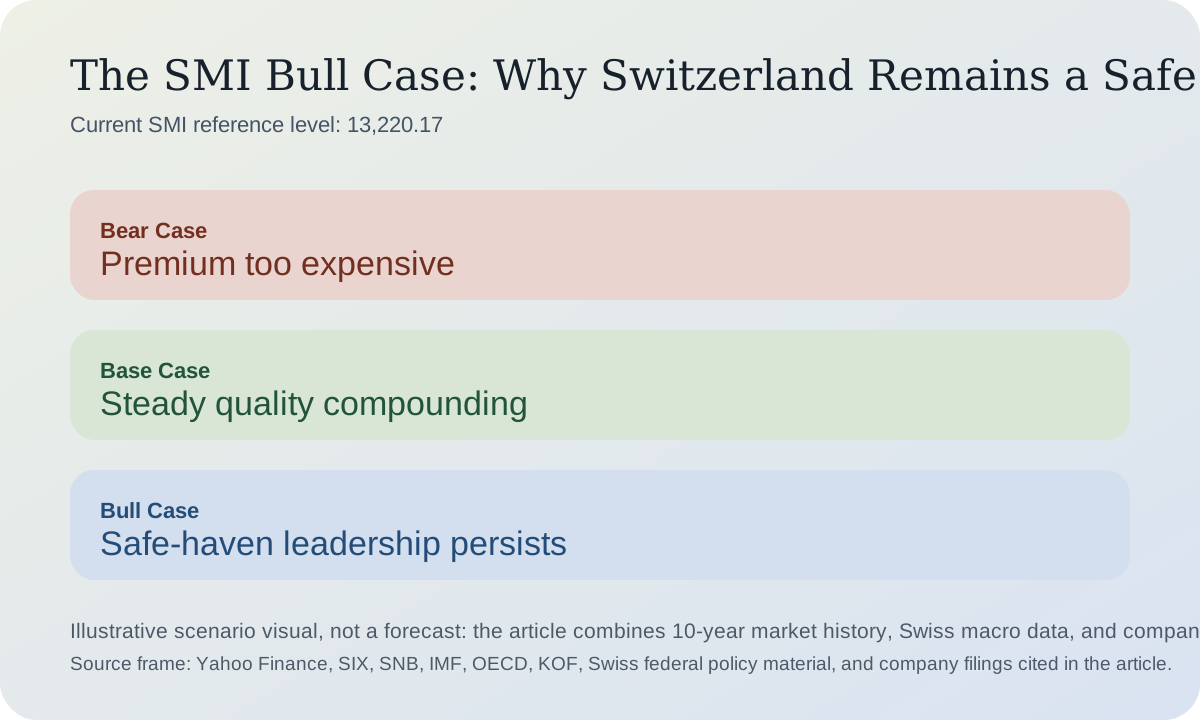
The core bull case is 15,900 to 17,200 by 2030. That path requires sustained healthcare leadership, a steadier Nestlé profile, continued safe-haven demand, and financial-sector support.
Base-case scenario
The base case is 14,300 to 15,600. This remains constructive, but it assumes slower upside and more valuation pauses.
Bearish counter-scenario
The bull thesis weakens materially if the franc stays too strong, defensive valuations compress, or the largest constituents fail to generate enough earnings growth to justify the premium.
Risks to watch
Watch CHF behavior, healthcare execution, Nestlé's recovery, financial-sector capital return, and whether global investors continue favoring safe-haven quality.
What could invalidate the bull case
The bullish view would be wrong if the SMI remains far more dependent on a narrow set of slow-growing defensives than current narratives admit. It would also fail if safe-haven demand proves less durable than expected.
Conclusion
The SMI bull case is not about blind faith in safety. It is about a market whose leading franchises may still deserve a premium because trust, quality, and balance-sheet strength remain scarce. That is a real reason for optimism, provided investors stay disciplined about concentration and valuation.
Disclaimer: This article is for research and informational purposes only. Bull cases are conditional scenarios, not promises of future returns.
| Scenario | Range | Conditions | Probability |
|---|---|---|---|
| Bull | 15,900-17,200 | Healthcare, staples, and safe-haven demand align positively | 30% |
| Base | 14,300-15,600 | Constructive defensive compounding with normal pauses | 45% |
| Bear | 12,100-13,200 | Premium compresses and growth disappoints | 25% |
| Path | Estimated probability | Comment |
|---|---|---|
| Rising | 55% | The benchmark still owns some of Europe's most trusted defensive franchises. |
| Falling | 20% | Downside remains real, but not dominant if healthcare and safe-haven support both hold. |
| Sideways | 25% | Possible if strong earnings are offset by a flatter valuation regime. |
06. Investor Positioning
Even a bull case requires prudent positioning
| Investor type | Cautious approach | What to watch |
|---|---|---|
| Investor already in profit | Let quality winners work, but trim if the position has become too concentrated. | The best bull case still fails if position sizing gets ignored. |
| Investor currently at a loss | Reassess whether the loss comes from timing or from a broken thesis about Swiss quality. | Use the bull case only if the core drivers remain intact. |
| Investor with no position | Stage entries and avoid chasing the safe-haven label at any price. | The bull case is better pursued through patience than fear of missing out. |
| Trader | Trade momentum, but respect that the SMI can still react to earnings and currency surprises. | Defensive does not mean non-volatile. |
| Long-term investor | Favor diversified exposure and reinvestment over all-in directional calls. | The bull case works best over time, not in one quarter. |
| Risk-hedging investor | Pair upside exposure with hedges if CHF or healthcare concentration is uncomfortable. | Safe havens can still correct. |
07. FAQ
Frequently asked questions about the SMI outlook
What makes the SMI bull case stronger than many European peers?
Its mix of healthcare, staples, insurance, and institutional credibility gives it a more resilient quality profile than many continental indices.
Does the bull case require fast Swiss GDP growth?
No. It mainly requires continued franchise execution and a market still willing to value Swiss quality highly.
What is the main risk to the bullish thesis?
That investors pay less for defensiveness while earnings growth stays too modest to offset the valuation reset.
References
Sources
- Yahoo Finance chart API for ^SSMI, 10-year monthly history
- Yahoo Finance chart API for ^SSMI, recent daily closes
- SIX SMI overview page
- SIX SMI methodology 2026
- SIX Exchanges Figures February 2026
- Swiss National Bank Quarterly Bulletin 1/2026
- IMF 2025 Article IV consultation for Switzerland
- OECD Switzerland economic snapshot
- KOF Spring 2026 economic forecast
- Federal Council adopts Digital Switzerland Strategy 2026
- Swiss AI regulation overview
- Nestlé three-month sales 2026
- Roche first quarter sales 2026
- Novartis Q1 2026 results
- UBS first-quarter 2026 results
- ABB Q1 2026 results
- Zurich Insurance May 2026 operating update
- Swiss Re Q1 2026 results