01. Quick Answer
The SSEC bull case is credible because the market has more support than many skeptics admit
The positive case starts with facts, not slogans. The official SSE monthly statistics show deep liquidity and a large domestic market base. SSE ETF data show a growing domestic ecosystem, with 2025 ETF turnover reaching RMB61 trillion. The Invesco and Invesco Q1 update both remain constructive on Chinese equities because of valuation, liquidity, and structural industrial themes. Meanwhile, Q1 2026 GDP and industrial output show the economy still has growth engines. That combination is the core of the SSEC bull case. The rebuttal is that property and consumption are still soft, which is why this article still uses scenarios rather than certainty.
| Point | Why it matters |
|---|---|
| Historical data still matters | The SSEC's 3.52% 10-year price CAGR shows why scenario analysis is more credible than simple hype. |
| Current conditions are better, not fully healed | GDP, PMI, and industrial data improved, but property and consumption still limit certainty. |
| Institutional views are constructive but conditional | Public research from IMF, Goldman Sachs, UBS, Invesco, and J.P. Morgan supports nuance rather than certainty. |
| Forecast ranges must separate bull, bear, and base cases | The evidence is mixed enough that any serious SSEC forecast should explain probability, not just destination. |
02. Historical Context
The last decade shows why the Shanghai Composite resists simple narratives
Yahoo Finance data show the Shanghai Composite rising from 2,929.61 on 2016-05-31 to 4,135.39 on 2026-05-15, a 10-year price CAGR of 3.52%. That sounds respectable until you remember how range-bound the index has been. Over the same period, it traded between 2,493.90 and 4,162.88. This is not a market that rewards lazy extrapolation. It oscillates between policy support, domestic-demand skepticism, and bursts of enthusiasm around technology, liquidity, and reform.
| Metric | Latest reading | Why it matters |
|---|---|---|
| Recent close | 4,135.39 | Every scenario in this article starts from the latest Yahoo Finance close on 2026-05-15. |
| 10-year starting point | 2,929.61 | Anchors long-run scenario math instead of using a cherry-picked low. |
| 10-year price CAGR | 3.52% | Shows the market has compounded, but far less cleanly than a smooth growth benchmark. |
| 10-year range | 2,493.90 to 4,162.88 | Defines realistic historical limits for bull and bear scenario work. |
| Recent 1-month range | 4,027.21 to 4,242.57 | Captures the current near-term regime and volatility. |
| Fact | Latest public evidence | Interpretation |
|---|---|---|
| Listed A-share companies | 2,308 as of March 2026 | The Shanghai market is broad and systemically important, not a narrow sector trade. |
| Total market capitalization | RMB63.85 trillion | The exchange remains one of the world's largest pools of onshore equity capital. |
| Average daily trading value | RMB1.023 trillion | Liquidity remains deep even during choppy sentiment phases. |
| SSE Composite P/E | 16.10x in March 2026 | The market is not obviously distressed, but it is also not priced like a high-trust U.S. growth benchmark. |
| STAR Market listed companies | 606 by March 31, 2026 | Innovation and hard-tech exposure are becoming a more visible part of Shanghai's equity story. |
The official SSE March 2026 monthly statistics help explain that behavior. As of March 2026, the exchange had 2,308 A-share listings, total market capitalization of RMB63.85 trillion, average daily trading value of RMB1.023 trillion, and an official March closing P/E of 16.10x for the SSE Composite. The SSE overview page also reminds investors that Shanghai is not a niche market: the exchange is one of the world's largest by market capitalization and turnover. Even so, the index remains heavily shaped by the policy cycle, state-linked sectors, manufacturing, banks, brokers, energy, and the newer innovation complex around the STAR Market. That is why the SSEC often behaves differently from U.S. benchmarks and even from Hong Kong's more offshore-facing market.
03. Main Drivers
Why a new China bull-market case is plausible
1. Valuation still leaves room for rerating
An official March P/E of 16.10x does not look euphoric for a market with China's scale and industrial depth. A new bull market rarely starts from perfect conditions. It starts when expectations are still skeptical enough to leave room for surprise.
2. Industrial upgrading is feeding the equity story
Invesco explicitly highlights EVs, automation, pharma, and innovation as key themes. The STAR Market materials and SSE leading-company data show that the listed ecosystem is gradually tilting toward hard-tech and higher-quality leaders.
3. Domestic market infrastructure has become deeper
The ETF report shows the Shanghai market ranked first in Asia and third globally in ETF turnover in 2025. That matters because deeper domestic participation can make the market more resilient and more investable.
4. Policy still works as an accelerator
SSE 2026 priorities emphasize improving listed-company quality, investment value, and opening-up. When policy, liquidity, and earnings align, China equities can rerate faster than many global investors expect.
5. Macro data are good enough to support optimism
Q1 GDP, industrial production, and PMI data are not euphoric, but they are good enough to support a constructive market narrative as long as the weak spots do not deteriorate further.
| Driver | Public evidence | Bullish implication |
|---|---|---|
| Valuation | 16.10x official March P/E | Leaves room for rerating if earnings hold. |
| Industrial upgrading | Strong policy and institutional support | Supports a better earnings mix. |
| Domestic market depth | RMB61tn ETF turnover in 2025 | Supports liquidity and participation. |
| Policy alignment | SSE and government emphasis on investment value | Can amplify gains when fundamentals cooperate. |
04. Institutional Forecasts and Analyst Views
The public institutional tone is constructive enough to support a rebound framework
Invesco, Goldman Sachs, UBS, and J.P. Morgan AM all provide pieces of a constructive China-equity story: resilient growth, industrial upgrading, better earnings in selected sectors, and attractive long-term market structure. None of that proves a guaranteed bull market. It does, however, make a rebound framework more credible than a pure stagnation thesis.
| Source | Constructive signal | SSEC implication |
|---|---|---|
| Invesco | Positive China equity outlook based on valuation and structure | Supports rerating potential. |
| Goldman Sachs | 4.8% 2026 growth outlook | Supports earnings resilience. |
| J.P. Morgan AM | Q1 2026 shows resilience and stock-selection opportunity | Supports selective upside rather than blanket optimism. |
| SSE official data | Liquidity, ETFs, and listed-company quality are improving | Supports market-function side of the bull case. |
05. Bull, Bear, and Base Cases
A bullish article still needs a disciplined range and explicit rebuttal
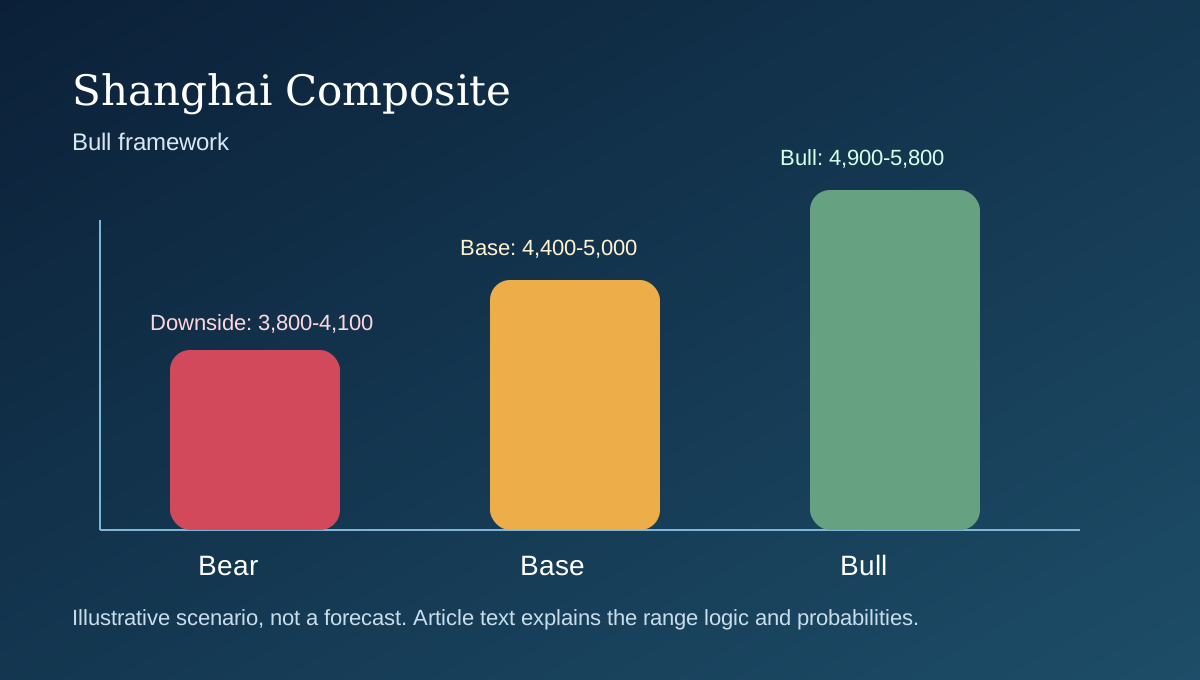
Bullish scenario
The bull case is 4,900 to 5,800. That requires policy, earnings, and industrial leadership to reinforce each other for more than a single rally window.
Base-case scenario
The base case is 4,400 to 5,000. This path assumes moderate rerating without pretending the economy has solved every legacy drag.
Bearish scenario
The bear case is 3,800 to 4,100. The bullish thesis can still fail if demand weakens or investors decide policy support is not enough.
| Scenario | Range | Conditions | Probability |
|---|---|---|---|
| Bull | 4,900-5,800 | Flows, earnings, and policy credibility improve together | 30% |
| Base | 4,400-5,000 | Moderate rerating with ongoing recovery | 45% |
| Bear | 3,800-4,100 | Confidence and demand remain too weak | 25% |
| Path | Estimated probability | Comment |
|---|---|---|
| Rising | 55% | The rebound case is credible because valuation, policy, and industrial themes can reinforce one another. |
| Falling | 20% | The bullish case still respects unresolved demand and property risks. |
| Sideways | 25% | Another broad digestion range remains realistic. |
Risks to watch
The rebound thesis needs confirmation from earnings breadth, not only from policy rhetoric. Watch consumption, property, and whether industrial leadership keeps broadening.
What could invalidate the bullish thesis
The bull case weakens if domestic demand remains weak, reforms underdeliver, or the market decides that industrial-upgrading gains are too narrow to lift the broader index.
Conclusion
The SSEC bull case is no longer empty rhetoric. It has real support from valuation, liquidity, industrial strategy, and official market-development priorities. But it still needs broader earnings confirmation.
Disclaimer: This article is for research and informational purposes only. A bullish scenario is not a guarantee and should not be read as a personalized buy recommendation.
06. Investor Positioning
Different readers should respond to the same SSEC outlook in different ways
| Investor profile | Cautious approach | What to monitor |
|---|---|---|
| Investor already in profit | Hold a core position but consider trimming into policy-driven spikes if gains have outrun earnings follow-through. | Monitor breadth, earnings revisions, and whether the move is led by quality sectors or only by speculative pockets. |
| Investor currently at a loss | Avoid averaging down automatically; first decide whether the thesis was valuation, policy easing, industrial upgrading, or a cyclical rebound. | Property data, demand indicators, and whether policy support is improving fundamentals or only sentiment. |
| Investor with no position | Scale in gradually or wait for pullbacks instead of chasing rallies after macro headlines. | Valuation discipline, liquidity, and whether earnings breadth is improving. |
| Trader | Use stop-losses and treat the SSEC as a policy- and liquidity-sensitive market rather than a pure earnings market. | Two Sessions follow-through, PMIs, credit signals, and sector rotation. |
| Long-term investor | Dollar-cost averaging is more defensible than all-in timing, but only if the portfolio can tolerate long periods of range-bound performance. | Dividend discipline, market reforms, and the profit share of higher-quality sectors. |
| Risk-hedging investor | Rebalance or hedge if China exposure is already large elsewhere in the portfolio. | Correlation shifts, RMB moves, and renewed property or trade stress. |
07. FAQ
Common questions investors ask about this Shanghai Composite outlook
What is the strongest factual support for the SSEC bull case right now?
The combination of reasonable official valuation, improving macro stability, deep domestic liquidity, and visible policy support for industrial upgrading and market quality.
Does a bullish SSEC article mean China's macro problems are solved?
No. It means the positive forces may be strong enough to outweigh the negatives for a period, not that the negatives have disappeared.
What would make the bull case stronger over time?
Repeated quarters of broader earnings upgrades, steadier domestic demand, and more visible capital-market reforms around dividends and listed-company quality.
08. Sources
Primary and high-credibility references used in this article
- Yahoo Finance chart API for 000001.SS, 10-year monthly history
- Yahoo Finance chart API for 000001.SS, recent daily closes
- SSE Newsletter - March 2026 monthly market statistics
- Shanghai Stock Exchange overview page
- Focus on SSE: Post-Two Sessions Outlook 2026
- China Securities Journal report on 132 SSE companies above RMB 100 billion market cap
- SSE ETF industry report summary, February 2026
- STAR Market Composite Index benchmark report, April 2026
- China GDP preliminary accounting results for Q1 2026
- National Economy Got off to a Good Start in the First Quarter
- Total Retail Sales of Consumer Goods from January to March 2026
- Industrial Production Operation in March 2026
- Investment in Fixed Assets from January to March 2026
- Investment in Real Estate Development from January to March 2026
- Purchasing Managers’ Index for April 2026
- Consumer Price Index in April 2026
- Industrial Producer Price Indexes in April 2026
- IMF Executive Board concludes 2025 Article IV consultation with China
- IMF staff report on China 2025 Article IV consultation
- Goldman Sachs: China's economy is expected to grow 4.8% in 2026
- UBS China Outlook 2026-27: Resilience and Rebalancing
- Invesco 2026 investment outlook - Chinese equities
- Invesco China economy and markets update - Q1 2026
- J.P. Morgan AM: What China's 1Q 2026 GDP data tells us