01. Quick Answer
The STOXX50 bull case is real because the rally drivers are broader than in the old Europe narrative
The best bullish case for the STOXX50 is not that Europe has suddenly become immune to macro risk. It is that the benchmark now has more potential rally engines than it had in the 2010s: stronger banks, better fiscal support, a real semiconductor and industrial-software footprint, and more capital spending linked to electrification, defense, and AI infrastructure.
That does not make the market easy. But it does mean the next eurozone rally can be grounded in more than valuation alone. Public strategy notes from J.P. Morgan and UBS both point in that direction, even if they stop well short of making certainty claims (J.P. Morgan; UBS).
| Driver | Why it is bullish |
|---|---|
| Broader earnings growth | The market no longer depends on only one or two sectors. |
| Healthier banks | Banks can support index earnings instead of acting as a persistent drag. |
| Industrial and AI capex | Semis, software, automation, and electrification can all feed profits. |
| Fiscal support | Germany and broader Europe have more room to support investment than in the austerity era. |
02. Historical Context
This rally setup looks different from older value-only Europe arguments
Europe's older bull cases often failed because they relied too heavily on cheap valuations and ECB liquidity without enough profit growth. Today's setup is different. The benchmark has a deeper mix of technology, software, industrial automation, and financial strength than it did a decade ago, while still keeping defensives such as healthcare and insurance.
That shift does not eliminate cyclicality, but it does improve the quality of the upside argument. A market driven only by mean reversion can stall quickly. A market driven by a better mix of profit engines has a better chance of sustaining advances for longer, even if the path remains uneven.
| Metric | Reading | Why bulls care |
|---|---|---|
| Recent close | 5,827.76 | The market has already climbed, but not far beyond a plausible earnings-supported zone. |
| 10-year CAGR | 7.36% | Shows Europe can compound meaningfully when policy and sector mix align. |
| 52-week high | 6,199.78 | The market has already tested higher levels, reducing the need for a heroic breakout assumption. |
| Q1 2026 GDP | 0.1% q/q | Soft growth leaves room for upside surprise if demand improves. |
| Old pattern | Current difference | Bull-case implication |
|---|---|---|
| Pure value rerating | Now combined with semis, software, and industrial capex | More durable upside if earnings confirm. |
| Weak banks | Banks are in better shape than in prior cycles | Financials can help rather than hurt the index. |
| Fiscal restraint | Germany and Europe are discussing more strategic spending | Domestic demand support is stronger. |
| Low-growth stereotype | AI, defense, and electrification offer new growth channels | Leadership can broaden. |
03. Main Drivers
Five forces could power the next eurozone rally
1. Banks are no longer the same drag they once were
UBS and J.P. Morgan both highlight healthier banks, better loan growth prospects, and improved fee income as supports for Europe (UBS add to Europe; J.P. Morgan Asset Management).
2. Industrial and capital-goods exposure is now a strength
Companies tied to automation, grids, software, and industrial equipment can benefit from investment spending in a way older Europe narratives often ignored.
3. Europe's semiconductor exposure matters more than before
ASML's Q1 2026 release explicitly tied industry growth to AI-related infrastructure demand, reinforcing the idea that at least part of Europe's equity leadership is plugged into a global secular trend (ASML Q1 2026).
4. Fiscal support can amplify cyclical recovery
Strategists pointing to German spending plans are effectively arguing that Europe has more domestic support for a rally than in prior low-growth cycles.
5. Valuation still helps
Europe does not need to become expensive to outperform. It only needs earnings and policy to stay good enough that investors stop demanding an excessive discount.
04. Institutional Forecasts and Analyst Views
Public strategist material provides real support for a balanced bullish thesis
Public strategist commentary is unusually helpful for a bull case because the arguments are explicit. J.P. Morgan sees improving eurozone risk-reward and stronger earnings expectations. UBS sees Europe benefiting from stabilization, sector opportunity, and attractive valuations. Even State Street's constructive equity tone adds support, though it remains more macro-sensitive (J.P. Morgan; UBS; State Street).
BlackRock is the main reminder that the rally still needs proof. Its more neutral stance tells investors not to confuse a better setup with a guaranteed structural breakout. In other words, the bull case is strong enough to respect, but not strong enough to treat as destiny.
That tension is healthy. Strong bull cases are usually better when they include their own rebuttal, because the investor can then identify what evidence would justify pressing the thesis and what evidence would argue for trimming or waiting. For Europe, that means watching profit growth breadth just as closely as valuation discounts.
| Source | Bullish element | Why it matters |
|---|---|---|
| J.P. Morgan | Improving eurozone risk-reward and higher earnings expectations | Adds a credible earnings-based case for upside. |
| UBS | Constructive on Europe, banks, industrials, and broadening rally | Suggests upside is not limited to one narrow theme. |
| ASML | AI-related infrastructure still supporting semiconductor demand | Strengthens the secular-growth component inside Europe. |
| State Street | Constructive global equity backdrop | Helps the broader risk-asset environment if shocks stay contained. |
05. Bull, Base, and Bear-Rebuttal Cases
A strong bull case still needs an explicit downside challenge
Bullish scenario
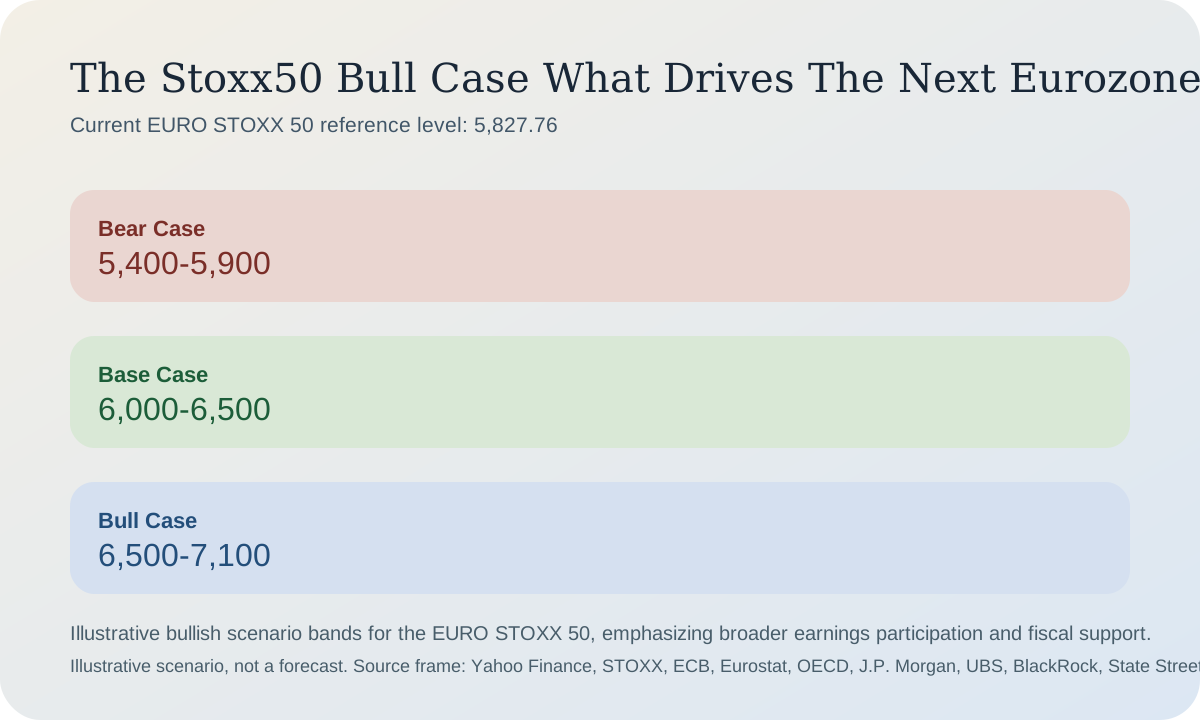
The bull case is around 6,500 to 7,100. It assumes broader EPS upgrades, no major energy shock, and enough macro stability to let investors reward European cyclicals and quality compounders together.
Base-case scenario
The base case is 6,000 to 6,500. Here, the rally continues but at a slower pace because valuations already reflect some optimism.
Bearish rebuttal
The bearish rebuttal is straightforward: if earnings fail to broaden or energy inflation returns, the bull case can unravel quickly.
| Scenario | Likely outcome | Conditions | Probability |
|---|---|---|---|
| Bull | 6,500-7,100 | Broader earnings growth, stable energy, supportive policy, and strong capex. | 35% |
| Base | 6,000-6,500 | Steady but unspectacular progress. | 45% |
| Bear rebuttal | 5,400-5,900 | Inflation and energy re-accelerate or demand weakens. | 20% |
| Direction | Probability | Comment |
|---|---|---|
| Rising | 45% | The bull case has real evidence behind it, but it is not overwhelming. |
| Falling | 20% | Downside exists, but it likely needs a visible macro trigger. |
| Sideways | 35% | Quite plausible if good news is already partly priced. |
The bull-case probability is built from current strategist evidence, live price context, and the simple fact that Europe's rally drivers are broader than they used to be, even if they are not invulnerable.
That broader mix is important because it reduces reliance on a single macro bet. Europe no longer needs just lower rates or just a luxury rebound. It can also benefit from industrial digitization, bank profitability, semiconductor demand, and strategic investment themes.
06. Investment Implications
Even bullish investors need disciplined entry, trim, and hedge plans
| Investor type | Prudent approach | Main watchpoints |
|---|---|---|
| Investor already in profit | Hold core exposure but trim if enthusiasm outruns earnings reality. | EPS revisions and sector breadth. |
| Investor currently at a loss | Reassess whether the thesis was timing-related or fundamentally wrong. | Whether leadership broadens beyond a few names. |
| Investor with no position | Avoid chasing; wait for pullbacks or scale in gradually. | Valuation and macro entry points. |
| Trader | Trade the trend with stop-loss discipline. | ECB, inflation, and earnings season. |
| Long-term investor | Use rebalancing and dollar-cost averaging rather than all-in moves. | Total-return profile and diversification role. |
| Risk-hedging investor | Keep hedge tools ready because bull cases can still reverse fast in Europe. | Energy and currency stress. |
Risks to watch: energy, margins, a stronger dollar, and disappointing external demand.
What could invalidate the bull case: weak earnings breadth, re-accelerating inflation, or a fresh geopolitical shock would all undermine the rally argument.
Conclusion: the STOXX50 bull case is stronger than many skeptics admit because it is now backed by banks, industrials, semis, software, and fiscal support. But it still needs earnings to do the heavy lifting.
The most durable rallies are the ones that broaden rather than narrow. That is the key test for this bullish thesis: whether more parts of Europe's benchmark keep participating consistently and profitably and visibly together as the cycle matures.
Disclaimer: This article is for educational and research purposes only and is not personalized financial advice.
07. FAQ
Frequently asked questions about the STOXX50 bull case
What is the strongest part of the bull case?
The strongest part is that Europe now has a broader set of earnings drivers than it did in many earlier rally attempts.
Does valuation alone make the market bullish?
No. Valuation can help, but without earnings delivery it is not enough for a durable rally.
What could stop the rally fastest?
A new energy shock or a renewed inflation problem could quickly weaken the bullish setup.
References
Sources
- Yahoo Finance chart API for ^STOXX50E, 10-year monthly history
- Yahoo Finance chart API for ^STOXX50E, recent daily closes
- STOXX index details page for the EURO STOXX 50
- STOXX Index Guide, April 2026
- iShares Core EURO STOXX 50 UCITS ETF fact sheet, March 2026
- State Street SPDR EURO STOXX 50 ETF benchmark page
- Eurostat flash GDP estimate for Q1 2026
- Eurostat euro area inflation release for April 2026
- ECB staff macroeconomic projections for the euro area, March 2026
- ECB Economic Bulletin Issue 3, 2026
- OECD Economic Outlook, euro area chapter
- Reuters market coverage on European shares and inflation worries, via Investing.com
- J.P. Morgan European Stocks Outlook
- J.P. Morgan Asset Management on Europe
- UBS on adding to European equities
- UBS secular-growth market note
- State Street Equity Outlook 2026
- ASML Q1 2026 results