01. The Bull Case
Tencent still has the ingredients of a long-term powerhouse
The Tencent bull case starts with a simple observation: few companies combine Tencent's consumer reach, game cash flow, payments adjacency, merchant traffic, and content distribution under one roof. As of 1Q2026, Weixin and WeChat had 1.432 billion combined monthly active users, and Tencent kept growing domestic games, international games, and fintech plus business services at the same time (Tencent 1Q2026 results).
That kind of ecosystem scale matters because it gives Tencent many shots on goal. If one growth vector cools, another can carry more of the earnings burden. In 2025 that was visible in the way game performance, marketing services, and business services all supported the income statement while the company stepped up AI investment (Tencent FY2025 results; Reuters on Tencent AI investment plans).
02. Current Snapshot
Tencent enters the next cycle with real operating momentum
FY2025 revenue rose to RMB751.8 billion and non-IFRS operating profit rose to RMB280.7 billion. That is not a distressed base. It is a company that has already reaccelerated after a difficult regulatory period. The stock may still carry a discount, but the business is no longer behaving like a challenged platform (Tencent FY2025 results; Tencent 2025 Annual Report PDF).
The recent quarter strengthens that argument. Domestic games remained healthy, international games kept growing, business services held up well, and WeChat's traffic base kept inching higher. This matters for the bull case because it means Tencent is not betting the entire future on one new product or one new business line (Tencent 1Q2026 results).
The past decade also supports a constructive interpretation. Tencent has repeatedly shown that it can take an existing consumer position and widen it into a broader monetization network. The shape of that monetization has changed over time, but the pattern of ecosystem leverage has not disappeared. That is the real historical support for the bull case, not simply nostalgia for the 2021 peak (CompaniesMarketCap Tencent price history; Tencent 2024 Annual Report PDF; Tencent 2025 Annual Report PDF).
| Bull-case pillar | Evidence today | Why bulls care |
|---|---|---|
| Scale | 1.432B Weixin/WeChat MAU | Traffic scale is still hard to match |
| Cash generation | FY2025 profit growth and strong operating base | Funds capex, buybacks, and new ventures |
| Diversification | Games, ads, fintech, cloud, and content | Reduces single-segment dependence |
| AI optionality | Management is scaling investment and product integration | Could deepen monetization across the ecosystem |
03. Why The Bull Case Exists
Tencent's moat is broader than many valuation models admit
WeChat is a distribution moat. It is part messaging app, part payment rail, part merchant platform, part content layer, and increasingly part AI interface. That lowers user-acquisition friction across multiple verticals.
Gaming is a cash-flow moat. Bulls do not need gaming to be the entire story. They need it to remain resilient enough to fund the rest of the story. Tencent's 2025 results support that view (Tencent FY2025 results; Newzoo Global Games Market Report 2025).
Advertising has room to deepen. AI-enhanced targeting, search, video accounts, and mini programs all give Tencent more inventory and more relevance. That can support a structurally better ad business without requiring a massive surge in user count (Tencent 1Q2026 results).
Fintech and business services add quality. These businesses help Tencent participate in digitization, payments volume, and enterprise tooling rather than relying only on entertainment spend.
Capital allocation matters. Mature platform companies can still create strong returns if management is disciplined on buybacks, investment pacing, and ecosystem reinvestment.
An underrated point is that Tencent does not need every business unit to become best-in-class at the same time. It needs enough business lines to remain above average while the ecosystem keeps reinforcing itself. That creates a much sturdier long-term earnings base than companies that rely on one product cycle or one advertising surface. The bull case is fundamentally about redundancy of monetization, not about perfection.
| Moat | Bullish implication | Counterargument |
|---|---|---|
| WeChat ecosystem | Sticky distribution and transaction layer | Maturity limits explosive user growth |
| Gaming portfolio | Durable cash generation | Still exposed to hit risk and regulation |
| Ad surfaces | Higher yield from AI and commerce integration | Ad budgets remain cyclical |
| Fintech / services | Broadens the profit model | Regulatory oversight can cap monetization |
| Capital return | Supports per-share growth | Cannot erase macro or political discounts |
04. Institutional Context
The bullish view is supported by operational evidence, not blind optimism
The strongest part of the Tencent bull case is that it is grounded in reported data, not just aspiration. Official results show improving revenue mix, better profit growth, and management willingness to fund AI from internally generated cash flow. Media and market coverage around the latest results broadly reflected that strength even while flagging higher spending (Tencent FY2025 results; Tencent 1Q2026 results; CNBC Tencent Q1 2026 earnings).
The weakness in the bull case is that the market still demands a China discount. That is why even a bullish article must include a base case and a downside case.
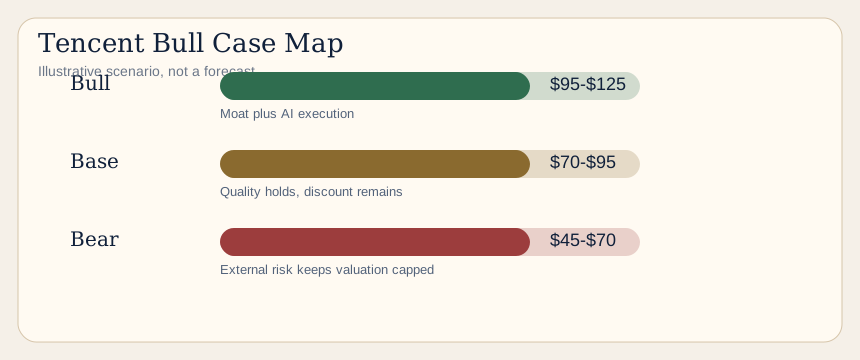
The scenario ranges below are author-built ranges rather than broker price targets. They are anchored to Tencent's current ADR reference price of $58.69 on May 15, 2026, the Hong Kong line's 52-week range of HK$316.8 to HK$614.0, Tencent's past-decade trading history from roughly the mid-teens to a peak near $89.03, reported revenue and profit growth, and a qualitative assessment of regulation, macro conditions, AI monetization, and capital intensity (Stock Analysis TCEHY quote; CompaniesMarketCap Tencent price history; Tencent Investors). The probability table separates three paths: rising, falling, and sideways. 'Sideways' means a result that does not decisively confirm either a major rerating or a major derating.
05. Scenarios And Investor Implications
How the long-term bull case translates into ranges
| Scenario | Range | Conditions | Takeaway |
|---|---|---|---|
| Bull | $95 to $125 by 2030 | AI monetization works, games stay strong, and the discount rate eases | Tencent is recognized as a compounding platform again |
| Base | $70 to $95 by 2030 | Business quality remains strong but valuation stays moderate | Still a respectable long-term outcome |
| Bear | $45 to $70 by 2030 | Macro, policy, or capex pressures dominate | The bull story is delayed, not necessarily destroyed |
| Path | Probability | Reasoning |
|---|---|---|
| Probability of rising | 55% | Tencent has more durable quality than the market often credits |
| Probability of falling | 20% | Real risks remain, but the business base is stronger than in the downturn |
| Probability of moving sideways | 25% | Valuation drag can mute solid fundamentals |
| Investor type | Bull-case positioning | Caution |
|---|---|---|
| Investor already in profit | Hold core, trim excess concentration | Do not let a good thesis become an oversized bet |
| Investor currently at a loss | Stay evidence-based and avoid anchoring to old highs | A bull thesis still requires patience |
| Investor with no position | Build slowly on weakness | Avoid chasing breakouts in a headline-sensitive stock |
| Trader | Respect the long-term case but trade the tape | Tencent can be fundamentally right and tactically wrong |
| Long-term investor | Favor dollar-cost averaging and periodic review | Bull cases fail when discipline disappears |
| Risk-hedging reader | Keep exposure balanced with less correlated assets | China platform risk should not dominate a portfolio |
06. Risks And Invalidation
What would break the bull case
The bull case would be materially weaker if Tencent's AI spend fails to improve monetization, if gaming growth fades while costs rise, or if regulation reopens a serious pressure cycle. A strong ecosystem does not guarantee a strong stock in every period (CNBC on China draft gaming rules; Reuters on Tencent AI investment plans).
Even so, the long-term case remains compelling because Tencent still owns scarce assets: attention, payments adjacency, data-rich recommendation surfaces, game IP distribution, and a balance sheet capable of funding transformation. That is why the bull case deserves to be taken seriously, but never treated as certain.
The most useful discipline for bulls is to ask what evidence would force a downgrade of conviction. If Tencent's newer monetization layers stall, if capex intensity stays high without revenue quality improving, or if the policy discount widens again, the correct response is not to defend the thesis emotionally. It is to narrow the range and lower the probability of the bullish path. A real bull case survives scrutiny because it accepts that possibility upfront.
In other words, the bullish argument is strongest when it stays grounded in operating evidence. Tencent does not need a story stock multiple to create respectable long-term returns. It needs durable earnings, sensible reinvestment, and enough confidence from the market that those earnings deserve to compound at a healthier multiple than the one implied by peak pessimism.
That is why the long-term bull case can remain credible even if the path is uneven. Tencent's strengths are cumulative rather than purely cyclical, and cumulative strengths tend to matter more over multiyear holding periods than over any single quarter.
Disclaimer: This article is for research and educational purposes only. It is not individualized investment advice, and all scenario ranges are conditional estimates rather than promises of future performance.
07. FAQ
Frequently asked questions
What makes Tencent a long-term powerhouse?
The combination of ecosystem scale, game cash flow, WeChat distribution, and optionality in ads, fintech, cloud, and AI.
Why hasn't the stock already fully rerated?
Because operational strength still competes with China-related macro, policy, and geopolitical risk.
Can AI really matter that much for Tencent?
Yes, if it improves monetization across existing traffic surfaces. The key is not AI for its own sake but AI inside Tencent's current products.
What is the smartest bullish strategy?
A patient, staged approach that avoids chasing and keeps position sizing disciplined.
References
Sources
- Tencent Investors
- Tencent 1Q2026 results
- Tencent FY2025 results
- Tencent 2025 Annual Report PDF
- Tencent 2024 Annual Report PDF
- Stock Analysis TCEHY quote
- CompaniesMarketCap Tencent price history
- Newzoo Global Games Market Report 2025
- CNBC Tencent Q1 2026 earnings
- Reuters on Tencent AI investment plans
- CNBC on China draft gaming rules
- IMF China 2025 Article IV
- World Bank China Economic Update