01. Quick Answer
The TM bull case is not that Toyota is perfect, but that it may still be better positioned than most rivals
TM closed at 190.68 on 2026-05-15 after compounding from 99.99 over the last decade (Yahoo Finance chart API for TM, 10-year monthly history; Yahoo Finance chart API for TM, recent daily closes). The core bullish argument is that Toyota combines scale, profitability, manufacturing discipline, hybrid leadership, and enough battery option value to win an auto market that remains more uneven than the pure-EV narrative once implied.
Public data supports that case. Toyota FY2026 presentation showed 10.477 million Toyota and Lexus retail sales and 5.040 million electrified vehicles, with FY2027 electrified guidance at 5.956 million. That is not a niche transition. It is one of the largest industrial shifts happening anywhere in global autos, and Toyota is still doing it from a position of cash generation and dividend growth.
| Point | Why it matters |
|---|---|
| The bull case is about quality of scale | Toyota's size matters because it improves resilience and optionality, not just bragging rights. |
| Hybrids may have been the right bridge | If EV adoption remains uneven, Toyota's installed base and product mix can look increasingly intelligent. |
| Capital returns remain supportive | Dividend growth and shareholder returns still matter for the equity story. |
| The bullish thesis still needs rebuttal | Margins, trade policy, and execution risk can still damage the upside case. |
02. Historical Context
The bull case starts from a company that already proved resilience
Unlike a turnaround story, Toyota does not need investors to imagine a dramatic rescue. Its 10-year share history, balance sheet, and operating record already establish resilience. Toyota finance page showed FY2025 ROE at 13.6%, while the Integrated Report documented very large liquidity and a massive global operating base.
The more interesting bullish point is that Toyota may now be better matched to a messy transition than purer strategy stories. If the world were moving quickly and uniformly to one drivetrain and one software stack, Toyota's flexibility might look indecisive. But if the market remains regionally fragmented, affordability constrained, and politically inconsistent, flexibility becomes an advantage.
| Driver | Evidence | Bullish implication |
|---|---|---|
| Scale and resilience | Global sales, liquidity, and strong historical ROE | Supports downside protection and strategic staying power. |
| Electrified volume leadership | 5.040 million electrified vehicles in FY2026 | Shows Toyota is transitioning at scale, not watching from the sidelines. |
| Capital returns | FY2026 dividend rose to ¥95, with ¥100 forecast for FY2027 | Adds shareholder-return support even in a choppy sector. |
| Battery roadmap | Next-gen BEV and solid-state programs remain active | Gives the bull case future optionality rather than only present strength. |
| Area | Why it helps | Main caveat |
|---|---|---|
| Hybrids | Still commercially relevant in many regions | Can look less exciting to momentum investors. |
| BEVs | Provide future relevance and valuation optionality | Toyota still has to prove stronger competitiveness. |
| Financial services and value chain | Can stabilize earnings beyond new-vehicle cycles | Still exposed to rates and credit quality. |
| Manufacturing execution | Toyota remains one of the industry's best operators | Great execution cannot erase all macro risk. |
03. Main Drivers
Six forces explain why Toyota could keep winning
1. The world may remain hybrid-heavy longer than many expected. IEA work and S&P Global Mobility both support an environment where electrification grows but not uniformly. That is exactly the kind of world Toyota's product strategy was built for.
2. Toyota's electrified scale is already massive. The market often debates Toyota as if it were still only a legacy internal-combustion player. Its FY2026 electrified volume argues otherwise (Toyota FY2026 financial results presentation).
3. Next-generation batteries create asymmetric upside. Toyota battery roadmap and the Idemitsu partnership mean the company still has real technology optionality if timelines hold.
4. Value-chain and mobility earnings can improve quality. Toyota's own medium-term framing is less about maximizing unit volume and more about improving earnings stability and ROE (Toyota FY2026 financial results presentation). That is precisely what long-term investors want.
5. Dividend support remains real. Even in a difficult FY2026 profit year, Toyota maintained dividend growth. For a global auto leader, that is a significant confidence signal (Toyota FY2026 financial summary).
6. AI and software may improve productivity, not just product marketing. Woven by Toyota and Toyota intelligence efforts suggest future advantage could come through operations, design, and data, not only through infotainment buzzwords.
04. Institutional Forecasts and Analyst Views
The public evidence base supports the bull case, but only if investors accept that Toyota wins differently from many EV narratives
The most powerful data point in the bull case is not a slogan; it is scale combined with transition progress. Toyota FY2026 presentation shows electrified vehicles already represented 48.1% of retail sales and are forecast to reach 56.7% in FY2027. That makes Toyota one of the few companies trying to transition at global mass scale while still returning capital to shareholders.
Analysts remain divided because the evidence is mixed. The skeptics argue that Toyota must prove itself in pure BEVs and software-defined vehicles. The bulls argue that most of the world is still too uneven, too cost sensitive, and too politically fragmented for a single pure-BEV playbook to dominate. Available data suggests the bull side currently has enough evidence to stay credible.
| Source | Positive signal | Why it matters |
|---|---|---|
| Toyota FY2026 materials | Huge electrified volume and continued shareholder returns | Supports a high-quality industrial leadership thesis. |
| Battery strategy | Next-gen BEV and solid-state paths remain alive | Adds technology upside without requiring a one-path bet. |
| IEA and S&P Global | The industry remains uneven and regionally fragmented | Favors Toyota's flexibility if execution remains strong. |
| Woven and intelligence efforts | AI and software are being incorporated into Toyota's future operating model | Supports a broader mobility-company narrative over time. |
05. Scenarios, Risks, and Invalidation
The bull case is strong, but it still needs a disciplined risk framework
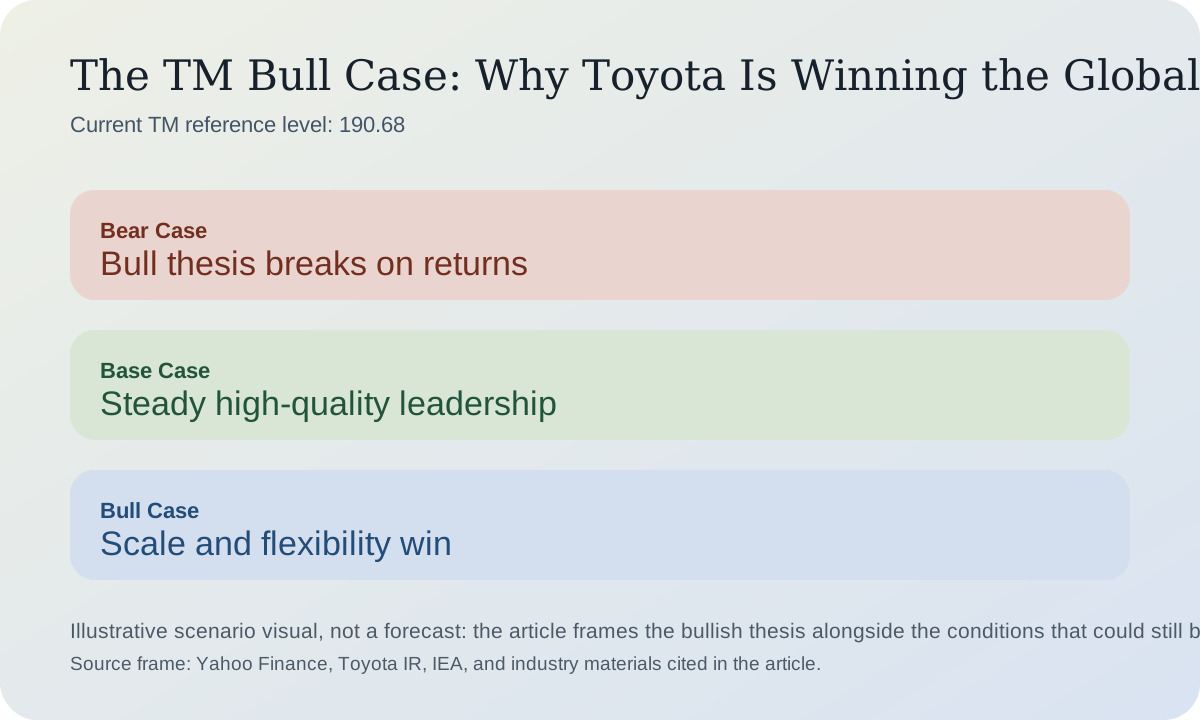
Bullish scenario
The core bull range is $230 to $270 in the medium term. This path requires stronger-than-feared margins, continued hybrid leadership, and visible progress in batteries or mobility earnings.
Base-case scenario
The base case is $195 to $225. It assumes Toyota remains one of the strongest operators in a difficult industry, but not one that earns an aggressive market premium.
Bearish counter-scenario
The bull thesis weakens if Toyota's flexibility starts to look like strategic delay and if capital intensity rises faster than shareholder returns.
Risks to watch
Watch margin performance, China competition, BEV ramp quality, trade policy, and whether electrified growth translates into better economics rather than just more complexity.
What could invalidate the bull case
The bullish view would be wrong if Toyota cannot improve the perceived quality of its transition earnings or if the global market rewards pure EV or software ecosystems much more than Toyota's diversified model.
Conclusion
The TM bull case is not about hype. It is about a company whose scale, operational culture, capital returns, and drivetrain flexibility may still be better matched to the real auto market than many cleaner narratives.
Disclaimer: This article is for research and informational purposes only. Bull-case scenarios are conditional paths, not guarantees of future returns.
| Scenario | Range | Conditions | Probability |
|---|---|---|---|
| Bull | $230-$270 | Higher-quality transition earnings and resilient demand | 30% |
| Base | $195-$225 | Steady execution with normal sector volatility | 45% |
| Bear | $155-$180 | Strategic delay or persistent margin pressure | 25% |
| Path | Estimated probability | Comment |
|---|---|---|
| Rising | 60% | The bull case assumes Toyota still has more strategic flexibility than many rivals. |
| Falling | 15% | Downside exists, but the franchise is strong enough to keep it from dominating the distribution. |
| Sideways | 25% | Valuation digestion is still possible even for a high-quality leader. |
06. Investor Positioning
Even a bullish article still calls for sizing discipline
| Investor type | Cautious approach | What to watch |
|---|---|---|
| Investor already in profit | Let a core position run, but trim if the portfolio is already too heavy in global cyclicals. | The best bull case still fails if sizing gets careless. |
| Investor currently at a loss | Reassess whether the original thesis was quality, yield, or transition upside. | Only add if the same bullish drivers still apply. |
| Investor with no position | Stage entries rather than chasing a rebound move. | The bull case is stronger when pursued patiently. |
| Trader | Trade momentum, but respect earnings and macro-event risk. | FX, tariffs, and auto demand data can reverse setups quickly. |
| Long-term investor | Favor gradual accumulation and dividend reinvestment over aggressive timing. | The thesis works best over years, not quarters. |
| Risk-hedging investor | Pair upside exposure with hedges if global cyclical risk is already elevated elsewhere. | The strongest company in the sector is still in the sector. |
07. FAQ
Frequently asked questions about the TM bull case
What makes Toyota's bull case different from a pure EV bull case?
It relies on flexibility, manufacturing discipline, hybrids, value-chain profits, and gradual electrification rather than on one all-or-nothing technology bet.
Does the bull case depend on solid-state batteries?
No. Solid-state progress helps, but the broader bullish thesis is viable even without immediate commercialization.
What is the main risk to the bullish thesis?
The main risk is that Toyota's diversified strategy stops looking adaptive and starts looking too slow for a more software- and battery-led market.
References
Sources
- Yahoo Finance chart API for TM, 10-year monthly history
- Yahoo Finance chart API for TM, recent daily closes
- Toyota FY2026 financial summary
- Toyota FY2026 financial results presentation
- Toyota financial highlights and financial performance
- Toyota Integrated Report 2025
- Toyota next-generation battery EV strategy
- Toyota and Idemitsu cooperation on solid-state batteries
- Toyota and Woven by Toyota AI technologies announcement
- Toyota intelligence technology overview
- IEA Global EV Outlook 2025
- S&P Global Mobility automotive industry outlook for 2026