01. Quick Answer
The WTI Bull Case: Why Oil Prices Could Surge Higher
The quick answer is that the bull case is credible because the oil market remains vulnerable to both physical disruption and structural underinvestment at the same time. The World Bank's April 2026 outlook openly states that Brent could average as high as 115 dollars in 2026 under a more damaging disruption scenario, while several banks have recently raised 2026 oil views as the Strait of Hormuz shock persisted longer than expected (World Bank press release on the April 2026 Commodity Markets Outlook; Reuters on HSBC raising its 2026 Brent forecast to $95; Reuters on Barclays raising its 2026 Brent forecast to $100).
A sensible editorial upside framework is 95 to 120 dollars per barrel, with an extreme bull extension above that only if current disruptions become semi-structural. That is not the same as saying 100-dollar oil should be the base case for years. It is saying the market still has enough fragility that upside cannot be dismissed as a brief overshoot (IEA, Oil Market Report, May 2026; Investing.com summary of JPMorgan seeing Brent in the low $100s for much of 2026; Reuters summary via BOE Report on Citi's updated 2026 Brent path and extreme disruption scenario).
| Category | Evidence-based read | Implication |
|---|---|---|
| The bull case is still fundamental | It is not only a headline trade; it also rests on spare capacity, inventories, and years of low long-cycle investment. | Oil can stay firmer than consensus expects even after the first shock fades. |
| Demand resilience matters | OPEC still sees strong non-OECD demand into 2030. | A slower energy transition raises the floor under crude. |
| Supply fragility is visible | The current market showed how quickly large outages can reset pricing. | Thin buffers amplify every disruption. |
| But the bull case is conditional | It can be invalidated by faster normalization, weaker demand, or stronger non-OPEC growth. | A serious bull thesis must include its rebuttal. |
02. Historical Context
Current market snapshot and historical context
WTI's 10-year range of $18.84 to $105.76 per barrel is the first reason any forecast has to be scenario-based rather than point-based. Oil is not a stable compounder. It is a clearing price for a system shaped by geology, OPEC+ policy, inventories, freight constraints, war risk, and global growth. The same benchmark that collapsed in 2020 recovered above $100 in both 2022 and 2026, which means investors should distinguish between a correction, a cyclical bear market, and a structurally lower oil regime (Yahoo Finance chart API, CL=F 10-year monthly data; IEA, Global Energy Review 2026: Oil).
Oil bulls should also remember that some of the strongest rallies happen after the market has spent months pricing oversupply. Late 2025 WTI closed near 57 dollars, yet a few months later the market was back above 100. That kind of repricing only happens when buffers are thinner than they look and spare barrels are less mobile than paper models assume (Yahoo Finance chart API, CL=F 10-year monthly data; EIA press release, forecast update amid continued Middle East disruption, May 12, 2026).
| Metric | Latest read | Why it matters |
|---|---|---|
| Spot WTI | $103.37/bbl | The market is already pricing a meaningful scarcity premium |
| 1-month high | $106.88/bbl | Confirms that upside pressure has been real, not theoretical |
| Shock scenario | World Bank sees Brent averaging as high as $115 in an escalation case | Shows upside is recognized by official institutions too |
| Main bullish floor | OPEC+ discipline plus underinvestment | Explains why oil can remain firm even after the first panic fades |
| Period marker | Approximate price | Interpretation |
|---|---|---|
| June 2016 monthly close | $48.33/bbl | WTI started the visible 10-year band in the high $40s as shale was still absorbing the 2014-2016 crash. |
| April 2020 monthly close | $18.84/bbl | The pandemic collapse shows how violently oil can break when storage, mobility, and sentiment all fail at once. |
| March 2022 monthly close | $100.28/bbl | Russia's invasion of Ukraine pushed crude back into a geopolitical scarcity regime. |
| December 2025 monthly close | $57.42/bbl | Before the 2026 supply shock, the market had already repriced toward oversupply and weaker demand expectations. |
| May 18, 2026 close | $103.37/bbl | Current scenarios start from an elevated, disruption-driven base rather than a neutral equilibrium. |
03. Main Drivers
Main drivers of price movement
1. Spare capacity is valuable only if it is usable
The current shock made that point brutally clear. EIA and IEA both emphasized the importance of the Strait of Hormuz and the rate at which shut-in supply can actually re-enter the market. Nominal spare capacity does not stabilize WTI if logistics, insurance, and geopolitics stop the barrels from reaching buyers (EIA, Short-Term Energy Outlook, May 2026; IEA, Oil Market Report, May 2026).
2. OPEC still sees stronger demand than many bearish narratives allow
OPEC's World Oil Outlook 2025 still projects demand rising to 113.3 mb/d by 2030. If that proves closer to reality than the market's softer assumptions, oil does not need a crisis to stay firm. It only needs demand to remain more persistent than expected (OPEC, World Oil Outlook 2025, oil demand chapter; OPEC, World Oil Outlook 2025).
3. Underinvestment and decline rates can keep the floor high
Even Goldman, while lowering its 2030-2035 assumptions, still argued that higher long-run prices are needed after years of low long-cycle spending. In practice, that means every geopolitical shock lands on a supply system that may already be tighter than surface balances imply (Investing.com summary of Goldman Sachs cutting 2030-2035 Brent and WTI estimates to $75 and $71; Reuters/MarketScreener on Goldman seeing 2026 surplus and long-run Brent/WTI near $80/$76 by late 2028).
4. Inventory draws can force the market into rationing faster than expected
JPMorgan's latest tightness framing argues that accelerating inventory depletion can keep Brent in the low 100s for much of 2026 even if the Strait reopens. WTI would not necessarily match Brent one-for-one, but the logic is the same: if inventories keep falling, price has to do the balancing (Investing.com summary of JPMorgan seeing Brent in the low $100s for much of 2026; EIA, STEO current/previous forecast comparisons, May 12, 2026).
5. The energy transition does not remove hard-to-substitute demand overnight
IEA's oil review shows aviation and petrochemicals still matter, and OPEC's long-run demand case remains driven by emerging-market mobility and industrial use. The bull case therefore does not require denying electrification. It requires arguing that substitution happens more slowly than depletion and geopolitics (IEA, Global Energy Review 2026: Oil; OPEC, World Oil Outlook 2025, oil demand chapter).
04. Institutional Forecasts and Analyst Views
Institutional forecasts and analyst views
Recent bank revisions have mostly moved in the bullish direction because disruption lasted longer than expected. HSBC raised its 2026 Brent forecast to 95 dollars. Barclays raised its 2026 Brent view to 100. Citi outlined a higher near-term path and an extreme scenario if disruption persisted. Those are not long-run forecasts, but they are useful evidence that serious institutions still see meaningful upside risk (Reuters on HSBC raising its 2026 Brent forecast to $95; Reuters on Barclays raising its 2026 Brent forecast to $100; Reuters summary via BOE Report on Citi's updated 2026 Brent path and extreme disruption scenario).
At the same time, the bull case has to contend with EIA's 2027 WTI average near 74 dollars and Goldman's lower long-run WTI estimate. That tension is the right way to think about crude now: real upside exists, but it is still conditional rather than permanent (EIA, STEO current/previous forecast comparisons, May 12, 2026; Investing.com summary of Goldman Sachs cutting 2030-2035 Brent and WTI estimates to $75 and $71).
| Source | Forecast / signal | Interpretation |
|---|---|---|
| World Bank | Brent could average $115 in a more damaging 2026 shock scenario | Official acknowledgment of meaningful upside risk |
| HSBC | 2026 Brent forecast raised to $95 | Bank view supports a higher-for-longer near-term environment |
| Barclays | 2026 Brent forecast raised to $100 | Confirms upside has institutional backing |
| Citi | Sees a much higher path if Hormuz disruption persists | Upside tail risk remains live |
| JPMorgan | Brent can stay in the low $100s for much of 2026 under persistent tightness | Inventories and bottlenecks can keep oil elevated |
| OPEC | Strong demand outlook into 2030 | Structural support for the bull case beyond the immediate shock |
05. Bull, Bear, and Base Case
How the forecast range and probability table are built
The bull framework below assumes that current tightness is not entirely fleeting. It does not assume a permanent emergency, but it does assume supply buffers remain thinner than many normal-cycle models prefer.
Probability is assigned by asking whether the current market is mostly a temporary dislocation or a sign of a more fragile oil system. If inventories, freight routes, and usable spare capacity all remain stressed, the upside case can outlast the news cycle.
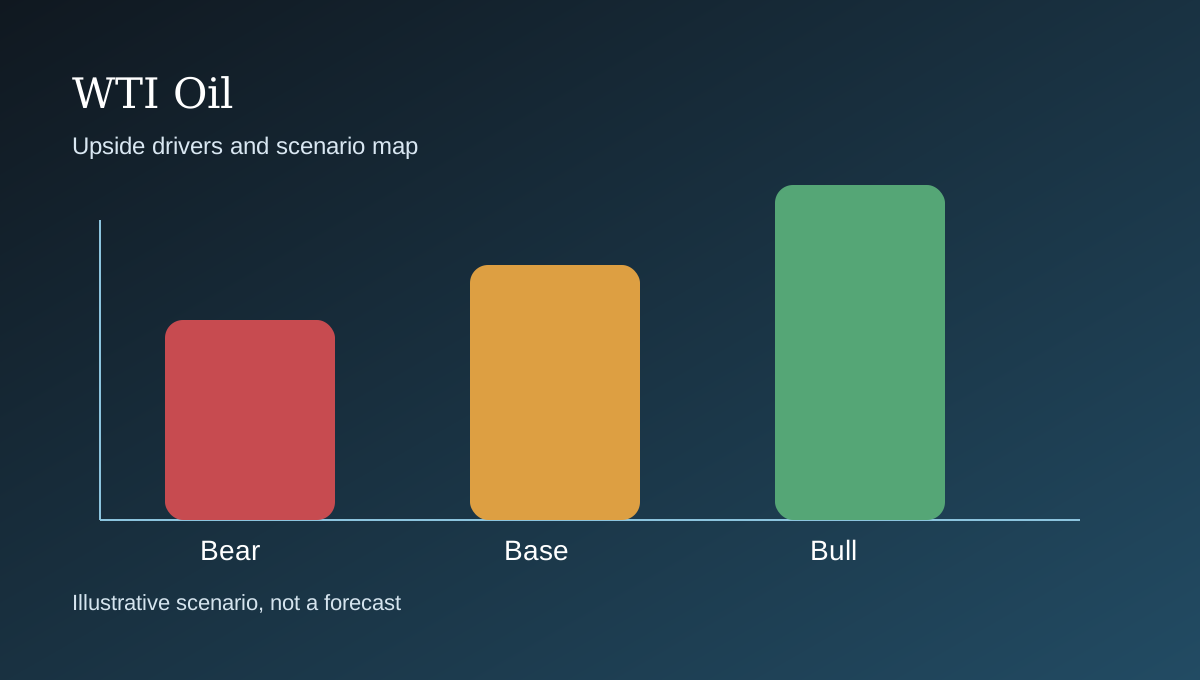
| Scenario | Price range | Conditions | Probability |
|---|---|---|---|
| Bull | $95-$120/bbl | Supply disruptions linger, OPEC+ stays disciplined, and inventory draws keep the market in rationing mode | 40% |
| Base | $80-$95/bbl | Some normalization occurs, but oil remains structurally firmer than late-2025 surplus pricing suggested | 35% |
| Bear | $60-$80/bbl | Risk premium fades quickly and non-OPEC supply plus weaker demand cool the market | 25% |
| Direction | Probability | Comment |
|---|---|---|
| Higher from current medium-term consensus | 40% | Bullish because the market's buffers still look fragile |
| Lower from current spot | 30% | Possible if the shock fades cleanly and supply returns faster |
| Sideways but elevated | 30% | A realistic middle path where oil stays expensive without breaking out indefinitely |
| Investor type | Prudent approach | Main watchpoints |
|---|---|---|
| Investor already in profit | Consider holding a core allocation but trim into sharp spikes, especially when spot prices outrun medium-term fundamentals. | Watch whether prompt risk premium is fading faster than the narrative. |
| Investor currently at a loss | Reassess position size and thesis rather than averaging automatically. A cyclical commodity can stay volatile longer than expected. | Separate the long-term oil thesis from an entry-price mistake. |
| Investor with no position | Avoid chasing parabolic moves. Wait for pullbacks, stagger entries, or stay patient if the risk-reward no longer compensates for volatility. | High spot prices often compress future returns. |
| Trader | Use stop-loss discipline, monitor inventory data, OPEC+ signaling, and time spreads, and treat headlines as catalysts rather than investment theses. | WTI can overshoot both up and down when positioning becomes crowded. |
| Long-term investor | Dollar-cost averaging can make sense only if you accept long drawdowns and use a horizon long enough to absorb policy and macro cycles. | Long-run oil exposure should be sized as a cyclical asset, not a bond substitute. |
| Risk-hedging investor | Use crude as part of a broader inflation or geopolitical hedge basket, and rebalance when one shock turns a hedge into an outsized directional bet. | Oil can hedge some macro risks while creating others. |
The WTI bull case is credible because oil remains a market where thin buffers and slow supply response can overwhelm consensus quickly. But a serious bull thesis still has to admit that current spot pricing is already elevated and that normalization remains possible. The strongest bullish stance is therefore conditional and risk-aware, not euphoric. Disclaimer: This article is for informational and research purposes only and does not constitute personalized financial advice.
06. FAQ
Frequently asked questions
Can WTI stay above 100 dollars for long?
Yes, but sustaining that level likely requires either persistent disruption, unexpectedly tight inventories, or stronger demand resilience than many baseline forecasts assume.
What is the strongest official bullish input today?
The World Bank's escalation scenario and OPEC's demand outlook are the clearest official inputs that support continued firmness.
Does the bull case require denying the energy transition?
No. It only requires the transition to move more slowly than oil-field decline and supply frictions.
What would invalidate the WTI bull case?
A faster supply recovery, rebuilt inventories, or softer demand under high prices would all weaken it.
Methodology and Invalidation
How to interpret this framework and what would change it
This article uses current WTI pricing, official shock scenarios from the World Bank and EIA, bank forecast revisions, and OPEC's longer-run demand outlook to build an upside framework (Yahoo Finance chart API, CL=F recent daily data; World Bank press release on the April 2026 Commodity Markets Outlook; EIA, Short-Term Energy Outlook, May 2026; Reuters on HSBC raising its 2026 Brent forecast to $95; Reuters on Barclays raising its 2026 Brent forecast to $100; OPEC, World Oil Outlook 2025, oil demand chapter).
The point is not to predict that oil must surge. It is to show why an upside outcome remains credible even after a large move has already happened.
Invalidation would come from normalization that is both faster and cleaner than expected. If usable spare capacity returns, inventories rebuild, and demand softens, the upside range would need to move lower.
References
Sources
- Yahoo Finance chart API, CL=F recent daily data
- Yahoo Finance chart API, CL=F 10-year monthly data
- EIA, STEO current/previous forecast comparisons, May 12, 2026
- EIA, Short-Term Energy Outlook, May 2026
- EIA press release, forecast update amid continued Middle East disruption, May 12, 2026
- IEA, Oil Market Report, May 2026
- World Bank press release on the April 2026 Commodity Markets Outlook
- OPEC, World Oil Outlook 2025
- OPEC, World Oil Outlook 2025, oil demand chapter
- Investing.com summary of Goldman Sachs cutting 2030-2035 Brent and WTI estimates to $75 and $71
- Reuters/MarketScreener on Goldman seeing 2026 surplus and long-run Brent/WTI near $80/$76 by late 2028
- Investing.com summary of JPMorgan seeing Brent in the low $100s for much of 2026
- Reuters on HSBC raising its 2026 Brent forecast to $95
- Reuters on Barclays raising its 2026 Brent forecast to $100
- Reuters summary via BOE Report on Citi's updated 2026 Brent path and extreme disruption scenario