01. Quick Answer
The most defensible TM 2030 outlook is constructive, but Toyota now has to prove that hybrids, software, and batteries can coexist profitably
Toyota's ADR, traded under `TM`, closed at 190.68 on 2026-05-15, versus 99.99 on 2016-06-01 in the 10-year Yahoo Finance series, for a price-only CAGR of about 6.70% (Yahoo Finance 10-year history; recent daily closes). That is solid long-run compounding, but it is not the kind of exponential price path that lets analysts ignore future execution risk.
The long-term case still has substance. Toyota FY2026 results show fiscal-year sales revenue rose to ¥50.685 trillion, even as operating income fell to ¥3.766 trillion and operating margin narrowed to 7.4%. At the same time, Toyota management materials show Toyota and Lexus retail sales reached 10.477 million units in FY2026, while electrified sales rose to 5.040 million vehicles. That creates a credible 2030 framework: Toyota is still huge, still profitable, and still adapting, but future upside depends on whether its multi-pathway strategy remains economically superior to more concentrated EV approaches.
| Point | Why it matters |
|---|---|
| Toyota still scales better than most global automakers | Size matters because pricing, procurement, and manufacturing resilience still drive auto profitability. |
| Electrified growth is already visible | Toyota sold 5.040 million electrified vehicles in FY2026, showing the transition is broader than BEV headlines imply. |
| Margins matter more than volume alone | FY2026 operating income and margin fell, so the market cannot rely on unit growth by itself. |
| 2030 should be framed as scenarios | The evidence is mixed enough that a range is more credible than a one-number target. |
02. Historical Context
Toyota's history supports durability, but not automatic rerating
Over the past decade, TM moved from 99.99 to 190.68 in ADR terms, with a 10-year observed range from 99.99 to 251.68 (Yahoo Finance chart API for TM, 10-year monthly history). That tells investors two things. First, Toyota has already shown it can preserve and grow value through a difficult automotive cycle that included pandemic disruption, semiconductor shortages, inflation, and EV-capex anxiety. Second, the stock is not trading from a distressed base that would make a heroic 2030 rerating easy.
Toyota Integrated Report 2025 and Toyota financial highlights show a company that entered FY2026 from a position of unusual balance-sheet strength, a FY2025 return on equity of 13.6%, and a huge global production and sales footprint. That makes Toyota different from smaller, less diversified automakers. But it also raises the bar for incremental upside. A leader this large has to create value through capital discipline, technology choices, and resilience, not only through unit growth.
| Metric | Latest reading | Why it matters |
|---|---|---|
| Current ADR price | 190.68 | Anchors the forecast to the latest available close. |
| 52-week range | 167.18 to 248.90 | Shows the stock is well below the 52-week high but still above the low, so sentiment is neither euphoric nor broken. |
| 10-year price CAGR | 6.70% | Provides discipline when modeling 2030 returns. |
| Editorial base range | $210-$245 | Assumes moderate earnings growth, continued buybacks and dividends, and no major strategic misfire. |
| Feature | Implication | Forecast effect |
|---|---|---|
| Multi-pathway electrification | Toyota is not forced into a single drivetrain outcome | Can reduce strategic risk if EV adoption remains uneven. |
| Scale and manufacturing depth | Large procurement and production base still matter | Helps resilience, but also limits how fast growth can compound. |
| Financial-services exposure | Auto earnings are supported by financing and value-chain businesses | Adds stability but also sensitivity to rates and credit. |
| Battery and software transition | Execution risk remains real despite Toyota's size | 2030 upside depends on whether technology investments earn attractive returns. |
03. Main Drivers
Six forces are most likely to shape Toyota into 2030
1. Hybrid and plug-in demand may stay stronger for longer. The auto market is not moving to one endpoint at one speed. S&P Global Mobility still expects uneven EV adoption, while the IEA shows global electrification continues to rise but under very different regional policy and affordability conditions. Toyota's multi-pathway stance therefore still has a real commercial logic.
2. BEV credibility must improve from a lower base. Toyota battery strategy laid out next-generation BEVs targeted for 2026 with faster charging, lower cost, and longer range. The stock's long-term upside depends partly on whether Toyota can convert technical roadmaps into profitable volume, not just prototype headlines.
3. Solid-state batteries are a strategic option, not a guaranteed catalyst. Toyota and Idemitsu are targeting commercialization of all-solid-state batteries in 2027-2028. That is important, but investors should treat it as an option value driver rather than a certainty until industrial scaling is clearer.
4. Value-chain and financing businesses matter. Toyota's FY2026 presentation highlights a goal of transforming into a mobility company with expanded value-chain profits and a long-run target of 20% ROE (Toyota FY2026 financial results presentation). That means valuation support increasingly depends on recurring earnings streams, not only on vehicle shipment cycles.
5. Tariffs, FX, and input costs remain major variables. Toyota itself lists exchange rates, trade policy, commodity costs, and supply risk as material forward-looking risks (IR cautionary statements). With a global footprint, Toyota benefits from diversification, but it is also exposed to many macro channels at once.
6. Industry demand is stable, not euphoric. S&P Global sees global light-vehicle sales around 91.8 million in 2026, while its production forecast describes a market still vulnerable to energy and geopolitical shocks. That backdrop supports Toyota's cautious operational focus but limits the case for an easy re-rating.
04. Institutional Forecasts and Analyst Views
Institutional evidence supports resilience, but not complacency
The strongest public evidence for a constructive Toyota view comes from Toyota itself, though it must still be handled carefully. FY2026 results show revenue growth despite lower profit, while the FY2026 presentation shows electrified vehicle sales rising from 4.732 million to 5.040 million units and management targeting 5.956 million electrified vehicles in FY2027. Those numbers matter because they frame the company as evolving, not static.
Outside the company, the evidence is mixed. The IEA argues electric mobility keeps expanding globally, but regional adoption remains uneven. S&P Global Mobility stresses volatility in tariffs, costs, and supply chains rather than a one-way automotive boom. For investors, that means Toyota's best case is not that the whole industry becomes easy. It is that Toyota adapts better than peers because its drivetrain mix, balance sheet, and manufacturing discipline stay more flexible.
| Source | What it says | Implication for TM |
|---|---|---|
| Toyota FY2026 materials | Revenue is growing, margins are lower, and electrified sales are expanding | Supports a constructive but selective long-term case. |
| IEA | Global electrification keeps rising, but market conditions differ by region | Supports Toyota's multi-pathway argument better than a pure BEV thesis. |
| S&P Global Mobility | Global auto growth is near-flat and subject to macro shocks | Argues for cautious scenario ranges instead of heroic upside assumptions. |
| Toyota integrated and finance materials | ROE, liquidity, and capital-return discipline remain meaningful strengths | Adds durability to the base case even when industry conditions are noisy. |
05. Scenarios, Risks, and Invalidation
A sensible 2030 forecast for TM is a range, not a promise
Bullish scenario
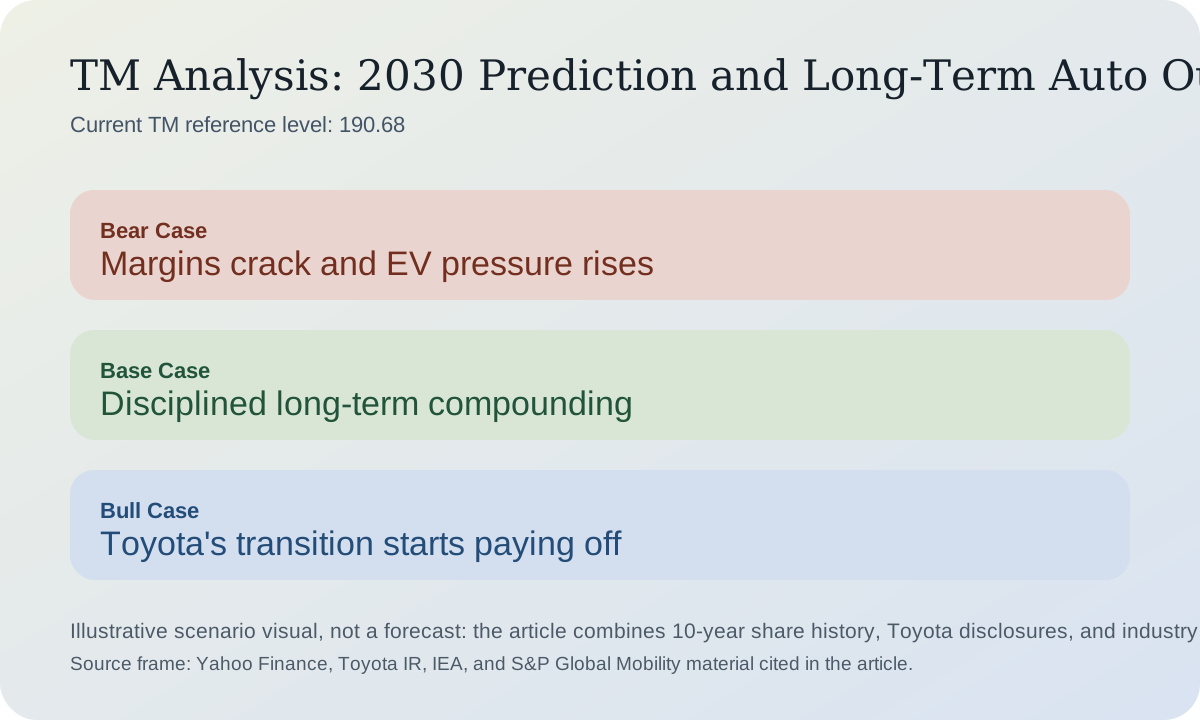
The bull case is roughly $260 to $310 by 2030. This scenario depends heavily on hybrids remaining commercially strong, BEV execution improving materially, value-chain profits expanding, and capital returns continuing without a margin collapse.
Bearish scenario
The bear case is $140 to $175. That path would likely require weaker global auto demand, more tariff or cost pressure, slower EV competitiveness, and a market view that Toyota's technology roadmap is too cautious rather than adaptive.
Base-case scenario
The base case is $210 to $245. It assumes Toyota keeps compounding through volume discipline, dividends, buybacks, and moderate earnings growth, but not through dramatic multiple expansion.
Risks to watch
Watch global pricing pressure, China competition, battery-cost execution, tariff and trade developments, USD/JPY, and whether value-chain earnings really broaden as management intends.
What could invalidate the forecast
This forecast would prove too conservative if Toyota's BEV and software transition gains traction faster than skeptics expect, or if solid-state milestones become commercially clearer. It would prove too optimistic if cost pressure and competition erode margins faster than scale can offset them.
Conclusion
The most credible TM 2030 outlook is constructive, but it is not a blind quality premium call. Toyota still has strategic flexibility and industrial depth. What investors need to watch now is whether those advantages keep translating into profitable electrification rather than only respectable volume.
Disclaimer: This article is for research and informational purposes only. Scenario ranges and probabilities are editorial judgments based on public information and cited sources, not guarantees or personalized investment advice.
| Scenario | Range | Key conditions | Probability |
|---|---|---|---|
| Bull | $260-$310 | Hybrid durability, stronger BEV execution, and stable capital returns | 25% |
| Base | $210-$245 | Moderate compounding with uneven but positive transition progress | 50% |
| Bear | $140-$175 | Margin pressure, tougher competition, and weaker auto demand | 25% |
| Path | Estimated probability | Why |
|---|---|---|
| Rising from current levels by 2030 | 55% | Toyota still has scale, capital discipline, and a flexible drivetrain strategy. |
| Falling below current levels by 2030 | 20% | A lower 2030 level likely requires both strategic execution disappointment and a weaker global auto cycle. |
| Moving broadly sideways | 25% | Auto stocks can digest years of volume and cash flow without large multiple expansion. |
06. Investor Positioning
Toyota should be approached differently depending on the investor's starting point
| Investor type | Cautious approach | What to watch |
|---|---|---|
| Investor already in profit | Hold core exposure, but trim if the position has become an oversized bet on a defensive auto franchise. | Watch whether margin compression is proving cyclical or structural. |
| Investor currently at a loss | Separate entry timing from thesis quality before averaging down. | Check whether the thesis was about dividends and resilience or about a rapid EV re-rating. |
| Investor with no position | Build exposure in stages or wait for pullbacks instead of chasing strength. | Auto stocks often offer better entries during industry scares. |
| Trader | Use stop-losses and trade around earnings, guidance, and policy headlines. | FX, tariffs, and industry demand data can move the stock quickly. |
| Long-term investor | Dollar-cost averaging and periodic rebalancing are more defensible than one-shot timing. | Focus on capital returns, electrified mix, and margin resilience over time. |
| Risk-hedging investor | Use hedges or rebalance if cyclical auto exposure would hurt broader portfolio stability. | Oil, rates, and consumer-credit conditions remain key macro signals. |
07. FAQ
Frequently asked questions about TM and Toyota's long-term outlook
Why use a range instead of one Toyota stock target for 2030?
Because autos are cyclical, capital intensive, and heavily exposed to policy and cost changes. A scenario range is more credible than pretending one price is inevitable.
Is Toyota still mainly a hybrid story?
Hybrids remain central, but Toyota is also trying to expand BEVs, solid-state batteries, and higher-value software and financing businesses.
What matters most right now for TM?
Margin resilience, electrified mix growth, battery execution, trade policy, and whether management can expand mobility and value-chain profits without overcommitting capital.
References
Sources
- Yahoo Finance chart API for TM, 10-year monthly history
- Yahoo Finance chart API for TM, recent daily closes
- Toyota FY2026 financial summary
- Toyota FY2026 financial results presentation
- Toyota financial highlights and financial performance
- Toyota Integrated Report 2025
- Toyota next-generation battery EV strategy
- Toyota and Idemitsu cooperation on solid-state batteries
- S&P Global Mobility automotive industry outlook for 2026
- S&P Global Mobility 2026 light vehicle production forecast
- IEA Global EV Outlook 2025
- Toyota investor relations homepage