01. Quick Answer
The most defensible TM 2027 call is a moderate range because Toyota sits between strong cash flow and tougher near-term guidance
TM closed at 190.68 on 2026-05-15, within a 52-week range of 167.18 to 248.90 (Yahoo Finance chart API for TM, recent daily closes; Yahoo Finance chart API for TM, 10-year monthly history). That already tells investors not to treat Toyota like a low-volatility utility. It is more stable than many auto names, but it still trades as a cyclical industrial stock.
The near-term tension is clear in public filings. Toyota FY2026 results showed revenue up 5.5% and net income attributable to Toyota at ¥3.848 trillion, yet the FY2027 forecast calls for net income to fall to ¥3.0 trillion and operating income to decline to ¥3.0 trillion (FY2027 guidance). That mix supports a 2027 base range of roughly $185 to $220: constructive enough for resilience, but cautious enough to respect guidance pressure and industry volatility.
| Point | Why it matters |
|---|---|
| 2027 is more about guidance than distant strategy | Near-term stock performance will depend on whether Toyota beats or merely meets lower profit expectations. |
| Electrified mix is a real catalyst | FY2027 management targets 5.956 million electrified vehicles, well above FY2026 actuals. |
| Margins remain the key swing factor | Volume without pricing or cost discipline will not protect the stock. |
| Macro headwinds still matter | FX, tariffs, oil, and consumer affordability can all hit the auto cycle quickly. |
02. Historical Context
Toyota enters 2027 from a position of strength, but not from peak optimism
TM's 10-year path from 99.99 to 190.68 (Yahoo Finance chart API for TM, 10-year monthly history) shows Toyota can still compound over time, but the stock is below its 52-week high of 248.90. That matters because a 2027 forecast should start from current sentiment, not from an old peak narrative.
Toyota's own numbers also set the tone. The FY2026 presentation showed Toyota and Lexus retail sales of 10.477 million in FY2026 and a FY2027 retail sales outlook of 10.500 million. That is stability rather than hypergrowth. The more important near-term question is whether electrified mix and value-chain profit growth can offset margin pressure well enough to support the stock.
| Metric | Latest reading | Why it matters |
|---|---|---|
| Current ADR price | 190.68 | Starting point for every 2027 scenario. |
| 52-week range | 167.18 to 248.90 | Shows that upside and downside are both still plausible in the next 12-18 months. |
| FY2026 operating margin | 7.4% | Indicates how much earnings quality cooled versus FY2025. |
| Editorial base range | $185-$220 | Reflects a near-term balance between resilience and caution. |
| Near-term variable | Why it matters now | Forecast effect |
|---|---|---|
| FY2027 guidance execution | Toyota already guided to lower profit | Beating or missing those targets can move the stock materially. |
| FX and trade policy | Auto earnings react quickly to currency and tariffs | Can change sentiment faster than long-run strategic narratives. |
| Electrified sales mix | Higher mix supports the transition story | Helps bullish scenarios if margins hold. |
| Industry demand | Affordability and financing conditions still shape unit sales | Can cap upside even if Toyota executes well operationally. |
03. Main Drivers
Five catalysts are most likely to decide the 2027 path
1. Whether Toyota can outperform its own FY2027 guide. Management forecast FY2027 revenue of ¥51.0 trillion but operating income of only ¥3.0 trillion (Toyota FY2026 financial summary). If actual results track better than that, the stock could rerate from a cautious base.
2. Electrified sales expansion. Toyota FY2027 outlook calls for electrified sales to rise from 5.040 million to 5.956 million, including BEV growth from 243,000 to 598,000 units. Those targets matter because they create a measurable catalyst rather than a vague transition story.
3. Cost reduction and margin defense. Toyota's FY2027 operating-income bridge emphasizes cost reduction and forex offsets against price, labor, and other pressures (Toyota FY2026 financial results presentation). The market will care about the quality of those offsets.
4. Oil, tariffs, and macro volatility. S&P Global Mobility still sees production risk from higher energy costs and geopolitical tension. Toyota's global footprint does not eliminate those risks.
5. Capital returns. Toyota raised FY2026 annual dividends to ¥95 per share and forecasts ¥100 for FY2027 (Toyota FY2026 financial summary). For a near-term stock outlook, dividend credibility and buyback discipline remain meaningful support.
04. Institutional Forecasts and Analyst Views
Institutional evidence is constructive on Toyota's resilience, but careful on the auto cycle
The most concrete public forecast comes from Toyota itself. FY2027 guidance implies lower profits despite slightly higher revenue, which is a cautious setup rather than a euphoric one (Toyota FY2026 financial summary). Industry context reinforces that caution. S&P Global describes a near-flat global auto market with ongoing cost and electrification uncertainty, while its production forecast still highlights energy and geopolitical risk.
At the same time, the evidence is mixed rather than outright bearish. Toyota's electrified mix is still improving, its financial position remains strong, and its dividend profile is still supportive. That is why the 2027 view is best framed as a broad range rather than a pure downside call.
The probability ranges in this article are built from three inputs: the current share-price anchor, management guidance, and the width of Toyota's recent trading range. This is a practical framework for the next few reporting cycles, not a claim that anyone can forecast the entire auto market with precision into 2027.
| Source | Main signal | 2027 implication |
|---|---|---|
| Toyota guidance | Revenue up modestly, profits down notably | Creates a cautious starting point that can still be beaten. |
| S&P Global Mobility | The auto market remains volatile and near-flat | Supports moderate rather than aggressive upside assumptions. |
| IEA | Electrification keeps advancing globally | Supports Toyota's mix transition if execution holds. |
| Toyota capital returns | Dividend growth remains intact | Adds support for the base case even if the market de-rates cyclicals. |
05. Scenarios, Risks, and Invalidation
A 2027 TM forecast should be tactical and scenario based
Bullish scenario
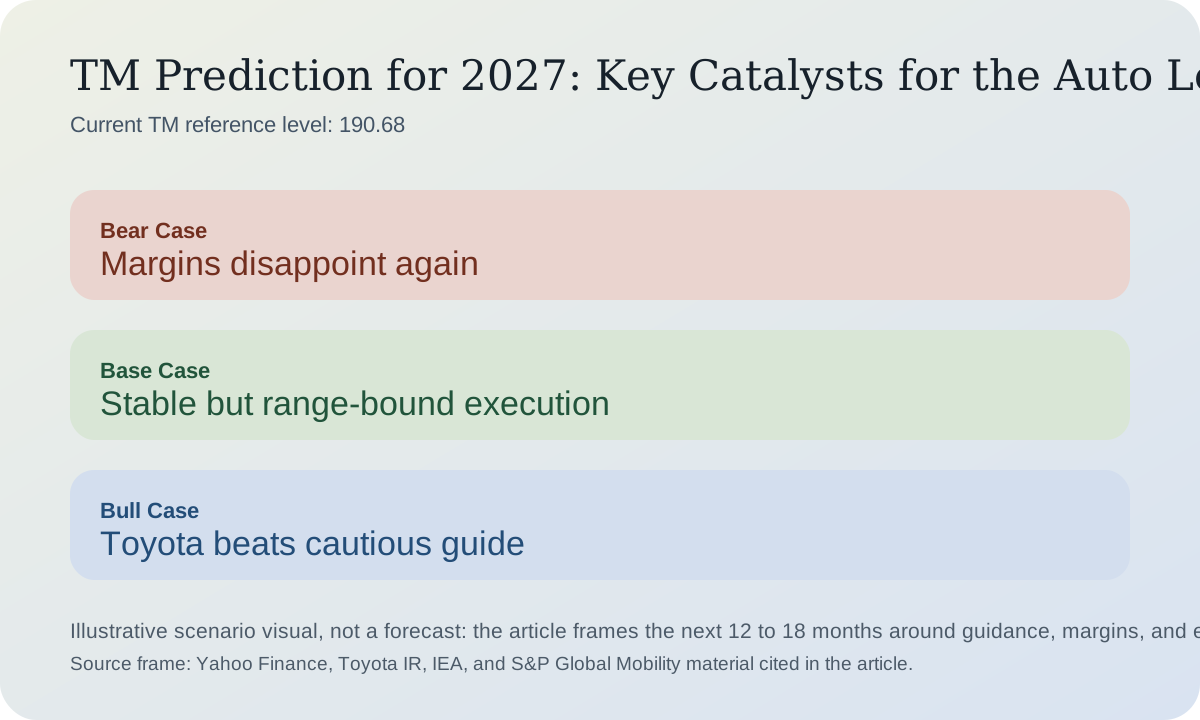
The bull case is $225 to $245. This path requires Toyota to outperform its cautious profit guide, keep electrified mix improving, and avoid major tariff or cost shocks.
Bearish scenario
The bear case is $155 to $175. That would likely require weaker global demand, further margin erosion, and a market view that Toyota's transition spending is not earning enough return.
Base-case scenario
The base case is $185 to $220. It assumes Toyota remains fundamentally solid but does not escape the normal volatility of a global auto leader.
That base case also assumes valuation stays disciplined. Even if Toyota executes reasonably well, markets may wait for repeated proof that electrified mix, pricing discipline, and cost controls are all moving in the right direction before awarding a meaningfully higher multiple.
Risks to watch
Watch quarterly margin trends, North American pricing, China competition, FX, tariffs, and whether the electrified mix targets remain on track.
What could invalidate the forecast
This range would be too conservative if Toyota beats profit expectations while also lifting confidence in batteries or software-linked earnings. It would be too optimistic if macro demand deteriorates and management has to cut guidance again.
Conclusion
The best 2027 TM framework is cautious but not pessimistic. Toyota is still one of the industry's stronger operators, yet near-term investors should respect how much auto equities can move on guidance and margins.
Disclaimer: This article is for research and informational purposes only. Near-term scenario ranges and positioning ideas are conditional estimates, not personalized investment advice.
| Scenario | Range | Key conditions | Probability |
|---|---|---|---|
| Bull | $225-$245 | Guidance beat and stronger mix quality | 25% |
| Base | $185-$220 | Stable execution with industry volatility | 45% |
| Bear | $155-$175 | Demand, pricing, or margin pressure intensifies | 30% |
| Path | Estimated probability | Why |
|---|---|---|
| Rising from current levels by 2027 | 45% | Toyota's resilience and dividends support the upside, but guidance tempers optimism. |
| Falling below current levels by 2027 | 25% | Auto stocks remain vulnerable to macro and margin disappointment. |
| Moving broadly sideways | 30% | The most realistic outcome may be a digestion range while the market waits for cleaner evidence. |
06. Investor Positioning
Near-term positioning in TM should reflect the auto cycle, not only Toyota's reputation
| Investor type | Cautious approach | What to watch |
|---|---|---|
| Investor already in profit | Hold a core position but consider trimming if recent gains rest on a quick rebound trade. | Monitor guidance revisions and margin quality. |
| Investor currently at a loss | Do not average down automatically; check whether the thesis was income, defensiveness, or transition upside. | Near-term guidance matters more than distant strategy here. |
| Investor with no position | Scale in gradually or wait for better entry points during industry volatility. | Auto leaders often offer better setups after cyclical scares. |
| Trader | Use stop-losses and trade around earnings and macro headlines. | FX, tariffs, and margin commentary can shift sentiment quickly. |
| Long-term investor | Separate the 2027 range from the decade thesis and use dollar-cost averaging if conviction is long term. | A weak quarter does not automatically break a strong long-term case. |
| Risk-hedging investor | Hedge or rebalance if broader cyclical exposure is already high elsewhere. | Oil, financing conditions, and consumer demand remain key macro markers. |
07. FAQ
Frequently asked questions about TM's 2027 outlook
Why is the 2027 range narrower than the 2030 or 2035 ranges?
Because it is anchored more directly to current price, current guidance, and the next few earnings cycles.
What is the biggest 2027 catalyst?
The biggest catalyst is whether Toyota can do better than its own cautious FY2027 profit guidance.
What is the biggest near-term risk?
The biggest risk is margin pressure from costs, pricing competition, or macro demand softness rather than a dramatic collapse in volume.
References
Sources
- Yahoo Finance chart API for TM, 10-year monthly history
- Yahoo Finance chart API for TM, recent daily closes
- Toyota FY2026 financial summary
- Toyota FY2026 financial results presentation
- Toyota investor relations homepage
- Toyota financial highlights and financial performance
- S&P Global Mobility automotive industry outlook for 2026
- S&P Global Mobility 2026 light vehicle production forecast
- IEA Global EV Outlook 2025