01. Quick Answer
A 2035 Toyota forecast is really a forecast on whether industrial discipline can outlast drivetrain volatility
TM closed at 190.68 on 2026-05-15, up from 99.99 on 2016-06-01 for a 10-year CAGR of 6.70% (Yahoo Finance chart API for TM, 10-year monthly history; Yahoo Finance chart API for TM, recent daily closes). That is respectable long-term compounding, but 2035 requires a harder question: can Toyota stay structurally advantaged after the transition from internal combustion toward a more software-, battery-, and service-heavy auto industry?
The case for 2035 is stronger than the case for the next quarter because Toyota still has time to adapt. FY2026 management materials show a target 20% ROE ambition tied to expanding value-chain and new mobility businesses, while Toyota and Woven by Toyota are already framing AI and Woven City as long-term innovation platforms. Still, analysts remain divided because the evidence is mixed: Toyota has scale and options, but the auto industry is becoming more technologically demanding and more geopolitically fragmented.
| Point | Why it matters |
|---|---|
| 2035 is about business mix, not only vehicle volume | Value-chain, software, financing, and battery economics will matter more over time. |
| Toyota still has unusual flexibility | Its hybrid base, supplier depth, and capital strength keep several strategic paths open. |
| The BEV question remains central | Even a multi-pathway strategy needs credible battery EV economics by the next decade. |
| Scenario ranges are essential | Long-run auto outcomes are too path dependent for a single target to be honest. |
02. Historical Context
Toyota's historical strength provides a foundation, not a guarantee
The 10-year ADR history from 99.99 to 190.68 (Yahoo Finance chart API for TM, 10-year monthly history) already reflects Toyota's reputation for manufacturing discipline and balance-sheet durability. So does the company's operating record: the Integrated Report shows FY2025 vehicle sales above 9.3 million units and very large liquidity, while Toyota finance data shows FY2025 ROE at 13.6%.
But 2035 asks for more than durability. By then, investors will care about whether Toyota's profits are less dependent on classical auto cycles and more supported by electrified mix, services, finance, software-defined vehicle capabilities, and higher-quality capital returns. That is why 2035 should be modeled as a set of structural scenarios rather than an extrapolation of the last decade.
| Anchor | Reading | Why it matters |
|---|---|---|
| Current ADR price | 190.68 | Prevents the forecast from assuming Toyota starts from deep distress. |
| 10-year price CAGR | 6.70% | Useful as history, but too aggressive as a default 2035 base-case assumption. |
| FY2025 ROE | 13.6% | Shows Toyota entered this transition period with strong capital efficiency. |
| Editorial base range | $240-$310 | Assumes a slower but still positive decade of compounding. |
| Question | Bullish answer | Bearish answer |
|---|---|---|
| Can Toyota monetize electrification without crushing margins? | Yes, through hybrids, BEVs, and battery cost advantages. | No, transition spending outgrows the returns. |
| Can software and value-chain profits expand? | Yes, recurring earnings reduce vehicle-cycle volatility. | No, earnings remain too tied to unit cycles. |
| Can Toyota remain globally relevant in batteries? | Yes, solid-state and next-gen batteries create real option value. | No, competitors scale faster and cheaper. |
| Can scale still defend pricing power? | Yes, manufacturing and supplier depth stay decisive. | No, pricing pressure and Chinese competition keep intensifying. |
03. Main Drivers
Five structural drivers matter most in a 2035 Toyota forecast
1. Drivetrain optionality versus wrong-way commitment. Toyota's multi-pathway stance looks stronger if EV adoption remains uneven by region (IEA Global EV Outlook 2025; S&P Global Mobility automotive industry outlook for 2026). It looks weaker if pure BEVs become dominant faster than Toyota's roadmap implies.
2. Battery economics and commercialization. Toyota 2023 battery roadmap and the Idemitsu collaboration give the company a real long-run battery narrative. But it is still scenario dependent. The durability of the 2035 bull case depends on cost, manufacturability, and timeline discipline.
3. Value-chain profit expansion. Toyota's FY2026 presentation explicitly ties higher future ROE to broader value-chain and new business domains (Toyota FY2026 financial results presentation). If that works, Toyota becomes less cyclical than a pure automaker multiple would imply.
4. AI, software-defined vehicles, and manufacturing intelligence. Woven by Toyota AI work and Toyota intelligence strategy matter because 2035 winners in autos may be judged as much on data, software, and production intelligence as on drivetrain hardware alone.
5. Geopolitical and supply-chain resilience. S&P Global Mobility still describes a world where energy shocks and sourcing changes can alter regional production forecasts. Toyota's scale helps, but it does not remove those risks.
04. Institutional Forecasts and Analyst Views
Public institutional evidence supports a durable business, but not a frictionless decade
Toyota FY2026 summary and presentation give the most concrete starting point: huge revenue, lower profitability than FY2025, a planned FY2027 net income of JPY 3.0 trillion, and faster electrified growth than total vehicle sales growth. Those are facts, not forecasts from outsiders. The market then has to decide what multiple to place on that transition.
Industry sources add useful caution. The IEA supports the view that electrification is a durable theme, but not a simple straight line. S&P Global and its production forecast show an industry still exposed to tariffs, energy shocks, and uneven affordability. The long-run base case for Toyota is therefore positive, but it should not be modeled as though the next decade will be cleaner than the last one.
| Source | Main message | 2035 implication |
|---|---|---|
| Toyota FY2026 materials | Huge scale remains intact, but near-term profits are below the FY2025 peak | Upside exists, though it likely comes through mix improvement more than easy rerating. |
| Toyota battery roadmap | Next-gen BEV and solid-state milestones are visible | Creates option value but not certainty. |
| IEA | Electrification remains a global trend with uneven regional adoption | Supports Toyota's flexible path if execution is strong. |
| S&P Global Mobility | The industry remains volatile and heavily macro-sensitive | Argues for a broad range of long-run outcomes. |
05. Scenarios, Risks, and Invalidation
The 2035 framework should distinguish between durability, upside, and strategic disappointment
Bullish scenario
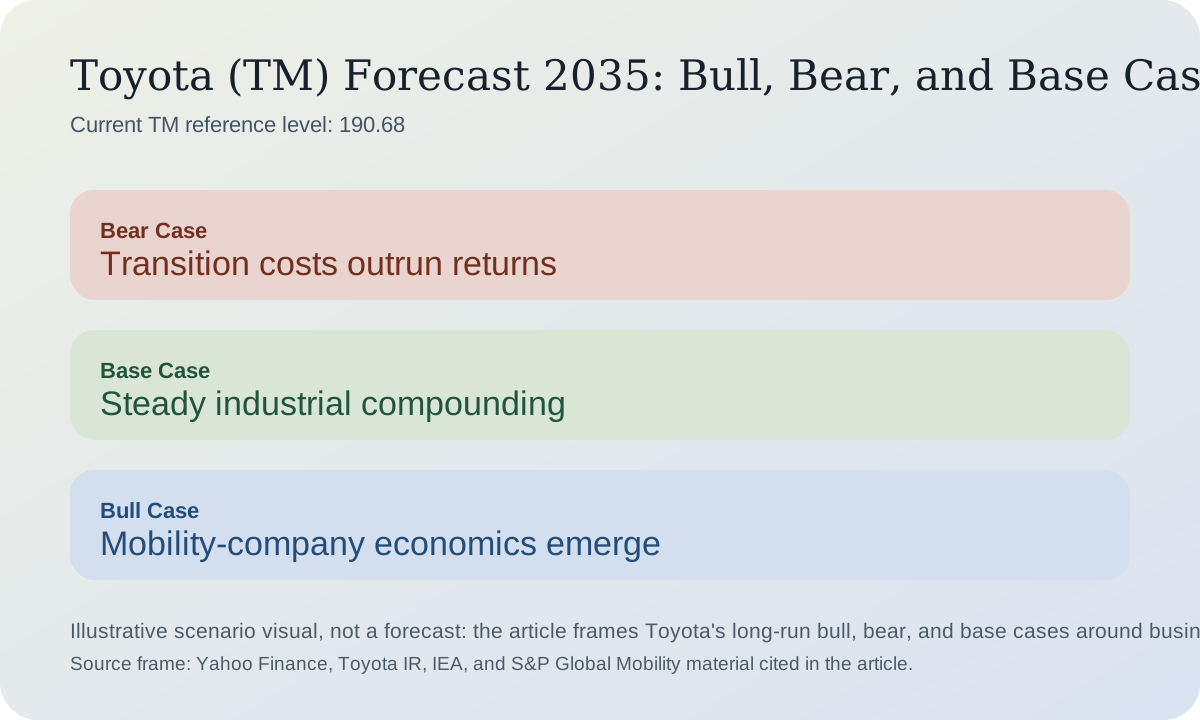
The bull case is $320 to $400 by 2035. This requires Toyota to execute on batteries, expand recurring value-chain profits, keep hybrid leadership, and prove that software and mobility earnings can support a higher-quality multiple.
Bearish scenario
The bear case is $150 to $210. That path would likely come from transition spending outgrowing returns, a weaker capital-allocation profile, and more intense price competition in key markets.
Base-case scenario
The base case is $240 to $310. It assumes Toyota remains a global winner, but one whose returns are moderated by the capital intensity and competitive complexity of the industry.
Risks to watch
Watch battery commercialization timelines, Chinese competition, trade policy, software monetization, financing and credit conditions, and whether management can keep shareholder returns disciplined while funding a broad technology roadmap.
What could invalidate the forecast
The base range would be too low if Toyota's value-chain and SDV efforts materially reduce earnings cyclicality. It would be too high if drivetrain optionality turns into strategic hesitation and the market stops awarding Toyota any transition premium.
Conclusion
A 2035 Toyota forecast is ultimately a bet on industrial adaptability. Toyota does not need to become the market's purest EV story to win. It does, however, need to show that its broad strategy can deliver superior returns on capital over a very long horizon.
Disclaimer: This article is for research and informational purposes only. Long-term scenario ranges are conditional estimates based on public information, not promises of future returns.
| Scenario | Range | Key conditions | Probability |
|---|---|---|---|
| Bull | $320-$400 | Battery execution, broader value-chain profits, and better-quality earnings | 20% |
| Base | $240-$310 | Steady but not dramatic long-term compounding | 55% |
| Bear | $150-$210 | Transition costs, price pressure, and weaker returns on capital | 25% |
| Path | Estimated probability | Why |
|---|---|---|
| Rising from current levels by 2035 | 60% | Toyota's scale and flexibility still support a constructive long-run case. |
| Falling below current levels by 2035 | 15% | A lower level after nine years likely needs structural transition disappointment. |
| Moving broadly sideways | 25% | Auto equities can absorb years of transition spending without strong multiple expansion. |
06. Investor Positioning
Long-horizon investors and shorter-term traders should not treat 2035 the same way
| Investor type | Cautious approach | What to watch |
|---|---|---|
| Investor already in profit | Let a core position run, but trim if Toyota becomes too large a share of total cyclical exposure. | Watch whether the business mix is really improving over time. |
| Investor currently at a loss | Review whether the position was bought for yield, resilience, or EV optionality. | The 2035 thesis only works if the long-run strategy still looks coherent. |
| Investor with no position | Build exposure gradually and avoid treating one battery headline as a full thesis. | Auto transitions are rarely linear enough for one-shot entries. |
| Trader | Use stop-losses and separate long-term narrative from shorter-term technicals. | Earnings, FX, and tariff headlines will dominate shorter windows. |
| Long-term investor | Favor staged accumulation and periodic rebalancing. | Capital returns and business-mix quality matter more than month-to-month delivery noise. |
| Risk-hedging investor | Use portfolio hedges if auto-cycle exposure is already high elsewhere. | Global growth, rates, and energy costs remain the main macro pressure points. |
07. FAQ
Frequently asked questions about Toyota's 2035 outlook
Can Toyota still outperform if EV adoption remains uneven?
Yes. In that world, Toyota's hybrid and multi-pathway strategy may actually look stronger than a pure-BEV approach.
Why is the 2035 base case not more aggressive?
Because Toyota is large, capital intensive, and exposed to intense competition. Long-term upside is plausible, but it likely arrives through disciplined compounding rather than a speculative rerating.
What is the biggest long-term risk?
The biggest risk is that strategic flexibility turns into strategic delay and competitors capture the highest-quality battery and software economics first.
References
Sources
- Yahoo Finance chart API for TM, 10-year monthly history
- Yahoo Finance chart API for TM, recent daily closes
- Toyota FY2026 financial summary
- Toyota FY2026 financial results presentation
- Toyota financial highlights and financial performance
- Toyota Integrated Report 2025
- Toyota next-generation battery EV strategy
- Toyota and Idemitsu cooperation on solid-state batteries
- Toyota and Woven by Toyota AI technologies announcement
- Toyota intelligence technology overview
- IEA Global EV Outlook 2025
- S&P Global Mobility automotive industry outlook for 2026
- S&P Global Mobility 2026 light vehicle production forecast