01. Quick Answer
The most credible 2030 TTE forecast is constructive, but still heavily constrained by commodity reality
TotalEnergies is no longer just an oil major. It is trying to be a differentiated multi-energy major with cash flow from oil and LNG funding expansion in power and lower-carbon energy. That is why a 2030 forecast for TTE.PA must balance two very different realities: commodity cyclicality on one side and a steadily broadening integrated energy model on the other (two-pillar strategy; integrated power strategy).
| Point | Why it matters |
|---|---|
| TotalEnergies still depends on oil and gas | Commodity exposure remains central to earnings and the stock's near- and medium-term range. |
| LNG and integrated power increasingly matter | These businesses give TotalEnergies a more differentiated path than a pure upstream producer. |
| 2030 should be modeled as scenarios | Oil, gas, geopolitics, and transition economics are too unstable for point precision. |
| Capital returns remain a core part of the thesis | Dividends and buybacks still heavily shape the equity story. |
02. Historical Context
TotalEnergies has outgrown the old oil-major label, but not the energy cycle
Historical context keeps the 2030 discussion honest. TTE.PA rose from roughly €43.38 in May 2016 to €78.68 in May 2026, for a price-only CAGR of about 6.16%, but the path was anything but smooth (Yahoo Finance history). The 10-year low of €25.82 in September 2020 shows how violently the market can reprice energy exposure during crisis periods, while the more recent high of €80.91 in February 2026 shows how quickly the stock can recover when commodity conditions improve.
| Metric | Latest reading | Why it matters |
|---|---|---|
| 1Q 2026 adjusted net income | $5.394 billion | Shows the company still has strong earnings power when trading and price realizations cooperate. |
| 2025 adjusted net income | $15.6 billion | A useful anchor for what a softer but still substantial annual earnings base looks like. |
| 2026 buyback guidance framework | $0.75bn-$1.5bn per quarter at $60-$70 Brent | Capital returns remain explicitly tied to commodity conditions. |
| 2030 electricity target | 100-120 TWh | The integrated-power strategy is not a side project; it is a formal growth pillar. |
| Feature | Company implication | Forecast effect |
|---|---|---|
| Integrated LNG | Gas and LNG are central to the strategy | Makes gas-market dynamics more important than for some peers. |
| Integrated Power build-out | Electricity and flexible power are part of the 2030 growth plan | Adds transition optionality but also execution risk. |
| Disciplined capital returns | Buybacks flex with commodity prices | Downside and upside both remain linked to macro energy conditions. |
| European policy context | Transition and climate scrutiny remain constant | Valuation reflects not only earnings but also how the strategy is perceived. |
TotalEnergies' Board said in late 2025 that the company aims to grow overall energy production by 4% per year through 2030 while reducing emissions from operations (Board strategy statement). The key question for investors is whether this model can keep generating enough cash from hydrocarbons to fund both shareholder returns and transition capex without destroying returns on capital.
03. Main Drivers
Five forces are most likely to shape TTE into 2030
1. Oil prices still drive a large part of the equity range
The IEA's May 2026 Oil Market Report said the market remains in deficit until the final quarter of the year, while the EIA's April STEO expected Brent to peak in Q2 2026 before easing later in the year (IEA May 2026; EIA April 2026). That divergence itself shows why TTE forecasts must stay conditional.
2. LNG is increasingly strategic
TotalEnergies has made integrated LNG one of its signature differentiators. The IEA's gas market work suggests global gas demand should accelerate in 2026 as more LNG arrives, which can support the company's broader gas platform even if near-term volatility remains high (IEA gas demand news).
3. Integrated power is now a real value driver, not a footnote
The company lowered 2026-2030 annual net capex guidance to $14-$16 billion as it accelerated inorganic growth in Integrated Power, while maintaining the 2030 electricity target of 100-120 TWh (integrated power strategy).
4. Buybacks and dividends remain a central valuation support
Reuters-linked coverage in February 2026 highlighted that TotalEnergies cut first-quarter buybacks to $750 million when oil and gas prices weakened. That matters because capital returns are not static; they move with the cycle (Reuters-linked February 2026 coverage).
5. Transition strategy and policy credibility can affect the multiple
TotalEnergies wants to be seen as a profitably growing energy major, not as an oil company reluctantly dabbling in renewables. Whether the market believes that story influences how much premium or discount the shares deserve.
04. Institutional Forecasts and Analyst Views
Company targets and official energy outlooks matter more than thin public point forecasts
There are few credible public 2030 point targets for TotalEnergies in the open domain, so the better approach is to combine official company targets with macro energy outlooks. The company expects energy production growth of 4% per year through 2030 and electricity production above 100 TWh, while the IEA and EIA keep revising oil and gas balances as geopolitics and supply conditions shift (company strategy; IEA January 2026; IEA May 2026).
| Source | What it says | Implication for TTE |
|---|---|---|
| TotalEnergies strategy materials | Energy production growth target of 4% through 2030 | Supports a constructive long-term volume and cash-flow framework. |
| IEA oil reports | Oil balances can swing quickly between surplus fears and deficit conditions | Keeps commodity uncertainty central to valuation. |
| IEA gas reports | Gas demand growth should accelerate with new LNG supply | Supports the importance of LNG in the investment case. |
| EIA STEO | Brent could ease after near-term tightness | Reinforces why buyback and cash-flow scenarios need a range. |
Available data suggests the 2030 base case should assume solid but not spectacular appreciation from today's level. TotalEnergies has real strategic optionality, but the equity still lives inside a volatile commodity ecosystem where range-based thinking is much more credible than point-target certainty.
05. Scenarios, Risks, and Invalidation
Bull, bear, and base cases are more credible than one-number certainty
Bullish scenario
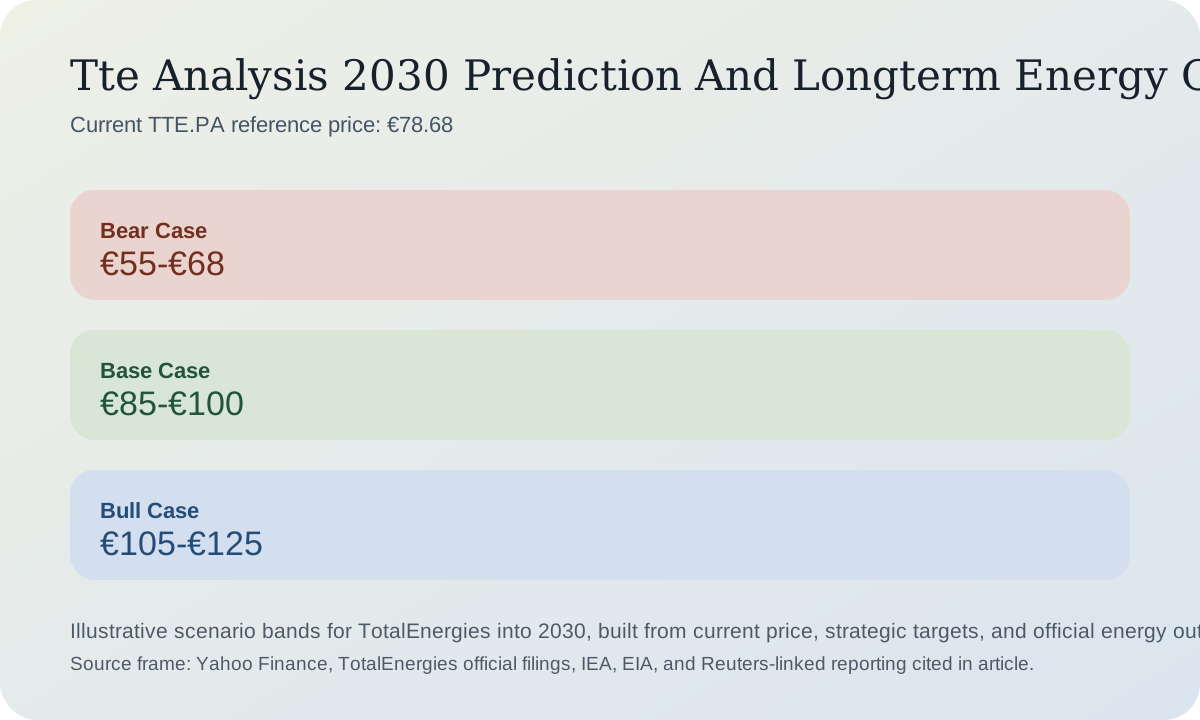
The bull range for 2030 is €105 to €125. That scenario depends heavily on supportive oil and LNG economics, steady execution in integrated power, and continued large capital returns without a major deterioration in policy or project economics.
Bearish scenario
The bear range is €55 to €68. This path would likely emerge if oil prices weaken structurally, LNG margins normalize lower, and transition investments fail to offset the market's lower confidence in hydrocarbon cash flows.
Base-case scenario
The base case is €85 to €100. That range assumes moderate commodity support, steady LNG strength, disciplined capital allocation, and enough power growth to justify a more differentiated multiple than a pure oil producer would deserve.
| Scenario | Range | Key conditions | Probability |
|---|---|---|---|
| Bull | €105-€125 | Commodity support stays constructive and integrated power execution builds confidence. | 25% |
| Base | €85-€100 | Oil and LNG stay healthy enough to fund shareholder returns and strategic growth. | 50% |
| Bear | €55-€68 | Hydrocarbon weakness and lower confidence in transition returns compress the stock. | 25% |
| Path | Estimated probability | Why |
|---|---|---|
| Rising from current levels by 2030 | 55% | The current strategy still supports a constructive long-run cash-return case. |
| Falling below current levels by 2030 | 20% | A materially lower outcome likely needs weaker oil and gas plus transition skepticism. |
| Moving broadly sideways | 25% | Energy equities can spend years oscillating if cash returns and commodity volatility offset each other. |
Risks to watch
Watch Brent and global LNG balances, buyback flexibility, capex discipline, policy risk around fossil fuels, and whether integrated power can scale without destroying returns.
What could invalidate the forecast
This 2030 framework would be too conservative if TotalEnergies' integrated model earns the market a cleaner transition premium than peers. It would be too optimistic if long-run oil and gas profitability weakens faster than the company can replace that value with power and lower-carbon cash flows.
Conclusion
The most reasonable 2030 view on TTE is constructive but range-bound by macro energy realities. TotalEnergies has more strategic depth than a plain oil stock, but not enough insulation to escape commodity cycles.
Disclaimer: This article is for informational and research purposes only. Scenario ranges are editorial judgments based on public sources, not guarantees or personal investment advice.
06. Investor Positioning
Different investor types should handle TTE differently
| Investor type | Cautious approach | What to watch |
|---|---|---|
| Investor already in profit | Hold core exposure if the thesis is cash-return plus transition optionality, but rebalance if energy is oversized. | Oil and LNG conditions plus whether buybacks stay meaningful. |
| Investor currently at a loss | Reassess whether the thesis was commodity timing or long-run strategy. | If the integrated model still makes sense, averaging should remain gradual. |
| Investor with no position | Use staged entries or wait for pullbacks. | The stock is cyclical enough that timing discipline still matters. |
| Trader | Use stop-losses and respect earnings, OPEC, and macro-energy headlines. | Commodity volatility can dominate the tape quickly. |
| Long-term investor | Dollar-cost averaging fits better than all-in commodity timing. | Dividend and buyback sustainability matter as much as price. |
| Risk-hedging investor | Do not confuse an energy major with a hedge instrument. | Pair with broader hedges if inflation or geopolitical exposure is the goal. |
07. FAQ
Frequently asked questions about TotalEnergies' 2030 outlook
Is TotalEnergies still mainly an oil stock?
Oil still matters enormously, but LNG and integrated power now matter enough that the company should be analyzed as more than a pure upstream name.
Why use a scenario range for 2030?
Because energy prices, LNG balances, and transition economics can change too quickly for a single-point target to be credible.
What matters most for TTE today?
Oil and LNG conditions, capital returns, and whether integrated power continues to look like value creation rather than capital-intensive distraction.
References
Sources
- Yahoo Finance chart API for TTE.PA, 10-year monthly history
- Yahoo Finance chart API for TTE.PA, recent daily closes
- TotalEnergies annual financial reports page
- TotalEnergies 2025 Universal Registration Document
- TotalEnergies results page
- TotalEnergies Q1 2026 results press release
- Board statement on TotalEnergies strategy and 2026 buyback framework
- TotalEnergies two-pillar multi-energy strategy
- TotalEnergies energy-transition page
- TotalEnergies gas-to-power integration strategy in Europe
- IEA Oil Market Report, May 2026
- IEA Gas Market Report, Q1 2026
- EIA Short-Term Energy Outlook, April 2026
- Reuters-linked coverage of TotalEnergies cutting buybacks in February 2026
- Reuters-linked coverage of TotalEnergies Q1 2026 trading and earnings outlook