01. Quick Answer
The 2027 TTE outlook depends more on concrete catalysts than on abstract strategic admiration
The 2027 question for TotalEnergies is narrower than the 2030 or 2035 debate. Investors are not asking whether the company has a strategy. They are asking which specific catalysts can move the shares over the next 12 to 18 months: oil prices, LNG balances, trading performance, buybacks, and whether integrated power keeps looking like a value creator instead of a capital sink.
| Catalyst | Why it matters |
|---|---|
| Brent and refining/trading conditions | Near-term earnings and cash flow still move with commodity realizations. |
| LNG market strength | TotalEnergies has more gas exposure than some peers, which can materially affect the story. |
| Buyback flexibility | Market confidence can weaken quickly if returns to shareholders shrink. |
| Integrated power execution | A non-upstream growth engine can help support the multiple if results are credible. |
02. Historical Context
Recent price behavior shows why the 2027 call is about catalysts, not just long-run theory
Recent price history shows why 2027 must be framed as a catalyst call. TTE.PA touched €80.91 in February 2026 and then spent the following months trading around €78.68 as investors reassessed oil, gas, geopolitics, and the buyback profile (recent Yahoo daily closes). That means the next 12 to 18 months are likely to be shaped less by broad theory and more by what the company actually delivers quarter by quarter.
| Metric | Latest reading | 2027 implication |
|---|---|---|
| 1Q 2026 adjusted net income | $5.394 billion | Confirms strong earnings power when trading and pricing are favorable. |
| Integrated Power 1Q 2026 adjusted NOI | $0.5 billion | Shows the power business is financially visible, not just strategic rhetoric. |
| 2026 capex guide | $14-$16 billion per year for 2026-2030 | Capital intensity remains a key debate in the near term. |
| Recent share range | Roughly €75-€79 in early May 2026 | The stock is still reacting to every macro-energy signal. |
The evidence is mixed in the classic energy-stock way. TotalEnergies looks stronger than a pure oil bet because of LNG and power, but not strong enough to escape commodity sentiment. That makes 2027 a catalyst-driven setup, not a purely structural one.
That nuance matters because a good long-term strategy does not guarantee a good 12-month stock outcome. The market will still price what it can see in near-term cash flow and capital returns.
In practical terms, TTE can remain a good company while still behaving like a waiting room for better commodity evidence.
That is a common pattern in energy equities and one reason short-horizon forecasts must stay humble.
03. Main Drivers
Five forces are most likely to move TTE over the next 12 to 18 months
1. Oil price direction remains the biggest short-term driver
The IEA and EIA do not even tell the same clean story about 2026 balances, which underlines how unstable the forecasting environment remains (IEA May 2026; EIA April 2026). That uncertainty flows straight into TTE.
2. LNG conditions can differentiate TotalEnergies from peers
If gas demand and LNG flows remain favorable, TTE's integrated LNG platform can help cushion oil-market noise. If LNG normalizes lower, one of the company's biggest strategic differentiators looks less special.
3. Trading performance can materially change quarterly perception
Reuters-linked April 2026 coverage pointed to strong trading helping offset wartime production hits, which is exactly the kind of short-horizon support investors watch closely (Reuters-linked April 2026 coverage).
4. Buybacks remain a sentiment lever
When TotalEnergies halved buybacks in early 2026, the market was reminded that energy capital returns are conditional. That can still matter enormously in 2027 (Reuters-linked February coverage).
5. Integrated power milestones can improve quality perception
Even if not the main earnings driver yet, visible progress in gas-to-power and electricity can support a better narrative around medium-term valuation.
04. Institutional Forecasts and Analyst Views
Near-term energy conditions and company guidance matter more than heroic targets
Public near-term institutional thinking on TTE is better derived from official company guidance and the latest oil and gas outlooks than from one-number targets. TotalEnergies itself provided a buyback framework linked to Brent, while the IEA and EIA continue to update supply-demand balances in ways that can quickly change earnings expectations.
| Input | Signal | Why it matters |
|---|---|---|
| Q1 2026 results | Strong earnings and visible power contribution | Supports the constructive side of the near-term range. |
| Board buyback framework | Shareholder returns remain commodity-linked | Keeps valuation sensitive to oil prices. |
| IEA oil outlooks | Balance is still unstable and geopolitical | Explains why price targets should be ranges, not declarations. |
| IEA gas outlooks | LNG demand should strengthen with more supply | Reinforces why gas matters more for TTE than for some peers. |
Available data suggests analysts remain divided less on TotalEnergies' strategic quality than on how much near-term upside current commodity conditions justify. That distinction matters because 2027 will likely be determined by catalysts, not by admiration for the corporate slide deck.
For practical forecasting, investors should watch Brent, LNG tone, buyback language, and whether Integrated Power keeps contributing visibly to earnings. If most of those lean positive together, the bull case improves quickly.
If they weaken together, the stock can lose support faster than strategic narratives can compensate.
That is why investors should keep the near-term lens practical rather than ideological.
For 2027, sequencing matters: a modest improvement in commodities plus stable buybacks can matter more than a grand long-term narrative, while a small disappointment on all three fronts can drag the shares even if the franchise quality itself remains intact.
05. Scenarios, Risks, and Invalidation
Bull, bear, and base cases should be tied to explicit 2027 triggers
Bullish scenario
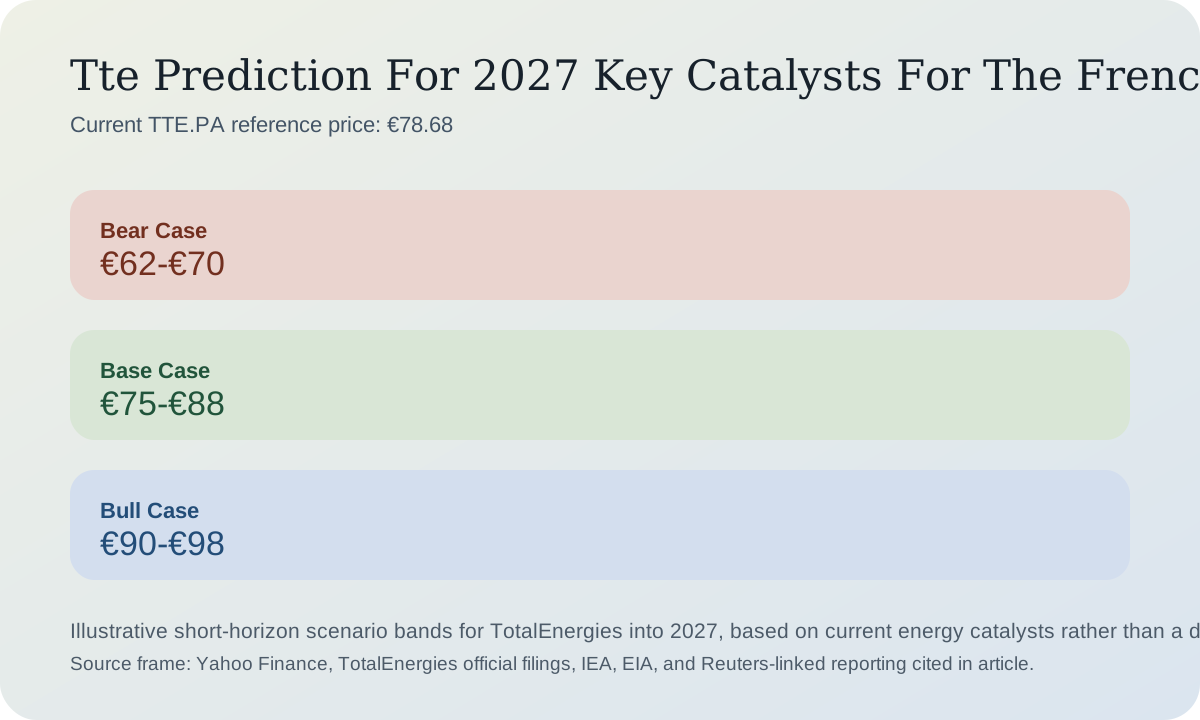
The bull range is €90 to €98. That would likely require supportive Brent, strong LNG/trading conditions, continued buybacks, and enough integrated power progress to strengthen the market's quality perception.
Bearish scenario
The bear range is €62 to €70. This scenario depends on weaker commodity prices, thinner buybacks, and a market that decides transition spending is not earning enough to offset hydrocarbon pressure.
Base-case scenario
The base case is €75 to €88. That range assumes a balanced but still cyclical environment in which cash returns stay meaningful even if the commodity backdrop is only average.
| Scenario | Range | Catalysts | Probability |
|---|---|---|---|
| Bull | €90-€98 | Commodity support plus visible LNG and power strength. | 25% |
| Base | €75-€88 | Moderate oil and gas conditions with continued capital returns. | 50% |
| Bear | €62-€70 | Lower oil and gas plus more skeptical sentiment on transition spending. | 25% |
| Path | Estimated probability | Why |
|---|---|---|
| Rising by 2027 | 45% | The integrated model still gives TTE enough ways to outperform if energy conditions cooperate. |
| Falling by 2027 | 25% | Commodity weakness and buyback cuts can still drag the stock lower. |
| Moving sideways | 30% | Energy majors often stall when cash returns and commodity uncertainty offset each other. |
Risks to watch
Watch Brent, LNG balances, buyback guidance, power-market returns, and whether geopolitical shocks produce sustainable price support or only temporary noise.
What could invalidate the forecast
The base case would be too low if higher oil and gas realizations persist while integrated power keeps proving itself. It would be too high if commodities weaken and the market places less value on the transition build-out than management expects.
Conclusion
The 2027 TTE setup is constructive but still commodity-led. TotalEnergies has strategic depth, but the next 12 to 18 months will still be driven by very tangible macro-energy catalysts.
That is why flexibility matters. A near-term TTE view should be updated as the macro and company signals evolve rather than treated as a permanent conviction call.
In energy, timing errors can matter as much as thesis errors.
That is why 2027 ranges are more credible than one-direction certainty.
A good range is more useful than a false promise in a cyclical market.
That is especially true in a year when macro and energy signals can reverse fast.
Flexibility is part of the edge in energy investing.
Disclaimer: This article is for informational purposes only and does not constitute personalized investment advice.
06. Investor Positioning
Different time horizons require different TTE tactics
| Investor type | Prudent approach | Key monitor |
|---|---|---|
| Investor already in profit | Hold core exposure and trim only if energy concentration became excessive. | Buyback guidance and commodity support. |
| Investor currently at a loss | Reassess whether the thesis was short-term oil timing or the integrated strategy. | If the latter, entries should still be gradual. |
| Investor with no position | Scale in or wait for pullbacks rather than chase oil-driven spikes. | Volatility remains part of the setup. |
| Trader | Use stop-losses around earnings and macro energy events. | Oil, LNG, and OPEC/IEA headlines. |
| Long-term investor | A staged approach still fits better than all-in commodity timing. | Total return and strategic execution. |
| Risk-hedging investor | Do not rely on one energy stock as a hedge. | Pair with explicit hedges if the concern is inflation or geopolitical risk. |
07. FAQ
Frequently asked questions about a TTE 2027 prediction
What is the biggest catalyst for TTE into 2027?
Oil and LNG conditions remain the clearest catalysts, with buyback visibility a close second.
Can TTE rise even if oil prices soften?
Yes, but the upside is likely more limited unless LNG, trading, and integrated power compensate enough to keep cash returns strong.
Why is the sideways probability still meaningful?
Because energy majors often generate cash and dividends while their share prices remain trapped in commodity-range markets.
References
Sources
- Yahoo Finance chart API for TTE.PA, 10-year monthly history
- Yahoo Finance chart API for TTE.PA, recent daily closes
- TotalEnergies annual financial reports page
- TotalEnergies 2025 Universal Registration Document
- TotalEnergies results page
- TotalEnergies Q1 2026 results press release
- Board statement on TotalEnergies strategy and 2026 buyback framework
- TotalEnergies two-pillar multi-energy strategy
- TotalEnergies energy-transition page
- TotalEnergies gas-to-power integration strategy in Europe
- IEA Oil Market Report, May 2026
- IEA Gas Market Report, Q1 2026
- EIA Short-Term Energy Outlook, April 2026
- Reuters-linked coverage of TotalEnergies cutting buybacks in February 2026
- Reuters-linked coverage of TotalEnergies Q1 2026 trading and earnings outlook