01. Quick Answer
Visa still has a constructive 2030 framework, but the next leg of value depends on whether the network becomes broader and stickier faster than alternative rails can threaten it
The most defensible 2030 Visa view is constructive but selective. The company still combines massive acceptance, healthy consumer and commercial spending volumes, strong cross-border economics, and a growing services layer that improves the quality of the business. By 2030, however, the market will likely care less about whether Visa can keep growing payment volume and more about whether it can keep broadening the moat through services, B2B, tokenization, and money movement. That is why the base case remains positive, but not unlimited.
| Category | Evidence-based read | Implication |
|---|---|---|
| Historical data | Visa moved from about $74.17 to about $322.52 over 10 years | Long-run upside is credible, but future ranges should reflect maturity and premium quality |
| Current market conditions | Payments volume, cross-border, and services remain strong despite macro uncertainty | Forecasts should stay scenario-based, not just premium-by-default |
| Institutional signals | Official reporting, Reuters, and S&P all point to high-quality execution with visible competitive questions | Analysts remain constructive, though not blind to rail competition |
| Most important watchpoints | Payments volume, cross-border, services mix, commercial payments, and alternative-rail adoption | These variables will likely shape the stock range more than generic fintech optimism |
02. Historical Context
Visa is still a payments toll road first, but the modern thesis now includes services, B2B flows, and global network leverage
Visa moved from roughly $74.17 to about $322.52 over the last 10 years based on Yahoo Finance monthly data, implying a 10-year CAGR of about 15.83%. That is a strong long-run result for a large-cap network business and reflects more than simple card-volume growth. Visa's modern investment case blends consumer and commercial payments, cross-border volume, value-added services, tokenization, fraud prevention, and network economics that become more powerful as digital payments deepen globally. The key forecasting question is no longer whether Visa can keep taking transactions online. It is whether the company can keep widening its moat while defending against new rails, stablecoins, and account-to-account alternatives.
| Metric | Latest official reading | Why it matters |
|---|---|---|
| Q2 FY26 net revenue | `$11.2 billion, up 17% | Shows the business is still compounding at an attractive rate even from a large base |
| Payments volume growth | 9% | Core spending activity on the network remains healthy |
| Cross-border volume ex-intra-Europe | Up 14% | Cross-border remains a key higher-yield growth driver |
| Value-added services | Continued double-digit growth | Services increasingly matter to mix quality beyond pure payment processing |
03. Main Drivers
Five forces are most likely to shape Visa stock over the next several years
1. Consumer and commercial payment volumes still drive the core engine
Visa's Q2 2026 results and Reuters coverage both show that payment volumes remain healthy despite macro uncertainty. That matters because the core thesis still begins with more transactions flowing over the network.
2. Cross-border remains one of the most important quality growth levers
Cross-border volumes tend to carry better economics and often move with travel, business activity, and international commerce. As long as those flows remain solid, Visa can keep defending a premium multiple.
3. Value-added services increasingly improve the earnings mix
Fraud tools, tokenization, risk services, and data products matter because they make Visa more than a transaction toll road. If services keep scaling faster than the core, the business quality improves structurally.
4. Commercial payments and money movement are still large underpenetrated opportunities
Reuters and S&P both pointed to commercial payments and money movement as important medium-term growth vectors. These are harder markets than consumer card payments, but the addressable opportunity is much larger.
5. Competitive threats are real, but most alternatives still face scale, acceptance, and trust constraints
Account-to-account systems, real-time rails, fintech wallets, and stablecoins all matter. But Visa's network remains deeply embedded in global commerce. The key issue is not whether alternatives exist. It is whether they can meaningfully displace Visa's economics at scale.
04. Institutional Forecasts and Analyst Views
The market still values Visa as a premium network, but it is asking harder questions about where the next leg of growth comes from
Official reporting, Reuters, and S&P all support that framing. Payments volume remains resilient, cross-border is still strong, and value-added services continue to scale. But the evidence is mixed enough on regulatory pressure and alternative-rail competition that a 2030 forecast should remain scenario-based rather than simply extending the last decade in a straight line.
| Source | Message | Interpretation |
|---|---|---|
| Visa official reporting | Payments volume, cross-border, and value-added services remained strong in Q2 FY26 | Operational quality remains strong |
| Reuters | Consumer spending stayed resilient and payment volumes rose despite macro uncertainty | Supports a constructive but valuation-aware base case |
| S&P Global | Cross-border and services remain the key quality-growth drivers | Keeps both upside and mix-risk questions visible |
| Rail-competition reporting | Stablecoins and A2A are increasingly part of the payments conversation | Strengthens the need to evaluate Visa's moat dynamically, not statically |
05. Bull, Bear, and Base Case
How the forecast range and probability table are built
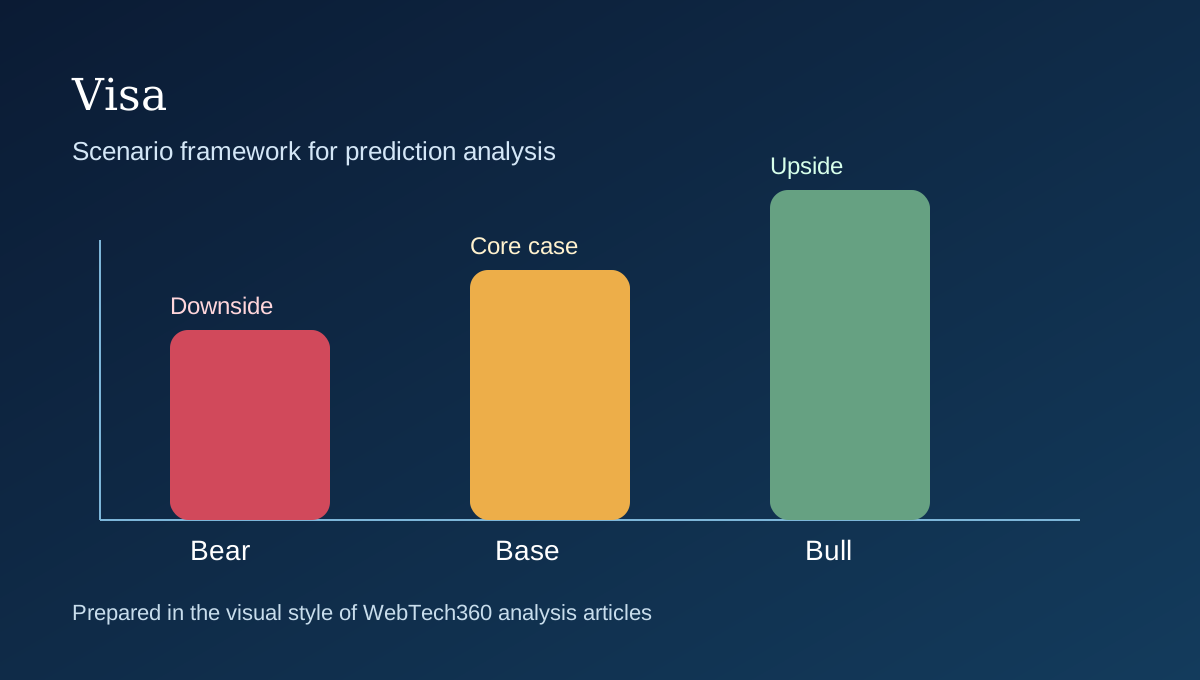
The ranges in this article are not institutional point targets. They are editorial scenario matrices built from current price, 10-year compounding history, core volume durability, cross-border strength, services growth, commercial-payments opportunity, and the pace at which alternative rails affect Visa's economics.
| Scenario | 2030 range | Conditions | Probability |
|---|---|---|---|
| Bull | $460-$560 | Cross-border, services, and commercial payments all deepen the moat while alternative rails remain more complementary than disruptive | 30% |
| Base | $390-$460 | Visa compounds steadily, though maturity and periodic valuation resets keep the multiple from expanding dramatically | 45% |
| Bear | $290-$390 | Cross-border cools, services mix growth slows, or disintermediation concerns become more material | 25% |
| Direction | Probability | Comment |
|---|---|---|
| Higher | 45% | Most plausible if Visa keeps widening its moat beyond pure transaction routing |
| Lower | 20% | Would likely require a broader reset in cross-border, regulation, or rail-competition assumptions |
| Sideways to moderate gains | 35% | Plausible because premium-quality networks often compound through steady execution more than dramatic re-rating |
| Investor type | Prudent approach | Main watchpoints |
|---|---|---|
| Investor already in profit | Hold a core stake, but trim if the premium multiple now assumes flawless cross-border and services execution | Position size, multiple expansion, and mix quality |
| Investor currently at a loss | Reassess whether the thesis is core payment growth, services expansion, or network durability before averaging down | Cross-border, take rate, and competitive pressures |
| Investor with no position | Stage entries or wait for macro travel or spending pullbacks instead of chasing a premium network at any price | Valuation, volume growth, and regulatory noise |
| Trader | Use stop-loss discipline and trade around earnings, travel data, consumer-spending signals, and regulatory headlines | Volatility, guidance shifts, and sector rotation |
| Long-term investor | Dollar-cost average only if convinced Visa can keep broadening its moat beyond pure transaction routing | Services mix, B2B adoption, and network acceptance depth |
| Risk-hedging investor | Rebalance if Visa has become too large a premium-quality holding relative to cheaper cyclical or faster-growth assets | Portfolio concentration and opportunity cost |
Conclusion: Visa still looks like a credible long-term payments compounder, but the 2030 upside case depends on whether services, B2B flows, and network intelligence keep improving the quality of growth faster than new rails can challenge it. Disclaimer: This article is for informational and research purposes only and does not constitute personalized financial advice.
06. FAQ
Frequently asked questions
Is Visa still mainly a consumer card-volume story?
Core payment volume still matters a great deal, but services, cross-border, commercial payments, and money movement increasingly matter to the long-run thesis too.
What matters most for the next forecast revision?
Payments volume, cross-border, services growth, commercial flows, and competitive developments around alternative rails are the key inputs.
Is the biggest risk regulation or payment-rail disruption?
Both matter. Regulation can affect pricing and economics, while new rails matter if they can meaningfully displace Visa at scale rather than merely coexist with it.
What would invalidate the bullish case?
Slower cross-border growth, weaker services mix, heavier regulatory pressure, or faster-than-expected disintermediation by alternative rails would all weaken the bullish case.
Methodology and Invalidation
How to interpret this Visa framework and what would change it
Visa should not be analyzed like a simple consumer-finance stock, but it also should not be treated as immune to competitive or regulatory change. The company sits at the intersection of consumer payments, commercial payments, cross-border flows, value-added services, fraud infrastructure, and digital money movement. That mix is why point forecasts are often less useful than scenario ranges. Visa can look expensive relative to some financial firms and still look rational because its capital intensity is low, its margins are strong, and its global network is unusually difficult to replicate. It can also look safe right before regulatory or rail-competition questions start mattering more.
These articles therefore anchor their ranges to three things: current price, 10-year growth history, and present operating evidence. Yahoo Finance chart data place V around `$322.52` in mid-May 2026, versus roughly `$74.17` at the start of the 10-year comparison window. That implies a 10-year CAGR of about 15.83%. That is a strong result for a mature network business. But it is not a forecast by itself. Visa's next decade will depend on whether the company can keep broadening beyond consumer card volume into higher-value services, B2B, and cross-border while defending its economics from alternative rails.
Primary documents matter most. Visa's fiscal second quarter 2026 results showed net revenue of roughly `$11.2 billion`, diluted EPS growth of 20%, 9% payments-volume growth, and strong cross-border and services trends. The 2025 10-K adds context on geographic revenue mix, litigation, regulation, network security, and the strategic importance of tokenization, value-added services, and Visa Direct. Those materials are important because they explain both why Visa deserves a premium and why that premium is constantly tested by regulatory and technological shifts.
External reporting explains what the market is debating now. Reuters highlighted resilient consumer spending and payment-volume growth despite macro uncertainty, while also noting that commercial payments and global money movement remain strategic priorities. S&P Global similarly emphasized cross-border and value-added services as key performance drivers. Reuters also reported on the broader challenge from stablecoins and account-to-account systems, which matters because Visa's moat is strong but not static. Available data suggests the company still benefits from both resilience and expansion. The key question is whether those strengths can remain ahead of disintermediation risk.
Investor positioning should therefore reflect horizon. A trader may care most about cross-border trends, travel volumes, and quarterly guidance. A long-term allocator should care more about whether Visa keeps improving the mix toward services, commercial flows, and network intelligence without losing acceptance breadth. Someone already in profit may trim if valuation now assumes near-perfect execution. Someone with no position may prefer staged entries during macro or travel-related pullbacks rather than chasing clean quarters. What would invalidate a constructive Visa view? Slower cross-border growth, lower take-rate confidence, heavier regulatory pressure, or faster payment-rail disintermediation would all matter. What would invalidate a bearish Visa view? Continued payment-volume resilience, faster growth in services and B2B, and evidence that alternative rails complement rather than displace Visa would weaken it.
Inline evidence anchors the framework (Yahoo Visa chart API; Visa Q2 2026 results; Visa 2025 Form 10-K; Reuters on Q2 results; Reuters on payments-rail competition; S&P Global post-quarter snapshot). That combined evidence base is why the forecast ranges here are scenario tools rather than certainty theater.
References
Sources
- Yahoo Finance chart API, Visa 10-year monthly history and current price
- Visa fiscal second quarter 2026 financial results
- Visa Q2 2026 earnings release PDF
- Visa Q2 2026 earnings conference call page
- Visa, Form 10-K for fiscal year ended September 30, 2025
- Visa Q2 2026 earnings release SEC exhibit
- Visa to announce fiscal second quarter 2026 financial results
- Reuters, Visa beats quarterly profit estimates on resilient consumer spending, April 28, 2026
- Reuters, Visa pushes commercial payments and cross-border growth, March 18, 2026
- Reuters, Visa sees stable spending despite macro uncertainty, April 28, 2026
- S&P Global, Visa post-quarter snapshot, April 2026
- S&P Global, Visa preview on cross-border and value-added services, April 2026
- Axios, Visa earnings highlight cross-border and payment-volume resilience, April 29, 2026
- Reuters, global payments face stablecoin and A2A competition, February 21, 2026