01. Quick Answer
The most useful 2027 VIX forecast is a catalyst map, not a directional stock-market shortcut
The VIX could be higher, lower, or choppier in 2027 depending on what kind of uncertainty dominates markets. Policy mistakes, geopolitical escalation, valuation resets, or concentrated earnings disappointment could all lift it. A calmer inflation and growth environment could keep it subdued. That is why a 2027 VIX article should focus on catalysts, not slogans.
| Issue | Current read | Why it matters |
|---|---|---|
| Current market snapshot | VIX is moderate, not distressed | Leaves room for either compression or reacceleration |
| Main upside catalyst | Policy and geopolitical shock | Fastest way to lift hedging demand |
| Main downside catalyst | Calmer realized volatility | Allows implied vol to compress |
| Best framework | Catalysts and scenario analysis | VIX reacts to regime shifts more than to fixed narratives |
02. Historical Risk Context
A 2027 VIX call should distinguish plunge, spike, and range-bound normalization
Unlike many assets, the VIX is especially vulnerable to being misread because it is both mean-reverting and shock-sensitive. A plunge is not the same as stability forever. A spike is not the same as a permanent crisis. A sideways regime can still be painful if option hedges remain expensive. Those distinctions are central to any 2027 scenario framework.
| Regime | Typical driver | What it implies |
|---|---|---|
| Plunge | Calmer realized vol and better policy clarity | Markets are paying less for protection |
| Sideways | Mixed macro backdrop with episodic stress | Implied volatility stays sticky around a moderate range |
| Spike | Shock, panic, or forced hedging | Protection demand overwhelms complacency quickly |
03. Top Catalysts
Five variables are likely to matter most in 2027
1. Inflation and rates
Unexpected policy repricing remains a core volatility catalyst.
2. Geopolitics
Middle East and Eastern Europe remain obvious volatility triggers.
3. Equity concentration
High leadership concentration can make equity volatility more nonlinear.
4. Earnings disappointment
When expectations are high, guidance misses can matter more than macro data.
5. Options market structure
Dealer hedging and demand for protection can amplify or dampen VIX moves.
04. Institutional Forecasts and Analyst Views
Institutions still see complacency and fragility coexisting
BlackRock's 2026 macro work highlighted a fragile equilibrium, while Cboe's own materials argued for a steady-state VIX around 19 under continued uncertainty. That is a helpful baseline for 2027 because it suggests moderate volatility is more plausible than a permanent return to ultra-low readings unless the macro environment becomes decisively cleaner.
| Source | Message | 2027 implication |
|---|---|---|
| Cboe | Steady-state VIX around 19 in 2026 under ongoing risk | Supports a moderate baseline |
| BlackRock | Fragile equilibrium and complacency concerns | Supports upside catalyst risk |
| J.P. Morgan | Polarization and uncertainty remain relevant | Keeps volatility catalysts active |
05. Bull, Bear, and Base Case
How the 2027 VIX range is built
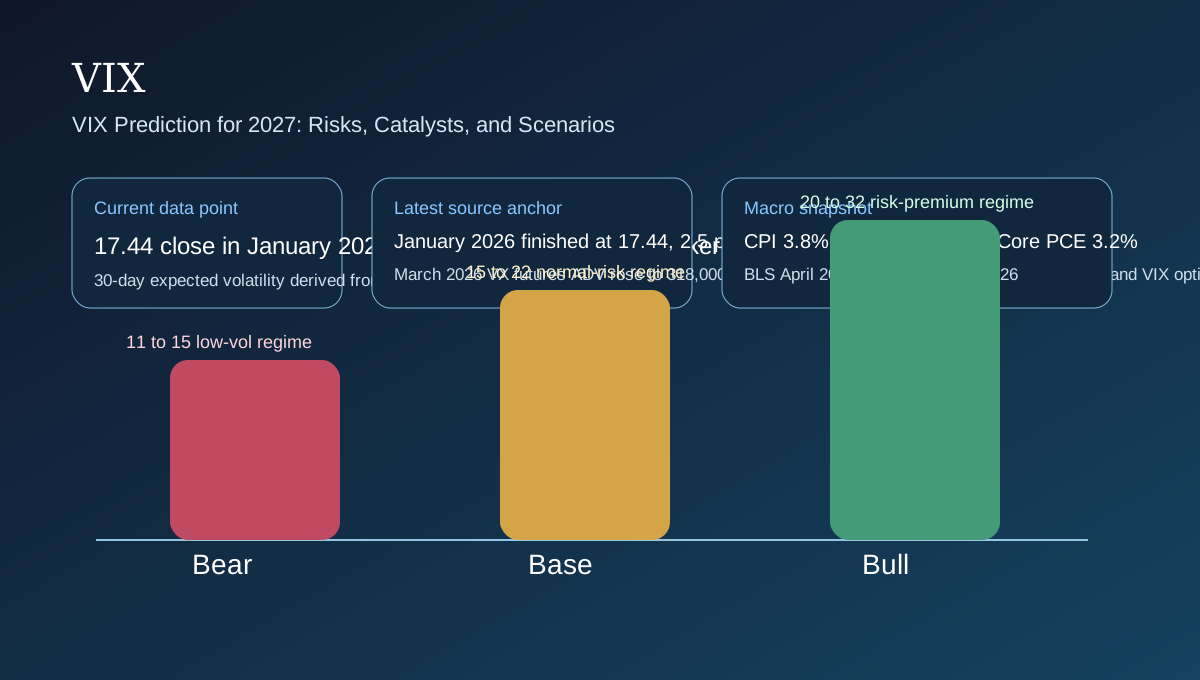
| Scenario | 2027 range | Conditions | Probability |
|---|---|---|---|
| Bull | 24-34 | Policy or geopolitical shocks lift hedging demand | 30% |
| Base | 16-24 | Moderate realized volatility with periodic spikes | 45% |
| Bear | 11-16 | Realized volatility stays calm and policy uncertainty fades | 25% |
| Direction | Probability | Comment |
|---|---|---|
| Higher | 35% | Most likely if catalyst risk turns into repeated hedging demand |
| Lower | 25% | Needs calmer realized volatility and cleaner macro data |
| Sideways | 40% | Plausible because volatility often clusters around a moderate base |
06. Investor Positioning
How different investors can think about a 2027 volatility setup
| Investor type | Prudent approach | Watchpoints |
|---|---|---|
| Investor already in profit | Trim or hedge because long-volatility gains can reverse quickly | Term structure and catalyst decay |
| Investor currently at a loss | Reassess whether the position was a hedge or a speculation | Mean reversion and carry cost |
| Investor with no position | Wait for clearer asymmetry rather than chase middling readings | Event calendar and options pricing |
| Trader | Focus on event-driven setups | Macro and earnings shocks |
| Long-term investor | Use volatility tactically within a broader risk plan | Hedging efficiency |
| Risk-hedging investor | Prefer selective hedging over permanent long-vol exposure | Hedge cost relative to visible risks |
Conclusion: the most credible 2027 VIX outlook is one of moderate base levels punctuated by event-driven spikes rather than a single sustained trend. Disclaimer: This article is for informational and research purposes only and is not personalized investment advice.
07. FAQ
Frequently asked questions
Can the VIX stay low while risks build?
Yes. Implied volatility can stay muted if realized volatility and hedging demand remain calm.
What is the biggest 2027 VIX catalyst?
Policy and geopolitical shocks remain the biggest upside catalysts.
What is the clearest downside force?
Calmer realized volatility and clearer policy direction are the clearest downside forces.
Why not read VIX as a stock-market direction tool?
Because it measures the price of implied volatility, not a guaranteed market path.
Methodology and Invalidation
How to interpret this VIX framework and what would change it
Inline evidence is essential in volatility writing because the VIX is frequently oversimplified. Cboe's 2026 methodology confirms that the index is built from SPX option prices and represents 30-day expected volatility rather than a direct stock-market forecast (Cboe VIX methodology, 2026). FRED data show both the current moderate spot reading and the April 9, 2025 spike to 52.33, a reminder that volatility regimes can remain calm for months and still reprice violently when markets are surprised (FRED VIXCLS; FRED VIX table data). Institutional commentary adds nuance: BlackRock has described a fragile equilibrium after a low-volatility rally, while Cboe's March 2026 webinar material discussed a steady-state VIX near 19 under continuing geopolitical and trade uncertainty (BlackRock 2026 macro outlook; Cboe webinar deck, March 2026). That combination of official methodology, time series data, and institutional framing is the basis for the ranges used here.
A serious VIX article has to begin with methodology, because many readers still treat the VIX as if it were a simple sentiment poll or a forecast of where stocks will go next. Cboe's own methodology makes the right interpretation clearer. The VIX is a measure of 30-day expected volatility implied by SPX option prices, not a direct measure of stock-market direction. It can rise while equities fall, but it can also fail to surge if the market believes downside is orderly or temporary. It can stay low while risks accumulate, and it can fall quickly after a shock even if the underlying macro environment remains fragile. That is why any useful VIX forecast should focus on catalysts, regime shifts, and the distinction between low realized volatility, low implied volatility, and genuinely low macro risk.
Those distinctions matter because volatility regimes often change faster than economic narratives. Cboe's methodology documents, FRED data, and institutional outlooks from BlackRock and J.P. Morgan all suggest the same basic lesson: volatility is cyclical, nonlinear, and highly sensitive to the interaction between valuations, policy, positioning, and geopolitics. BlackRock's 2026 macro work explicitly described a fragile equilibrium after a low-volatility rally, while Cboe's March 2026 webinar materials suggested a steady-state VIX around 19 under continued geopolitical and trade uncertainty. That is already a more nuanced picture than the usual retail framing of VIX as simply \"fear high\" or \"fear low.\" Available data suggests that low VIX readings can coexist with latent fragility, while elevated VIX readings can coexist with highly tradable opportunity once panic becomes too one-sided.
Geopolitical issues are especially relevant here. Military conflict in the Middle East, the war in Eastern Europe, trade tensions, sanctions, fiscal disputes, and election risk do not affect volatility in a constant way. Sometimes they create one-day spikes that reverse quickly. Other times they become structural uncertainty channels through energy prices, rates, earnings revisions, or policy reactions. This is why a VIX scenario range has to incorporate not only the existence of geopolitical stress, but whether the market interprets that stress as systemic, inflationary, liquidity-related, or ultimately containable. A volatility index can remain suppressed in the face of risk if options sellers remain confident and realized volatility stays muted. It can also remain elevated even after prices stabilize if investors believe follow-through shocks are still likely.
Positioning is therefore even more horizon-dependent here than in many other asset classes. A trader may use the VIX tactically around event windows, options pricing, term-structure signals, or mean-reversion setups. A long-term allocator should not treat the VIX itself as a standalone investment thesis, but rather as a tool for judging hedging cost, portfolio fragility, and whether market pricing looks complacent or stressed relative to macro reality. Someone already in profit from a long-volatility position may need to think about decay and normalization. Someone caught on the wrong side of a volatility spike may need to separate temporary panic from a regime shift. Someone with no position may be better served by focusing on whether volatility is cheap or expensive relative to the risks they are actually trying to hedge.
What would invalidate a low-volatility or falling-VIX thesis? A resurgence of inflation volatility, a sharper policy mistake, renewed geopolitical escalation, or a more disorderly repricing of richly valued risk assets would all do it. What would invalidate a strong rising-VIX thesis? Better policy clarity, calmer realized volatility, stronger earnings absorption of macro shocks, and reduced demand for equity downside protection would all weaken it. This kind of invalidation logic matters because the VIX is highly prone to narrative abuse. A credible volatility article should tell readers what evidence would make the outlook more calm and what evidence would make it more stressed.
The practical conclusion is that the VIX remains one of the market's most useful barometers precisely because it prices uncertainty rather than certainty. But that also means investors should resist treating it as a single-direction macro oracle. Available data suggests the VIX is best understood as a regime-sensitive pricing tool whose behavior depends on the mix of realized volatility, hedging demand, liquidity, rates, geopolitical shocks, and valuation stress. That is the lens through which the scenario ranges in these articles are built, and it is the most defensible way to update them over time.
References
Sources
- Cboe, VIX methodology, revised February 26, 2026
- FRED, CBOE Volatility Index: VIX
- FRED, VIX table data
- Cboe Indices overview
- Cboe webinar deck, March 4, 2026
- BlackRock, 2026 global macro outlook: patience
- BlackRock, 2026 Spring Investment Directions
- BlackRock, Credit Currents Quarterly, 2026
- J.P. Morgan Global Research, 2026 market outlook
- J.P. Morgan AM, 2026 Long-Term Capital Market Assumptions
- IMF, Global Financial Stability Report, October 2025
- IMF Blog, Adequate reserves shield economies from shocks