01. Downside Context
What a pullback would actually mean for Airbus
The bearish case for Airbus is not that the company lacks demand. It is that demand can mask operational fragility for only so long. AIR can pull back sharply if the market starts to believe that engine shortages, tariffs, customer financing strain, or working-capital stress will keep backlog from turning into the expected level of earnings and free cash flow.
| Risk | Why it matters |
|---|---|
| A correction is easier to imagine than a collapse | Airbus has strategic strength, but that does not prevent meaningful derating. |
| Backlog does not immunize the stock | Execution and cash conversion still decide what the market pays. |
| Cash-flow disappointment matters fast | Industrial investors react quickly when working capital absorbs the thesis. |
| Bear cases need explicit triggers | Without operational pressure, a downside thesis becomes lazy rhetoric. |
Before discussing downside, it helps to distinguish three market terms. A correction usually implies a decline of around 10% from recent highs. A bear market implies a more sustained drop of 20% or more. A crash implies disorderly panic selling. For Airbus, the most plausible negative case is a correction or mild bear market, not a crash, because the strategic backlog and balance sheet still offer real support.
| Type | What it would look like from EUR 167.68 | Most plausible trigger |
|---|---|---|
| Correction | Around EUR 151 or lower | Delivery slippage, cash-flow disappointment, or tariff noise. |
| Bear market | Around EUR 134 or lower | A more durable industrial bottleneck or aviation-cycle setback. |
| Crash | Far below EUR 134 | Would likely require an extreme global aviation or financial shock beyond current evidence. |
That distinction matters because aerospace stocks often invite exaggerated narratives. Bulls focus on backlog and forget the factory. Bears focus on one weak quarter and forget the duopoly. A disciplined downside framework should avoid both mistakes.
The evidence is mixed enough that bearishness on Airbus must be earned. Yet it is not hard to imagine a pullback if investors conclude the company is still asking them for patience without giving enough operational proof in return.
That is especially true after several years in which backlog size itself became part of the equity story. Once investors suspect that backlog is not being monetized at the pace they expected, patience can fade faster than the strategic narrative changes.
Another reason the downside can surprise people is that aerospace optimism often becomes self-reinforcing at the top. Investors begin to treat demand visibility as if it already solved production, inventory, and supplier constraints. When that assumption breaks, the share-price adjustment can feel abrupt even if the operational warning signs were visible for some time.
02. Bearish Drivers
Five risks that could push AIR lower
1. Engine shortages and supplier bottlenecks
Management itself keeps pointing to Pratt & Whitney shortages and a dynamic operating environment. That makes supplier execution the clearest direct bearish trigger (Q1 2026 results).
2. Weak free cash flow can damage confidence
Negative early-year free cash flow can be tolerated for only so long. If later quarters do not recover convincingly, the market may decide that Airbus deserves a lower multiple despite the backlog.
3. Tariffs and global trade friction
Airbus explicitly said its 2026 guidance includes the impact of currently applicable tariffs. That means the issue is not hypothetical. Any worsening here could hit sentiment and margins.
4. Airline customer strain
IATA expects profitability to remain positive, but airline margins are still not enormous. If customer economics soften materially, delivery timing and financing appetite could become harder (IATA 2026 profitability outlook).
5. Defence and Space may not fully offset commercial disappointment
Defence momentum helps, but the commercial aircraft business still dominates the equity story. If commercial execution slips badly, other segments may not save the multiple in the near term.
03. Bearish Framework
How a credible downside thesis for Airbus should be built
A credible bearish framework for Airbus should start from today's public evidence, not from generic industrial caution. Q1 2026 already showed how weak deliveries can pressure cash flow, and management's unchanged guidance only works if the rest of the year does heavy lifting. That creates a real downside setup if the operational recovery does not materialize.
| Condition | Current evidence | Bearish implication |
|---|---|---|
| Deliveries remain uneven | Visible in Q1 2026 | The market could keep discounting the industrial story. |
| Cash flow stays weak | Q1 was materially negative | Confidence in backlog monetization would weaken. |
| Supply-chain friction persists | Still openly acknowledged by management | Rerating would become harder to justify. |
| Macro or trade stress increases | Tariff language already appears in guidance assumptions | Could hit both valuation and margin confidence. |
In practical terms, the downside case is strongest when weaker delivery execution and weaker cash conversion reinforce each other. If only one appears, the pullback may stay limited. If both persist, the market can re-rate AIR lower for longer than bulls expect.
That is especially true because Airbus spent several years earning a premium for visibility. If visibility starts to look less monetizable, the market may demand a wider margin of safety.
Bearish investors should also remember that most aerospace drawdowns are not dramatic from day one. They often unfold through a series of small operational disappointments, each of which appears manageable on its own, until the market eventually decides the execution discount deserves to be larger.
04. Scenarios
Correction, bear-market, and invalidation framework
Bearish scenario
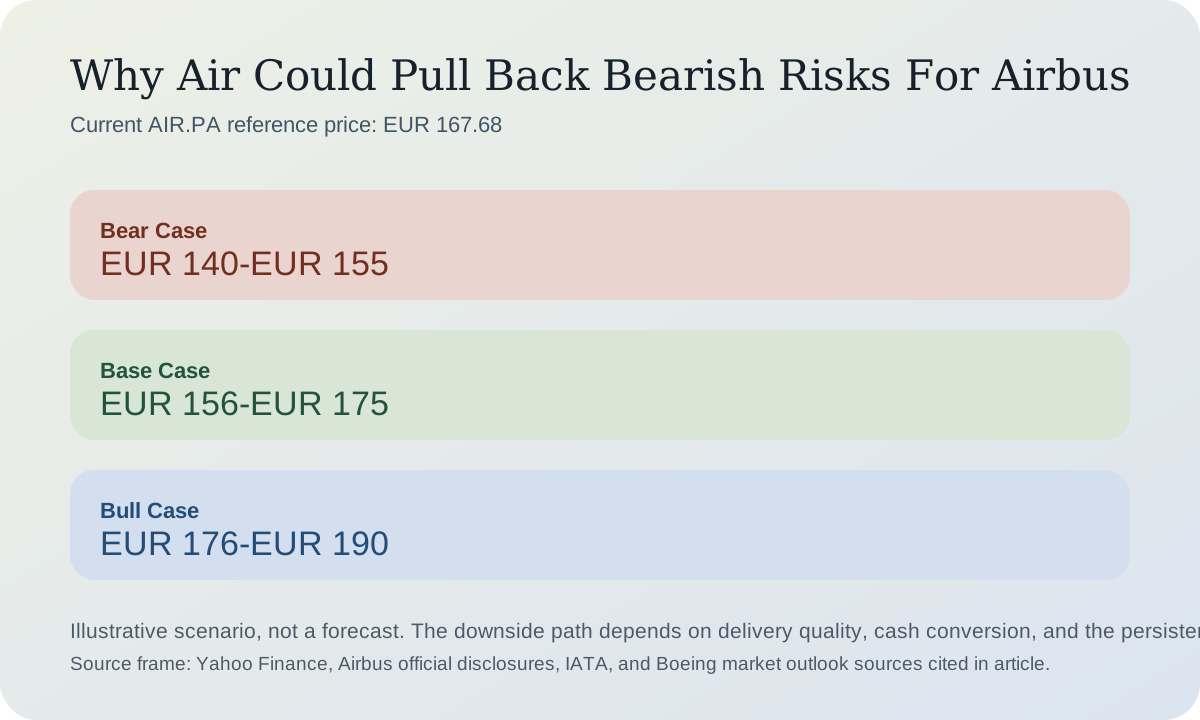
The main downside range is EUR 140 to EUR 155. That would fit a serious but not disorderly pullback driven by delivery disappointment, weaker cash recovery, or worsening supplier and tariff conditions.
Base scenario
The base scenario is not actually bearish. It is that Airbus stays strategically strong and any downside remains limited because backlog, balance-sheet support, and market structure still matter.
What could make the bear case wrong
The bear case would weaken significantly if Airbus begins to deliver aircraft more smoothly, restores free cash flow more rapidly than expected, and shows that supplier issues are easing instead of compounding.
| Path | Probability | Interpretation |
|---|---|---|
| Meaningful pullback | 30% | Real, but not the base case while demand and backlog remain strong. |
| Sideways consolidation | 33% | A common outcome if the market waits for cleaner evidence. |
| Recovery and renewed upside | 37% | Still slightly more likely if execution improves. |
| Investor type | Prudent move | Bear-case discipline |
|---|---|---|
| Investor already in profit | Trim if the Airbus position is oversized and the thesis depends on flawless ramp-up. | Protect gains before assuming backlog cancels risk. |
| Investor currently at a loss | Avoid panic selling unless the industrial thesis is clearly worsening. | Focus on deliveries and FCF, not headlines alone. |
| Investor with no position | Wait for clearer support or better operating evidence. | Do not chase a falling industrial-growth story. |
| Trader | Use stop-loss rules and event-driven discipline. | Results days and production headlines matter. |
| Long-term investor | Stay patient if the business case is intact, but rebalance if concentration is high. | Long horizon does not excuse ignoring execution slippage. |
| Risk-hedging investor | Prefer true hedges elsewhere; Airbus remains cyclical equity exposure. | Do not mistake backlog for downside protection. |
How this downside range was built: it combines Airbus' current share level, prior drawdown behavior, the resilience implied by backlog and balance sheet, and the observation that aerospace multiples can compress quickly when cash conversion wobbles.
Risks to watch: engine availability, delivery delays, inventory build, tariff developments, and customer financing stress.
What would invalidate this forecast: consistently stronger deliveries, clear free-cash-flow recovery, and visible de-bottlenecking across the industrial system.
Disclaimer: This article is for informational purposes only and does not constitute personal investment advice. Bearish scenarios are editorial judgments built from public information and can prove wrong quickly.
Airbus can absolutely pull back without becoming a bad company. That is the essence of the bearish case: valuation and confidence can slip even while the strategic franchise remains impressive.
That is why prudent bearish positioning should stay evidence-led. The goal is not to deny Airbus' strengths, but to recognize that strong franchises can still trade poorly when the market loses confidence in the timing of financial delivery.
For bearish investors, the key is to separate operational disappointment from permanent impairment. Airbus can be worth less for a period without becoming structurally broken, and that distinction matters for both timing and risk management.
That also means the bear case is strongest when it stays humble. The goal is not to call for disaster, but to recognize how quickly a premium industrial name can de-rate when financial delivery stops matching strategic promise.
In that sense, bearishness is less a rejection of Airbus and more a judgment about timing, trust, and the market's willingness to wait.
05. FAQ
Frequently asked questions about Airbus downside risk
Is Airbus at risk of a crash?
Current public evidence points more to correction risk than crash risk. A crash would likely require a much larger global aviation or financial shock.
What is the biggest bearish trigger?
A combination of weak deliveries and disappointing cash recovery would likely be the most damaging near-term mix.
Does the backlog prevent a selloff?
No. Backlog supports the strategic thesis, but it does not prevent the market from discounting operational frustration.
Why mention tariffs in a bear case?
Because Airbus itself includes currently applicable tariffs in its guidance assumptions, which means the issue is already live.
06. Sources
Reference list
- Yahoo Finance chart API for AIR.PA, 10-year monthly history
- Yahoo Finance chart API for AIR.PA, recent daily closes
- Airbus Full-Year 2025 results release
- Airbus First Quarter 2026 results release
- Airbus annual reports page
- Airbus 2025 Report of the Board of Directors
- Airbus financial results page
- Airbus 2025 deliveries and backlog release
- Airbus Global Market Forecast 2025
- Airbus services-market outlook 2026
- IATA 2026 airline profitability outlook
- IATA global outlook for air transport, December 2025
- Boeing Commercial Market Outlook 2025-2044