01. Quick Answer
The most credible ALV downside case is a pullback driven by valuation and earnings pressure, not a collapse in solvency
The bear case for Allianz is not that the company is weak. It is that a strong company can still suffer a meaningful pullback when the market has already rewarded quality and then starts to question how much upside remains. With ALV.DE having compounded strongly over the last decade and trading not far below its late-2025 high, the stock is vulnerable if catastrophe losses rise, pricing softens, or capital-market-sensitive businesses disappoint (Yahoo Finance; Allianz 1Q 2026).
| Risk | Why it matters |
|---|---|
| A correction is easier to imagine than a collapse | Allianz's fortress balance sheet makes a crash less likely than a valuation-led pullback. |
| The market can punish excellent companies too | A premium-quality reputation does not protect the stock if earnings momentum cools. |
| Catastrophe volatility is still real | Natural-cat losses can change the narrative quickly even for well-capitalized insurers. |
| Bear cases need explicit triggers | Without real catalysts, calling for a pullback is just opinion, not analysis. |
02. Historical Context
It is important to distinguish a correction, a bear market, and a crash before discussing ALV downside
Before discussing downside, it helps to distinguish three market terms clearly. A correction usually means a pullback of around 10% from recent highs. A bear market is a more extended decline of 20% or more, typically tied to a material deterioration in fundamentals or valuation. A crash implies a fast, disorderly drop driven by panic, solvency fears, or systemic stress. For Allianz, the most plausible negative case is a correction or mild bear market, not a crash, precisely because the group's capital position remains strong (Allianz ratings; Solvency II 221%).
| Type | What it would look like from €374.50 | What could cause it |
|---|---|---|
| Correction | Roughly €337 or lower | Valuation fatigue, mixed earnings, or a rough catastrophe season. |
| Bear market | Roughly €300 or lower | A deeper repricing driven by weaker pricing, larger losses, and lower confidence in earnings durability. |
| Crash | Sharp disorderly break far below €300 | Would likely require a system-wide financial or solvency shock, which current evidence does not support. |
That distinction matters because many bearish arguments overstate the downside by ignoring Allianz's capital base. The stock can still fall materially. It just usually takes earnings disappointment, valuation compression, or macro stress rather than a balance-sheet panic.
Another reason to be precise is investor behavior. Pullbacks in high-quality names often feel more dramatic than they are because shareholders become accustomed to resilience. When a company like Allianz misses the market's ideal script, the reaction can be sharper than the underlying franchise damage would justify. That is how a defensible correction thesis can coexist with a still-respectable long-term business profile.
03. Main Risks
Five risks could pressure Allianz despite its strong balance sheet
1. Commercial insurance pricing could normalize faster than investors expect
If pricing softens while claims inflation remains sticky, the underwriting margin story gets weaker. Aon and Swiss Re both show a market that is rational but no longer uniformly hard, which means investors should not assume pricing tailwinds are endless.
2. Catastrophe losses can overwhelm a good narrative for several quarters
Allianz can absorb heavy loss years, but the stock may still derate if repeated events make earnings look more volatile than the market had priced.
3. Asset-management franchises are helpful until they are not
Pimco and AllianzGI add diversification, but they also expose the story to fee pressure, flow volatility, and capital-market sentiment.
4. A stronger eurozone regulatory mood could limit flexibility
Higher capital conservatism or political scrutiny of pricing could weigh on the long-term bull case by limiting how efficiently Allianz recycles capital to shareholders.
5. A premium quality multiple can still compress
Even if Allianz remains sound, investors may decide the shares already discount too much of that quality, especially after a decade in which the price roughly tripled.
04. Institutional Forecasts and Analyst Views
A credible bearish setup needs explicit triggers rather than vague negativity
Institutional bearishness on Allianz is usually conditional rather than absolute. Public evidence does not suggest a solvency crisis or a broken franchise. Instead, it suggests that downside would most likely come from a weaker pricing cycle, adverse weather, flow pressure in asset management, or simple valuation digestion after a strong run.
| Condition | Current evidence | Bearish implication |
|---|---|---|
| Pricing softens meaningfully | Possible, but not yet clearly broad-based | Would pressure underwriting margins. |
| Cat losses remain elevated | Always possible in insurance | Could keep reported earnings noisy and cap multiple expansion. |
| Flows or fee income disappoint | Mixed and market-sensitive | Would dilute the diversification premium. |
| Capital return weakens | No current sign of this | Would remove a major support for the stock. |
The evidence is mixed, which is why the bear case should stay probabilistic. Analysts may be constructive on Allianz's quality while still expecting the stock to pause or pull back if the next several quarters fail to produce fresh upside catalysts.
That nuance matters for positioning. Bearish investors who ignore solvency and payout support risk overstating the downside. Bullish investors who ignore valuation and cycle risk risk treating every dip as automatically cheap. The more balanced conclusion is that Allianz can absolutely correct, but the path lower would likely be earned through disappointment, not panic.
05. Bear, Base, and Counter-Bull Cases
The downside case is real, but so is the risk of getting too bearish on a fortress balance sheet
Bearish scenario
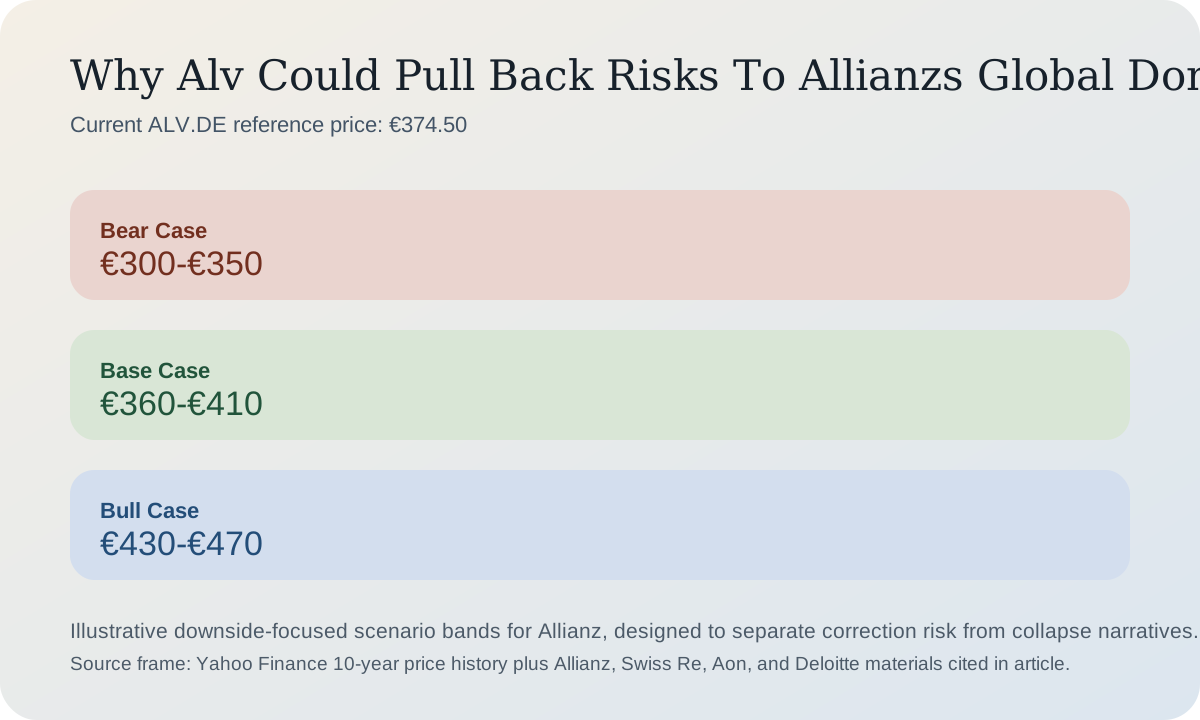
The primary bear case is a move into the €300 to €350 range. That would fit a classic large-cap correction or mild bear-market pattern: not a collapse in solvency, but a repricing as investors lower expectations for pricing, capital return, or fee-business momentum.
Base scenario
The base case in a bearish article should still be balanced. A sideways to modestly higher range around €360 to €410 remains plausible if Allianz continues to execute well enough to prevent a deeper derating.
Counter-bullish scenario
The bull case, and the reason not to become dogmatic, is a rebound toward €430 to €470 if reported losses normalize, asset-management flows improve, and capital return remains generous. A strong franchise can invalidate a bearish narrative quickly.
| Scenario | Range | What it means | Probability |
|---|---|---|---|
| Bear | €300-€350 | A real but non-catastrophic pullback driven by earnings and valuation pressure. | 45% |
| Base | €360-€410 | The stock digests gains without a dramatic breakdown. | 35% |
| Bull | €430-€470 | The bearish setup fails because fundamentals stay too strong. | 20% |
| Path | Estimated probability | Comment |
|---|---|---|
| Rising | 30% | Possible if the bearish triggers fail to materialize. |
| Falling | 45% | The stock is mature enough that disappointment can still matter. |
| Sideways | 25% | A quality name can tread water while the market waits for clearer evidence. |
Risks to watch
Catastrophe severity, pricing trends, any deterioration in capital return, and signs that investors are rotating away from defensive financials all matter. The most important bear-market test is whether earnings weakness is cyclical or structural.
Investors should also watch language changes in management commentary. Bear cases often become more credible when companies stop sounding merely cautious and start sounding constrained about pricing, capital flexibility, or fee momentum.
What could invalidate the bear case
A bearish thesis would be undermined if Allianz keeps posting resilient operating profit, holds solvency above 200%, and continues large buybacks. In that world, valuation compression becomes much harder to sustain.
Conclusion
Allianz absolutely could pull back. The company is not immune to the insurance cycle, catastrophe risk, or valuation digestion. But the evidence does not support a collapse narrative. The more rigorous downside view is a correction or mild bear market, not a crash.
For that reason, bearish investors should focus less on dramatic language and more on confirming signals: softer pricing, noisier reported losses, weaker fee-business momentum, or a visible change in the capital-return story. Without those signals, the downside thesis remains incomplete.
Disclaimer: This downside framework is for informational research only. It is not a recommendation to short, sell, or avoid ALV.
06. Investor Positioning
Different investor types should handle an ALV pullback differently
| Reader type | Cautious approach | Risk control |
|---|---|---|
| Investor already in profit | Consider trimming if the position became oversized. | Rebalance rather than making an all-or-nothing call. |
| Investor currently at a loss | Separate thesis damage from temporary volatility. | Use stop-loss or review levels if the original case was short-term. |
| Investor with no position | Wait for confirmation or a deeper pullback. | Avoid catching a falling knife on valuation alone. |
| Trader | Respect downside momentum and event risk. | Use strict stop-loss rules around earnings and catastrophe events. |
| Long-term investor | Keep dry powder and scale gradually. | Long-run quality does not eliminate entry-price risk. |
| Risk-hedging investor | Use broader hedges rather than relying on one stock call. | Portfolio context matters more than proving a bearish point. |
07. FAQ
Frequently asked questions about the Allianz bear case
Could Allianz experience a crash?
Current public evidence does not support a crash thesis. A correction or mild bear market is much more plausible than a solvency-driven panic move.
What is the biggest near-term downside trigger?
A combination of heavier catastrophe losses and weaker pricing discipline would be the cleanest downside trigger.
Why include a bull case in a bearish article?
Because a serious bear case should also explain what would make it wrong. Otherwise it is bias, not analysis.
References
Sources
- Yahoo Finance chart API for ALV.DE, 10-year monthly history and recent daily closes
- Allianz 1Q 2026 earnings release
- Allianz full-year 2025 earnings release
- Allianz Group Annual Report 2025
- Allianz Capital Markets Day 2024: 2027 targets and capital framework
- Allianz ratings page
- Swiss Re Institute insurance industry outlook and sigma research
- Aon Global Insurance Market Insights, Q1 2026 overview
- Deloitte insurance industry outlook
- Allianz Risk Barometer
- Allianz natural catastrophe resilience research
- Allianz Responsible AI principles