01. Quick Answer
The ASML bear case is mainly about timing, concentration, and valuation, not about technological irrelevance
ASML closed at 1,306.60 on 2026-05-15, up from 88.39 at the start of its 10-year Yahoo Finance monthly series on 2016-06-01, for a price-only CAGR of about 30.91% (Yahoo Finance 10-year history; recent daily closes). A market that already understands ASML's strategic importance can still punish the stock if near-term conditions disappoint.
That possibility remains real because ASML's own disclosures emphasize customer concentration, export controls, supply-chain dependencies, and cyclical timing. None of those destroys the long-run thesis, but all of them can cause a meaningful pullback in the stock.
| Point | Why it matters |
|---|---|
| The biggest bear risk is not technological disruption | It is a slower or lumpier customer spending cycle than investors expect. |
| Valuation still matters even for a rare asset | A great company can still correct hard when expectations stretch too far. |
| Export controls are a real swing factor | Policy can hit revenue mix and sentiment quickly. |
| A correction is not a collapse | The evidence today supports a correction-risk discussion more than a broken-moat claim. |
02. Historical Context
ASML now has enough gains behind it to make a setback plausible even if the long-run thesis survives
Bear-case work starts with context, not drama. ASML closed at 1,306.60 on 2026-05-15, up from 88.39 at the start of its 10-year Yahoo Finance monthly series on 2016-06-01, for a price-only CAGR of about 30.91% (Yahoo Finance 10-year history; recent daily closes). That type of performance is exactly what can create vulnerability to a normal correction or shallow bear market.
A correction typically means a meaningful retreat from a rally. A bear market implies a deeper and more durable decline. A crash implies disorderly selling. The evidence today points more clearly to correction or shallow bear-market risk than to a structural collapse because the moat remains intact and leading-edge customers still depend on ASML.
The important lesson is that a premium compounder can still reset if timing disappoints. Investors do not need to stop believing in ASML for the stock to pull back sharply.
That distinction is especially important in semiconductor equipment. These stocks often fall well before the industry narrative fully changes because the market reacts to order confidence, shipment timing, and customer caution rather than waiting for a broken technological thesis.
| Risk factor | Why it matters | Bear-case relevance |
|---|---|---|
| Foundry capex pause | Customer timing remains the core revenue driver | High |
| China export restrictions | Shipment mix and sentiment can change quickly | High |
| High NA delays | Moat remains intact, but timing optics can worsen | Medium to high |
| Premium-multiple compression | A rare asset can still de-rate | High |
| Supply-chain bottlenecks | Complex manufacturing still depends on execution | Medium |
| Term | Typical meaning | How it applies here |
|---|---|---|
| Correction | A normal but painful retreat from a rally | The most plausible downside framework for current ASML conditions. |
| Bear market | A deeper and longer decline | Possible if capex and policy both deteriorate. |
| Crash | Fast, disorderly selling | Less supported by current evidence unless a broader tech or geopolitical shock emerges. |
03. Main Drivers
Five specific threats could drag ASML lower even if the technology moat remains untouched
1. Customer capex normalizes harder than expected. TSMC, Intel, or other major customers can slow the stock simply by stretching deployment timing.
2. Export-control friction gets worse. Policy can restrict what ASML ships or how investors think about the China revenue mix.
3. High NA becomes optically messy. A strategically good technology transition can still produce uneven near-term results and sentiment.
4. The semi-equipment cycle cools after AI enthusiasm peaks. If AI spending turns out to be more front-loaded than structural, premium multiples can compress.
5. The market decides to pay less for rarity. Even if the business remains exceptional, the stock can fall if the valuation regime changes.
6. Supply-chain execution becomes a source of friction. ASML's systems are complex enough that component bottlenecks, qualification timing, or customer-site readiness can still matter for reported outcomes.
04. Institutional Forecasts and Analyst Views
The evidence supports caution, but not a deterministic collapse narrative
Official-style evidence here comes mostly from company and customer disclosures. ASML, the 20-F, TSMC, and Intel all imply strong long-run relevance but enough timing and policy risk that a pullback remains entirely plausible.
Analysts remain divided because the evidence is mixed. The moat is hard to dispute, yet valuation and timing can still hurt the stock. The bear case is therefore best framed as a plausible medium-term correction scenario, not as an argument that ASML has become replaceable.
In practical terms, the downside case works when investors stop paying for distant strategic value and start caring much more about the next several quarters of shipments, mix, and customer caution. That shift in time horizon alone can be enough to pressure the stock.
| Condition | Current status | Why it matters |
|---|---|---|
| Capex pauses broaden | Possible if customers preserve cash or delay ramps | Would pressure order visibility and sentiment. |
| China restrictions tighten | A live policy risk | Would affect mix and narrative immediately. |
| High NA cadence disappoints | Execution risk exists in any major transition | Would hurt confidence in the next leg of the moat story. |
| AI demand cools | The evidence is mixed on durability | Would pressure the multiple even if long-run relevance stays intact. |
05. Scenarios, Risks, and Invalidation
The most credible downside path is a correction or shallow bear market, not a sensational broken-moat call
Bearish scenario
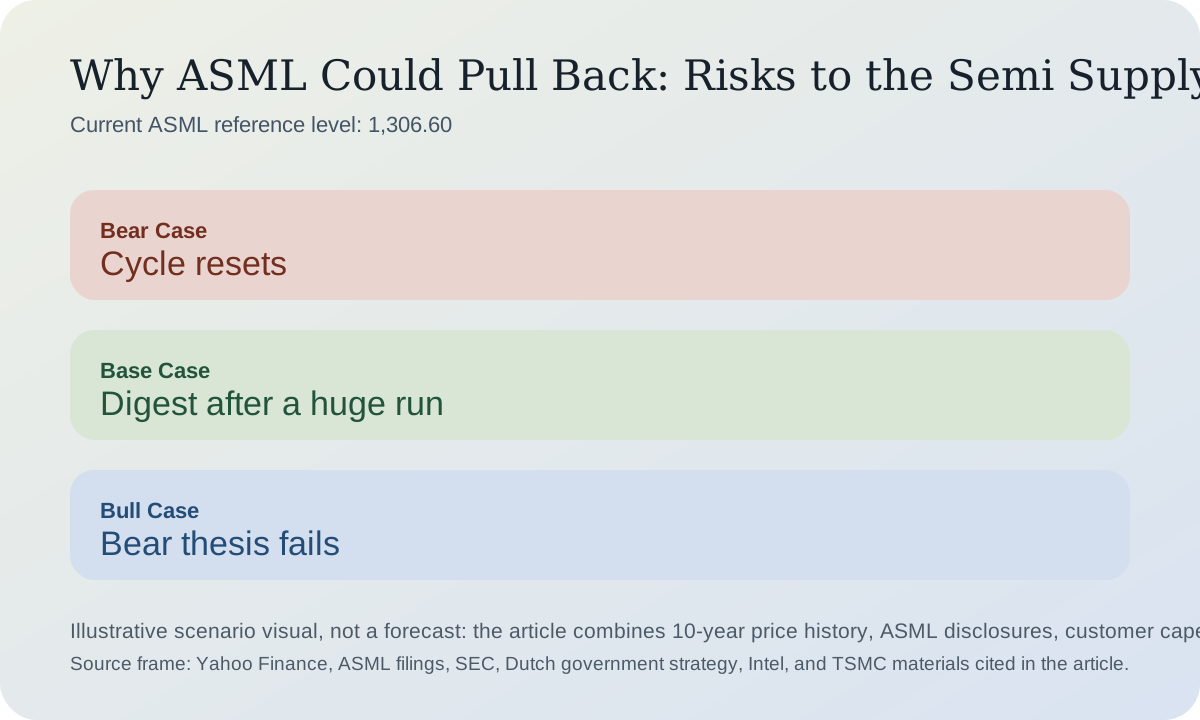
The primary bear case is 950 to 1,100. That range implies the stock gives back part of its rerating as customer timing softens and valuation compresses.
Base-case scenario
The base case is a more mixed 1,100 to 1,250 range where the stock corrects, consolidates, and then looks for support from the installed base, backlog, and moat quality.
Bullish counter-scenario
The bear case fails if AI capex remains stronger than feared, High NA execution goes smoothly, and export-control pressure stays manageable. In that case the stock can move back toward its highs.
Risks to watch
Watch customer capex commentary, China policy, High NA shipment timing, service revenue mix, and whether AI demand broadens or cools.
What could invalidate the downside view
This bearish framework would be too harsh if customers accelerate tool spending faster than expected or if the market continues rewarding ASML's rarity with a higher premium. It would also be too harsh if service and installed-base revenue prove more stabilizing than feared.
Conclusion
ASML could pull back from here without proving the long-term thesis wrong. The key distinction is that a correction or mild bear market is plausible even when the underlying technological moat remains exceptional.
For that reason, bearish analysis here is less about denying the company and more about respecting how premium stocks behave when timing, policy, and valuation all turn less friendly at once.
Disclaimer: This article is for research and educational use only. It is not a short recommendation or a claim of certainty about future market direction.
| Scenario | Range | Conditions | Probability |
|---|---|---|---|
| Deep bear | 850-950 | Capex pauses and policy friction intensify together | 15% |
| Correction / primary bear case | 950-1,100 | Timing disappointment plus multiple compression | 35% |
| Base / choppy consolidation | 1,100-1,250 | No broken moat, but gains digest | 35% |
| Bullish invalidation | 1,250-1,450 | Demand stays stronger and the premium persists | 15% |
| Path | Estimated probability | Why |
|---|---|---|
| Rising from current levels | 30% | The moat is strong, but a lot of good news is already known. |
| Falling from current levels | 45% | Correction risk is meaningful given timing and valuation sensitivity. |
| Moving sideways | 25% | Possible if service and moat quality offset near-term spending noise. |
06. Investor Positioning
A bear-case framework is about discipline rather than drama
| Investor type | Cautious approach | What to watch |
|---|---|---|
| Investor already in profit | Trim oversized winners and rebalance before concentration becomes the entire thesis. | How much of the gain depends on premium multiple rather than only earnings. |
| Investor currently at a loss | Do not average down blindly into a weakening tape. | Test whether the thesis remains about moat durability rather than short-term timing. |
| Investor with no position | Wait for confirmation or for a better entry after volatility. | There is no need to chase a premium asset into a correction-risk window. |
| Trader | Use stop-losses and respect volatility around earnings and policy headlines. | ASML can move sharply on one customer or export-control update. |
| Long-term investor | Keep cash for staged entries instead of trying to pick the exact bottom. | Corrections can improve entry points if the structural story survives. |
| Risk-hedging investor | Use explicit hedges rather than assuming moat quality removes downside. | Policy, customer timing, and tech sentiment. |
07. FAQ
Frequently asked questions about the ASML outlook
Does a bearish ASML view mean the moat is broken?
No. The more evidence-based downside case is about timing, valuation, and policy, not about technological irrelevance.
Why focus so much on customer capex?
Because ASML monetizes its moat through customer spending cycles. The moat can stay intact while quarterly demand timing changes.
What would make the bear case wrong?
Stronger AI-driven demand, smoother High NA execution, and manageable export-control pressure.
References
Sources
- Yahoo Finance chart API for ASML.AS, 10-year monthly history
- Yahoo Finance chart API for ASML.AS, recent daily closes
- ASML first-quarter 2026 results
- ASML annual report 2025
- ASML Investor Day 2024: 2030 opportunity and roadmap
- ASML long-term financial framework
- Dutch Semiconductor Vision 2035
- Dutch vision on generative AI
- Intel foundry update and 18A manufacturing roadmap
- TSMC fourth quarter 2025 conference call transcript and 2026 capex discussion
- ASML Form 20-F filed with the SEC
- Dutch AI Act supervision update