01. Quick Answer
BNB could fall next if entity risk, competitive drift, and high-beta crypto weakness start reinforcing one another
BNB is still trading near $640, but that does not mean downside risk has disappeared. High-quality bear analysis is not about saying BNB is 'bad.' It is about identifying what would turn a normal pullback into a deeper repricing. The current price context from Yahoo Finance shows recent stability, yet BNB's full trading history also shows the token can reprice sharply when confidence and liquidity weaken (Yahoo 10-year history).
The bear case starts with a simple observation: BNB still carries a higher discount rate than the cleanest crypto narratives because it is closely associated with Binance. If legal pressure re-accelerates, if chain growth disappoints, or if the market stops rewarding exchange-linked utility tokens, downside can open faster than many holders expect.
| Risk area | Why it matters | Market implication |
|---|---|---|
| Regulatory overhang | BNB remains tied to Binance in investor perception. | Discount rates stay higher than for more neutral assets. |
| Competitive pressure | Losing app and liquidity share can compress utility value. | Price can fall even if the token remains functional. |
| Reflexive sentiment | BNB rallies and drops with broader crypto beta. | Macro weakness can amplify chain-specific concerns. |
| Misread corrections | Investors often confuse every drop with a bargain. | Some pullbacks are healthy; some signal a broken thesis. |
| Metric | Latest reading | Why it matters |
|---|---|---|
| Recent BNB price | $640 | A forecast range needs a current anchor, not an old cycle low. |
| Recent 1-month range | $615 to $678 | Shows whether momentum is expanding or cooling in the very near term. |
| Listed monthly history | 2017-12-01 to 2026-05-18 | BNB does not have a full 10-year public market history because it launched in 2017. |
| Long-run range | $5.079 to $1,089 | Useful for distinguishing a normal correction from a structural breakdown. |
| Price-only CAGR | 65.9% | Strong historical compounding warns against both easy extrapolation and easy dismissal. |
| Editorial base range | $500-$650 | A scenario band is more honest than one heroic point target. |
02. Historical Context
BNB has already shown that large drawdowns are normal even when the project survives
The first step in bearish analysis is to stop treating drawdowns as impossible. BNB's history includes sharp advances and equally sharp resets. That does not make the token uniquely fragile. It makes it a crypto asset. The lesson is that investors should separate a tradable correction, a multi-quarter bear market, and a crash driven by trust or liquidity failure.
In BNB's case, entity-linked headlines matter more than they do for some other major tokens. The formal record laid out by the DOJ and SEC is one reason. Even if future operating conditions improve, that historical baggage means BNB can underperform on risk-off days simply because the market assigns a higher uncertainty premium.
| Date anchor | Approximate monthly close | What changed |
|---|---|---|
| December 2017 | $8.636 | Public trading history begins near the first big crypto cycle. |
| December 2020 | $37.38 | DeFi and exchange-token usage broadened as crypto liquidity surged. |
| May 2021 peak month | $354 | BNB became one of the biggest cycle winners as BSC usage exploded. |
| December 2022 | $246 | The post-FTX environment reset valuations and put exchange-linked assets under pressure. |
| December 2024 | $701 | BNB recovered with stronger market breadth and steady chain usage. |
| May 2026 | $640 | The token remains far above early-cycle levels but below its all-time high near $1,089. |
03. Key Risks
Five concrete risks could push BNB lower from here
1. Regulation could widen the valuation discount
The biggest single risk remains regulatory. Even without a new enforcement shock, a token that is closely associated with a regulated global exchange can trade at a structurally lower multiple than pure infrastructure tokens. That risk is grounded in public documents, not rumor (DOJ and SEC).
2. Ecosystem growth could flatten
If BNB Chain's user and liquidity metrics stop improving, the market may eventually decide that BNB deserves a lower utility premium. BscScan and DeFiLlama are useful because they help investors check whether demand is broadening or simply recycling.
3. Competition can turn resilience into underperformance
BNB does not need to collapse to disappoint. It only needs to lag faster-growing ecosystems for a long enough period that investors rotate elsewhere. Underperformance can be just as costly as outright failure for long-term returns.
4. Burns may not be enough during a confidence reset
Quarterly burns are supportive, but they are not magical. In a risk-off phase, investors can choose to ignore supply discipline and focus instead on access, sentiment, and utility quality. That is why even meaningful burns like those in the 35th and 34th updates may fail to stop a broad repricing.
5. BNB remains a high-beta asset
When crypto de-risks, BNB typically does not behave like a hedge. It behaves like a large-cap risk asset with token-specific overhangs. That matters for investors who assume size alone makes BNB defensive.
04. Bearish Framework
A bearish BNB view should identify what kind of downside is actually being discussed
| Path | Approximate range | What it would likely mean |
|---|---|---|
| Correction | $500-$575 | Normal retracement inside an otherwise intact longer-term thesis. |
| Bear market | $400-$500 | More sustained weakness driven by poorer breadth, softer usage, or rising legal concern. |
| Crash | $300-$450 | A confidence shock, forced selling, or severe access impairment. |
This distinction matters because investor behavior should differ. A correction can justify patience, rebalancing, or staged accumulation. A true bear market may call for more caution, less averaging, and more focus on proof of recovery. A crash often requires capital preservation first and valuation debates second.
05. Bear, Base, and Rebound Scenarios
Even a bearish article needs a fair rebound case, because one-sided analysis is usually weak analysis
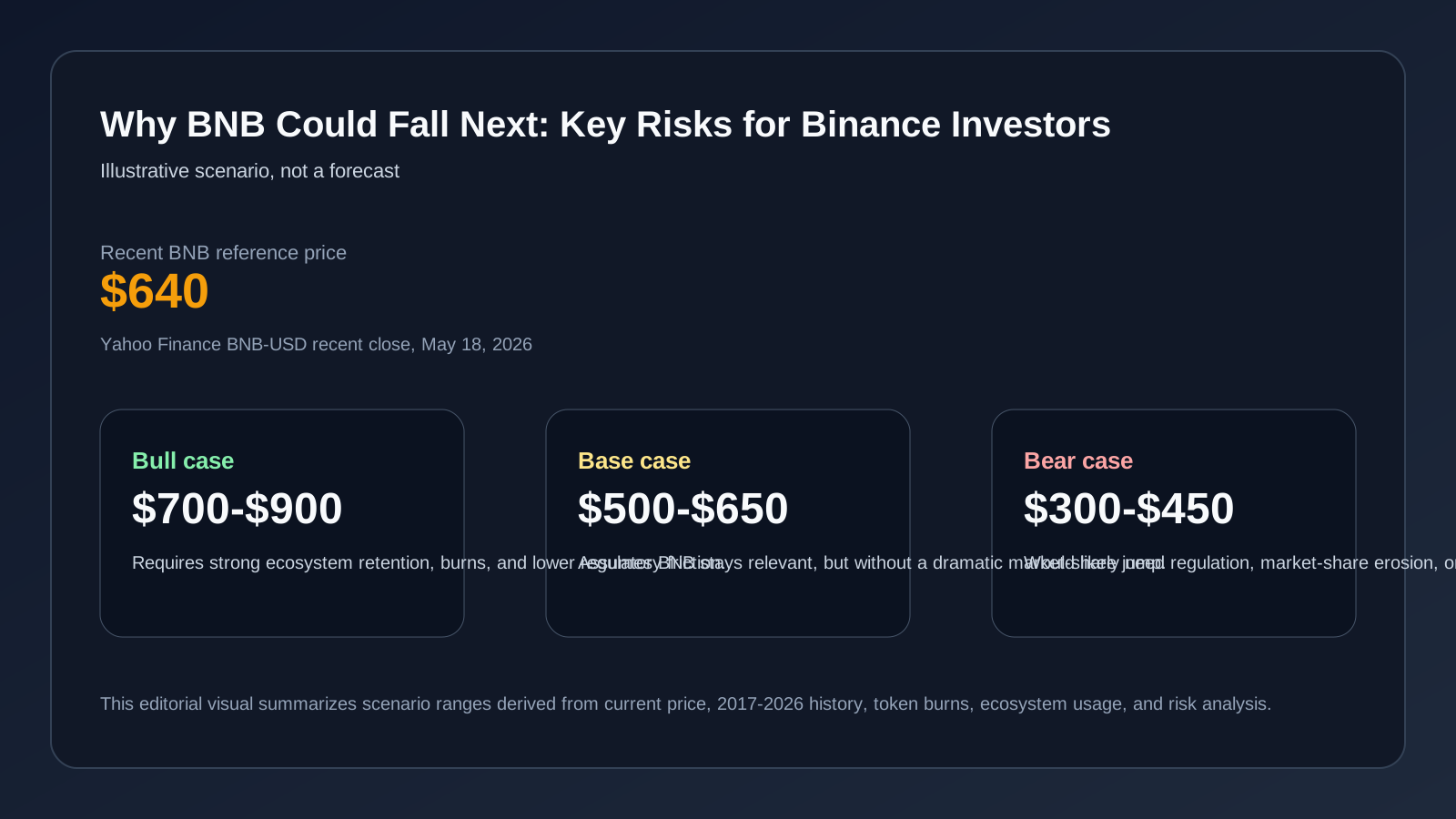
| Scenario | Range | Key assumptions | Investor implication |
|---|---|---|---|
| Rebound / invalidation | $700-$900 | Usage stays healthy, legal risk fades, and broader crypto liquidity improves. | Bears should not fight improving evidence. |
| Base cautious case | $500-$650 | BNB chops lower or sideways as the market waits for cleaner proof. | Patience, trims into strength, and disciplined risk sizing matter. |
| Deep bear case | $300-$450 | Fresh access shock, weaker activity, and risk-off crypto conditions align. | Capital preservation becomes more important than averaging down. |
| Path | Editorial probability | Why the estimate looks reasonable |
|---|---|---|
| Probability of rising | 28% | Possible if BNB's utility remains stronger than skeptics expect. |
| Probability of falling | 47% | Most likely path in this article because BNB still carries visible downside catalysts. |
| Probability of moving sideways | 25% | Reasonable if neither bulls nor bears get decisive new evidence quickly. |
| Investor profile | Cautious positioning approach | What to monitor next |
|---|---|---|
| Investor already in profit | Consider holding a core position while trimming into strength if BNB has become too large a share of the portfolio. | Watch whether chain activity and burns still justify the premium valuation. |
| Investor currently at a loss | Avoid revenge buying. Re-underwrite the thesis first, then average only if the ecosystem trend still looks durable. | Regulatory developments, market-share trends, and any loss of utility inside the BNB ecosystem. |
| Investor with no position | Prefer staged entries or a wait-for-pullback plan over chasing breakouts in a volatile token. | Monthly closes, network activity, and whether upside is driven by fundamentals or only beta. |
| Trader | Trade trend and liquidity, not ideology. Use stop-losses and be ready for high weekend gap risk. | Momentum, volume, BTC direction, and news tied to Binance or global crypto regulation. |
| Long-term investor | Treat BNB as a high-risk satellite allocation rather than a portfolio core unless the thesis is continuously revalidated. | Token burns, ecosystem retention, validator economics, and competitive positioning versus Ethereum and Solana. |
| Reader seeking a hedge | BNB is usually not a hedge in the classic sense. If the goal is protection, position size and diversification matter more than conviction. | Correlation with broader crypto drawdowns and how BNB behaves when exchange risk dominates. |
06. What Could Invalidate the Bear Case
The cleanest way to stay objective is to state what would prove the bearish thesis wrong
The bear case weakens materially if BNB Chain keeps gaining meaningful activity, if burns continue reducing supply, and if Binance-related regulatory risk stops expanding. In other words, the downside case does not fail because price bounces for a week. It fails because the underlying utility and access picture improves enough that the market no longer needs to price the same uncertainty premium.
Investors should therefore watch the boring evidence: chain statistics (BscScan), stablecoin routing (DeFiLlama), and recurring supply reduction (burn disclosures). If those improve while legal pressure cools, a bearish stance becomes harder to defend.
07. Methodology and Invalidation
How the range was built and what would invalidate it
This article uses live Yahoo Finance pricing, BNB's 2017-2026 trading history, official quarterly burn disclosures, the BNB Chain roadmap, network-statistics context, and public research from Binance Research and DeFiLlama research. The goal is not to pretend precision. It is to combine historical data, current market conditions, ecosystem activity, and known risk factors into conditional scenario ranges.
The probability table is an editorial estimate, not a machine-generated certainty. It weighs whether current evidence favors adoption and scarcity, a long consolidation, or a deeper repricing caused by regulation, market-share loss, or a broad crypto bear market. Wide ranges are intentional because BNB is still a high-volatility asset.
This downside framework is invalid if BNB keeps compounding real activity, preserves liquidity leadership in key retail use cases, and sees the regulatory discount narrow instead of widen. Disclaimer: This article is for information and research purposes only and does not constitute personalized financial advice.
08. FAQ
FAQ: why BNB could fall next
Is a BNB correction the same as a crash?
No. A correction is a normal reset. A crash usually requires a confidence or liquidity shock.
What is the single biggest downside risk?
Regulation is still the clearest single-issue risk because it can affect access, confidence, and valuation multiples at once.
Can burns stop BNB from falling?
Not necessarily. Burns help supply discipline, but they cannot fully offset a broad risk-off move or worsening utility trends.
What would make bearish investors rethink?
They should rethink if user activity, liquidity, and regulatory conditions all improve together instead of deteriorating.
References
Sources
- Yahoo Finance BNB-USD 10-year monthly chart API
- Yahoo Finance BNB-USD recent daily chart API
- BNB Chain tech roadmap 2026
- BNB Chain 35th quarterly BNB burn
- BNB Chain 34th quarterly BNB burn
- BNB Chain token model and BNB utilities
- BscScan charts and network statistics
- Binance Research full-year 2025 and themes for 2026
- Binance Research April 2026 monthly market insights
- Binance Research, DeFi on BNB Chain
- DeFiLlama research on stablecoins on BNB Chain
- U.S. DOJ plea announcement involving Binance
- U.S. SEC complaint announcement involving Binance and BAM entities