01. Quick Answer
The bear case for Brent is credible because today's price still carries a sizable disruption premium
When Brent trades near $110.99/bbl, the key bearish question is not whether oil can ever rally again. It is whether the market is temporarily pricing fear faster than it is pricing future supply. The EIA global oil page and IMF WEO database both point to lower medium-term averages than current spot, which immediately gives the bear case real substance. The World Bank Commodity Markets Outlook and IEA Oil Market Report show why that downside is not guaranteed, but they do not remove it.
| Category | Evidence-based read | Implication |
|---|---|---|
| Historical data | Brent has repeatedly corrected after shocks, including from $137/bbl in 2022 back into the $70s and $60s later in the cycle Yahoo Finance | A bearish path does not require a broken market; it only requires normalization. |
| Current market conditions | Spot Brent remains elevated because of live conflict and shipping risk Reuters market report | If that premium fades, downside opens quickly. |
| Institutional signals | The EIA global oil page and IMF WEO database both imply lower prices than spot | The bear case has official support at the baseline level. |
| Most important watchpoints | Inventory rebuilds, non-OPEC growth, OPEC market-share incentives, and weak macro data | Those variables drive whether the correction becomes a deeper bear market. |
02. Historical Context
Corrections, bear markets, and crashes are not the same thing in oil
Oil is not an equity index. A correction can simply mean a geopolitical premium fading. A bear market usually means a more durable supply-demand mismatch. A crash normally needs an extreme demand or financing shock. Brent's ten-year history from Yahoo Finance is a useful guide because it contains all three forms of downside at different moments.
| Metric | Latest read | Why it matters |
|---|---|---|
| Current Brent reference | $110.99/bbl | A high starting point increases correction risk if the trigger is premium rather than shortage. |
| Official 2027 baseline | $76/b | This gives the market a natural downside magnet if current disruptions ease. |
| World Bank stress reminder | $95-$115 in a stress case | Bearish positions still face upside tail risk if conflict worsens. |
| IEA demand sensitivity | High prices can weaken demand | That supports bearish logic if current prices persist. |
| Marker | Level | Interpretation |
|---|---|---|
| Correction example | From $137 to the $90s in 2022 | A correction can be large without becoming a full structural bear market. |
| Bear market example | From 2022 highs to late-2024 levels in the low $70s | This reflected rebalancing, softer macro conditions, and calmer supply expectations. |
| Crash example | $16/bbl | The 2020 collapse required extraordinary demand destruction and storage stress. |
| Late-2025 softness | $60.85/b December 2025 close | Shows how far Brent can fall when the market starts fearing oversupply. |
| 2026 rebound | $110.99/bbl | Highlights how much of the latest strength is event-driven rather than fully structural. |
03. Main Drivers
Five bearish forces matter most right now
1. Official baseline forecasts remain below spot
The most straightforward bearish argument is that major public baselines from the EIA global oil page and IMF WEO database do not support current spot levels as a durable equilibrium.
2. Disruption premium can fade fast
Ceasefires, sanctions shifts, and calmer shipping conditions can erase a meaningful premium quickly. That risk is embedded in every elevated Brent tape, including the current one covered by Reuters supply report.
3. Non-OPEC supply can reassert itself
Brent usually struggles to hold very high levels if flexible supply keeps growing. That remains one of the strongest counterweights to a permanent scarcity narrative.
4. Demand destruction is real at high prices
The IEA Oil Market Report repeatedly notes that high prices eventually hit demand. If Brent stays expensive, part of the bearish case can create itself through weaker consumption.
5. OPEC may eventually choose volume
If enough producers decide defending market share matters more than defending price, the downside can accelerate. That scenario does not need a 2020-style crash to be painful for late buyers.
04. Institutional Forecasts and Analyst Views
Institutional evidence for the bear case is stronger than many bulls admit
The reason the Brent bear case deserves respect is simple: official public forecasts already sit lower than today's spot price. The EIA global oil page and IMF WEO database give bears a real baseline, not just a mood. The World Bank Commodity Markets Outlook and Reuters on Barclays mainly define what can go wrong for that view if disruptions persist.
| Source | Message | Interpretation |
|---|---|---|
| EIA | Brent below $90/b in late 2026 and around $76/b in 2027 | Supports a cyclical downside path from current levels. |
| IMF | Oil assumption near $75.97 in 2027 | A second official source supporting normalization. |
| IEA | High prices can pressure demand while supply disruptions remain noisy | This combination can still resolve lower if supply stress fades. |
| World Bank | Escalation can keep Brent high, but that is a stress case rather than a baseline | The bearish view is wrong only if stress becomes durable. |
| Reuters and Barclays | Private forecasts moved higher because of disruption risk | Confirms that the key debate is premium persistence, not whether oil still matters. |
05. Bull, Bear, and Base Case
How a bearish Brent framework should be structured
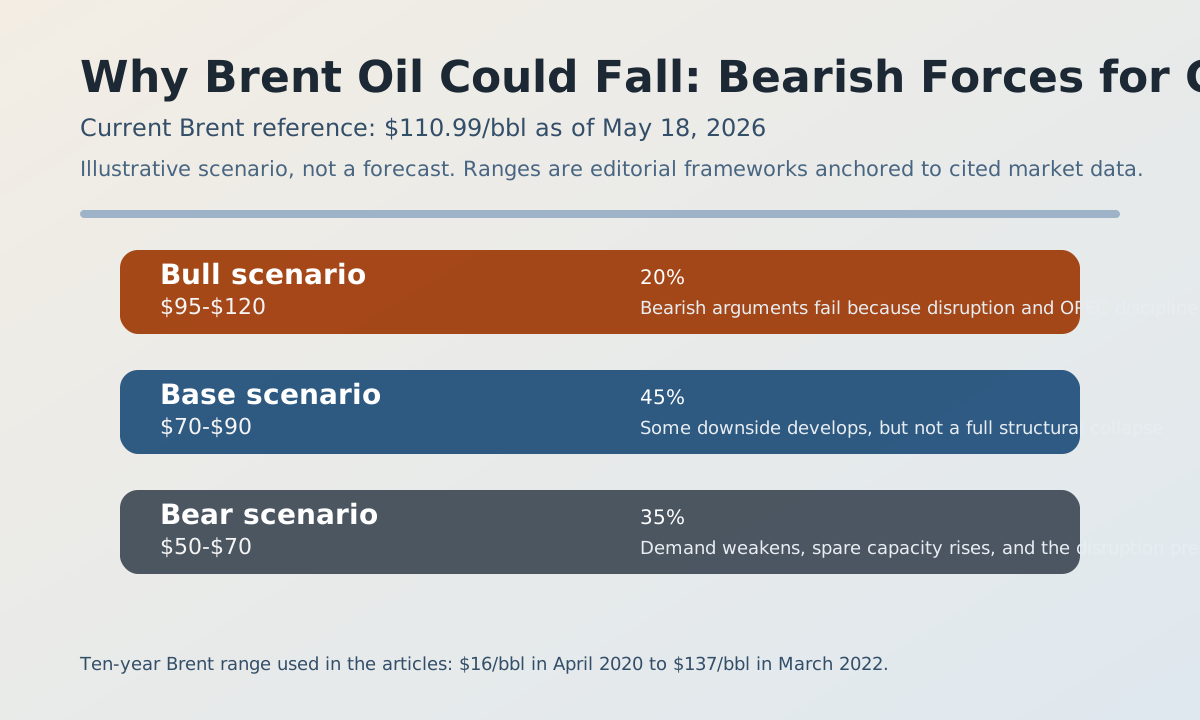
The main discipline is to separate a correction from a deeper bear market. A correction could simply take Brent toward the upper part of the official baseline. A bear market would likely require supply growth and softer demand to persist together. A crash would need something closer to a systemic demand shock, which is not the current base case.
| Scenario | Price range | Conditions | Probability |
|---|---|---|---|
| Bull | $95-$120 | Bearish arguments fail because disruption and OPEC discipline overpower softer demand | 20% |
| Base | $70-$90 | Some downside develops, but not a full structural collapse | 45% |
| Bear | $50-$70 | Demand weakens, spare capacity rises, and the disruption premium fades hard | 35% |
| Direction | Probability | Comment |
|---|---|---|
| Higher | 20% | The bear case fails if disruptions intensify or OPEC prevents the market from normalizing. |
| Lower | 40% | A lower outcome becomes more likely if spot loses its conflict premium. |
| Sideways to moderate downside | 40% | The most realistic bearish path may still be a grind lower rather than an immediate collapse. |
Bullish rebuttal. Bears still need to respect the possibility that supply insecurity is more durable than official models assume. That is why the bear thesis should always define what would invalidate it.
Base case. The $70-$90 range implies meaningful downside from current levels without assuming an economic accident. It is broadly consistent with official 2027 anchors and with the idea that current fear eventually cools.
Deeper bear case. The $50-$70 range requires a cleaner fade in the disruption premium plus enough supply and weaker demand to turn a correction into a more durable downtrend.
06. Positioning, Risks, and Conclusion
How to handle Brent if the bearish case is right
| Investor type | Prudent approach | Main watchpoints |
|---|---|---|
| Investor already in profit | Trim or hedge into strength rather than hoping the current premium expands forever. | Ceasefires, OPEC language, and inventory rebuilds. |
| Investor currently at a loss | Do not confuse stubbornness with discipline. Reassess the thesis if it depended on permanently tight supply. | Supply additions and macro softness. |
| Investor with no position | Avoid chasing late-cycle spikes. Wait for pullbacks or clearer evidence that the premium is durable. | Spot-futures spreads and volatility. |
| Trader | Use stop-losses and distinguish between fading a spike and calling for a structural bear market. | Headline risk and drawdown speed. |
| Long-term investor | Prefer diversified energy exposure and rebalance if one oil thesis has grown too dominant in the portfolio. | Capital discipline and free cash flow resilience. |
| Risk-hedging investor | Keep some hedge exposure if needed, but do not treat a hedging position as a conviction long when the bear case is strengthening. | Inflation correlations and event risk. |
Risks to watch
Risks to watch include ceasefire progress, OPEC quota behavior, non-OPEC supply surprises, industrial slowdown, and shifts in refinery margins. The central bearish distinction is this: a correction can happen fast, a bear market takes reinforcement, and a crash usually needs something much worse than today's baseline macro outlook.
Conclusion
The Brent bear case is not a fringe view. It is directly supported by official baselines that sit below current spot. What keeps the thesis from becoming automatic is the same factor that lifted oil in the first place: geopolitics. That is why a bearish framework should stay conditional, disciplined, and explicit about invalidation triggers. Disclaimer: This article is for informational and research purposes only and does not constitute personalized financial advice.
07. FAQ
Frequently asked questions
Could Brent fall without a recession?
Yes. Oil can correct sharply if geopolitical premium fades even without a full recession.
What is the difference between a correction and a crash in oil?
A correction often reflects fading premium, while a crash usually needs a much deeper demand or financial shock.
What level would support the bear case?
A move toward the $70-$90 zone would support the idea that the market is normalizing toward official baselines.
What would invalidate the bear case?
Persistent disruptions, tighter OPEC discipline, and weaker-than-expected non-OPEC supply growth would all weaken it.
Methodology and Invalidation
How to interpret this framework and what would invalidate it
This article builds the bear case from official baselines first: EIA global oil page and IMF WEO database. It then tests that baseline against high-price and disruption scenarios from the World Bank Commodity Markets Outlook and the physical-market commentary in the IEA Oil Market Report.
The forecast ranges distinguish a correction, a cyclical bear market, and a crash because oil behaves differently from equities. That distinction matters for investor positioning and for avoiding exaggerated certainty.
What would invalidate the bearish framework? A longer-lasting conflict premium, OPEC discipline that keeps supply tight, or evidence that underinvestment is materially shrinking the effective cushion of spare capacity would all move the distribution higher.
References
Sources
- Yahoo Finance, Brent Crude Oil Futures quote page and historical chart
- U.S. EIA, Short-Term Energy Outlook global oil section
- IMF, World Economic Outlook database, April 2026
- World Bank, Commodity Markets Outlook, April 2026
- World Bank, Commodity Markets Outlook release, April 28, 2026
- IEA, Oil Market Report, May 2026
- OPEC, Annual Statistical Bulletin
- Reuters via TradingView, Barclays raises 2026 Brent forecast
- Reuters via Investing.com, oil rises on Middle East supply fears
- Reuters via Investing.com, oil prices jump after ceasefire concerns