01. Quick Answer
Why Copper Prices Could Fall: Bearish Forces for the Red Metal
The quick answer is that copper could fall even if the long-term bull thesis stays broadly intact. The most credible bearish path is not a permanent collapse. It is a re-pricing from today's elevated level toward a lower but still historically rich range if demand slows and the refined balance loosens.
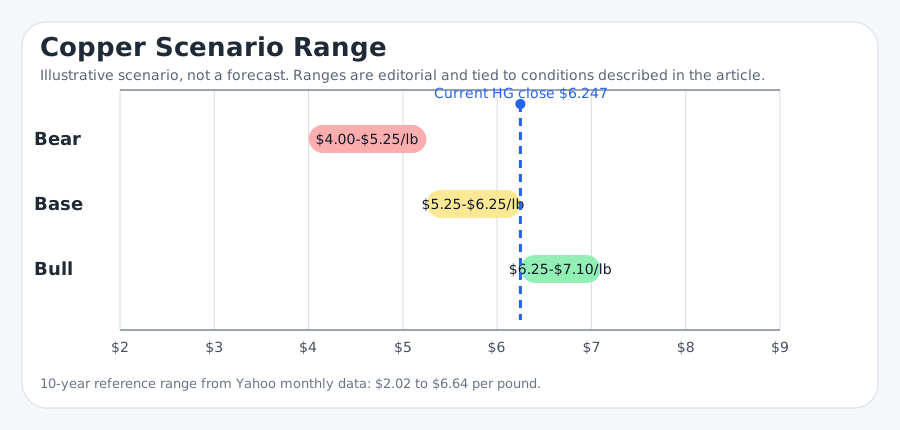
A practical downside framework is $4.00-$5.25/lb. That range would still sit well above the 10-year low, but it would represent a meaningful correction from current HG levels and from the scarcity premium embedded in recent highs.
That distinction matters for investors. A drop toward the low-$4s or low-$5s would look dramatic on a recent chart, yet it would still leave copper expensive versus much of the pre-2021 period (Yahoo Finance chart API, HG=F 10-year monthly data; Yahoo Finance chart API, HG=F recent daily data). In other words, the bearish case is strongest as a de-rating thesis, not as a call for copper to become structurally cheap again.
| Category | Evidence-based read | Implication |
|---|---|---|
| Bear cases do exist | Official and institutional data already point to some near-term cooling risks. | A strong secular narrative does not remove cyclical downside. |
| Most important bearish forces | Refined surplus, weaker Chinese demand, better scrap response, and macro slowdown. | These factors can work faster than new mines. |
| What matters most | Whether current scarcity premium is cyclical or structural. | Bearish outcomes are more plausible if the premium is mostly temporary. |
| What limits the downside | Mine disruptions, electrification demand, and strategic-mineral policy. | Copper is not an easy commodity to keep cheap for long. |
02. Historical Context
Current market snapshot and historical context
The bearish case is stronger when prices start high. Copper's 10-year history shows that sharp corrections often happen after the market becomes convinced one structural force can overwhelm all others. That pattern is relevant again today.
| Metric | Latest read | Why it matters |
|---|---|---|
| Current price regime | Near cycle highs | Creates asymmetry if bullish assumptions soften |
| World Bank baseline | 2027 average below spot | Suggests cooling is already part of official baseline thinking |
| ICSG balance | Surplus rather than deficit in latest near-term view | Important bearish evidence |
| Main floor under price | Electrification and mine disruption risk | Limits how deep a bear case can reasonably go |
| Period marker | Approximate price | Interpretation |
|---|---|---|
| 10-year low | $2.02/lb | The monthly series bottomed near this level during the 2016 industrial slowdown. |
| 2020 shock reset | around $2.10/lb | Copper sold off during the pandemic shock before reopening demand changed the trend. |
| 2021 reopening high | near $4.89/lb | Electrification optimism and supply friction started to re-rate the metal. |
| 2024–2026 re-rating | $5.20 to $6.64/lb | Tighter supply, tariffs, AI-related power demand, and mine disruptions pushed HG into a higher regime. |
| Latest close | $6.247/lb | Yahoo daily data puts HG near cycle highs on May 18, 2026. |
03. Main Drivers
Main drivers of price movement
1. A refined surplus can change sentiment fast
ICSG's April 2026 update matters because it reminds investors that refined copper does not need a deep recession to swing into surplus. Slower demand growth and higher secondary supply can do enough on their own.
2. China can disappoint without a crisis
Copper bulls often treat Chinese demand as either strong or collapsing. In practice, a muddle-through economy with persistent property weakness can still pressure prices by eroding the marginal demand impulse.
3. Higher prices invite substitution and thrift
BHP notes that substitution pressure usually rises when copper stays far above aluminum on a sustained basis. The process is slow, but by the late cycle it becomes more meaningful.
4. Scrap response can be faster than mine response
That is one reason bearish forces can matter before the long-run shortage returns. Secondary supply is not infinite, but it can cool prices sooner than a greenfield mine can.
5. Macro growth can delay the shortage story
The IMF's softer 2026 global-growth backdrop is a useful reminder that electrification demand still sits inside a real economy. If industrial activity weakens, the shortage story can be deferred.
04. Institutional Forecasts and Analyst Views
Institutional forecasts and analyst views
The bearish case becomes more credible when the official baseline is already below spot and the latest balance outlook has shifted away from deficit. That does not prove a bear market, but it makes complacency harder to justify.
| Source | Forecast / signal | Interpretation |
|---|---|---|
| World Bank | $11,000/t average in 2027 | Cooling from present conditions is part of the official baseline |
| ICSG | Refined surplus in 2026 and bigger surplus in 2027 | Directly supports a cyclical cooling thesis |
| Citi | Base case near $12,000/t by late 2026 | Still constructive, but not aligned with runaway upside |
| Goldman Sachs | $12,650/t average in 2026 | Shows even bullish banks see high prices coexisting with surplus talk |
| IEA / BHP / S&P | Long-run shortage signals remain | Why the bear case should be framed as a correction, not a permanent collapse |
05. Bull, Bear, and Base Case
How the forecast range and probability table are built
The range in this article is editorial and scenario-based rather than a deterministic forecast. It starts with current HG pricing, the 10-year trading band, the World Bank near-term baseline, ICSG balance data, and structural demand evidence from IEA, S&P Global, and BHP.
| Scenario | Price range | Conditions | Probability |
|---|---|---|---|
| Bear | $4.00-$5.25/lb | China slows, secondary supply rises, and surplus conditions linger longer than expected | 40% |
| Base | $5.25-$6.25/lb | Copper cools from extremes but remains structurally expensive | 35% |
| Bull | $6.25-$7.10/lb | Disruptions keep tightening the market before demand can weaken enough | 25% |
| Direction | Probability | Comment |
|---|---|---|
| Lower | 40% | The bearish argument has more credibility when starting from near-record levels |
| Higher | 25% | Upside still exists, but the market is no longer under-owned |
| Sideways | 35% | Copper can consolidate rather than crash if bearish and structural forces offset |
| Investor type | Prudent approach | Main watchpoints |
|---|---|---|
| Investor already in profit | Consider trimming or hedging instead of assuming a strong secular thesis makes drawdowns irrelevant. | Protecting gains is rational in late-cycle conditions. |
| Investor currently at a loss | Do not average down automatically unless the balance evidence actually improves. | Narrative conviction is not a substitute for confirmation. |
| Investor with no position | Avoid chasing a market that may already discount years of tightness. | Wait for better entry points or clearer resets. |
| Trader | Favor defined risk and fast reassessment because downside moves can be violent when positioning unwinds. | Watch spreads, inventories, and macro data. |
| Long-term investor | If you believe in copper's secular role, use a correction plan rather than a blind buy-every-dip rule. | Some dips are regime shifts, not gifts. |
| Risk-hedging investor | Use copper as part of a broader materials basket or paired hedge, not as a single-asset inflation bet. | Bearish cyclical swings remain large. |
Copper prices could fall without the secular bull case being 'wrong.' The cleanest bearish path is a cyclical normalization from a stretched starting point, helped by softer Chinese demand, better scrap supply, and a near-term refined surplus. What the bear case does not easily explain is a world where major supply disruptions persist while electrification demand accelerates again. Disclaimer: This article is for informational and research purposes only and does not constitute personalized financial advice.
06. FAQ
Frequently asked questions
Does a bearish copper view mean the long-term story is broken?
Not necessarily. It can simply mean current prices are ahead of near-term balance conditions.
What is the biggest downside catalyst?
A combination of softer Chinese demand and a more persistent refined surplus would likely matter most.
Why not call for a crash below $4/lb?
Because the evidence still shows a structurally tighter supply backdrop than in past cycles.
What would invalidate the bear case?
Persistent mine disruptions, stronger grid and AI demand, or a faster return to deficit would weaken it.
Methodology and Invalidation
How to interpret this framework and what would change it
This bearish framework deliberately emphasizes what can happen faster than new mine supply: softer demand, higher secondary output, inventory normalization, and positioning resets (Reuters on ICSG April 2026 forecast update; World Bank, Commodity Markets Outlook, April 2026; Reuters on Goldman Sachs raising short-term copper forecasts on resilient Chinese demand; IMF, World Economic Outlook, April 2026).
The downside zone is still historically high because structural support remains stronger than in prior copper bears. That is why this article distinguishes between a correction, a bear market, and a crash rather than treating them as interchangeable.
Invalidation would be straightforward: if deficits deepen despite softer macro data, or if AI- and grid-related copper demand proves stronger than expected while supply disruptions persist, the bearish range would need to move higher.
One more practical point: bearish copper analysis should not be reduced to a single recession call. Copper can underperform because inventories rebuild, because regional distortions normalize, because financing conditions tighten for end users, or because the market simply reprices an overly aggressive shortage narrative. Those are different mechanisms, and they imply different depths and durations of downside.
References
Sources
- Yahoo Finance chart API, HG=F 10-year monthly data
- Yahoo Finance chart API, HG=F recent daily data
- World Bank, Commodity Markets Outlook, April 2026
- ICSG, Table 1: World refined copper production and usage trends, April 2026
- Reuters on ICSG April 2026 forecast update
- IEA, Copper report within Global Critical Minerals Outlook 2024
- IEA, Global Critical Minerals Outlook 2025 overview
- IEA chart, mined supply and demand outlook for copper, 2026-2035
- S&P Global, Copper in the Age of AI: Challenges of Electrification, January 2026
- S&P Global, Plugged in and politicized: Copper in a fractured world
- BHP, Copper Growth
- BHP Insights, How copper will shape our future
- IMF, World Economic Outlook, April 2026
- USGS, Mineral Commodity Summaries 2026
- Reuters on Goldman Sachs raising short-term copper forecasts on resilient Chinese demand
- Reuters on Citi's copper base case near $12,000/t by Q4 2026