01. Downside Context
What a pullback would actually mean for AXA
The bearish case for AXA is not that it is weak. It is that strong insurers can still suffer meaningful share-price corrections when the market starts to doubt reserve adequacy, catastrophe absorption, capital-return durability, or the quality of the next growth phase. CS has enough strength to avoid looking fragile, but also enough financial-sector exposure to slide if sentiment changes.
| Risk | Why it matters |
|---|---|
| Correction risk is real | A quality insurer can still correct 10%-20% without any existential crisis. |
| Dividend support is not absolute protection | Yield can cushion sentiment but not erase fundamental disappointment. |
| Reserve and catastrophe issues matter fast | Confidence can deteriorate before headline earnings fully reflect it. |
| Bear cases should be conditional | AXA's quality means the downside thesis needs explicit triggers, not generic pessimism. |
For risk framing, it helps to separate a correction from a bear market and a crash. A correction usually means a decline of around 10% from recent highs. A bear market means a deeper, more sustained drop of 20% or more. A crash implies disorderly selling tied to panic or severe capital stress. For AXA, a correction or mild bear market is plausible. A crash would likely require a much more extreme solvency or system-wide financial shock than current public data suggests.
| Type | What it could look like from EUR 39.18 | Most plausible trigger |
|---|---|---|
| Correction | Around EUR 35 or lower | Results disappoint, cat losses rise, or investors re-rate the stock lower after ex-dividend weakness. |
| Bear market | Around EUR 31 or lower | A more durable hit to reserve confidence or capital-return expectations. |
| Crash | Far below EUR 31 | Would likely require a severe solvency event or broad financial-system stress. |
That distinction matters because dividend-heavy financial stocks often create emotional distortions. Holders can underestimate downside because the income stream feels comforting, while skeptics can overstate downside because they assume every financial correction is a crisis. A credible bear case should do neither.
The evidence is mixed enough that bearishness on AXA must be earned. Yet the risk is real because insurance confidence tends to erode in stages: first the market questions the loss outlook, then reserve resilience, then the sustainability of distributions.
That sequence matters because a stock can already be falling long before reported earnings look obviously weak. Once investors begin to doubt the durability of the business model's clean presentation, they usually demand a much larger margin of safety.
02. Bearish Drivers
Five risks that could push CS lower
1. Reserve or claims-quality anxiety
If investors begin to suspect that underwriting profitability is flattered by assumptions that later need strengthening, the stock can de-rate even before absolute earnings look bad. This is one of the most common ways quality insurers lose market trust.
2. Catastrophe losses and pricing fatigue
Swiss Re and Aon both imply an environment where cat risk and underwriting complexity remain elevated. AXA can absorb ordinary volatility, but repeated heavy events could alter market confidence (Swiss Re on fragmentation and risk; Aon on market conditions).
3. Capital return could look less secure
AXA's investor base values dividends and buybacks. If management ever sounds less confident about sustaining that posture, the rerating could move quickly in the wrong direction.
4. The next strategic plan may disappoint
A mediocre 2027-2029 framework could be enough to hurt sentiment even without a hard earnings miss. AXA has set a high bar for capital discipline and predictability.
5. Macro-financial stress can still hit insurers
Even strong insurers are still financial stocks. A risk-off environment, wider credit spreads, or regulatory uncertainty can pressure valuations without any company-specific implosion.
03. Bearish Framework
How a credible downside thesis for AXA should be built
A credible bearish framework has to acknowledge that AXA starts from a strong position. FY 2025 results were record-level on several measures, Q1 2026 still looked solid, and the solvency ratio remains strong. That means the downside thesis is not about fragility. It is about whether expectations for durable quality, distributions, and next-plan credibility become too high relative to what AXA can actually deliver.
| Condition | Current evidence | Bearish implication |
|---|---|---|
| Reserve confidence weakens | Not visible in current headline numbers | The stock could de-rate before earnings clearly roll over. |
| Cat losses stay elevated | A structural sector risk | Higher volatility can make quality look less predictable. |
| Capital return confidence slips | Current policy is strong, but conditional | A lower payout tone would likely hurt sentiment. |
| Post-2026 plan underwhelms | Still unknown | The market could conclude AXA is entering a lower-growth phase. |
In practical terms, the downside case is strongest when weaker underwriting confidence and lower capital-return confidence reinforce each other. If only one appears, the pullback may stay contained. If both emerge together, a longer derating becomes plausible.
That is especially true for stocks with large income-oriented ownership, because expectations of stability are often embedded more deeply than headline valuation ratios imply.
Bearish investors should also remember that most insurance drawdowns are not cinematic. They often unfold through a few mediocre updates, an increasingly cautious market tone, and slow multiple compression as investors decide they no longer trust the old comfort narrative.
04. Scenarios
Correction, bear-market, and invalidation framework
Bearish scenario
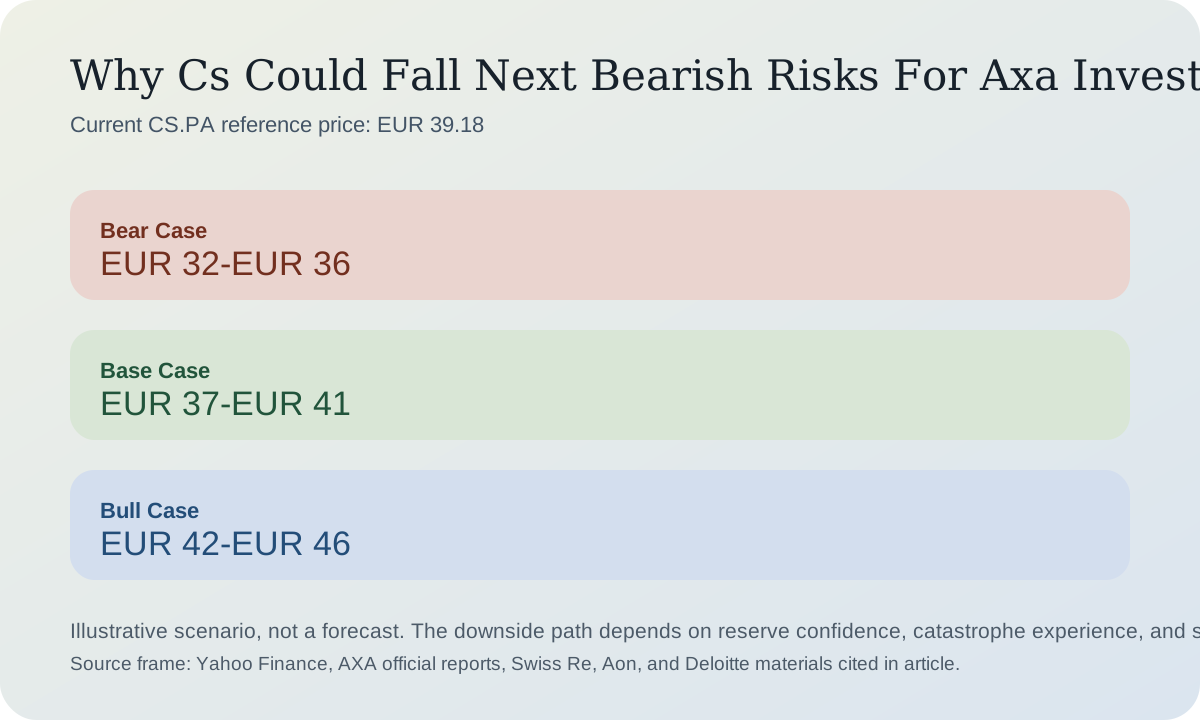
The main downside range is EUR 32 to EUR 36. That would fit a serious but not disorderly pullback driven by reserve concerns, heavier claims pressure, or a weaker-than-expected next strategic plan.
Base scenario
The base scenario is not actually bearish. It is that AXA remains fundamentally solid and any downside stays limited because solvency, diversification, and capital returns still provide support.
What could make the bear case wrong
The bear case would weaken materially if AXA keeps reporting clean growth, launches another disciplined strategic plan, and shows that cat losses or reserve questions remain manageable. A company with AXA's scale and balance-sheet profile can repair market nerves quickly when execution stays credible.
| Path | Probability | Interpretation |
|---|---|---|
| Meaningful pullback | 30% | Real, but not the base case while solvency and earnings remain strong. |
| Sideways consolidation | 34% | A common outcome if investors wait for more evidence. |
| Recovery and renewed upside | 36% | Still slightly more likely if the next plan reassures the market. |
| Investor type | Prudent move | Bear-case discipline |
|---|---|---|
| Investor already in profit | Trim if the AXA position is oversized and the thesis is mostly about yield. | Protect gains before assuming the dividend erases downside. |
| Investor currently at a loss | Avoid panic selling unless the fundamental thesis changed materially. | Focus on reserve and payout credibility. |
| Investor with no position | Wait for clearer technical support or better visibility on the next plan. | Do not chase a falling dividend story. |
| Trader | Use stop-loss rules and event-driven discipline. | Do not confuse a correction with a solvency crisis too early. |
| Long-term investor | Stay patient if the business case is intact, but rebalance if concentration is high. | Long horizons do not excuse ignoring deterioration. |
| Risk-hedging investor | Prefer true hedges elsewhere; AXA is still an equity risk asset. | Do not treat financials as crash insurance. |
How this downside range was built: it combines AXA's current share level, the shape of prior drawdowns, the resilience implied by recent solvency data, and the observation that valuation support from income can slow but not eliminate equity corrections.
Risks to watch: reserve changes, cat-loss headlines, softer pricing, lower buyback confidence, and any strategic message that sounds more defensive than ambitious.
What would invalidate this forecast: consistently strong results, stable reserve commentary, and a convincing 2027-2029 plan that keeps investors focused on compounding rather than risk containment.
Disclaimer: This article is for informational purposes only and does not constitute personal investment advice. Bearish scenarios are editorial judgments built from public information and can prove wrong quickly.
AXA can absolutely fall without becoming a bad company. That is the essence of the bearish case: valuation and confidence can slip even while the franchise remains respectable.
That is why prudent bearish positioning should stay evidence-led. The goal is not to assume disaster, but to recognize that a premium-for-stability stock can still correct hard once stability itself starts to look less certain.
Investors should also distinguish between a temporary valuation reset and a full break in thesis. If AXA were to fall because the market simply demanded a wider margin of safety, that would be painful but not necessarily fatal to the long-run case. If it fell because reserve credibility or capital-return confidence cracked, the implications would be much more serious.
That distinction can keep bearish analysis grounded instead of emotional, reactive, careless, and premature.
05. FAQ
Frequently asked questions about AXA downside risk
Is AXA at risk of a crash?
Current public evidence points more to correction risk than crash risk. A crash would likely require a much larger solvency shock.
What is the biggest bearish trigger?
A combination of reserve concerns and weaker confidence in capital returns would probably be the most damaging mix.
Can the dividend prevent a selloff?
It can cushion sentiment, but it cannot prevent a selloff if investors lose confidence in earnings quality.
Why mention the next strategic plan in a bear case?
Because weak forward messaging can re-rate a stock lower even if current-year numbers still look fine.
06. Sources
Reference list
- Yahoo Finance chart API for CS.PA, 10-year monthly history
- Yahoo Finance chart API for CS.PA, recent daily closes
- AXA Full Year 2025 earnings release
- AXA 1Q26 activity indicators
- AXA 2025 Annual Report
- AXA 2024-2026 strategic plan and financial targets
- AXA strategic plan page
- AXA 2026 share buyback execution release
- AXA 2026 shareholders meeting and dividend approval
- AXA analysts coverage page
- AXA ratings page
- Swiss Re sigma 2/2025 on world insurance conditions
- Swiss Re sigma 5/2025 on insurance market outlook
- Aon Q1 2026 global insurance market overview
- Deloitte 2026 global insurance outlook